WLY(000858)

Search documents
酒价内参12月11日价格发布,习酒君品回调5元
Xin Lang Cai Jing· 2025-12-11 01:25
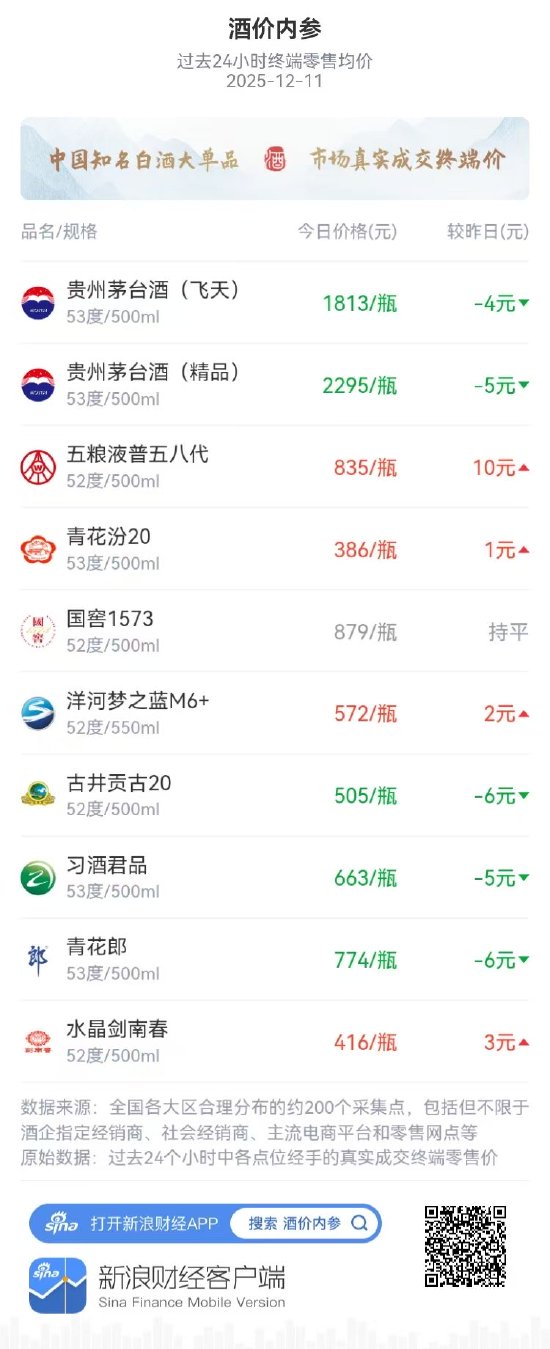
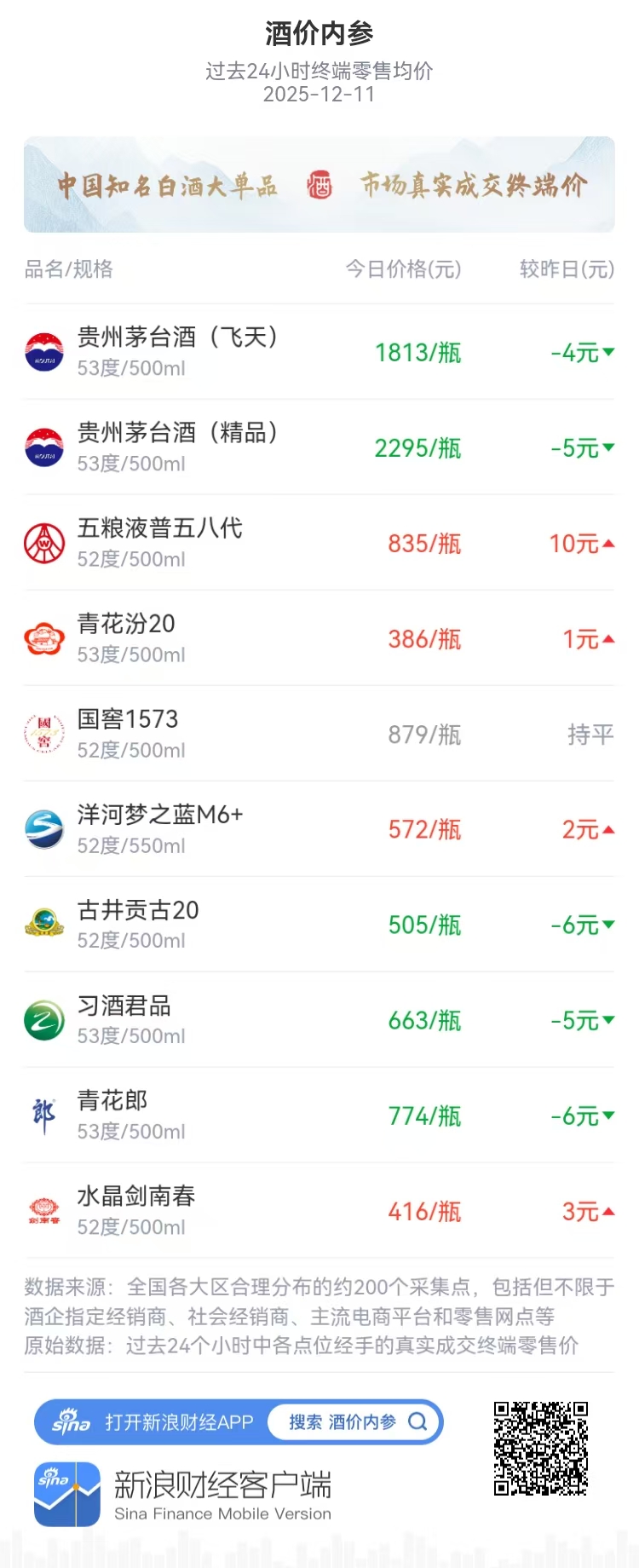
新浪财经"酒价内参"重磅上线 知名白酒真实市场价尽在掌握 新浪财经"酒价内参"过去24小时中收集的数据显示,白酒市场十大单品的终端零售均价周四整体继续小 幅回调。如果十大单品各取一瓶整体打包售价为9138元,较昨日回落10元,创下本月来新低。 "酒价内参"的每日数据源自全国各个大区均有合理分布的约200个采集点,包括但不限于酒企的指定经 销商、社会经销商、主流电商平台和零售网点等,原始取样数据为过去24个小时中各点位经手的真实成 交终端零售价格,确保为社会各界提供一份关于知名白酒市场价格的客观、真实、科学、全程可追溯的 数据。 今日市场跌多涨少,结构性分化持续。值得关注的是,五粮液普五八代在昨日因渠道开票价调整消息显 著下跌后,今日价格环比大幅反弹10元/瓶,展现出抗跌韧性。水晶剑南春价格上涨3元/瓶。洋河梦之 蓝M6+价格微涨2元/瓶。青花汾20价格微涨1元/瓶。国窖1573价格则与昨日持平,表现稳定。下跌产品 方面,近期表现强势的青花郎价格环比回落6元/瓶。古井贡古20价格下跌6元/瓶。习酒君品价格回调5 元/瓶。飞天茅台与精品茅台价格延续阴跌,分别下跌4元/瓶和5元/瓶。 【点击进入酒价内参,查看真实酒 ...



酒价内参12月11日价格发布,洋河梦之蓝M6+微涨2元
Xin Lang Cai Jing· 2025-12-11 01:25
Core Insights - The overall retail price of the top ten Chinese liquor products has slightly decreased, with a total packaged price of 9138 yuan, down 10 yuan from the previous day, marking a new low for the month [1][5][6] Market Price Trends - The market shows a mixed trend with more declines than increases. Notably, Wuliangye's Pu Wuliangye 8th generation rebounded by 10 yuan per bottle after a significant drop due to channel price adjustments [1][6] - Other price movements include: - Water Crystal Jian Nan Chun increased by 3 yuan per bottle - Yanghe Dream Blue M6+ rose by 2 yuan per bottle - Qinghua Fen 20 saw a slight increase of 1 yuan per bottle - Guojiao 1573 remained stable with no price change - Declines were observed in Qinghua Lang (down 6 yuan), Gujing Gong Gu 20 (down 6 yuan), and Xijiu Junpin (down 5 yuan) [1][6] Company Dividend Announcements - Leading liquor companies Kweichow Moutai and Wuliangye announced their mid-term dividend plans for 2025, totaling approximately 40 billion yuan in cash dividends to shareholders. Kweichow Moutai plans to distribute 300.01 billion yuan at 23.957 yuan per share, while Wuliangye will distribute 100.07 billion yuan at 25.78 yuan per 10 shares [2][6][7] - The dividend payout ratios are 1.71% for Kweichow Moutai and 2.31% for Wuliangye based on their respective closing prices [2][6]
酒价内参12月11日价格发布,国窖1573较昨日持平
Xin Lang Cai Jing· 2025-12-11 01:25
新浪财经"酒价内参"重磅上线 知名白酒真实市场价尽在掌握 新浪财经"酒价内参"过去24小时中收集的数据显示,白酒市场十大单品的终端零售均价周四整体继续小 幅回调。如果十大单品各取一瓶整体打包售价为9138元,较昨日回落10元,创下本月来新低。 "酒价内参"的每日数据源自全国各个大区均有合理分布的约200个采集点,包括但不限于酒企的指定经 销商、社会经销商、主流电商平台和零售网点等,原始取样数据为过去24个小时中各点位经手的真实成 交终端零售价格,确保为社会各界提供一份关于知名白酒市场价格的客观、真实、科学、全程可追溯的 数据。 今日市场跌多涨少,结构性分化持续。值得关注的是,五粮液普五八代在昨日因渠道开票价调整消息显 著下跌后,今日价格环比大幅反弹10元/瓶,展现出抗跌韧性。水晶剑南春价格上涨3元/瓶。洋河梦之 蓝M6+价格微涨2元/瓶。青花汾20价格微涨1元/瓶。国窖1573价格则与昨日持平,表现稳定。下跌产品 方面,近期表现强势的青花郎价格环比回落6元/瓶。古井贡古20价格下跌6元/瓶。习酒君品价格回调5 元/瓶。飞天茅台与精品茅台价格延续阴跌,分别下跌4元/瓶和5元/瓶。 【点击进入酒价内参,查看真实酒 ...
酒价内参12月11日价格发布 市场整体回调五粮液反弹
Xin Lang Cai Jing· 2025-12-11 01:16
Core Viewpoint - The retail prices of the top ten liquor products in the white liquor market have shown a slight decline, with the overall packaged price reaching a new low for the month at 9,138 yuan, down 10 yuan from the previous day [1]. Price Movements - The market experienced a mixed performance with more declines than increases, indicating ongoing structural differentiation [1]. - Notably, Wuliangye's Pu Wubai 8th generation rebounded by 10 yuan per bottle after a significant drop due to channel pricing adjustments, demonstrating resilience [1]. - Other price changes include: - Crystal Jian Nan Chun increased by 3 yuan per bottle - Yanghe Dream Blue M6+ rose by 2 yuan per bottle - Qinghua Fen 20 saw a slight increase of 1 yuan per bottle - Guojiao 1573 remained stable with no price change [1][3][4]. Declining Products - Products that experienced price declines include: - Qinghua Lang decreased by 6 yuan per bottle - Gujing Gong Gu 20 fell by 6 yuan per bottle - Xijiu Junpin dropped by 5 yuan per bottle - Feitian Moutai and Jingpin Moutai continued to decline, with decreases of 4 yuan and 5 yuan per bottle, respectively [1][3][4].
重要信号!飞天茅台,批发价逼近指导价
Shang Hai Zheng Quan Bao· 2025-12-11 00:49
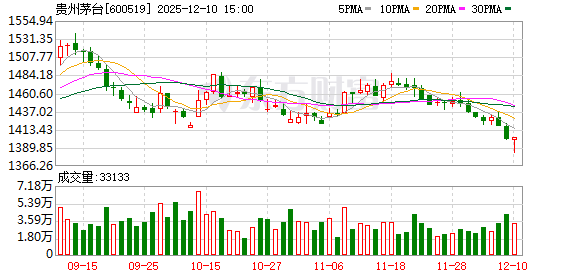
Core Viewpoint - The wholesale price of 25-year Feitian Moutai has dropped significantly, nearing the official guidance price, raising concerns in the market [2][5]. Price Trends - As of December 10, the wholesale price for 25-year Feitian (loose) is 1500 RMB per bottle, down 15 RMB from the previous day, while the original box price remains at 1520 RMB [2][3]. - The price of Feitian Moutai has decreased by over 30% throughout the year, with a cumulative decline of 32.43% from its peak [4][5]. Market Dynamics - The decline in Moutai prices is attributed to dealers liquidating inventory amid falling prices, leading to a "cut-loss" strategy to recover funds [6]. - There are three pricing tiers for Moutai: factory price, official guidance price, and the comprehensive cost for dealers, which is currently between 1700 RMB and 1800 RMB [7]. Consumer Demand - Consumer demand for high-end liquor is reportedly shrinking, which could further impact prices if the trend continues into the 2026 Spring Festival [7][8]. - The market is experiencing a "price drop panic," exacerbated by online platforms and promotional activities [8]. Industry Outlook - The Chinese liquor industry is expected to see more operators exit the market in the next 3-5 years, leading to a continuous supply of low-priced liquor [8]. - Despite the price downturn, leading companies like Guizhou Moutai and Wuliangye are maintaining strong dividend payouts, reflecting their robust financial health [8][9]. Dividend Announcements - Guizhou Moutai announced a cash dividend of approximately 300.01 billion RMB, while Wuliangye announced a total of 100.07 billion RMB in cash dividends [8][9].
合计超400亿元!两大龙头酒企下周分红
Zhong Guo Ji Jin Bao· 2025-12-11 00:29
Core Viewpoint - The announcement of significant cash dividends by leading liquor companies Guizhou Moutai and Wuliangye amidst a challenging industry environment highlights their financial confidence and commitment to shareholder returns [1][4][7]. Group 1: Dividend Announcements - Guizhou Moutai will distribute a cash dividend of 239.57 yuan per 10 shares, totaling 30 billion yuan, with the record date on December 18, 2025, and the ex-dividend date on December 19, 2025 [1][4]. - Wuliangye will distribute a cash dividend of 25.78 yuan per 10 shares, totaling 10 billion yuan, with the record date on December 17, 2025, and the ex-dividend date on December 18, 2025 [2][4]. Group 2: Financial Performance - Guizhou Moutai's third-quarter revenue growth was nearly stagnant at 0.56%, with net profit growth at 0.48%, marking the lowest growth rate in nearly a decade [4]. - Wuliangye experienced a more pronounced decline, with third-quarter revenue down 52.66% and net profit down 65.62% year-on-year [4]. Group 3: Market Conditions - The price of Guizhou Moutai's core product has been declining, with the market price for a bottle dropping to 1,500 yuan, nearing the official guidance price of 1,499 yuan [4]. - Wuliangye has reportedly increased discounting on its products to stabilize pricing amid industry pressures [4]. Group 4: Cash Flow and Dividend Policy - As of the end of the third quarter of 2025, Guizhou Moutai had cash and cash equivalents of 51.75 billion yuan and 135.40 billion yuan in other funds, while Wuliangye had 136.31 billion yuan in cash [7]. - Guizhou Moutai's dividend policy aims to distribute at least 75% of its net profit as cash dividends annually, while Wuliangye plans to distribute at least 70% of its net profit, with a minimum of 20 billion yuan each year [8].

合计超400亿元!贵州茅台、五粮液下周分红
Zhong Guo Ji Jin Bao· 2025-12-11 00:28
Core Viewpoint - Both Wuliangye and Kweichow Moutai announced their mid-term dividend distribution plans for 2025, totaling over 40 billion yuan to be distributed to shareholders next week [1][2]. Group 1: Dividend Distribution - Kweichow Moutai will distribute a cash dividend of 239.57 yuan (including tax) for every 10 shares, amounting to a total cash dividend of 30 billion yuan (including tax) [1]. - Wuliangye will distribute a cash dividend of 25.78 yuan (including tax) for every 10 shares, totaling a cash dividend of 10 billion yuan (including tax) [2]. - The record date for Kweichow Moutai is December 18, 2025, and the ex-dividend date is December 19, 2025 [1]. The record date for Wuliangye is December 17, 2025, with the ex-dividend date on December 18, 2025 [2]. Group 2: Financial Performance - Kweichow Moutai's third-quarter revenue growth was nearly stagnant, with a year-on-year increase of only 0.56%, and net profit attributable to shareholders grew by 0.48%, marking the lowest growth rate in nearly a decade [4]. - Wuliangye experienced a more significant decline, with third-quarter revenue down by 52.66% and net profit attributable to shareholders down by 65.62% [5]. - The price of Kweichow Moutai's core product, Feitian Moutai, has been decreasing, with the market price dropping to 1,500 yuan per bottle, approaching the official guidance price of 1,499 yuan [5]. Group 3: Market Sentiment and Cash Flow - The market performance reflects investor concerns, with both Kweichow Moutai and Wuliangye's stock prices declining throughout the year, and Wuliangye hitting a new low [5]. - Industry insiders believe that the high dividend payouts from both companies signal confidence in their financial health and emphasize shareholder returns amid operational pressures during the industry adjustment period [9]. - As of the end of the third quarter of 2025, Kweichow Moutai had cash and cash equivalents of 51.75 billion yuan and 135.40 billion yuan in other funds, while Wuliangye had cash and cash equivalents of 136.31 billion yuan [9].
合计超400亿元!两大龙头酒企下周分红
中国基金报· 2025-12-11 00:21
Core Viewpoint - The announcement of substantial mid-term dividends by leading liquor companies Kweichow Moutai and Wuliangye, totaling over 40 billion yuan, is noteworthy amid the industry's overall adjustment period and declining performance [2][5][10]. Group 1: Dividend Distribution - Kweichow Moutai will distribute a cash dividend of 239.57 yuan per 10 shares (including tax), totaling 30 billion yuan [2][3]. - Wuliangye will distribute a cash dividend of 25.78 yuan per 10 shares (including tax), totaling 10 billion yuan [3][10]. - The record date for Kweichow Moutai is December 18, 2025, and the ex-dividend date is December 19, 2025 [2][3]. Group 2: Financial Performance - Kweichow Moutai's third-quarter revenue growth was nearly stagnant at 0.56%, with net profit growth at 0.48%, marking a 10-year low [5][10]. - Wuliangye experienced a more significant decline, with third-quarter revenue down 52.66% and net profit down 65.62% [5][10]. Group 3: Market Conditions - The price of Kweichow Moutai's core product, Feitian Moutai, has been decreasing, with the retail price dropping to 1,500 yuan per bottle, nearing the official guidance price of 1,499 yuan [5][10]. - Wuliangye has increased discount rates for its products to stabilize pricing amid market pressures [5][10]. Group 4: Financial Health and Future Plans - As of the end of the third quarter of 2025, Kweichow Moutai had cash and cash equivalents of 51.75 billion yuan and 135.40 billion yuan in other funds, while Wuliangye had 136.31 billion yuan in cash [10]. - Kweichow Moutai's dividend policy aims to distribute no less than 75% of its annual net profit, while Wuliangye plans to distribute at least 70% of its net profit, with a minimum of 20 billion yuan annually [10].

【立方早知道】深夜重磅!美联储降息/“果链巨头”拟入局AI算力赛道/沐曦股份逾2万股被弃购
Sou Hu Cai Jing· 2025-12-11 00:10
Focus Events - The Federal Reserve announced a 25 basis point reduction in the federal funds rate target range to between 3.5% and 3.75%, marking the third consecutive rate cut this year and the sixth since the rate cut cycle began in September 2024 [1] Macro News - The Ministry of Agriculture and Rural Affairs is launching a consumption promotion activity titled "Special Products for the New Year" to boost agricultural product consumption during the upcoming holiday season [3] - The International Monetary Fund (IMF) has raised China's economic growth forecast for 2025 to 5%, an increase of 0.2 percentage points from its previous report [5] Industry Dynamics - The National Medical Products Administration is supporting companies in enhancing the research and development of innovative drugs and medical devices, with a focus on original products and breakthrough technologies [6] - China's AI industry has surpassed 900 billion yuan, with applications reaching 657, a year-on-year increase of 61.8% [9] Company Focus - Muxi Co., Ltd. reported that online investors abandoned the subscription of 20,349 shares, with a total subscription amount of 10.09 billion yuan [12] - Wuliangye and Kweichow Moutai announced significant mid-year cash dividends, with Wuliangye distributing 100.07 billion yuan and Kweichow Moutai distributing 300.01 billion yuan [14] - Century Huatong disclosed an indirect holding in Moer Thread, estimating a profit impact of approximately 640 million yuan for the fourth quarter of 2025 [16] - Huayi Brothers announced overdue debts totaling 52.5 million yuan, exceeding 10% of its audited net assets for 2024 [23] - CATL plans to register bonds not exceeding 10 billion yuan for project construction and working capital [24] - JD.com is acquiring a property in Hong Kong for approximately 3.473 billion HKD [25]





【早报】美联储宣布:降息25个基点!鲍威尔重磅发声;中方正考虑限制获取英伟达H200芯片?外交部回应
财联社· 2025-12-10 23:09
Industry News - The National Medical Products Administration is prioritizing the review of innovative products and domestic alternatives to critical technologies to enhance the competitiveness of China's pharmaceutical industry [4] - The Ministry of Agriculture and Rural Affairs is launching a consumption promotion activity for the New Year and Spring Festival in 2026, aiming to boost agricultural product consumption during peak seasons [5] - The NAND storage module market is experiencing significant shortages, with some manufacturers expected to run out of stock by the first quarter of 2026, leading to a nearly 50% monthly price increase for Micron's NAND products [5] - The China Computing Power Platform has officially launched, marking a significant step in the construction of a nationwide integrated computing power network [5] - Semiconductor equipment manufacturers report that TSMC and other companies are accelerating the expansion of advanced packaging capacity, with demand for GPUs and ASICs exceeding expectations for 2026-2027 [6] Company News - Kweichow Moutai announced a mid-term dividend of 30 billion yuan for 2025, with the record date set for December 18 [7] - Wuliangye announced a mid-term dividend of 10.007 billion yuan for 2025, with the record date set for December 17 [9] - Blue Si Technology plans to acquire 100% of the shares of Peimei International, a liquid cooling and server cabinet company, to expand into the AI computing infrastructure sector [10] - Huayi Brothers reported a debt default of 52.5 million yuan and plans to gradually exit and dispose of some assets [11] - Century Huatong announced that its subsidiary holds 19.5887 million shares of Moer Thread [11]