AT&M(000969)

Search documents
安泰科技:公司为生产第三代半导体材料(包括GaN)的化学气象沉积设备提供配套材料和部件
Zheng Quan Ri Bao Wang· 2026-01-26 13:14
Group 1 - The company, Antai Technology (000969), provides supporting materials and components for chemical vapor deposition equipment used in the production of third-generation semiconductor materials, including GaN [1] - The company does not engage in the production of silicon carbide or gallium nitride materials [1]

安泰科技:公司新建的1万吨非晶带材项目已按期于2025年6月30日完成整体验收
Zheng Quan Ri Bao Wang· 2026-01-26 12:40
Core Viewpoint - Antai Technology (000969) has confirmed that its new 10,000-ton amorphous strip project is on track for completion and acceptance by June 30, 2025, and is currently in the production ramp-up phase [1]. Group 1 - The company is in the process of achieving full production capacity for its new project [1]. - The project is expected to be completed on schedule, indicating effective project management [1].
多家A股公司披露可控核聚变业务进展
Xin Lang Cai Jing· 2026-01-23 03:42
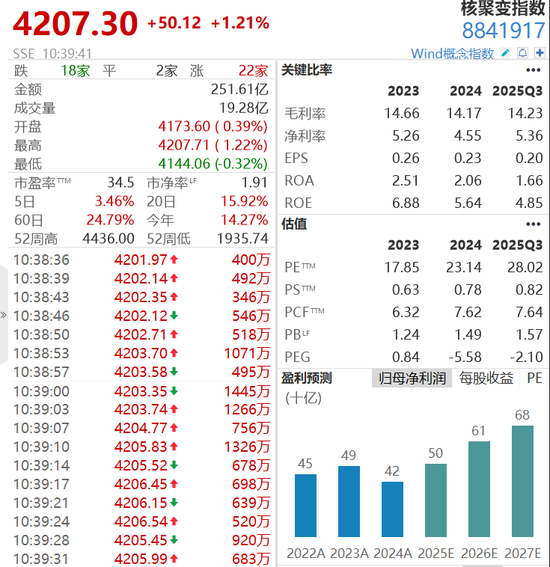
Core Viewpoint - The A-share market is experiencing significant investment interest in the controllable nuclear fusion sector, with the Wind nuclear fusion index rising by 20.5% at its peak in January and currently up by 15.92%, with monthly trading volume exceeding 780 billion yuan [1][2]. Industry Developments - Several companies, including Zhongji HuanKe, Antai Technology, Tiangong International, and Xuguang Electronics, have disclosed their involvement in controllable nuclear fusion, while others have clarified their limited business scale to manage market expectations [2][13]. - The compact fusion energy experimental device (BEST) in Hefei has made significant progress, with key components successfully delivered, and it is expected to be completed by 2027, potentially becoming the first device to achieve fusion power generation [4][15]. - The controllable nuclear fusion industry is advancing rapidly in China, with a notable increase in commercialization efforts since 2022, and a significant number of startups emerging in the past five years, attracting around $6.5 billion in investments [6][16]. Market Performance - As of January 23, 2026, many nuclear fusion concept stocks have seen substantial gains, with companies like Zinc Industry Co., Yuguang Gold Lead, and Western Materials hitting their daily price limits [2][14]. - The stock prices of companies involved in nuclear fusion have shown significant increases, with Zhongji HuanKe's stock rising by 18.31% since the beginning of January [18]. Regulatory Environment - The implementation of the Atomic Energy Law on January 15, 2023, encourages and supports controllable nuclear fusion, providing a foundational framework for the industry's development [5][16]. Company Initiatives - Companies like Antai Technology and Tiangong International are actively participating in nuclear fusion projects, with Antai signing agreements for advanced filter projects and Tiangong achieving breakthroughs in neutron shielding materials [19][20]. - Star Ring Fusion announced a record-breaking 1 billion yuan A-round financing, with plans to complete engineering validation by 2028 and start construction of a commercial demonstration reactor by around 2032 [17][18].


逐梦“人造太阳”,A股公司竞相“亮牌”
2 1 Shi Ji Jing Ji Bao Dao· 2026-01-22 13:08
2026年开年,A股热钱持续席卷可控核聚变领域。数据显示,1月22日,核聚变指数本月最高上涨 20.5%,截至目前则上涨12.91%,板块月度成交额接近7800亿元,接近12月全月8200亿成交总额。 去年下半年来,我国核聚变行业开始步入快车道。 位于安徽合肥的紧凑型聚变能实验装置(BEST)取得重大进展,装置主机关键部件的杜瓦底座研制成 功并顺利完成交付。该装置预计2027年竣工,有望成为人类历史上首个实现聚变发电的装置。 从技术原理上来说,可控核聚变是指在一定条件下,控制原子核聚变反应的速度和规模,使其能够安 全、持续、平稳地输出能量。其基本原理是模仿太阳发光发热的过程,将轻原子核在极端高温高压条件 下聚合成较重的原子核,并在此过程中释放出巨大能量。 被当成概念爆炒的部分涉核聚变业务公司,"顺水推舟"披露更多相关进展;部分公司则急于"划清界 限"或澄清业务规模较小,以正视听。 据21世纪经济报道记者不完全统计,近期已经有包括中集环科(301559)、安泰科技(000969)、天工 国际、旭光电子(600353)等多家公司明确涉足可控核聚变。 与此同时,诸多企业也向市场投资者发出相关业务体量较小、对公司短期 ...
金属新材料板块1月22日涨1.61%,天力复合领涨,主力资金净流入2.65亿元
Zheng Xing Xing Ye Ri Bao· 2026-01-22 08:48
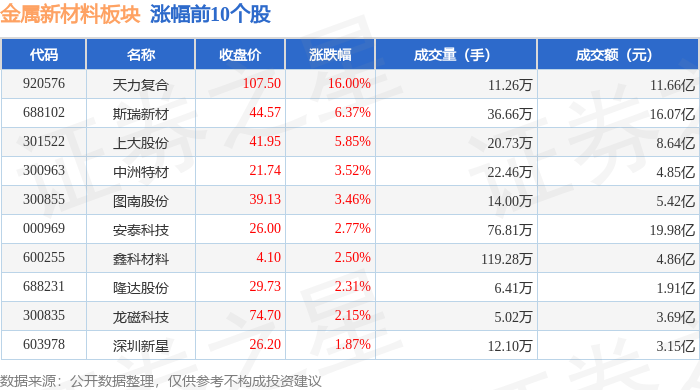
Group 1 - The metal new materials sector increased by 1.61% on January 22, with Tianli Composite leading the gains [1] - The Shanghai Composite Index closed at 4122.58, up 0.14%, while the Shenzhen Component Index closed at 14327.05, up 0.5% [1] - Key stocks in the metal new materials sector showed significant price increases, with Tianli Composite rising by 16.00% to a closing price of 107.50 [1] Group 2 - The sector experienced a net inflow of 265 million yuan from institutional investors, while retail investors saw a net outflow of 283 million yuan [2] - Major stocks like Tianli Composite and Sry New Materials had varying net inflows and outflows, indicating differing investor sentiment [3] - The trading volume and turnover for key stocks in the sector were substantial, with Tianli Composite achieving a turnover of 1.166 billion yuan [1][2]


华创交运公用可控核聚变双周报(第5期):核聚变能科技与产业大会召开,可控核聚变产业化进展或加速推进
Huachuang Securities· 2026-01-19 13:20
Investment Rating - The report maintains a "Recommended" rating for the controllable nuclear fusion industry, indicating an expectation of significant growth in the sector over the next 3-6 months [3][49]. Core Insights - The 2026 Nuclear Fusion Energy Technology and Industry Conference held in Hefei is expected to accelerate the industrialization of nuclear fusion, with major procurement projects and collaborative laboratory projects being signed [1][8]. - Star Ring Fusion has completed a 1 billion yuan Series A financing round, which will expedite the commercialization of nuclear fusion technology, with plans to complete engineering validation by 2028 and establish a demonstration reactor by around 2032 [9][1]. - The report anticipates that the domestic nuclear fusion projects will see a total investment of approximately 146.5 billion yuan, with capital expenditures expected to enter an expansion phase from 2025 to 2028, leading to increased orders in the industry chain [8][1]. Summary by Sections Industry Overview - The report highlights the significant participation of over 1,500 attendees from various sectors, including government, academia, and finance, at the 2026 Nuclear Fusion Energy Technology and Industry Conference [8]. - The conference aims to foster collaboration across innovation, industry, finance, and talent chains to build a synergistic nuclear fusion energy ecosystem [8]. Financing and Investment - Star Ring Fusion's 1 billion yuan financing round was led by Shanghai Guotou and other investment groups, focusing on developing a unique high-temperature superconducting spherical tokamak technology [9][1]. - The report notes that the nuclear fusion industry is entering a capital expenditure upcycle, with significant investments expected to drive order volumes in the supply chain [1][8]. Market Performance - The report provides a performance review of the nuclear fusion sector, noting that several companies have seen substantial stock price increases, with top performers including New Wind Power (+42%) and China Nuclear Construction (+27%) [22][26]. - The report also tracks bidding activities, indicating a total bidding amount of 1.28 billion yuan in early January 2026, with several high-value projects being awarded [12][15]. Recommended Companies - The report continues to recommend companies such as Hezhong Intelligent and Lianchuang Optoelectronics, while suggesting attention to Guoguang Electric [3][23]. - It emphasizes the importance of the magnet segment, recommending companies like Western Superconducting and Yongding Co., which have significant value contributions in the nuclear fusion supply chain [33][3].


2025年1-11月有色金属矿采选业企业有1390个,同比增长2.81%
Chan Ye Xin Xi Wang· 2026-01-19 03:44
Group 1 - The core viewpoint of the article highlights the growth in the number of enterprises in the non-ferrous metal mining and selection industry in China, with a total of 1,390 enterprises reported for the period from January to November 2025, marking an increase of 38 enterprises or a year-on-year growth of 2.81% [1] - The proportion of non-ferrous metal mining enterprises in the total industrial enterprises stands at 0.26% [1] - The report referenced is the "2026-2032 China Non-Ferrous Metal Industry Market Development Status and Competitive Landscape Forecast Report" published by Zhiyan Consulting [1] Group 2 - The data source for the statistics on the number of non-ferrous metal mining enterprises is the National Bureau of Statistics, organized by Zhiyan Consulting [2] - Zhiyan Consulting is recognized as a leading industry consulting firm in China, specializing in deep industry research and providing comprehensive industry solutions to empower investment decisions [2]


可控核聚变行业周报:2026核聚变能科技与产业大会开幕,星环聚能完成10亿元A轮融资
GUOTAI HAITONG SECURITIES· 2026-01-19 03:00
Investment Rating - The report assigns an "Accumulate" rating for the controlled nuclear fusion industry [26]. Core Insights - The controlled nuclear fusion sector is experiencing significant growth, with increasing procurement demands and notable financing activities, such as the completion of a 1 billion RMB Series A funding round by Star Ring Fusion [3][22]. - The 2026 Nuclear Fusion Technology and Industry Conference highlighted advancements in plasma technology, including the successful operation of the "Xuanlong-50U" hydrogen-boron plasma high-confinement mode discharge, marking a significant milestone in fusion research [16][19]. - The establishment of the Fusion Financial Institutions Alliance aims to facilitate the transition of nuclear fusion from laboratory research to engineering and commercialization, involving 130 financial and technology service institutions [24][25]. Summary by Sections Market Performance - During the week of January 12-16, the nuclear fusion index fell by 3.22%, underperforming the broader market indices [8][11]. Tender and Bid Information - Significant procurement activities were reported, focusing on superconducting materials and structural components, with total procurement amounts nearing 100 million RMB [10][13]. Domestic and International News - The 2026 Nuclear Fusion Technology and Industry Conference, held in Hefei, attracted over 1,500 participants and featured major procurement projects and collaborations [14][19]. - Japan announced the opening of three top fusion research facilities to private enterprises, marking a shift towards public-private collaboration in fusion technology [19][20]. Investment Dynamics - Star Ring Fusion's 1 billion RMB Series A financing is one of the largest in the domestic fusion energy sector, indicating strong confidence in the commercialization of next-generation energy technologies [22]. - The Fusion Financial Institutions Alliance was formed to enhance capital efficiency and support the commercialization of nuclear fusion technologies [24][25]. Investment Recommendations - The report suggests focusing on key components of controlled nuclear fusion, including magnets, power supplies, and structural components, with specific companies highlighted for potential investment [26].


产业研讨+融资落地 核聚变能热度持续提升
Shang Hai Zheng Quan Bao· 2026-01-18 18:15
Core Insights - Nuclear fusion energy is transitioning from "science" to "energy," becoming a global competitive focus [2] - The 2026 Nuclear Fusion Energy Technology and Industry Conference held in Hefei, China, showcased significant industry achievements and fostered collaboration [3] Industry Developments - The conference featured over 1,500 professionals from academia, research institutions, and industry, exceeding expectations and highlighting the growing interest in nuclear fusion [3] - Key highlights included the establishment of a comprehensive platform for fusion science and engineering, aiming to cover various fields within nuclear fusion [3][4] - The conference announced the launch of a 1 billion yuan investment fund for future fusion energy projects, with 15 financial institutions forming a fusion finance alliance [4] Technological Achievements - The conference revealed the top ten innovative achievements in fusion technology for 2025, including the EAST project setting a world record and the initiation of the BEST project [4] - The Hefei University of Technology established a new Fusion Science and Engineering College during the conference [4] Investment Trends - The nuclear fusion sector is experiencing a surge in financing, with global cumulative funding reaching $9.766 billion in 2025, an increase of $2.643 billion from 2024 [6] - The establishment of 58 fusion device companies globally, with 14 based in China, indicates a 24% share in the global market [6] Project Opportunities - A project roadshow at the conference attracted significant interest, featuring 13 companies presenting various fusion-related projects [7] - The rapid growth of the nuclear fusion sector in China is highlighted by the increase in investment opportunities and the emergence of competitive companies in the supply chain [7] Market Potential - The market for fusion diagnostics is projected to reach a scale of hundreds of billions in the next decade, with applications extending beyond fusion energy to sectors like aerospace and medical devices [8]
“可控核聚变”热潮背后
经济观察报· 2026-01-17 06:13
Core Viewpoint - The A-share "nuclear fusion" concept companies may face a long performance gap before commercial power generation is realized, despite recent funding and technological breakthroughs in the sector [4]. Group 1: Market Dynamics - On January 15, 2026, the implementation of the "Atomic Energy Law" encouraging controlled nuclear fusion coincided with a market style shift, leading investors to focus on the "controlled nuclear fusion" sector as a potential new market leader [2]. - Recent funding activities, such as Shanghai Xinghuan Fusion Technology's completion of a 1 billion yuan Series A financing, have set records for domestic private fusion companies, indicating strong investor interest [2][16]. - Several listed companies in the "nuclear fusion concept" category, including China First Heavy Industries and China Nuclear Engineering, experienced significant stock price increases, but many issued announcements clarifying that they currently have minimal related revenue [3][25]. Group 2: Technological Advancements - The nuclear fusion industry is seeing advancements in technology, with breakthroughs in high-temperature superconducting magnets, which are crucial for achieving the necessary magnetic field strength for fusion [11][18]. - The energy density of nuclear fusion is significantly higher than that of nuclear fission, with 1 gram of deuterium-tritium fusion fuel releasing energy equivalent to 11.2 tons of standard coal, making it a promising solution for future energy needs [9]. - The development of compact fusion reactors is being facilitated by high-temperature superconductors, which allow for smaller and more cost-effective designs compared to traditional fusion reactors [11]. Group 3: Challenges and Future Outlook - Despite optimism in the investment community, significant challenges remain, including material durability under extreme conditions, tritium supply issues, and the need for high-throughput neutron sources for testing new materials [20][21]. - The timeline for commercial nuclear fusion is projected to extend to around 2050, with various milestones set for experimental and demonstration reactors in the coming decades [24][28]. - The current market for nuclear fusion equipment is expected to grow significantly, with estimates suggesting an annual scale of 266 billion yuan by 2035, but achieving this will require overcoming substantial technical and operational hurdles [27].