Sinoma Science & Technology (002080)

Search documents
建材周专题:特种电子布需求蓝海,国内龙头积极扩张
Changjiang Securities· 2025-09-02 09:46
Investment Rating - The industry investment rating is "Positive" and maintained [12] Core Viewpoints - The demand for special electronic fabrics is a blue ocean, with domestic leaders actively expanding [6] - Cement prices continue to rise, while glass inventory has shifted from increasing to decreasing [7] - The report recommends focusing on special fabrics and the African chain, with existing leaders as the main line for the year [9] Summary by Relevant Sections Special Electronic Fabrics - China National Materials Technology has announced new expansion plans, indicating strong commitment. Taishan Fiberglass plans to invest 1.81 billion yuan to build a project with an annual output of 35 million meters of special fiber fabric and another 1.75 billion yuan for a project with an annual output of 24 million meters of ultra-low loss low dielectric fabric (Q fabric). The total annual output of these projects will reach 59 million meters, with a construction period of 18 months. The funding will come from self-owned funds and bank loans. After production, the total capacity is expected to reach approximately 120 million meters. Additionally, China Jushi has also confirmed its increased investment in the special electronic fabric sector. AI electronic fabrics are expected to be a new wave for industry leaders, considering the high technical barriers, product iteration, and sustained unexpected demand [6]. Cement Market - As of the end of August, cement demand has slightly rebounded in southern regions due to reduced rainfall. However, demand has weakened in regions like Beijing-Tianjin-Hebei, Shandong, and Henan due to stricter environmental controls. The average cement shipment rate in key regions is approximately 45.3%, a decrease of 0.2 percentage points month-on-month. Some areas are still actively pushing for price increases, leading to an overall market price increase of 0.5% [7]. Glass Market - The domestic float glass market has seen a slight improvement in transactions, with prices gradually stabilizing and some areas experiencing minor price increases. As downstream processing plants further digest inventory, there has been a slight increase in essential replenishment, supporting float glass manufacturers. However, the current inventory level remains high, and speculative sources still pose risks. The production capacity has slightly increased, with 283 float glass production lines in total, 222 of which are operational, with a daily melting capacity of 158,855 tons [8][36]. Recommendations - The report recommends focusing on core leader China National Materials Technology due to the explosive demand for AI and high supply barriers in special electronic fabrics. The report also highlights the African chain, recommending Keda Manufacturing, which has advantages in production, channels, and brand in the African market. The report anticipates continued recovery in net profit margins in 2025H, benefiting from the recovery in lithium carbonate prices. Additionally, it recommends Huaxin Cement and Western Cement, noting Huaxin's acquisition of Haorui's Nigerian assets, which enhances overseas profit elasticity [9].


建筑材料行业跟踪周报:8月建筑业PMI略超季节性,推荐水泥和洁净室工程-20250902
Soochow Securities· 2025-09-02 05:56
Investment Rating - The report maintains an "Overweight" rating for the construction materials industry [1] Core Views - The construction materials sector is expected to benefit from a slight recovery in cement demand, particularly in southern regions as rainfall decreases. However, demand in areas like Beijing-Tianjin-Hebei, Shandong, and Henan is weakening due to stricter environmental controls [2][14] - The report highlights the potential for price increases in cement, driven by improved demand and supply-side discipline, with a focus on leading companies such as Conch Cement and Huaxin Cement [4][5] - The report emphasizes the importance of government policies aimed at boosting domestic demand and stabilizing the real estate market, which are expected to positively impact the home improvement and building materials sectors [17] Summary by Sections 1. Sector Overview - The construction materials sector saw a slight increase in the PMI for August, indicating a seasonal uptick in activity, particularly in major infrastructure projects initiated in July [4] - The construction materials index showed a marginal increase of 0.14% during the week, underperforming compared to the broader market indices [4] 2. Bulk Construction Materials 2.1 Cement - The national average price for high-standard cement is reported at 344.3 RMB/ton, reflecting a week-on-week increase of 1.7 RMB/ton but a year-on-year decrease of 35.2 RMB/ton [22][23] - The average cement inventory level among sample enterprises is 63.6%, down 1.0 percentage points from the previous week [25] - The report anticipates a potential price stabilization and recovery in the cement market, particularly in the second half of the year [5][14] 2.2 Glass - The average price for float glass is reported at 1189.7 RMB/ton, down 16.1 RMB/ton from the previous week and down 176.6 RMB/ton year-on-year [4] - The report suggests that supply-side adjustments are likely to improve the supply-demand balance in the glass industry, with a focus on leading companies benefiting from cost advantages [16] 2.3 Fiberglass - The report notes a stable pricing environment for fiberglass, with the average price for non-alkali roving at 3100-3700 RMB/ton, remaining stable compared to previous periods [4] - The demand for specialty fiberglass products is expected to grow significantly, driven by technological advancements and increased applications in various industries [15] 3. Home Improvement Materials - The report highlights the positive impact of government policies aimed at stimulating domestic consumption, particularly in the home improvement sector, with expectations for a recovery in demand [17] - Leading companies in the home improvement materials sector are encouraged to explore new business models and enhance their market positioning [17]


中邮证券:电子布AI产业趋势加速 关注中国巨石后续切入产业链机遇
Zhi Tong Cai Jing· 2025-09-02 03:35
Group 1 - The core players in the fiberglass electronic cloth industry are accelerating their capacity expansion, with China National Materials announcing an addition of 35 billion low dielectric cloth capacity and China Jushi indicating progress in developing specialty electronic cloth series products [1] - China Jushi's scale and cost control capabilities, along with its strong cooperation with downstream CCL manufacturers, suggest that it will penetrate the supply chain and capture a certain market share in the future [1] - The cement industry is expected to see a continuous decline in capacity under the anti-overproduction policy, leading to a significant increase in capacity utilization rates, with a potential demand recovery and price increase anticipated in August [2] - The glass industry is facing a downward trend in demand due to real estate impacts, but the supply side is expected to improve as most companies meet environmental requirements, accelerating the industry's cold repair progress [2] - The fiberglass sector is experiencing a surge in demand driven by the AI industry, with low dielectric products seeing both volume and price increases, indicating a trend of continuous growth in demand [2]
中邮证券:电子布AI产业趋势加速 关注中国巨石(600176.SH)后续切入产业链机遇
智通财经网· 2025-09-02 02:26
Group 1 - The core players in the fiberglass electronic cloth industry are accelerating their capacity expansion, with China National Materials announcing an addition of 35 million square meters of low dielectric cloth capacity and 24 million meters of ultra-low loss low dielectric cloth capacity [1] - China Jushi's mid-year report indicates that the development of special electronic cloth series products is progressing actively, with downstream certifications also accelerating [1] - Given China Jushi's cost control capabilities and good cooperation with downstream CCL manufacturers, it is expected that the company will penetrate the supply chain and capture a certain market share in the future [1] Group 2 - The cement industry is expected to see a continuous decline in capacity under the implementation of anti-overproduction policies, leading to a significant increase in capacity utilization rates [2] - The glass industry is facing a downward trend in demand due to real estate impacts, but the supply side is not expected to see a drastic capacity reduction despite increased environmental requirements [2] - The fiberglass industry is experiencing a surge in demand driven by the AI industry, with low dielectric products seeing both volume and price increases, indicating a trend of continuous growth in demand [2]
水泥、玻纤中报表现较优,继续推荐高端电子布/出海高景气方向及传统建材基本面改善品种 | 投研报告
Zhong Guo Neng Yuan Wang· 2025-09-02 02:13
Group 1 - The core viewpoint of the report highlights significant improvements in the cement and fiberglass sectors in Q2, with cement prices showing a downward trend but profitability increasing year-on-year, while fiberglass benefits from rising prices in thermoplastics and wind power yarns, leading to improved gross margins [1][3] - The construction materials sector saw a 2.71% increase in the Shanghai and Shenzhen 300 index, with the building materials sector (CITIC) rising by 0.53%, particularly driven by strong performance in the fiberglass segment [2] - The report recommends focusing on high-end electronic fabrics and traditional building materials with improving fundamentals, while also noting the impact of declining new construction in real estate on consumption building materials [3] Group 2 - The report indicates that the demand for traditional building materials remains generally weak, although there are signs of improvement in supply, with price increases announced for waterproof materials and gypsum boards in August [3] - A significant expansion announcement was made by China National Materials Group, planning to invest approximately 180.624 million yuan in a low-dielectric fiber fabric project and 175.089 million yuan in an ultra-low-loss low-dielectric fiber fabric project, adding a total of 5.9 million meters of production capacity [4] - The recommended stock portfolio includes companies such as Honghe Technology, China National Materials, Qingsong Chemical, Tibet Tianlu, Huaxin Cement, and Sankeshu, reflecting a focus on firms with potential for growth in the current market environment [5]
水泥、玻纤中报表现较优,继续推荐高端电子布、出海高景气方向及传统建材基本面改善品种
Tianfeng Securities· 2025-09-01 10:15
Investment Rating - Industry Rating: Outperform the market (maintained rating) [5] Core Viewpoints - The cement and fiberglass sectors showed significant improvement in Q2 year-on-year, with cement prices experiencing a sequential decline but profitability still increasing year-on-year. Fiberglass benefited from rising prices of thermoplastics and wind power yarn, leading to a continued increase in gross margins. The product structure advantages of leading companies are becoming more evident, with specialty fiber cloth contributing to profit growth [2][11] - The demand for consumer building materials is negatively impacted by the decline in new construction and completion in the real estate sector, resulting in a year-on-year revenue decrease. However, the revenue decline for waterproofing and board materials in Q2 narrowed compared to Q1. The glass demand remains weak, with prices and gross margins continuing to decline in Q2, leading to an average gross loss across the industry. As loss pressures increase, the pace of industry cold repairs may accelerate, with potential for price improvements in the short term [2][11] - The report continues to recommend traditional building materials with improving fundamentals, such as cement and coatings, as well as high-end electronic fabrics and overseas markets with high demand growth [2][20] Summary by Sections Market Review - During the week of August 25-29, 2025, the Shanghai and Shenzhen 300 index rose by 2.71%, while the building materials sector (CITIC) increased by 0.53%, with the fiberglass sector performing particularly well. Notable individual stock performances included China Jushi (+15.3%), Dongpeng Holdings (+13.6%), and King Kong Photovoltaic (+12.5%) [1][11] Electronic Fabric Sector - China National Materials Technology announced plans to invest 1.80624 billion yuan in a project to produce 35 million meters of low-dielectric fiber cloth in Jining, Shandong, and 1.75089 billion yuan for a project to produce 24 million meters of ultra-low-loss low-dielectric fiber cloth in Tai'an, Shandong. These projects will add a total of 59 million meters of production capacity, with a construction period of 18 months [3][17] Recommended Stocks - The report highlights a focus on the following stocks: Honghe Technology, China National Materials Technology, Qingsong Construction, Tibet Tianlu, Huaxin Cement, and Sankeshu [4][20]


玻璃玻纤板块9月1日跌0.77%,中材科技领跌,主力资金净流出2.25亿元
Zheng Xing Xing Ye Ri Bao· 2025-09-01 08:46
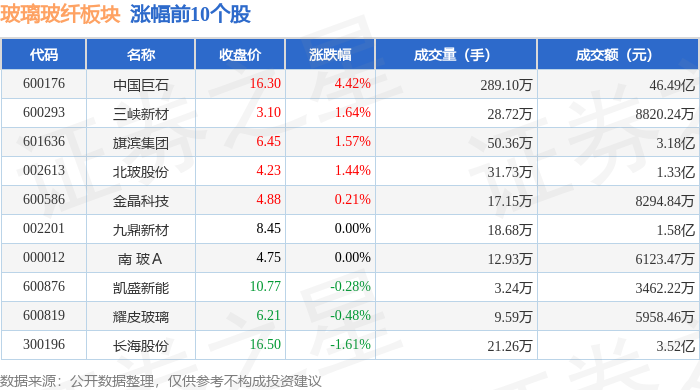
Market Overview - The glass fiber sector experienced a decline of 0.77% on September 1, with China National Building Material leading the drop [1] - The Shanghai Composite Index closed at 3875.53, up 0.46%, while the Shenzhen Component Index closed at 12828.95, up 1.05% [1] Stock Performance - Key stocks in the glass fiber sector showed varied performance, with China Jushi (600176) rising by 4.42% to a closing price of 16.30, while China National Building Material (002080) fell by 4.97% to 34.44 [1][2] - Other notable performers included: - Sanxia New Materials (600293) up 1.64% to 3.10 - Qibin Group (601636) up 1.57% to 6.45 - North Glass (002613) up 1.44% to 4.23 [1] Trading Volume and Value - The trading volume and value for key stocks were significant, with China Jushi recording a volume of 2.89 million shares and a transaction value of 464.9 million yuan [1] - China National Building Material had a trading volume of 704,000 shares and a transaction value of 2.421 billion yuan, indicating substantial market activity [2] Capital Flow Analysis - The glass fiber sector saw a net outflow of 225 million yuan from institutional investors, while retail investors contributed a net inflow of 303 million yuan [2] - Specific stock capital flows included: - China Jushi with a net inflow of 2.10 billion yuan from institutional investors - Sanxia New Materials with a net inflow of 11.64 million yuan from retail investors [3]


建材2025半年报业绩综述:2025中报:AI新材料+出海,基本面迎头向上
SINOLINK SECURITIES· 2025-09-01 07:06
Investment Rating - The report maintains a positive outlook on the construction materials sector, highlighting opportunities in AI materials, overseas expansion, and transformation strategies [4]. Core Insights - The cement industry is experiencing profit recovery through price increases and cost reductions, with strong overseas performance and ongoing supply-side checks on overproduction [4]. - Consumer building materials remain at a low point in terms of market conditions, but leading companies are showing signs of recovery; balance sheet improvements are gradual and vary by company [4]. - The fiberglass sector is benefiting from high demand for specialty fiberglass driven by AI, while traditional fiberglass margins continue to improve [4]. - The glass industry is in a bottoming phase, with ongoing monitoring of supply-side changes [4]. - Investment suggestions include focusing on AI PCB upstream new materials, leading companies with high technical barriers, and products that are rapidly upgraded, as well as opportunities in the "Belt and Road" initiative [4]. Cement Industry Analysis - The report provides a profit forecast and valuation for the cement sector, indicating a slight decline in sales volume for major players like Conch Cement and Huaxin Cement in H1 2025, with overall national cement production down 4.3% [14][13]. - The report notes that the cement industry's profit recovery is expected as supply-side checks on overproduction are implemented [14]. - The overseas expansion of companies like Huaxin and Conch Cement is highlighted as a significant growth area, with Huaxin establishing bases in 12 countries and Conch increasing its overseas clinker capacity [14]. Consumer Building Materials Overview - The consumer building materials sector is currently facing challenges, with a significant decline in construction activity and a focus on finding demand bottoms [17]. - Companies like Keda Manufacturing and Sanke Tree are showing resilience through overseas expansion and strong performance in non-real estate sectors [17]. - The report emphasizes the importance of business transformation and the progress of companies adapting to new market conditions, such as Keda's acquisition of new technology and partnerships [17]. Financial Performance Metrics - The report includes detailed financial metrics for various companies, indicating trends in revenue, profit margins, and market valuations [13][24]. - Notable improvements in gross margins for companies like Sanke Tree and Keda Manufacturing are reported, reflecting successful cost management and pricing strategies [23][24]. - The report also highlights the cash flow and receivables situation for consumer building materials companies, indicating varying levels of financial health and operational efficiency [19][21].

AI服务器渗透加速,特种电子布需求放量
CAITONG SECURITIES· 2025-09-01 07:03
Investment Rating - The industry investment rating is optimistic (first-time rating) [2] Core Insights - The rapid development of artificial intelligence (AI) technology is driving strong demand for AI servers, which is expected to reach 1.981 million units globally in 2024, accounting for 12.1% of the overall server market. This demand is projected to grow by 24.3% to 2.4611 million units in 2025 [2][14] - The demand for printed circuit boards (PCBs) is expected to increase significantly due to the rising AI server penetration, with global PCB output valued at $73.565 billion in 2024, representing a year-on-year growth of 5.8% [2][14] - The market for third-generation electronic fabrics (Q fabric) is anticipated to grow from $720 million in 2024 to $3.127 billion by 2031, with a compound annual growth rate (CAGR) of 23.3% from 2025 to 2031 [4][19] Summary by Sections 1. Electronic Fabric Product Upgrades - Electronic fabrics are critical materials in the electronic information industry, with continuous technological upgrades driven by the demand for high-frequency and high-speed signal transmission in advanced applications such as 5G and AI [7][9] - The evolution of electronic fabrics is categorized into three generations: first-generation (alkali-free glass fiber), second-generation (modified glass fiber), and third-generation (Q fabric/quartz fiber), each targeting different market needs [9][12] 2. Steady Progress in Domestic Substitution - The domestic substitution process is advancing steadily, with key companies like China Jushi, Zhongcai Technology, Honghe Technology, and International Composite Materials making significant strides in product development and capacity expansion [19][20] - China Jushi holds a 23% global market share in electronic fabrics, while Zhongcai Technology has established itself as a leader in low-DK fabric production, with plans to increase capacity significantly [19][20] - Honghe Technology and International Composite Materials are also expanding their production capabilities to meet the growing demand for high-performance electronic fabrics [20] 3. Market Dynamics and Future Outlook - The capital expenditure of major cloud service providers (CSPs) is on the rise, indicating a sustained demand for AI infrastructure, which is expected to further drive the need for high-end electronic fabrics [17][18] - The report highlights the importance of technological advancements in the electronic fabric sector, particularly in meeting the stringent requirements of high-frequency applications [4][19]
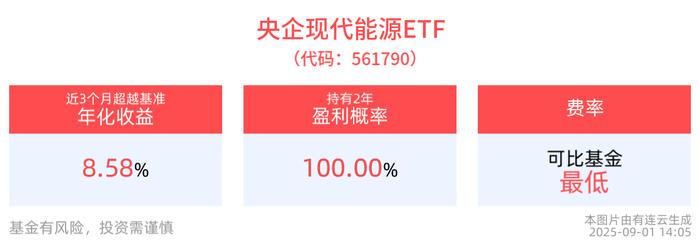
上海电力涨停,央企现代能源ETF(561790)红盘震荡,海上风电等领域仍具投资吸引力
Xin Lang Cai Jing· 2025-09-01 06:49
Group 1 - The core viewpoint of the news highlights the performance and trends in the modern energy sector, particularly focusing on the Central State-Owned Enterprises (SOEs) and their investment activities in renewable energy projects [3][4][5] - As of August 29, 2025, the Central State-Owned Enterprises Modern Energy ETF has shown a net value increase of 19.80% over the past two years, with a maximum monthly return of 10.03% since its inception [4] - The top ten weighted stocks in the Central State-Owned Enterprises Modern Energy Index account for 48.28% of the index, indicating a concentrated investment in key players within the energy sector [5] Group 2 - In the first half of 2025, China's total investment in new energy projects reached approximately 1.4 trillion yuan, despite a year-on-year decline of 32.2%, with wind and solar power investments showing significant decreases [3] - Wind power projects attracted 365.4 billion yuan, while solar power projects received 195 billion yuan, reflecting a saturation in traditional energy markets but continued interest in offshore wind and other niche areas [3] - Water power sector demonstrated resilience in profitability, with leading companies like Yangtze Power achieving a 14.9% year-on-year increase in net profit despite challenges in water supply [3]