
Yanghe(002304)

Search documents
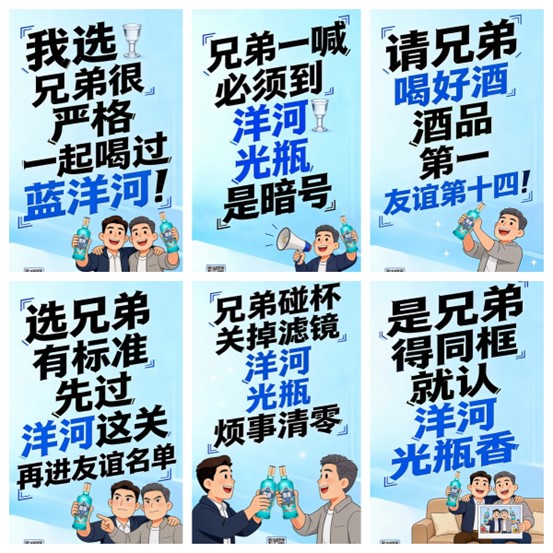
兄弟局就喝它!从街边小馆到家宴聚餐,洋河光瓶酒凭啥成了兄弟间的“默契酒”
Zhong Jin Zai Xian· 2026-01-14 10:10
Core Viewpoint - The recent advertising campaign by Yanghe featuring "brotherhood" themes has gained significant popularity, resonating with the everyday experiences of ordinary people rather than high-end luxury portrayals [1][3]. Group 1: Advertising Strategy - The campaign effectively captures the essence of brotherhood and camaraderie, reflecting the unspoken understanding among friends, which is often forged over drinks [3][5]. - The slogan "酒品第一,友谊第十四" (Quality of liquor first, friendship fourteenth) humorously conveys that true friendships do not require constant affirmation, making the message relatable and authentic [3][5]. - The simplicity and sincerity of the campaign stand out in a market filled with complex and high-end advertisements, showcasing a genuine connection with consumers [4][5]. Group 2: Emotional Connection - The campaign emphasizes the emotional value of the product, positioning Yanghe's light bottle liquor as a medium for genuine relationships, affordable yet respectable [5][9]. - Yanghe's marketing strategy successfully bridges different consumer segments by using a consistent emotional language, appealing to both high-end and everyday social contexts [9][10]. - The campaign reflects a broader understanding of social dynamics in China, where both high-end and casual drinking experiences share a core value of sincerity and trust [9][10].


酒价内参1月14日价格发布 洋河梦之蓝M6+下跌4元
Xin Lang Cai Jing· 2026-01-14 01:32
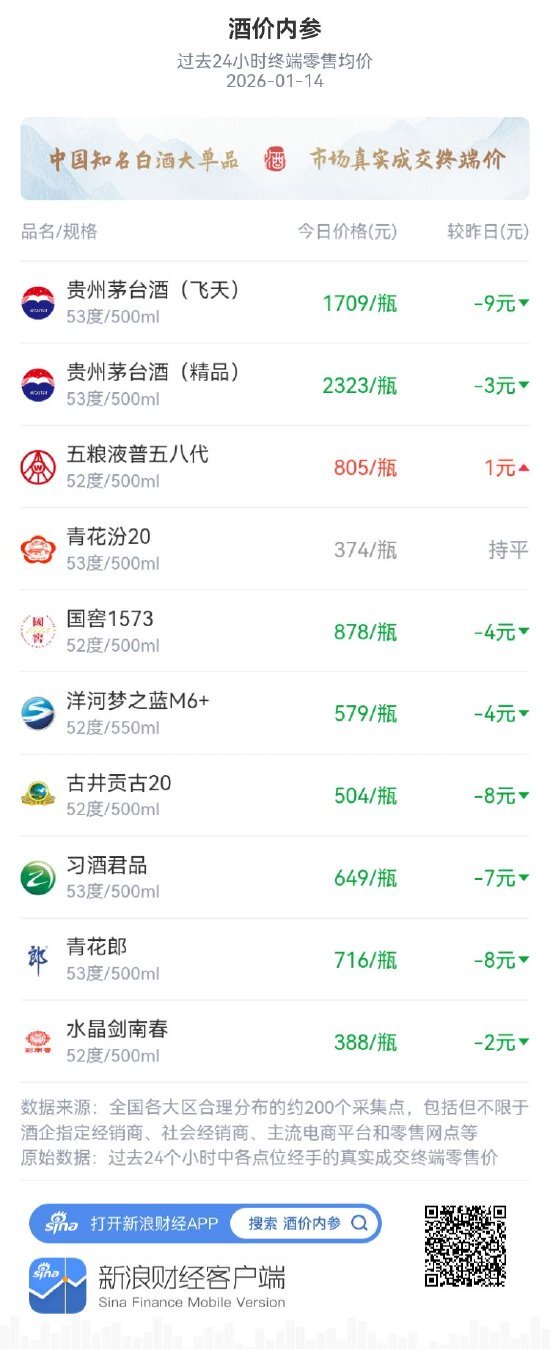
Core Viewpoint - The Chinese liquor market is experiencing a price adjustment, with the average retail price of the top ten liquor products declining, indicating cautious market sentiment [1]. Group 1: Market Price Trends - On January 14, the average retail price of the top ten liquor products decreased by 44 yuan, bringing the total price to 8925 yuan [1]. - Eight out of the ten products saw price declines, with Feitian Moutai leading the drop at 9 yuan per bottle [1]. - Other notable declines include Gujing Gonggu 20 and Qinghua Lang, both down 8 yuan per bottle, while Guojiao 1573 and Yanghe Dream Blue M6+ fell by 4 yuan each [1]. Group 2: Market Dynamics - The market is characterized by a general downward trend, with a narrowing trading volume and a clear differentiation among products [1]. - Only Wuliangye Pu 58th generation saw a slight increase of 1 yuan per bottle, while Qinghua Fen 20 remained unchanged [1]. Group 3: Pricing Mechanism Changes - On January 13, Kweichow Moutai announced a new market-oriented pricing strategy, moving away from fixed factory prices to a dynamic pricing mechanism based on market conditions [3]. - This new pricing system aims to enhance the company's control over retail prices and stabilize the market, allowing for flexible pricing based on product, channel, and operational model differences [3]. - The company is piloting a consignment model for new products, allowing consumers to order online and pick up in-store, aiming for a win-win situation between manufacturers and channels [3].




酒价内参1月14日价格发布 青花郎下跌8元
Xin Lang Cai Jing· 2026-01-14 01:20
Core Insights - The article highlights a recent decline in the retail prices of major Chinese liquor brands, indicating a cautious market sentiment and a general downward trend in prices [1][6]. Price Trends - The average retail price of the top ten Chinese liquor products decreased to 8,925 yuan on January 14, down by 44 yuan from the previous day [1][6]. - Eight out of the ten major products experienced price drops, with Feitian Moutai leading the decline at 9 yuan per bottle [1][6]. - Other notable price decreases include Gujing Gong and Qinghua Lang, both down by 8 yuan per bottle, while Guojiao 1573 and Yanghe Dream Blue M6+ fell by 4 yuan per bottle [1][6]. Market Dynamics - The market is currently characterized by a broad decline in prices, with a notable contraction in trading volume [1][6]. - Only Wuliangye's Pu Wuhai Dai saw a slight increase of 1 yuan per bottle, while Qinghua Fen 20 remained unchanged [1][6]. Data Collection Methodology - The "Wine Price Reference" collects data from approximately 200 sampling points across various regions, including designated distributors, social distributors, e-commerce platforms, and retail outlets [2][7]. - The data aims to provide an objective and traceable representation of the market prices for well-known liquor brands [2][7]. Strategic Changes in Pricing - On January 13, 2026, Kweichow Moutai announced a new market-oriented operational plan, which includes a dynamic pricing mechanism that deviates from the traditional fixed pricing model [3][8]. - This new pricing strategy allows for flexible pricing based on market conditions, enhancing the company's ability to control retail prices and stabilize the market [3][8]. - The company is testing a consignment model where consumers can order online and pick up in-store, aiming for a win-win situation between manufacturers and distributors [3][8].

专项整治假冒伪劣白酒
Xin Lang Cai Jing· 2026-01-13 21:58
Core Viewpoint - The article highlights a recent enforcement action in Liancheng County, Fujian Province, aimed at combating counterfeit and inferior quality liquor, particularly focusing on well-known brands like Moutai and Xijiu [1] Group 1: Enforcement Actions - The Liancheng Market Supervision Administration, in collaboration with several liquor companies, conducted a special enforcement action against counterfeit liquor, inspecting over 30 businesses [1] - A total of 284 bottles of infringing liquor were seized during the operation, and involved stores have been officially investigated [1] Group 2: Collaboration with Industry - The enforcement action involved a partnership between the market supervision authority and professional anti-counterfeiting personnel from major liquor brands such as Guizhou Moutai, Xijiu, and Yanghe [1] - The focus of the inspections included well-known liquor stores, specialty liquor shops, and large supermarkets [1] Group 3: Methodology and Efficiency - The enforcement utilized a combined approach of administrative law enforcement and professional identification, enhancing the precision and efficiency of the inspections [1] - During the inspections, officials verified the business qualifications and purchase invoices of operators, while brand representatives conducted on-site assessments of product packaging and anti-counterfeiting features [1]
洋河股份三季度营收规模比古井贡酒高近20亿 双方利润却相差无几?
Xin Lang Cai Jing· 2026-01-13 14:35
Core Viewpoint - The financial reports for the third quarter of 2025 from leading liquor companies Yanghe Co. and Gujing Gongjiu show significant declines in revenue and profit, highlighting the competitive challenges in the industry [1]. Group 1: Financial Performance - Yanghe Co. reported a revenue of 18.09 billion yuan for the first three quarters, a decrease of 34.26% year-on-year, while Gujing Gongjiu's revenue was 16.43 billion yuan, down 13.87% [3][6]. - Yanghe Co.'s net profit attributable to shareholders was 3.98 billion yuan, a decline of 53.66%, whereas Gujing Gongjiu's net profit was 3.96 billion yuan, down 16.57% [3][6]. - In the third quarter alone, Yanghe Co. experienced a revenue drop of 29.01% to 3.29 billion yuan and a net profit loss of 158.38%, resulting in a loss of 369 million yuan [4][6]. Group 2: Profitability and Market Position - Yanghe Co.'s gross margin decreased by 2.71 percentage points to 71.10%, while Gujing Gongjiu's gross margin slightly increased to 79.87%, indicating stronger profitability [5]. - In the first half of the year, Yanghe Co. had a domestic revenue of 7.26 billion yuan, down 25.61%, with a narrowing revenue gap of about 1 billion yuan with its competitor Jianshe Yuan [6]. - Gujing Gongjiu maintained a strong market position in Anhui province, achieving a revenue of 12.30 billion yuan in the first half, a year-on-year increase of 3.60%, securing approximately 30% market share [7].
1月13日深证国企ESG(970055)指数跌1.7%,成份股中核科技(000777)领跌
Sou Hu Cai Jing· 2026-01-13 10:53
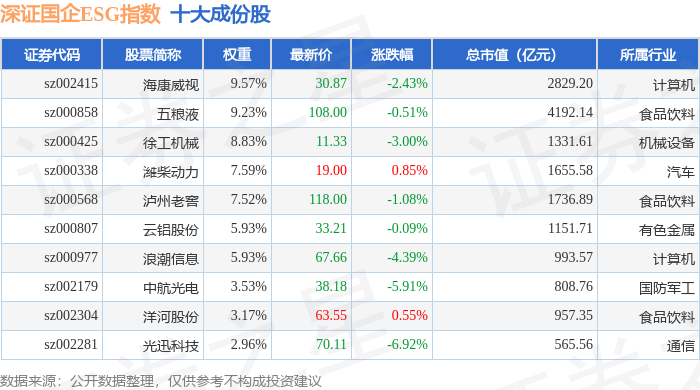
Group 1 - The Shenzhen State-owned Enterprise ESG Index (970055) closed at 1462.82 points, down 1.7%, with a trading volume of 56.526 billion yuan and a turnover rate of 2.08% [1] - Among the index constituents, 9 stocks rose while 40 stocks fell, with Dengkang Dental leading the gainers at a 6.17% increase and China Nuclear Technology leading the decliners at a 9.27% decrease [1] - The top ten constituents of the Shenzhen State-owned Enterprise ESG Index include Hikvision, Wuliangye, and Xugong Machinery, with respective weights of 9.57%, 9.23%, and 8.83% [1] Group 2 - The net outflow of main funds from the index constituents totaled 2.961 billion yuan, while retail investors saw a net inflow of 2.199 billion yuan [1] - Detailed fund flow data indicates that Yunnan Energy Investment and Yanghe Brewery experienced net inflows from retail investors, while major funds showed outflows for several stocks including Yun Aluminum and Wuliangye [2] - The fund flow analysis highlights the varying investor sentiment, with significant retail interest in certain stocks despite overall net outflows from institutional investors [2]


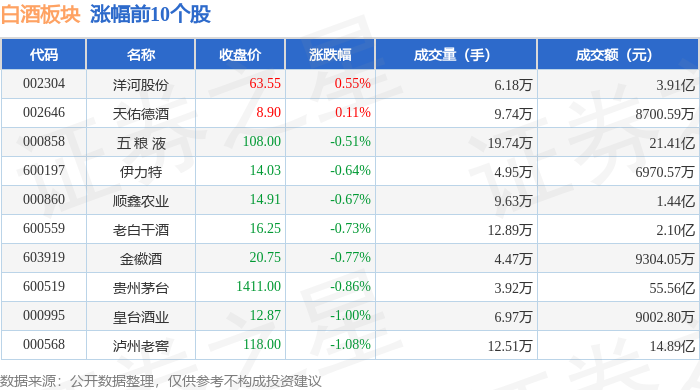
白酒板块1月13日跌0.9%,*ST岩石领跌,主力资金净流出8.17亿元
Zheng Xing Xing Ye Ri Bao· 2026-01-13 09:00
Group 1 - The liquor sector experienced a decline of 0.9% on January 13, with *ST Rock leading the drop [1] - The Shanghai Composite Index closed at 4138.76, down 0.64%, while the Shenzhen Component Index closed at 14169.4, down 1.37% [1] - Major liquor stocks showed mixed performance, with Wuliangye down 0.51% to 108.00 and Moutai down 0.86% to 1411.00 [1] Group 2 - The liquor sector saw a net outflow of 8.17 billion yuan from institutional investors, while retail investors contributed a net inflow of 3.19 billion yuan [2] - The top stocks by net inflow included Wuliangye with a net inflow of 46.20 million yuan from institutional investors, while *ST Rock had a net outflow of 38.73 million yuan [3] - Retail investors showed a preference for stocks like Moutai and Gujing Gongjiu, with net inflows of 15.08 million yuan and 15.08 million yuan respectively [3]

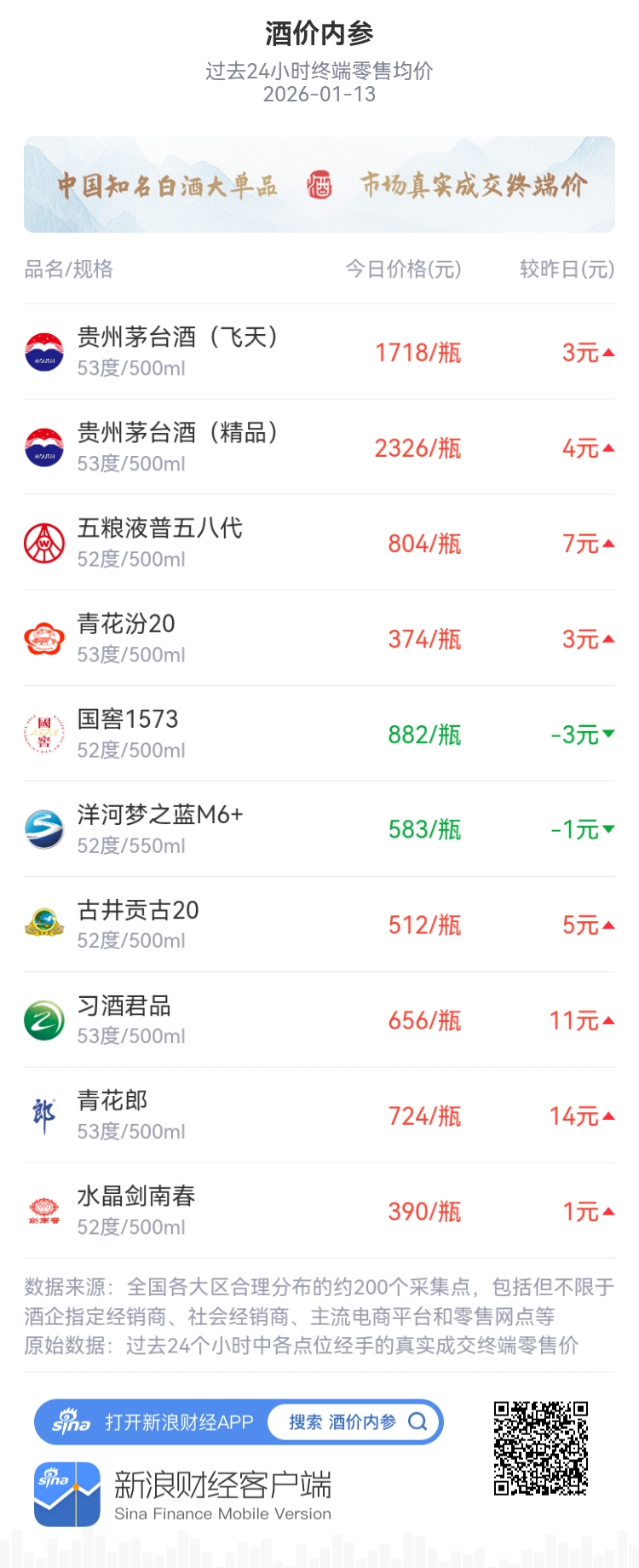
酒价内参1月13日价格发布 市场普涨反弹整体价格显著回升
Xin Lang Cai Jing· 2026-01-13 01:09
Core Viewpoint - The Chinese liquor market has experienced a significant rebound in retail prices for the top ten products, indicating a recovery in market sentiment after a period of decline [1]. Price Trends - The overall retail price for the top ten liquor products reached 8969 yuan, an increase of 44 yuan from the previous day [1]. - The market showed a broad upward trend, with most core products experiencing price increases, reflecting restored market confidence [1]. Individual Product Performance - Qinghua Lang saw the most substantial increase, rising by 14 yuan per bottle [1]. - Xijiu Junpin increased by 11 yuan per bottle, showing a strong rebound [1]. - Wuliangye Pu 58th generation ended its decline with a price increase of 7 yuan per bottle [1]. - Gujing Gonggu 20 rose by 5 yuan per bottle, while Jingpin Moutai increased by 4 yuan per bottle [1]. - Feitian Moutai and Qinghua Fen 20 both saw a rise of 3 yuan per bottle [1]. - The only products that experienced price declines were Guojiao 1573, which fell by 3 yuan, and Yanghe Dream Blue M6+, which decreased by 1 yuan [1][4]. Market Data Sources - The data was collected from approximately 200 points across major regions, including designated distributors, social distributors, mainstream e-commerce platforms, and retail outlets [4].

食品饮料行业周度更新:如何把握春节旺季备货行情?-20260112
Changjiang Securities· 2026-01-12 14:10
Investment Rating - The industry investment rating is "Positive" and is maintained [8] Core Viewpoints - The liquor sector is currently experiencing a phase of "supply optimization and weak demand recovery," with inventory destocking ongoing in Q4. Short-term price recovery is expected due to controlled supply from Moutai, with attention on Spring Festival sales and inventory movement [2][5] - The demand for mass-market products is expected to show marginal improvement, with January anticipated to see a strong start due to delayed Spring Festival stocking [2][5] - The report recommends focusing on products with strong seasonal effects and high performance realization, particularly in sectors like leisure snacks, restaurant supply chains, condiments, soft drinks, and dairy products [4][26] Summary by Sections Spring Festival Stocking Strategy - The Spring Festival stocking strategy should focus on products with strong seasonal effects and high performance realization. The timing of the Spring Festival can impact the performance of listed companies, especially in years when it falls later in the calendar [4][15] - Products with clear gifting scenarios and positive market sentiment in specific segments are prioritized for opportunity selection. The continuation of the post-Spring Festival market will depend on actual sales and positive Q1 performance feedback [4][26] CPI Trends - The food CPI has been strengthening since December, surpassing service and overall CPI. This trend is supported by supply clearing in certain items and seasonal demand recovery, which together bolster price improvements [32][34] - The CPI-PPI differential remains positive, supporting the continued improvement in profitability for food manufacturing companies [37] Market Performance Review - Since the beginning of 2026, the food and beverage index has increased by 2.21%, lagging behind the CSI 300, which rose by 2.79%. The performance of the liquor sector has remained stable, while the dairy sector has seen declines [6][40] - Soft drinks and leisure snacks have led the market in terms of growth related to Spring Festival stocking, while dairy and meat products have experienced declines [6][40] Industry Dynamics - The industry is increasingly focused on value deepening and structural optimization. Companies are prioritizing supply-demand balance, healthy pricing systems, and profit structure improvements rather than merely pursuing sales growth [7][46] - Food safety and supply chain resilience remain foundational to brand trust, highlighted by recent global recalls and supply chain disruptions [7][46]





酱酒品牌剩者为王,大众品重视春节催化:食品饮料行业周报(20260105-20260111)-20260112
Huachuang Securities· 2026-01-12 11:12
Investment Rating - The report maintains a "Recommendation" rating for the food and beverage industry, indicating an expected increase in the industry index exceeding the benchmark index by more than 5% in the next 3-6 months [26]. Core Insights - The report emphasizes that the remaining brands in the sauce liquor sector will thrive, while mass-market products are expected to benefit from the upcoming Spring Festival [2][8]. - The dairy sector is showing signs of improvement, with a potential rebound in raw milk prices and a narrowing supply-demand gap, which could lead to increased demand for processed dairy products [6]. - The beverage and snack categories are experiencing sustained growth, with specific segments like energy drinks and konjac snacks showing remarkable sales increases despite overall declines in the snack market [6]. - The report highlights a significant shift in the sauce liquor industry, where pricing strategies are becoming more pragmatic, with a new growth level emerging around the 200 yuan price point as lower-tier brands face market exit pressures [6][8]. - The report suggests that leading liquor companies should maintain operational stability during this industry downturn, focusing on balanced investments in base liquor to prepare for future market recovery [8]. Summary by Sections Industry Overview - The food and beverage sector consists of 126 listed companies with a total market capitalization of 44,935.30 billion yuan, representing 3.54% of the market [3]. - The circulating market value stands at 43,859.19 billion yuan, accounting for 4.28% of the total market [3]. Performance Metrics - The absolute performance of the industry over the past month is 1.3%, with a relative performance decline of 2.2% compared to the benchmark [4]. - Over the past 12 months, the industry has seen a relative performance decline of 25.2% [4]. Sector-Specific Insights - Dairy products are expected to benefit from a favorable pricing environment and improved supply dynamics, with major companies actively preparing for the Spring Festival [6]. - The beverage sector is witnessing growth in specific categories, with leading brands launching targeted marketing campaigns for the holiday season [6]. - The sauce liquor market is undergoing a consolidation phase, with a focus on brand strength and market share recovery among leading companies [6][8].
