EVE(300014)

Search documents
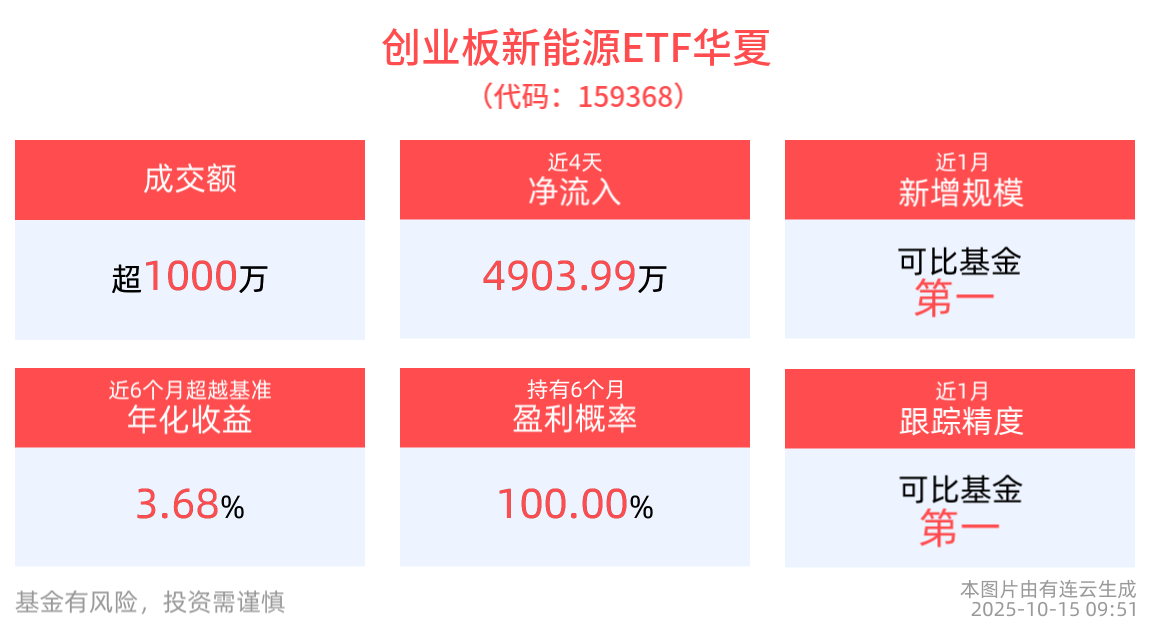
成交额超1000万元,创业板新能源ETF华夏(159368)近4个交易日净流入4903.99万元
Sou Hu Cai Jing· 2025-10-15 02:21
Core Insights - The Huaxia ChiNext New Energy ETF (159368) has experienced a recent decline of 1.27%, with a current price of 1.4 yuan, but has seen a cumulative increase of 4.50% over the past month [3] - The fund has shown significant liquidity, with a turnover rate of 1.54% and a total transaction volume of 16.21 million yuan, leading in average daily trading volume among comparable funds at 88.89 million yuan [3] - The fund's scale has increased by 593 million yuan over the past month, ranking it in the top third among comparable funds [3] - Recent net outflows amount to 46.85 million yuan, but there have been net inflows on three out of the last four trading days, totaling 49.04 million yuan [3] Performance Metrics - Over the past six months, the fund's net value has risen by 64.88%, placing it in the top 2.41% of index equity funds [4] - The fund has achieved a maximum monthly return of 29.70% since inception, with a longest consecutive monthly gain of five months and a total gain of 75.89% [4] - The average monthly return during up months is 12.56%, with a monthly profit percentage of 83.33% and a historical six-month holding profit probability of 100.00% [4] - The fund has a relative drawdown of 0.31% over the past six months compared to its benchmark [4] Fee Structure and Tracking Accuracy - The management fee for the fund is 0.15%, and the custody fee is 0.05%, which are the lowest among comparable funds [4] - The tracking error for the fund over the past month is 0.010%, indicating the highest tracking precision among comparable funds [4] Top Holdings - The top holdings in the fund include: - CATL (宁德时代) with a weight of 14.55% and a decline of 0.64% - Huichuan Technology (汇川技术) with a weight of 14.28% and a decline of 0.63% - Sungrow Power Supply (阳光电源) with a weight of 11.78% and a decline of 1.11% [6]






高端材料出口遇管制,多家锂电企业回应
2 1 Shi Ji Jing Ji Bao Dao· 2025-10-15 00:23
Core Viewpoint - China's export control on lithium batteries and key materials is set to take effect on November 8, 2025, targeting products with energy density ≥300Wh/kg, which includes critical production technologies and materials [1][12]. Industry Impact - The announcement has led to significant market reactions, with major companies like CATL and Yiwei Lithium Energy experiencing stock declines of 6.82% and 10.96% respectively on October 10 [3]. - The Shenwan Battery Index fell over 4% after three consecutive trading days of decline following the announcement [3]. Company Responses - Companies like Siengda Intelligent and Liyuanheng stated that the new policy's impact on their overall business is minimal, as their overseas orders primarily come from domestic battery manufacturers, which are not subject to the new controls [5][6]. - Rongbai Technology emphasized that the policy is a regulation rather than a prohibition, and it mainly affects products related to semi-solid and solid-state batteries, which do not significantly impact their supply [6][11]. - Companies such as Dingsheng Technology noted that their exports mainly consist of multi-element positive materials, which are not included in the control scope [7]. Market Dynamics - The Chinese lithium battery industry is projected to produce 1170 GWh in 2024, with a total industry output value exceeding 1.2 trillion yuan, reflecting a 24% year-on-year growth [9]. - China supplies approximately 90% of the global lithium battery market, making exports a crucial part of capacity digestion [9]. Long-term Outlook - The export control is expected to reshape the global lithium battery industry landscape, shifting focus from capacity to high-end technology [11]. - The policy may lead to increased emphasis on the domestic market and accelerate the application of high-end battery technologies within China [12].



高端材料出口遇管制,多家锂电企业回应
21世纪经济报道· 2025-10-15 00:14
Core Viewpoint - China's export control on lithium batteries and key materials is set to take effect on November 8, 2025, targeting high-energy-density batteries and critical production equipment, which reflects a shift towards high-end technology in the lithium battery industry [1][10]. Industry Impact - The new regulations have triggered a market reaction, with significant declines in stock prices for major lithium battery companies, including a 6.82% drop for CATL and a 10.96% drop for EVE Energy on October 10 [4][6]. - The Shenwan Battery Index fell over 4% after three consecutive trading days of decline, indicating market concerns about the impact of export restrictions [4][9]. Company Responses - Several companies, including Siengda Intelligent and Rongbai Technology, have stated that the new policy will have a minimal impact on their operations, as their primary overseas orders do not fall under the restricted categories [6][7]. - Companies like Dingsheng Technology emphasized that their exports mainly consist of materials not affected by the new regulations, suggesting a focus on domestic markets moving forward [7][9]. Market Dynamics - The Chinese lithium battery industry has a significant production capacity, with a total output expected to reach 1,170 GWh in 2024, a 24% increase year-on-year, and an industry value exceeding 1.2 trillion yuan [9]. - China supplies approximately 90% of the global lithium battery market, making export a crucial aspect of capacity utilization [9]. Long-term Outlook - The export control is seen as a strategic move to maintain China's leading position in high-end battery technology, potentially reshaping the global supply chain and encouraging domestic market focus [10]. - Analysts suggest that while there may be short-term market adjustments, the long-term implications could favor Chinese companies in the high-end battery sector [10].
高端材料出口遇管制 多家锂电企业回应
2 1 Shi Ji Jing Ji Bao Dao· 2025-10-14 23:13
Core Viewpoint - China's export control on lithium batteries and key materials is set to take effect on November 8, 2025, targeting products with energy density ≥300Wh/kg, which includes critical production technologies and materials [1] Group 1: Export Control Announcement - The Ministry of Commerce and the General Administration of Customs announced the export control measures, emphasizing the dual-use nature of the targeted items and aligning with international practices to safeguard national security [1] - The measures are not aimed at any specific country or region, and legitimate export applications will be reviewed and potentially approved [1] Group 2: Market Reactions - On October 10, several listed companies in the lithium battery sector experienced significant stock declines, with CATL down 6.82%, EVE Energy down 10.96%, and other second-tier leaders dropping over 8% [2] - The Shenwan Battery Index fell for three consecutive trading days, closing down over 4% on October 14 [2] Group 3: Company Responses - Companies like Siengda Intelligent stated that the policy's impact on their overall business is minimal, as their overseas orders primarily come from domestic battery manufacturers, which are not subject to the export control [3] - Li Yuanheng, a lithium battery equipment supplier, mentioned that they have established a robust R&D and manufacturing base overseas to mitigate potential trade policy changes [3] - Rongbai Technology held an investor communication meeting, clarifying that the export policy is a control rather than a ban, and it mainly affects products related to semi-solid and solid-state batteries [4] Group 4: Industry Insights - The lithium battery industry in China has developed a vast capacity and complete supply chain, with a projected total production of 1170GWh in 2024, representing a 24% year-on-year increase [5] - China supplies approximately 90% of the global lithium battery market, with domestic sales of power and other batteries reaching 920.7GWh in the first eight months of the year, including 173.1GWh in exports, a 48.5% increase year-on-year [6] - The recent export control is seen as a shift in the lithium battery competition from capacity to high-end technology, potentially reshaping the global industry landscape [7]
亿纬锂能公布国际专利申请:“电池组装结构及电池模组”
Sou Hu Cai Jing· 2025-10-14 21:10
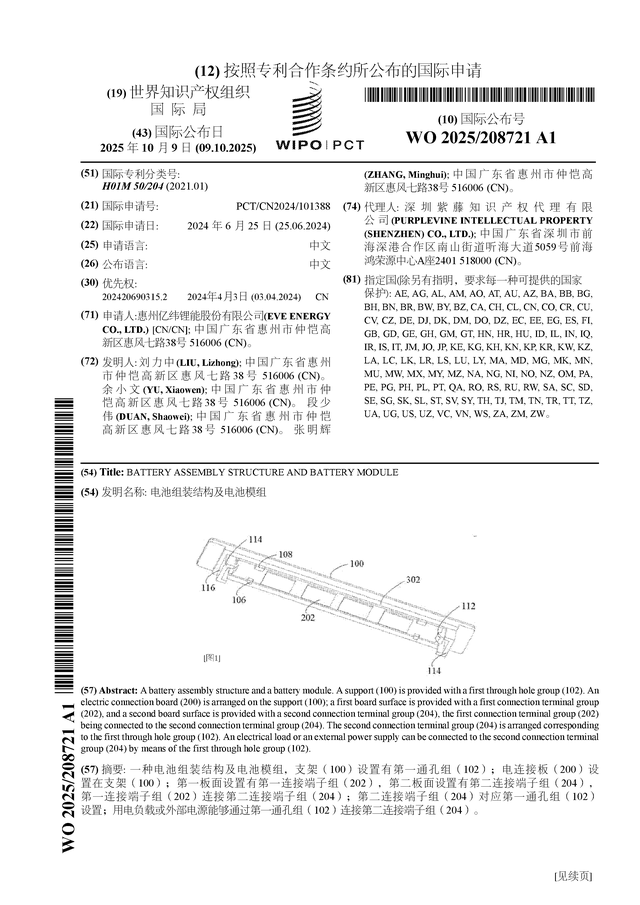
证券之星消息,根据企查查数据显示亿纬锂能(300014)公布了一项国际专利申请,专利名为"电池组 装结构及电池模组",专利申请号为PCT/CN2024/101388,国际公布日为2025年10月9日。 专利详情如下: 图片来源:世界知识产权组织(WIPO) 今年以来亿纬锂能已公布的国际专利申请176个,较去年同期增加了266.67%。结合公司2025年中报财 务数据,今年上半年公司在研发方面投入了12.61亿元,同比减11.33%。 数据来源:企查查 以上内容为证券之星据公开信息整理,由AI算法生成(网信算备310104345710301240019号),不构成 投资建议。 ...
2025固态电池:技术、量产、时间、协同“已定”
高工锂电· 2025-10-14 10:33
Core Viewpoint - The solid-state battery technology is transitioning from laboratory experiments to practical applications, with a clear industrial roadmap established for production and market expansion by 2025 [4][7][24]. Industry Overview - The 2025 (15th) Gaogong Lithium Battery Annual Conference will be held from November 18-20, 2025, in Shenzhen, focusing on technological breakthroughs and capacity expansion in the solid-state battery industry [4]. - The conference will feature the release of the "2025 China Large Cylindrical Lithium Battery Industry Development Blue Book," which will analyze mainstream technology trends and market forecasts [5]. Timeline and Production Plans - A unified timeline for the solid-state battery industry has been established, with small-scale production expected by 2027 and large-scale production by 2030 [7][11]. - Major companies like CATL, BYD, and others have set specific production targets, with various battery types and capacities outlined [8][10]. Technology Development - The solid-state battery technology has converged on the sulfide route as the mainstream direction due to its high ionic conductivity and compatibility with existing lithium battery supply chains [13][14]. - The industry has moved towards a pragmatic approach, utilizing semi-solid state batteries as a transitional technology while optimizing production processes [20][21]. Material and Equipment Advances - The industry is focusing on breakthroughs in both equipment and materials, with a consensus on the need for efficient layout and investment in solid-state battery production lines [22]. - Material costs are being addressed through various methods, including solid-phase and liquid-phase processes, to enhance performance and reduce expenses [23]. Market Outlook - The solid-state battery industry is entering a critical phase characterized by technological convergence, accelerated breakthroughs, and imminent market entry [24][25]. - With ongoing collaboration and cost reductions, the next generation of power batteries is expected to become more visible to the public within the next 3-5 years, driving new momentum for the renewable energy sector [25].

小鹏两款新车搭载亿纬锂能电芯!
起点锂电· 2025-10-14 10:24
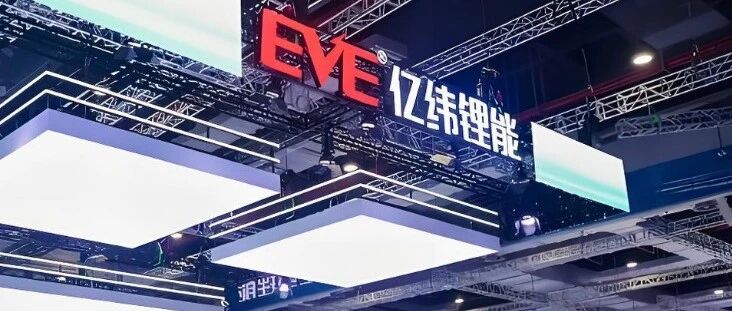
Core Viewpoint - The article highlights the strategic partnership between EVE Energy and XPeng Motors, emphasizing their mutual growth in the electric vehicle industry and the significant role of EVE's battery technology in XPeng's vehicle lineup [4][6][7]. Group 1: Partnership and Collaboration - EVE Energy has established a strong collaboration with XPeng Motors, providing comprehensive battery solutions since their strategic agreement in March 2019 [6]. - EVE's batteries are featured in several popular XPeng models, with a notable sales figure of 150,000 vehicles equipped with EVE batteries by the end of last year [7]. - The partnership extends to the development of next-generation low-voltage lithium batteries for XPeng's low-altitude economy projects [9]. Group 2: Business Growth and Performance - EVE Energy's revenue from the power battery segment reached approximately 12.7 billion yuan in the first half of the year, marking a year-on-year growth of about 41.7% [14]. - The company's overall revenue for the first half of the year was around 28.17 billion yuan, reflecting a 30% increase compared to the previous year [14]. - EVE's power battery shipments reached 21.48 GWh, showing a significant year-on-year growth of 58.58% [14]. Group 3: Future Directions and Innovations - EVE Energy is focusing on large cylindrical batteries as a key area for future growth, supported by a partnership with BMW to supply large cylindrical batteries for electric vehicles in Europe [11][12]. - The company is investing heavily in establishing production facilities, including a factory in Hungary expected to be completed by 2026, which will create over 1,000 jobs [12]. - EVE's Omnicell large cylindrical batteries have already been successfully integrated into BMW's iX3 model, showcasing advancements in technology such as reduced impedance and increased energy density [12].

中国汽车动力电池产业创新联盟:9月我国动力和其他电池合计产量同比增长35.4%
智通财经网· 2025-10-14 10:13
Core Insights - The Chinese automotive power battery industry continues to show significant growth, with production and sales figures for September and the first nine months of 2025 indicating strong year-on-year increases in both categories. Production Summary - In September 2025, the total production of power and other batteries reached 151.2 GWh, representing a month-on-month increase of 8.3% and a year-on-year increase of 35.4% [13][8]. - Cumulatively, from January to September 2025, the total production was 1,121.9 GWh, with a year-on-year growth of 51.4% [7][13]. Sales Summary - In September 2025, the total sales of power and other batteries amounted to 146.5 GWh, with a month-on-month increase of 9.0% and a year-on-year increase of 42.2% [18][16]. - For the first nine months of 2025, cumulative sales reached 1,067.2 GWh, reflecting a year-on-year growth of 55.8% [18][7]. Export Summary - In September 2025, the total export of power and other batteries was 26.7 GWh, showing a month-on-month increase of 18.2% and a year-on-year increase of 28.3% [28][25]. - Cumulatively, from January to September 2025, exports totaled 199.9 GWh, with a year-on-year growth of 45.5% [28][7]. Installation Volume Summary - The installation volume of power batteries in September 2025 was 76.0 GWh, marking a month-on-month increase of 21.6% and a year-on-year increase of 39.5% [49][46]. - From January to September 2025, the cumulative installation volume reached 493.9 GWh, with a year-on-year growth of 42.5% [49][46]. Material Type Breakdown - In September 2025, the production of lithium iron phosphate batteries was 119.4 GWh, accounting for 79.0% of total production, while ternary batteries accounted for 20.9% with a production of 31.5 GWh [12][11]. - Cumulatively, from January to September 2025, lithium iron phosphate batteries accounted for 78.8% of total production, while ternary batteries accounted for 21.0% [12][11]. Market Concentration - In September 2025, the top two battery manufacturers accounted for 63.8% of the market share, while the top five and top ten accounted for 81.1% and 94.4%, respectively [56][59]. - From January to September 2025, the top two manufacturers held 65.2% of the market share, with the top ten holding 94.3% [59][56].
亿纬锂能首套钠离子电池储能系统投运
鑫椤储能· 2025-10-14 06:13
Core Insights - EVE Energy has successfully commissioned its first large-capacity sodium-ion battery energy storage system, marking a significant breakthrough in new energy storage technology [1][2] - The sodium-ion battery features high safety, wide temperature range, high rate, long lifespan, and low carbon characteristics, with over 30,000 cycles and operational capability between -40℃ and +60℃ [1] - The system's lifecycle carbon emissions are reduced by over 42% compared to similar lithium-ion batteries, highlighting its environmental advantages [1] Technology and Development - The sodium-ion battery energy storage system is independently developed by EVE Energy, with all core components produced in-house, ensuring rapid mass production capabilities [1] - The system is designed to significantly reduce flammable gas generation during extreme thermal runaway conditions, thereby lowering explosion risks [1] Market Potential - The successful integration of the sodium-ion battery system represents a crucial step from laboratory research to practical application, with potential for widespread use in large-scale and distributed energy storage [2]
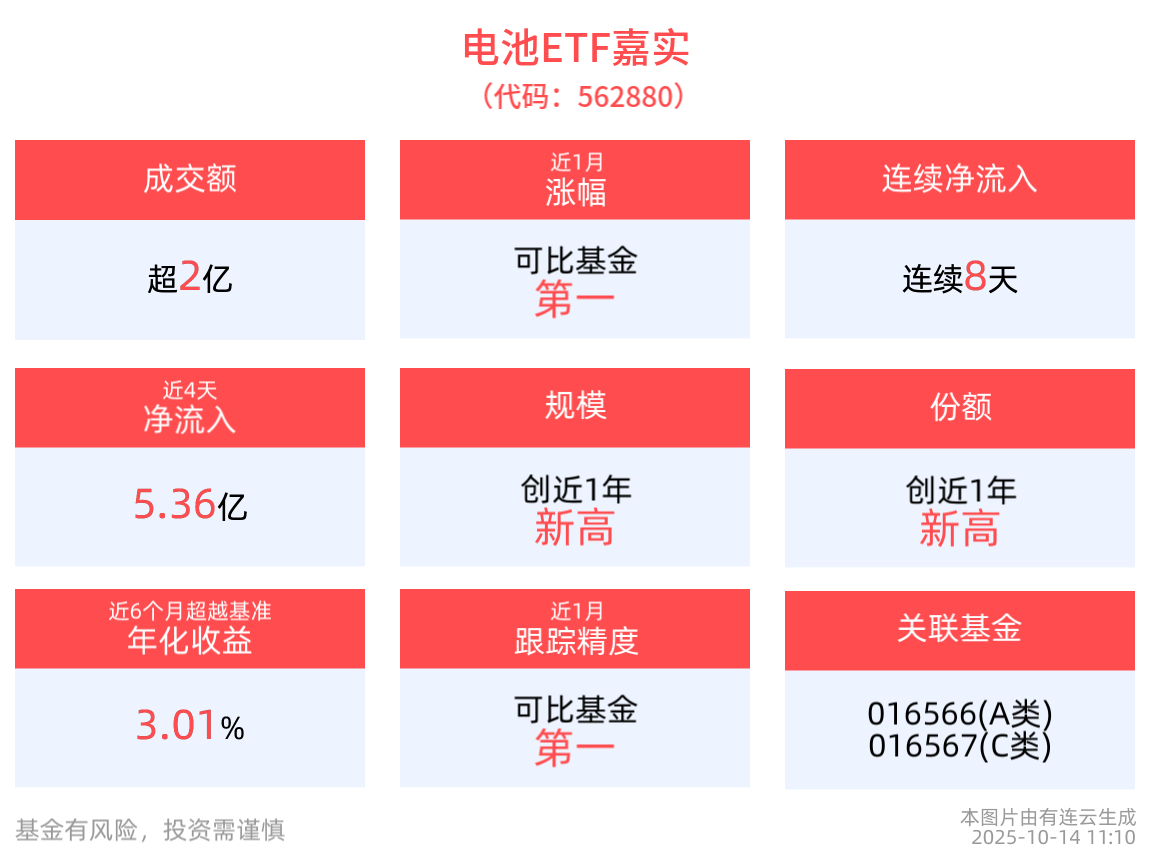
机构:看好锂电行业基本面,电池ETF嘉实(562880)连续8日“吸金”,规模创成立以来新高!
Sou Hu Cai Jing· 2025-10-14 04:24
Core Insights - The China Securities Battery Theme Index has decreased by 1.63% as of October 14, 2025, with mixed performance among constituent stocks [1] - The Jiashi Battery ETF has seen a significant increase of 9.68% over the past month, ranking first among comparable funds [1] - The Jiashi Battery ETF has reached a new high in scale at 1.792 billion yuan and a record share of 2.196 billion [3] Market Performance - Jiashi Battery ETF recorded a turnover rate of 14.21% with a trading volume of 255 million yuan, indicating active market participation [3] - The ETF has experienced continuous net inflows over the past eight days, totaling 603 million yuan, with a single-day peak inflow of 281 million yuan [3] - The net asset value of the Jiashi Battery ETF has increased by 78.67% over the past six months, ranking 49th out of 3737 index equity funds [3] Industry Outlook - CITIC Construction Investment Research suggests a continued focus on the energy storage sector, highlighting a favorable lithium battery industry outlook due to multiple catalysts [3] - The domestic energy storage market is experiencing a turning point, driven by the expansion of renewable energy and new pricing policies [3] - The demand for lithium batteries is expected to grow significantly in 2026, with Q3 showing notable increases in production and sales [4] Key Stocks - The top ten weighted stocks in the China Securities Battery Theme Index account for 55.79% of the index, with significant players including Longi Green Energy, CATL, and Yiwei Lithium Energy [4] - Notable stock performances include Longi Green Energy up by 2.20% and CATL down by 1.30% [6]