EVE(300014)

Search documents
锂电行情再起,2026年行情是否有望延续?
Shang Hai Zheng Quan Bao· 2025-12-25 23:45
Group 1 - The lithium battery sector is regaining market attention, driven by strong supply and demand dynamics, with a significant increase in global energy storage market demand [1][2] - The total demand for lithium batteries is projected to reach 2495 GWh by 2026, reflecting a 28% year-on-year growth from 1944 GWh in 2025, indicating a critical balance point in supply and demand [1] - The supply side shows that leading companies are currently hesitant to expand production, with a 30% growth rate identified as the threshold for potential supply shortages [1] Group 2 - Energy storage is becoming a key variable in reshaping industry growth, with expectations of over 60% growth in global energy storage installation demand by 2026 [2] - The average energy capacity per electric vehicle is expected to continue increasing, contributing to a total growth rate of over 15% in power batteries driven by the adoption of electric vehicles [2] - Solid-state battery technology is advancing from the verification phase to mass production preparation, with significant developments expected in the second half of 2025 [2] Group 3 - The midstream materials segment of the lithium battery industry is anticipated to see profitability improvements in 2026, benefiting from high demand for energy storage [3] - Key beneficiaries of the growth include leading battery manufacturers such as CATL, EVE Energy, and Guoxuan High-Tech, which are well-positioned to capitalize on global energy storage demand [3] - The materials chain is expected to experience significant profitability due to supply-side reforms and high-end product penetration, with companies like Tianqi Lithium and Hunan Youneng highlighted as potential investment opportunities [3]







储能内卷下的新蓝海:亿纬锂能10亿投资,开辟AI机器人新战线
Xin Lang Cai Jing· 2025-12-25 12:41
Core Viewpoint - The recent groundbreaking of the "EVE Sodium Energy Headquarters and Jinyuan Robot AI Center" project marks EVE Energy's entry into the AI robotics sector, with an investment of approximately 1 billion yuan [1][12]. Group 1: Industry Development and Competitive Landscape - The global energy storage industry is entering a phase of large-scale development, with an expected addition of 69 GW/169 GWh of new installations in 2024. China leads with a 51% share of global new installations, followed by the US at 19% and Germany at 6% [3][14]. - The new energy storage market is primarily dominated by front-of-the-meter storage, accounting for 83% of the total [3][14]. - Competition among leading companies has evolved from mere technology and capacity competition to include cost control, application innovation, and supply chain integration [3][14]. Group 2: AI Robotics as a Promising Sector - AI robotics, particularly in the field of embodied intelligence, has become a highly regarded technology sector, supported by national policies outlined in the 14th Five-Year Plan [3][15]. - The application value of AI robots in industrial settings is increasingly recognized, capable of performing tasks in harsh environments and handling repetitive, standardized processes [3][15]. - The maturity of technology and decreasing costs are rapidly expanding the application scenarios for industrial robots [3][15]. Group 3: Synergy Between Energy Storage and AI Robotics - There exists a natural synergy between the energy storage industry and AI robotics, as the mobility and autonomy of robots depend on efficient and reliable energy supply systems [6][17]. - EVE Energy plans to develop "intelligent energy" technology to enhance energy density within the limited space of robots, aiming to improve their endurance by 50% [7][17]. - The company intends to use sodium batteries as emergency backup solutions for data centers, complementing lithium batteries to create a comprehensive energy assurance system [8][18]. Group 4: Cross-Industry Integration and Future Prospects - EVE Energy's foray into the AI robotics sector is part of a broader trend where various industries are increasing their investments in embodied intelligence [10][20]. - This trend is evident not only in the energy storage sector but also in consumer electronics, automotive manufacturing, and internet technology, highlighting the widespread applicability and transformative potential of embodied intelligence [21][22]. - The integration of energy storage and AI robotics represents a significant direction for the upgrade of China's manufacturing industry towards intelligence and flexibility, opening new growth opportunities and providing new technological pathways for high-quality industrial development [25].


扩展版图!亿纬锂能连投三大项目
起点锂电· 2025-12-25 10:33
Core Viewpoint - The article highlights the expansion and diversification efforts of EVE Energy in the energy storage and power battery sectors, emphasizing new project investments and collaborations to enhance its market position [3][4][5]. Group 1: Project Investments - EVE Energy has invested in three projects across different fields, including a capital increase of 236,762,400 MYR (approximately 400 million RMB) in its Malaysian subsidiary, raising its registered capital to 744,649,400 MYR (approximately 1.1 billion RMB) [4]. - The company has initiated the construction of the "Sodium Energy Headquarters and Jinyuan Robotics AI Center," with plans for completion by 2027, focusing on sodium battery R&D and AI robotics integration [4]. - A joint venture with Foton Motor has been established with a registered capital of 500 million RMB, covering new material R&D, battery sales, and recycling of used power batteries [5]. Group 2: Market Expansion - EVE Energy is focusing on overseas expansion, with significant financing efforts since 2019 totaling nearly 20 billion RMB, targeting energy storage and power battery markets [7]. - The company announced a budget of approximately 8.654 billion RMB for a new energy storage battery project in Malaysia, with a construction period of two and a half years [7]. - EVE Energy's global footprint includes over ten projects, making it one of the fastest-growing lithium battery companies in recent years [7]. Group 3: Battery Technology and Collaborations - The company is stabilizing its power battery segment while expanding its energy storage market, with notable progress in a cylindrical battery project in collaboration with BMW [10]. - The Omnicell cylindrical battery, developed over eight years, features advanced technology and has already been installed in nearly 70,000 vehicles, achieving over 270,000 kilometers in total driving distance [10]. - EVE Energy's energy storage products, including various systems, are seeing increased shipments, supported by an optimized customer structure and the launch of flagship products [12]. Group 4: Future Outlook - The energy storage sector is expected to become a significant growth driver for EVE Energy, with ongoing technological iterations and a favorable market environment anticipated in the coming years [12]. - The strategic investment in the Malaysian project is seen as a crucial step for expanding the energy storage business, leveraging Malaysia's position as a key hub for global lithium battery enterprises [12].
GGII:2025年1-11月国内磷酸铁锂动力电池装机份额高达78.5% 后市有望突破历史峰值
智通财经网· 2025-12-25 08:52
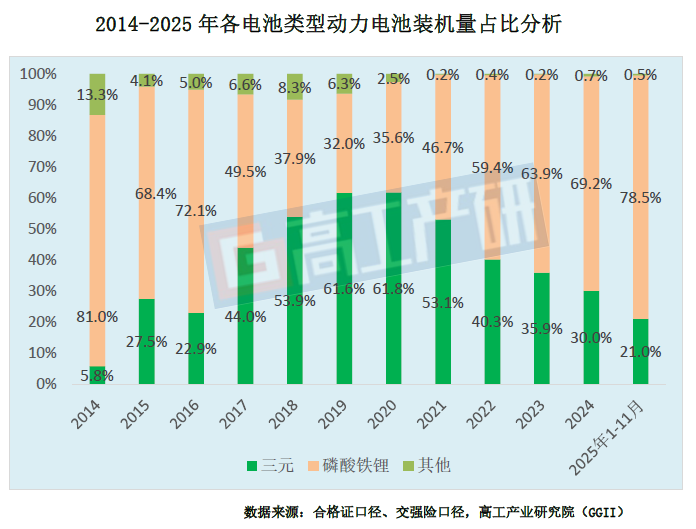
Core Insights - The domestic lithium iron phosphate (LFP) battery installation volume is projected to reach approximately 490 GWh from January to November 2025, representing a year-on-year growth of 55% and a market share of 78.5%, an increase of 10 percentage points compared to the same period last year [1][5]. Group 1: Market Trends - The significant increase in the market share of LFP batteries is primarily driven by market demand rather than policy incentives, contrasting with 2014 when policy was the main driver [3]. - The proportion of new vehicles equipped with LFP batteries has remained between 90% and 96% this year, with a notable increase from 92% to 94.5% in the second half of the year, indicating a growing preference among manufacturers for LFP technology [5]. Group 2: Product Offerings - The number of new energy passenger car models equipped with LFP batteries has risen from 213 to 536 over the past three years, with popular models like Geely Xingyuan, Xiaomi SU7, and XPeng MONA M03 accelerating production and delivery, further boosting the market share of LFP batteries [8]. Group 3: Competitive Landscape - The top 10 companies in the domestic LFP battery installation market accounted for 95.3% of the total volume from January to November 2025, with companies like CATL, EVE Energy, and Xinwangda showing steady growth over the past three years [10]. - CATL's market share is projected to increase from 34.42% in 2023 to 36.79% in 2025, while BYD's share is expected to decline from 43.49% to 29.19% during the same period [11].


长单潮带动4000亿大扩产,储能真爆发了
投中网· 2025-12-25 07:45
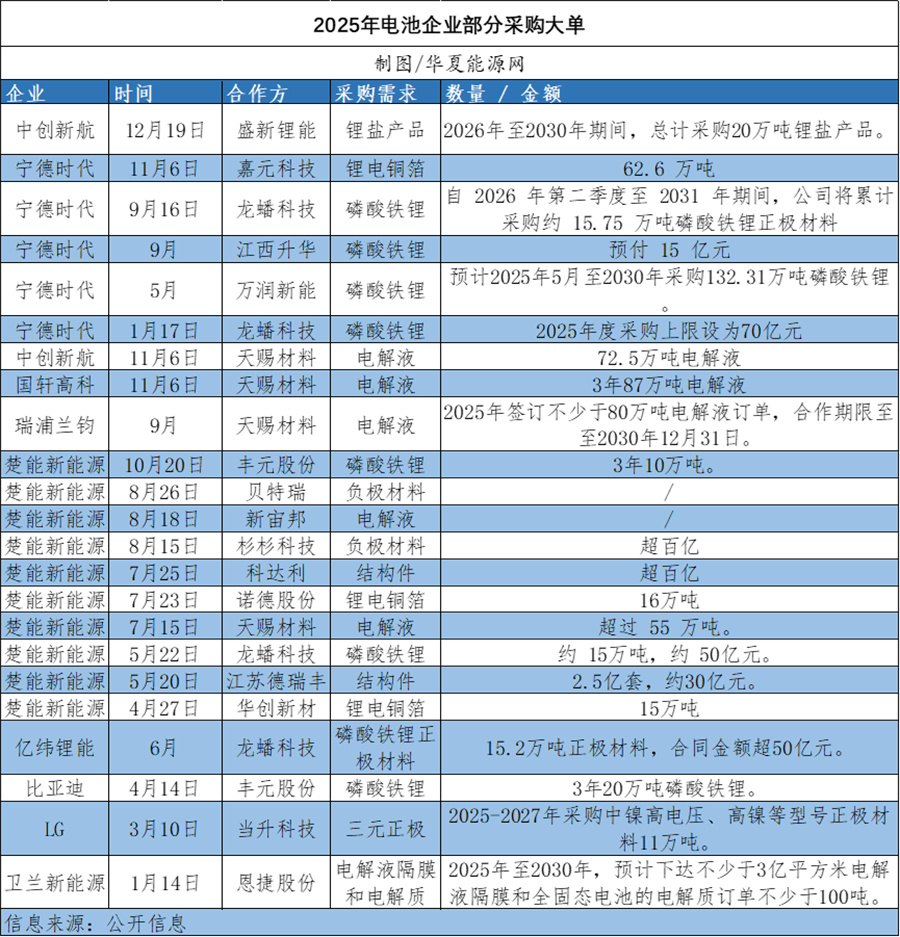
Core Viewpoint - The lithium battery industry is experiencing a surge in long-term contracts, driven by high demand and supply chain stability, but there are concerns about potential overcapacity similar to the solar industry in previous years [6][8][21]. Group 1: Long-term Contracts - Major companies in the lithium battery sector are signing significant long-term contracts, with examples including Longpan Technology's agreement to purchase 1.3 million tons of cathode materials worth approximately 45 billion yuan from Chuangneng New Energy [6]. - Other industry leaders like CATL and Yiwei Lithium Energy have also disclosed large procurement agreements, indicating a trend of securing supply for critical materials over multi-year periods [6][8]. - The trend of long-term contracts is seen as a response to the tight supply chain and high demand in the lithium battery market, with many contracts spanning 3 to 5 years [7][9]. Group 2: Market Demand and Growth - The global lithium battery storage market has seen explosive growth, with a reported 68% year-on-year increase in installed capacity, reaching 170 GWh in the first three quarters of 2025 [8]. - The demand for power batteries has also surged, with global installed capacity reaching 811.7 GWh, a 34.7% increase compared to the previous year [8]. - The industry is currently experiencing high operational rates, with companies like CATL and Yiwei Lithium Energy reporting utilization rates above 90% [10][11]. Group 3: Supply Chain and Material Costs - The high demand for raw materials has led to significant price increases across various components, including lithium carbonate and electrolytes, with lithium carbonate prices rising by 31.8% in two months [13]. - Companies are increasingly locking in long-term contracts for raw materials to mitigate production costs and ensure supply chain security [13]. - The current supply chain challenges are characterized by structural mismatches, particularly in high-capacity battery cells, leading to delivery difficulties for many companies [15]. Group 4: Capacity Expansion - The industry is entering a new phase of capacity expansion, with major players planning to increase production significantly, totaling over 510 GWh of new capacity and an investment of 176.2 billion yuan [17]. - This expansion is primarily driven by leading companies like CATL and Guoxuan High-Tech, which are ramping up production to meet the growing demand [18]. - However, there are concerns that this rapid expansion could lead to overcapacity, reminiscent of the solar industry's past experiences [21][22]. Group 5: Industry Outlook and Risks - Despite the optimistic outlook for growth in the lithium battery sector, there are warnings about the potential for overcapacity and the need for companies to avoid a race to expand production without careful consideration [20][21]. - The lessons learned from the solar industry highlight the risks associated with aggressive capacity expansion driven by order backlogs, which can lead to significant financial distress if market conditions change [22].

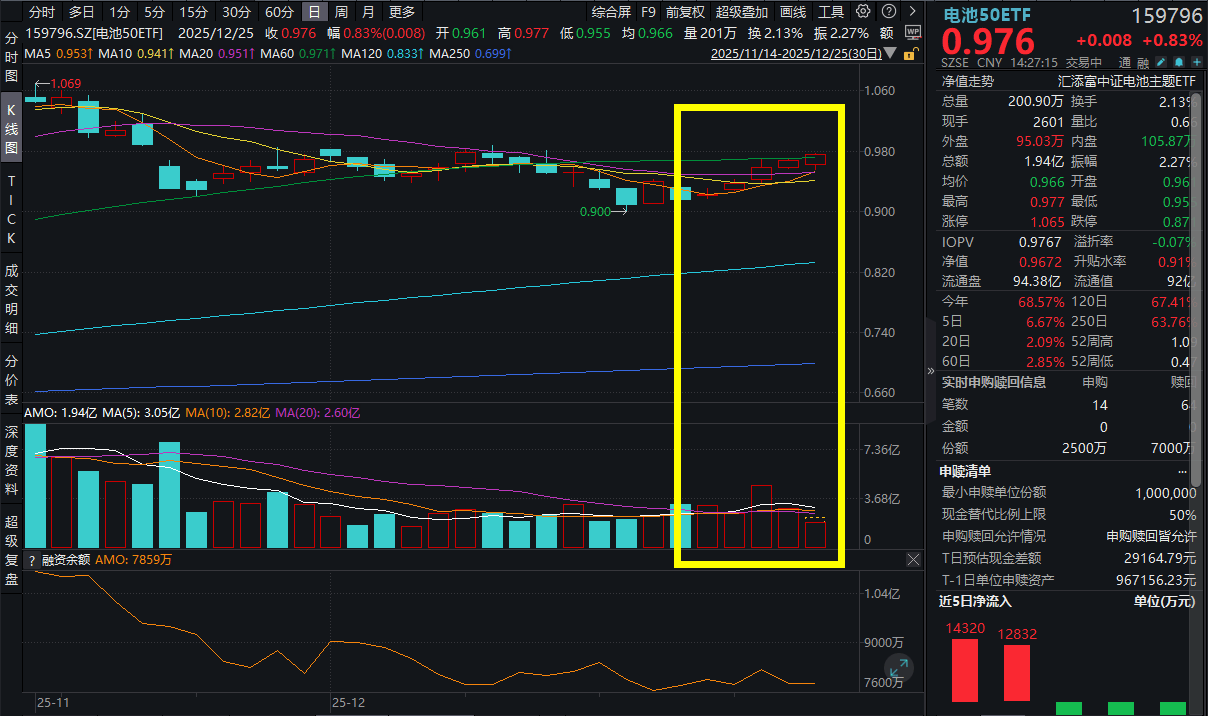
碳酸锂期货 “限购模式”开启!电池板块午后强劲翻红,先导智能涨超2%,电池50ETF(159796)涨近1%冲击五连阳,锂电材料领域迎多重积极变化
Sou Hu Cai Jing· 2025-12-25 06:57
Core Viewpoint - The A-share market is experiencing a strong upward trend, with the Battery 50 ETF (159796) showing significant gains and a notable increase in trading volume, indicating positive investor sentiment in the battery sector [1][3]. Market Performance - As of December 25, the Battery 50 ETF (159796) surged by 0.83%, with a trading volume exceeding 200 million yuan, marking a potential five-day winning streak [1]. - The index's constituent stocks exhibited mixed performance, with Sanhua Intelligent Control rising over 5% and leading other stocks, while companies like CATL and Yiwei Lithium Energy experienced slight declines [3][4]. Lithium Carbonate Market - Lithium carbonate futures saw a significant increase, rising nearly 6% on December 24, approaching 130,000 yuan, and reaching a new high for the year [6]. - The main contract for lithium carbonate experienced a short-term surge, with a daily decline narrowing to 0.6% after initially dropping nearly 6% [6]. Industry Trends - The lithium battery materials sector is witnessing multiple positive changes, driven by unexpected demand in energy storage, leading to a recovery in the industry’s overall health [6][7]. - The electrolyte supply chain is expected to see a significant upward shift, with lithium hexafluorophosphate prices rising rapidly, indicating a tight balance in the industry by 2026 [6][7]. Supply and Demand Forecast - Projections for lithium battery demand show an increase from 1,502 GWh in 2024 to 2,603 GWh by 2026, while supply is expected to grow from 2,271 GWh to 3,558 GWh in the same period, resulting in a decreasing surplus rate [8]. - The supply-demand balance for various components, including electrolytes and separators, is expected to improve significantly, with supply growth lagging behind demand [8]. Investment Strategy - The Battery 50 ETF (159796) is highlighted as a strategic investment option, focusing on sectors with high growth potential, such as energy storage and solid-state batteries, which are expected to benefit from technological advancements [9][11]. - The ETF's index has a high concentration of energy storage components (27%) and solid-state battery components (42%), positioning it favorably for future growth opportunities [9][11]. Conclusion - The Battery 50 ETF (159796) is positioned as a leading investment vehicle in the battery sector, with a low management fee and significant market presence, making it an attractive option for investors looking to capitalize on the sector's growth [14].


商用车电动化进入深水区:物流场景倒逼电池技术升级,补能网络建设同步加速
Zhong Guo Neng Yuan Wang· 2025-12-25 06:47
Core Viewpoint - The logistics sector is accelerating its transition to electric vehicles, driven by the need for green and low-carbon solutions, with significant involvement from leading battery manufacturers like CATL and EVE Energy [1][2]. Group 1: Strategic Collaborations - Multiple battery manufacturers have engaged in strategic partnerships within the logistics sector this year, such as the collaboration between Dola Haoyun and BYD's Fudi Battery to enhance electric commercial vehicle solutions [2]. - JD Group has signed a strategic cooperation agreement with CATL to explore high-quality development paths in the logistics industry, focusing on the electrification of urban distribution vehicles [2]. - EVE Energy and SF Express have also formed a strategic partnership to promote the integration of new energy technologies with modern logistics systems [3]. Group 2: Battery Performance Requirements - The demand for power batteries in logistics vehicles is increasing, driven by the need for zero emissions and lower operational costs [4]. - Logistics companies are increasingly incorporating electric vehicles into their fleets, with significant interest in electric heavy-duty trucks for high-energy, fixed-route transport scenarios [4]. - The logistics sector's unique operational demands require batteries with higher performance standards, including longer range, faster charging, and lighter weight [5][7]. Group 3: Charging Infrastructure Development - The development of a robust charging network is essential for the efficient operation of electric logistics vehicles, with calls for improved infrastructure at logistics parks and distribution centers [7][8]. - The National Development and Reform Commission has emphasized the need for planning and constructing high-power charging facilities for logistics and heavy-duty freight [8]. - Industry experts believe that the green transition in logistics will require collaborative efforts across the entire supply chain to address challenges such as charging convenience and range anxiety [8].
海内外全面开花,储能迈向市场化新阶段|2025中国经济年报
Hua Xia Shi Bao· 2025-12-25 02:20
Core Insights - The cancellation of mandatory energy storage requirements has not hindered the growth momentum of the energy storage industry, with both domestic and international markets experiencing unexpected growth in the second half of the year [2][4] - Energy storage is increasingly recognized for its economic value and importance in the consumption of green electricity, beyond just its role in energy transition [2] Industry Growth - The share of energy storage batteries in the lithium battery market has grown significantly, surpassing 25% in the first half of the year and reaching 28% in November [2] - Global lithium battery production reached 2058.44 GWh in the first 11 months of the year, a year-on-year increase of 48.59%, while cumulative production of energy storage batteries was 535.98 GWh, up 64.14% year-on-year [2] - The expected installed capacity of lithium energy storage in China for 2025 is projected to reach 157 GWh, representing an 82.9% year-on-year increase [2][4] Market Dynamics - The energy storage industry is transitioning from policy-driven growth to market-driven growth, with global lithium energy storage installations expected to reach 181 GWh in 2024, an 88% increase year-on-year [4] - China, Europe, and the United States account for approximately 90% of the energy storage market, with China holding a 50%-60% market share [4][5] - The European market is expected to see a significant increase in energy storage installations, with a projected growth rate of 92% and an addition of 48 GWh [4] Supply Chain and Production - Global energy storage cell shipments reached 410.45 GWh in the first three quarters of 2025, a year-on-year increase of 98.5%, with a record quarterly shipment of 170.24 GWh [5][6] - Chinese companies dominate the global energy storage cell market, with the top ten companies holding a market share of 89.9% [6] - The global energy storage battery market is expected to see a shipment volume of 746 GWh in 2026, with a year-on-year growth rate of 39% [6] International Expansion - Chinese companies are increasingly expanding into overseas markets, with significant growth in revenue from international operations, exemplified by CATL's overseas revenue rising from 0.59% to 30.48% of total revenue from 2015 to 2024 [7][8] - The overseas energy storage market is characterized by higher marketization and profitability due to significant price differentials between peak and off-peak electricity [8] - As of October 2025, 47 Chinese companies have signed or completed over 45 overseas strategic cooperation agreements, with a total scale of approximately 69 GWh [8]


海内外全面开花,储能迈向市场化新阶段
Zhong Guo Neng Yuan Wang· 2025-12-25 02:20
Core Insights - The cancellation of mandatory energy storage requirements has not hindered the growth momentum of the energy storage industry, with significant market expansion observed in both domestic and international markets in the second half of the year [1][2] - Energy storage is increasingly recognized for its economic value and importance in renewable energy consumption, with a notable rise in its share within the lithium battery market [1] Market Growth - The global lithium battery production reached 2058.44 GWh in the first 11 months of the year, marking a year-on-year increase of 48.59%, while the cumulative production of energy storage batteries was 535.98 GWh, up 64.14% year-on-year [1] - The energy storage battery's share of total lithium battery production exceeded 25% in the first half of the year and increased to 26% over the first 11 months, with November alone reaching 28% [1] - The expected installed capacity of lithium energy storage in China for 2025 is projected to reach 157 GWh, representing an 82.9% year-on-year growth [1] Regional Insights - China, Europe, and the United States account for approximately 90% of the energy storage market, with China holding a market share of 50%-60% [2] - The European market is expected to see a significant growth rate of 92%, with an anticipated addition of 48 GWh of installed capacity [2] - The U.S. market has experienced a slowdown in growth due to tariff fluctuations and lengthy project approval times, while the Middle East is emerging as a rapidly growing market driven by energy transition and decarbonization demands [3] Supply Chain Dynamics - In the first three quarters of 2025, global energy storage cell shipments reached 410.45 GWh, a year-on-year increase of 98.5%, with the third quarter setting a new record for quarterly shipments at 170.24 GWh [3] - Chinese companies dominate the global energy storage cell market, with the top ten companies holding a market share of 89.9% [4][5] Future Projections - The global energy storage battery shipment is expected to reach 746 GWh in 2026, with a year-on-year growth rate of 39% [5] - The global energy storage market is projected to have significant growth potential, with estimates suggesting that the peak annual installed capacity could exceed 1.5 TWh by 2035, indicating an 8.6 times growth potential from current levels [5] International Expansion - Chinese companies are increasingly expanding into overseas markets, with significant growth in international revenue observed, particularly for companies like CATL [6] - The overseas energy storage market is characterized by higher marketization levels and greater profit margins due to more pronounced peak-valley price differences [6] - As of October 2025, 47 Chinese companies have signed or completed overseas strategic collaborations and projects totaling approximately 69 GWh [6] Pricing Trends - The rising prices of energy storage cells reflect strong downstream demand, with major lithium battery material companies operating at full capacity [7] - Long-term contract negotiations for 2026 have already been completed, with price increases of 0.02-0.04 CNY per watt-hour compared to 2025 levels [7]
长单潮带动4000亿大扩产,储能走在了光伏过剩的老路上
3 6 Ke· 2025-12-25 02:17
Core Viewpoint - The lithium battery industry is experiencing a surge in long-term contracts, indicating a robust demand and supply chain stability, but there are concerns about potential overcapacity similar to past experiences in the solar industry [1][2][12]. Group 1: Long-term Contracts and Market Dynamics - Long-term contracts in the lithium battery sector have exploded, with significant agreements such as Longpan Technology's contract worth 45 billion yuan for 1.3 million tons of cathode materials from 2025 to 2030 [1]. - Major players like CATL and Wanrun New Energy have also signed substantial contracts, reflecting a trend of large-scale procurement across the industry [1][2]. - The storage market is booming, with companies like Haibosi Chuang and Hichain Energy entering into multi-year agreements for significant quantities of energy storage products [1][2]. Group 2: Supply Chain and Production Capacity - The lithium battery supply chain is currently under pressure due to high demand, leading to full production rates across various segments [3][4]. - Companies are reporting unprecedented production levels, with some indicating that December, typically a slow month, will see double-digit growth in battery production [4]. - The production capacity utilization rates for leading companies have exceeded 90%, with some reaching 100% [6][11]. Group 3: Price Increases and Material Demand - The surge in demand has led to rising prices for key raw materials, including lithium carbonate and electrolytes, with lithium carbonate prices increasing by 31.80% over two months [8]. - The price of hexafluorophosphate lithium has skyrocketed by over 260% in five months, prompting companies to secure long-term contracts to stabilize costs [8]. Group 4: Expansion Plans and Industry Outlook - The current expansion wave in the lithium battery sector is driven by the need to meet long-term orders, with over 510 GWh of new production capacity planned, involving investments of 176.2 billion yuan [11]. - Major companies are actively expanding their production capabilities, with CATL planning over 70 GWh of new capacity across multiple locations [9][11]. - Despite the optimistic outlook, there are concerns about potential overcapacity, as the industry may face challenges similar to those experienced in the solar sector [12][14].