
EOPTOLINK(300502)

Search documents
通信行业9月12日资金流向日报
Zheng Quan Shi Bao Wang· 2025-09-12 11:57
Market Overview - The Shanghai Composite Index fell by 0.12% on September 12, with 9 out of 28 sectors experiencing gains, led by non-ferrous metals and real estate, which rose by 1.96% and 1.51% respectively [1] - The communication sector had the largest decline, dropping by 2.13%, followed by the comprehensive sector with a decrease of 1.95% [1] Capital Flow Analysis - The net outflow of capital from the two markets reached 53.64 billion yuan, with 6 sectors seeing net inflows [1] - The non-ferrous metals sector led the net inflow with 2.168 billion yuan, while the construction and decoration sector followed with a net inflow of 721 million yuan [1] - The non-bank financial sector experienced the largest net outflow, totaling 8.138 billion yuan, followed by the electronics sector with a net outflow of 7.517 billion yuan [1] Communication Sector Performance - The communication sector saw a net outflow of 6.087 billion yuan, with 125 stocks in the sector; 50 stocks rose, including 4 that hit the daily limit, while 73 stocks fell, including 1 that hit the lower limit [2] - The top three stocks with the highest net inflow in the communication sector were Runjian Co., with 404 million yuan, followed by TeFa Information and Cambridge Technology, with 320 million yuan and 301 million yuan respectively [2] - The stocks with the largest net outflow included Xinyi Sheng, Tianfu Communication, and Changxin Bochuang, with outflows of 1.225 billion yuan, 599 million yuan, and 582 million yuan respectively [2][4]





热点追踪周报:由创新高个股看市场投资热点(第211期)-20250912
Guoxin Securities· 2025-09-12 11:55
Quantitative Models and Construction Methods 1. Model Name: 250-Day New High Distance Model - **Model Construction Idea**: This model tracks the distance of stock prices or indices from their 250-day high to identify market trends and hotspots. It is based on the premise that stocks nearing their 52-week high tend to outperform, as highlighted in prior research by George (2004) and others[11][18]. - **Model Construction Process**: The 250-day new high distance is calculated as: $ 250\ Day\ New\ High\ Distance = 1 - \frac{Close_t}{ts\_max(Close, 250)} $ Where: - $ Close_t $ is the latest closing price - $ ts\_max(Close, 250) $ is the maximum closing price over the past 250 trading days If the latest closing price reaches a new high, the distance is 0; otherwise, the distance is positive, indicating the percentage drop from the high[11]. - **Model Evaluation**: This model effectively captures momentum and trend-following strategies, aligning with established theories in quantitative finance[11][18]. 2. Model Name: Stable New High Stock Screening Model - **Model Construction Idea**: This model identifies stocks with stable momentum characteristics, emphasizing smooth price paths and consistent new highs. It builds on research showing that smoother momentum stocks outperform those with jumpy price paths[25]. - **Model Construction Process**: Stocks are screened based on the following criteria: - **Analyst Attention**: At least 5 "Buy" or "Overweight" ratings in the past 3 months - **Relative Strength**: 250-day return in the top 20% of the market - **Price Stability**: - **Price Path Smoothness**: Measured by the ratio of price displacement to the total price path length over the past 120 days - **New High Continuity**: Average 250-day new high distance over the past 120 days - **Trend Continuity**: Average 250-day new high distance over the past 5 days The top 50 stocks based on these metrics are selected[25][27]. - **Model Evaluation**: This model emphasizes the temporal characteristics of momentum, providing a refined approach to identifying high-momentum stocks with stable trajectories[25][27]. --- Backtesting Results of Models 1. 250-Day New High Distance Model - **Indices' 250-Day New High Distance**: - Shanghai Composite: 0.33% - Shenzhen Component: 0.43% - CSI 300: 0.57% - CSI 500: 0.00% - CSI 1000: 1.04% - CSI 2000: 1.56% - ChiNext Index: 1.09% - STAR 50 Index: 1.95%[12][13]. 2. Stable New High Stock Screening Model - **Selected Stocks**: 50 stocks were identified, including New Yisheng, Shenghong Technology, and Industrial Fulian. - **Sector Distribution**: - Cyclical and technology sectors had the highest representation, with 17 stocks each. - Within the cyclical sector, the chemical industry dominated, while the electronics industry led the technology sector[28][32]. --- Quantitative Factors and Construction Methods 1. Factor Name: 250-Day New High Distance - **Factor Construction Idea**: Measures the relative position of a stock's price to its 250-day high, capturing momentum and trend-following signals[11]. - **Factor Construction Process**: $ 250\ Day\ New\ High\ Distance = 1 - \frac{Close_t}{ts\_max(Close, 250)} $ Where: - $ Close_t $ is the latest closing price - $ ts\_max(Close, 250) $ is the maximum closing price over the past 250 trading days[11]. - **Factor Evaluation**: This factor is simple yet effective in identifying stocks with strong momentum characteristics[11]. 2. Factor Name: Price Path Smoothness - **Factor Construction Idea**: Quantifies the smoothness of a stock's price trajectory, emphasizing stable momentum over jumpy movements[25]. - **Factor Construction Process**: $ Price\ Path\ Smoothness = \frac{Price\ Displacement}{Total\ Price\ Path\ Length} $ Where: - $ Price\ Displacement $ is the absolute change in price over the period - $ Total\ Price\ Path\ Length $ is the sum of absolute daily price changes over the same period[25]. - **Factor Evaluation**: This factor highlights stocks with consistent upward trends, reducing noise from volatile price movements[25]. 3. Factor Name: New High Continuity - **Factor Construction Idea**: Measures the consistency of a stock's proximity to its 250-day high over time[27]. - **Factor Construction Process**: $ New\ High\ Continuity = Average\ (250\ Day\ New\ High\ Distance\ Over\ Past\ 120\ Days) $ This factor is calculated as the mean of the 250-day new high distance over a rolling 120-day window[27]. - **Factor Evaluation**: This factor captures the persistence of momentum, favoring stocks that consistently remain near their highs[27]. --- Backtesting Results of Factors 1. 250-Day New High Distance - **Indices' 250-Day New High Distance**: - Shanghai Composite: 0.33% - Shenzhen Component: 0.43% - CSI 300: 0.57% - CSI 500: 0.00% - CSI 1000: 1.04% - CSI 2000: 1.56% - ChiNext Index: 1.09% - STAR 50 Index: 1.95%[12][13]. 2. Price Path Smoothness - **Selected Stocks**: 50 stocks were identified, including New Yisheng, Shenghong Technology, and Industrial Fulian. - **Sector Distribution**: - Cyclical and technology sectors had the highest representation, with 17 stocks each. - Within the cyclical sector, the chemical industry dominated, while the electronics industry led the technology sector[28][32]. 3. New High Continuity - **Selected Stocks**: Same as the Price Path Smoothness factor, as it is part of the composite screening model[28][32].


和高盛相反!大摩:光模块是时候“获利了结”了
华尔街见闻· 2025-09-12 11:38
Core Viewpoint - Morgan Stanley believes that the positive fundamentals of the optical module industry have largely been reflected in stock prices after several months of significant increases, leading to rating adjustments for multiple related stocks [1][2]. Group 1: Market Sentiment and Stock Performance - Morgan Stanley suggests that investors should take profits during periods of high market sentiment, as the positive fundamentals are widely recognized and reflected in stock prices [2]. - Since April, stock price increases have been substantial: New Yisheng up 460%, Zhongji Xuchuang up 312%, Tianfu Communication up 269%, and Huagong Technology up 62% [4]. Group 2: Rating Adjustments and Valuation Concerns - Morgan Stanley has made significant rating adjustments, notably downgrading New Yisheng to "Underweight," citing a potential slowdown in growth after a 338% year-on-year performance increase in Q2 2025 [3][10]. - The firm warns that the current valuations of New Yisheng and Tianfu Communication have exceeded historical averages, indicating that the positive fundamentals may have already been partially digested [7]. - The forward P/E ratio for Zhongji Xuchuang has risen from 14x to 24x, while New Yisheng's has increased from 8x to 20x since the beginning of 2025 [7]. Group 3: Future Growth Catalysts - Morgan Stanley views the rapid rollout of 1.6T products as a potential catalyst for growth in the second half of 2025 and 2026, despite delays in the GB300's launch affecting the timeline for 1.6T module shipments [13]. - The demand for 800G modules is expected to remain strong, which will help offset pricing and sales pressures on lower-end optical modules [13].



主力资金丨一批热门股尾盘遭主力资金出逃!
Zheng Quan Shi Bao Wang· 2025-09-12 11:31
Group 1 - Main funds in the market experienced a net outflow of 37.278 billion yuan on September 12, with the ChiNext board seeing a net outflow of 18.948 billion yuan and the CSI 300 index stocks a net outflow of 18.506 billion yuan [1] - Among the 9 industries that received net inflows, the non-ferrous metals industry led with a net inflow of 1.599 billion yuan, followed by the pharmaceutical and biological industry with 565 million yuan [1] - The electronic industry faced the largest net outflow, amounting to 7.716 billion yuan, while the computer sector saw a net outflow of 5.367 billion yuan [1] Group 2 - The automotive parts stock, Shanzi Gaoke, saw a net inflow of 1.105 billion yuan, ranking first among individual stocks, with a trading volume of 5.279 billion yuan and a turnover rate of 20.5% [2] - The stock of Wolong Electric Drive in the electric motor sector hit the daily limit with a net inflow of 837 million yuan, marking the highest net inflow since March 26, 2025 [3] - The precious metals concept stock, Hunan Silver, experienced a net inflow of 549 million yuan, with its stock price also hitting the daily limit [3] Group 3 - The consumer electronics stock, Luxshare Precision, had the largest net outflow of 2.51 billion yuan, with its stock price declining by 0.36% [5] - Other notable stocks with significant net outflows included XianDao Intelligent and New Yi Sheng, each with outflows exceeding 1.2 billion yuan [5][6] - A total of 34 stocks saw net outflows exceeding 600 million yuan, with 15 stocks experiencing outflows over 1 billion yuan [9]





CPO概念强势爆发,大金融表现活跃,贵金属陷入调整
Ge Long Hui· 2025-09-12 10:59
Market Performance - The Shanghai Composite Index increased by 1.12%, the Shenzhen Component Index rose by 2.63%, and the ChiNext Index surged by 4.31% by midday [1] - Over 3,300 stocks in the two markets experienced gains, with a total trading volume of 1.48 trillion yuan [1] Sector Performance - The CPO concept stocks saw a strong surge, rising by 7.1% at midday, with over 10 stocks hitting the daily limit or increasing by more than 10% [3] - The computing hardware sector experienced a collective rise, with Industrial Fulian achieving two consecutive limit-ups [3] - Chip stocks also saw significant gains, with Saiwei Microelectronics hitting the daily limit of 20% [3] - The financial sector was active, highlighted by Guohai Securities reaching the daily limit [3] Declining Sectors - Precious metals concept stocks faced a sharp decline, dropping by 2.48% at midday, with Western Gold falling by 6.48% and other stocks like Zhaojin Gold and Hengbang shares declining over 3% [3] - Other sectors that experienced declines included jewelry, mining, oil and gas, and tourism [3] News and Developments - The government plans to launch HPV vaccination services for eligible girls this year [3] - Domestic gold jewelry prices increased today, approaching 1,080 yuan per gram [3] - The National Health Commission announced that by 2024, the average life expectancy in China is expected to reach 79 years, with the establishment of the world's largest disease prevention and control system [3]



“易中天”市值破万亿,凭什么?
Jing Ji Guan Cha Wang· 2025-09-12 09:06
Group 1: Market Overview - On September 11, the A-share market experienced a significant rally, with the CPO (Co-Packaged Optics) sector leading the way, rising by 6.64% and attracting a net inflow of 19.763 billion yuan [2] - The focus was on three companies, collectively referred to as "Yizhongtian": New Ease (300502.SZ), Zhongji Xuchuang (300308.SZ), and Tianfu Communication (300394.SZ), which saw substantial stock price increases of 13.42%, 14.28%, and 13.54% respectively, pushing their combined market capitalization above 1 trillion yuan for the first time [2] - Oracle's unexpected strong performance in cloud infrastructure contracts was a catalyst for this surge, indicating a robust demand for AI computing power and related infrastructure investments [3] Group 2: Industry Trends - The 26th China International Optoelectronic Exposition (CIOE) showcased a record attendance of 77,418 visitors, highlighting the growing interest in the optical communication sector [4] - The event emphasized the trend of "optoelectronic integration," with major domestic companies displaying advancements in 800G and 1.6T optical modules, as well as CPO and LPO technologies [4][9] - The rapid evolution of optical modules is driven by the explosive demand for AI computing, necessitating faster and more energy-efficient data transmission solutions [5][6] Group 3: Technological Developments - CPO technology, which integrates optical components directly with switching chips on the same substrate, is emerging as a solution to reduce signal loss and power consumption [7] - Major companies are focusing on developing 1.6T optical modules and CPO systems, with significant investments in R&D to maintain competitive advantages [9][12] - The optical module market is expected to see a surge in demand for 800G and 1.6T products, with predictions of rapid growth in 2026 [10] Group 4: Financial Performance - Companies in the optical module sector reported strong financial results, with Zhongji Xuchuang achieving a net profit of 3.995 billion yuan in the first half of 2025, a 69.4% year-on-year increase [14] - New Ease reported an astonishing 355.68% increase in net profit, reaching 3.942 billion yuan in the same period [14] - The competitive landscape is shifting, with New Ease closing the gap on Zhongji Xuchuang in terms of revenue and profitability [15][16] Group 5: Market Dynamics and Future Outlook - The debate over the sustainability of high valuations in the optical module sector continues, with differing opinions on future profit projections for companies like Zhongji Xuchuang [18][20] - The industry faces challenges related to reliance on imported high-end optical chips, with domestic companies striving for greater self-sufficiency [20][21] - Significant capital expenditures from major cloud service providers and domestic tech giants indicate ongoing strong demand for optical modules [22]

创业板人工智能ETF华夏(159381)蓄力回调,高盛上调“光模块双巨头”中际旭创和新易盛目标价
Xin Lang Cai Jing· 2025-09-12 06:50
Group 1 - The core viewpoint of the articles highlights the recent volatility in the optical module sector, particularly the performance of leading companies such as Xinyiseng, Zhongji Xuchuang, and Tianfu Communication, which experienced a decline after a significant surge [1] - The three major companies account for over 40% of the weight in the Huaxia AI ETF (159381), which tracks the ChiNext AI Index, with optical modules representing over 50% of the ETF's weight [1] - Goldman Sachs' research report indicates that despite the recent price increases of Xinyiseng and Zhongji Xuchuang, their valuations remain reasonable, with target prices being raised [1] Group 2 - The upstream computing power industry chain, represented by optical modules and PCBs, has seen an increase in overseas revenue, particularly from major tech companies like Nvidia and Microsoft [2] - There is a growing optimism regarding the A-share North American computing power industry chain due to increased capital expenditures from North American giants and ongoing technological advancements [2] - This positive sentiment is contributing to the sustained performance of the North American computing power market [2]
一则利空突袭!超级黑马赛道集体大跌!
天天基金网· 2025-09-12 05:18
Core Viewpoint - The market for optical modules is experiencing volatility, with significant declines in leading companies like Zhongji Xuchuang, Xinyi Sheng, and Tianfu Communication, following a cautious report from Morgan Stanley suggesting profit-taking after substantial price increases [3][5][8]. Group 1: Market Performance - Major optical module companies saw sharp declines: Zhongji Xuchuang dropped over 6%, Xinyi Sheng over 7%, and Tianfu Communication over 8% [5]. - Since April, Xinyi Sheng has surged by 460%, Zhongji Xuchuang by 312%, and Tianfu Communication by 269%, indicating a strong upward trend prior to the recent downturn [8]. Group 2: Analyst Opinions - Morgan Stanley's report highlighted that most positive fundamental factors have been reflected in stock prices, suggesting a cautious approach to further investments in the sector [3][8]. - Citigroup maintains a more optimistic view, projecting strong demand for optical modules by 2027, and believes that a valuation re-rating to a P/E ratio above 20 is reasonable [3][14]. Group 3: Company-Specific Insights - Despite a 12% year-on-year profit decline, ZTE's stock has risen 49% year-to-date, showcasing resilience in the face of earnings challenges [7]. - Yike De's stock price has skyrocketed by 319% despite a 22% drop in profits, driven by its high-end optical fiber products [7]. Group 4: Valuation Analysis - Morgan Stanley's analysis indicates that the valuations of Xinyi Sheng and Tianfu Communication have exceeded historical averages, suggesting limited room for further price increases [8]. - The forward P/E ratio for Zhongji Xuchuang has risen from 14 to 24, while Xinyi Sheng's has increased from 8 to 20 since early 2025, reflecting heightened investor expectations [8][14].

创业板人工智能概念股走低,多只相关ETF跌超2%
Sou Hu Cai Jing· 2025-09-12 05:15
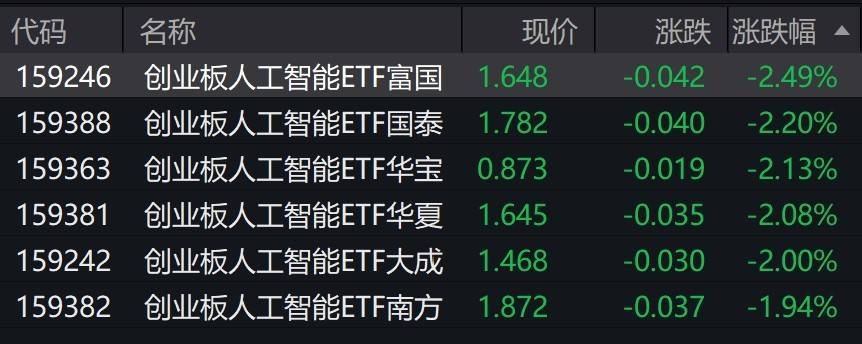
Group 1 - The core viewpoint is that the artificial intelligence concept stocks in the ChiNext board have declined, with notable drops in stocks such as New Yisheng and Tianfu Communication, which fell over 6%, and Zhongji Xuchuang, which dropped over 4% [1] - Several ChiNext artificial intelligence-related ETFs have also experienced declines of over 2% due to the impact of heavy-weight stocks [1] Group 2 - Specific performance data of ChiNext artificial intelligence ETFs shows that the ETF from Fuguo is priced at 1.648, down by 0.042 or 2.49%, while the ETF from Guotai is at 1.782, down by 0.040 or 2.20% [2] - Other ETFs such as Huayu, Huaxia, and Dachen also reported declines ranging from 1.94% to 2.13% [2] Group 3 - A brokerage firm indicates that as downstream applications of artificial intelligence continue to materialize, the sector is expected to transition from conceptual and thematic investments to a phase of prosperity investment [2] - The AI industry has successfully moved from the early stage of concept validation to large-scale application, shifting market focus from "can technology be realized" to "can companies be profitable" [2] - Investment decisions are increasingly emphasizing the progress of technology commercialization, corporate profitability, and the overall prosperity of the industry, with upward profit expectations for certain targets in the AI sector presenting good investment value [2]

一则研报突袭!超级黑马,集体大跌!
券商中国· 2025-09-12 04:05
Core Viewpoint - The article discusses the recent significant decline in the stock prices of leading optical module companies, influenced by a Morgan Stanley report suggesting profit-taking due to previously reflected positive fundamentals [1][3][4]. Group 1: Market Reaction - Major optical module stocks, including Zhongji Xuchuang, Xinyi Sheng, and Tianfu Communication, experienced sharp declines, with Zhongji Xuchuang dropping over 6%, Xinyi Sheng over 7%, and Tianfu Communication over 8% [3]. - The overall market sentiment weakened, with the ChiNext Index and 5G Index also showing declines following the report [1][3]. Group 2: Analyst Opinions - Morgan Stanley's report indicated that most positive factors for the stocks have been priced in, suggesting a cautious approach to the sector [1][5]. - In contrast, Citigroup maintains a positive outlook for optical module companies, projecting a valuation re-rating with P/E ratios potentially exceeding 20 times due to strong demand anticipated by 2027 [1][10]. Group 3: Company Performance - Despite a decline in profits, companies like ZTE and Yoke Technology have seen significant stock price increases, with ZTE's H-shares up 49% and Yoke Technology's H-shares soaring 319% year-to-date [5]. - Since April, stock price increases for Xinyi Sheng (460%), Zhongji Xuchuang (312%), and Tianfu Communication (269%) have been notable [5]. Group 4: Valuation Insights - Morgan Stanley's analysis shows that Xinyi Sheng and Tianfu Communication's valuations have surpassed historical averages, while Zhongji Xuchuang remains below its historical average [5]. - The forward P/E ratios for Zhongji Xuchuang increased from 14 to 24 times, and for Xinyi Sheng from 8 to 20 times since early 2025 [5]. Group 5: Future Outlook - Despite short-term volatility for some ASICs, the overall narrative for optical module companies remains strong, with expectations for a valuation re-rating and P/E ratios to rise above 20 times [10]. - Goldman Sachs believes that the valuations for Xinyi Sheng and Zhongji Xuchuang remain reasonable despite recent stock price increases, with projected EPS growth for 2025-2027 adjusted upwards by 3% to 38% [10].
