CATL(300750)

Search documents
兴证策略:2025年四季度主动权益基金管理规模小幅下降 四季度存量基金的赎回压力仍然较大
Sou Hu Cai Jing· 2026-01-23 12:38
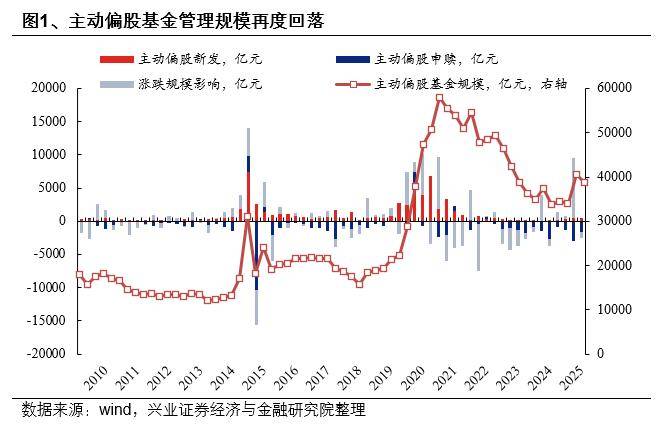
Group 1 - The active equity fund management scale decreased slightly in Q4 2025, primarily due to significant redemption pressure from existing funds, resulting in a net redemption of 165.6 billion yuan [1] - The total management scale of three types of active equity funds (ordinary stock, mixed equity, and flexible allocation) decreased by 189.8 billion yuan, with new active equity fund issuance at 56.2 billion yuan [1] - The active equity fund's position in Q4 2025 decreased by 0.83 percentage points to 86.62%, remaining at the second-highest level in history [2] Group 2 - In terms of sector allocation, the proportion of the ChiNext board increased by 1.24 percentage points to 24.98%, while the main board and Sci-Tech Innovation board saw declines [5][8] - The allocation to the main board decreased by 0.30 percentage points to 58.21%, indicating a further increase in underweight [8] - Active equity funds increased their positions in cyclical and financial real estate sectors while reducing exposure to technology growth and pharmaceuticals [11] Group 3 - The active equity funds increased their allocation in the non-ferrous metals, communication, and non-bank financial sectors, with increases of 2.26 percentage points, 1.85 percentage points, and 0.87 percentage points respectively [13] - The funds reduced their positions in electronics, pharmaceuticals, media, power equipment, and computers, with reductions of 1.72 percentage points, 1.54 percentage points, and 1.16 percentage points respectively [13] - Excluding thematic/sector funds, the active equity funds still increased their positions in non-ferrous metals, communication, and non-bank financial sectors [14] Group 4 - The allocation to the TMT sector slightly decreased in Q4 2025, with the configuration coefficient at 1.48, indicating room for further improvement [29] - Within the TMT sector, active equity funds increased their holdings in communication equipment and components while reducing positions in consumer electronics and semiconductors [32] - The dividend sector's allocation stabilized and increased, with the low-volatility dividend index rising by 1.7 percentage points to 4.3% [37] Group 5 - The top five stocks in active equity funds in Q4 2025 included Zhongji Xuchuang, Xinyi Sheng, Dongshan Precision, China Ping An, and Zijin Mining, with respective increases in holding ratios [43] - The top ten holdings accounted for 4.83%, 4.01%, and 3.97% of the total market value of the funds [46] - The concentration of individual stocks in active equity funds increased slightly, while the concentration of industries showed a mixed trend [49] Group 6 - The Hong Kong stock allocation of active equity funds decreased to 15.98%, down from 19.09%, with a total holding value of 302.9 billion yuan [51] - The funds increased their positions in the healthcare, materials, and energy sectors while reducing exposure to consumer discretionary and information technology sectors [54] - Tencent maintained its position as the largest holding in Hong Kong stocks, with a market value of 57.3 billion yuan [56]







锂电池产业链行业双周报:2025年全球储能电池出货同比增长超80%-20260123
Dongguan Securities· 2026-01-23 11:39
Investment Rating - The report maintains an "Overweight" rating for the lithium battery industry, expecting the industry index to outperform the market index by over 10% in the next six months [47]. Core Insights - Global energy storage battery shipments are projected to grow by over 80% year-on-year in 2025, with significant contributions from both the automotive and energy storage sectors [40]. - The lithium battery index has seen a decline of 5.75% over the past two weeks, underperforming the CSI 300 index by 5.46 percentage points [12]. - The report highlights a positive outlook for the lithium battery market, driven by strong demand in the energy storage sector and supportive government policies [43]. Summary by Sections Market Review - As of January 22, 2026, the lithium battery index has decreased by 4.84% year-to-date, lagging behind the CSI 300 index by 6.87 percentage points [12]. - The report notes a recent upward trend in lithium carbonate and lithium hydroxide prices, with increases of 19.84% and 17.19% respectively over the past two weeks [24][5]. Price Changes in the Lithium Battery Supply Chain - Prices for battery-grade lithium carbonate averaged 166,100 CNY/ton, while lithium hydroxide (LiOH 56.5%) was priced at 160,200 CNY/ton as of January 22, 2026 [24]. - Positive price movements were observed in cathode materials, with lithium iron phosphate and NCM materials seeing increases of 16.60% and 12.35% respectively [27][22]. Industry News - By the end of 2025, China's new energy storage capacity is expected to reach 144.7 GW, marking an 85% increase year-on-year [40]. - The global lithium battery production is projected to reach 3,092 GWh in 2026, reflecting a year-on-year growth of 34.6% [40]. Company Announcements - Companies such as Penghui Energy and Defu Technology have reported significant expected profit increases for 2025, indicating a positive trend in the industry [42]. - CATL has introduced a new sodium battery solution, showcasing innovation in the battery technology space [40]. Weekly Perspective - The report emphasizes that while the demand for power batteries may weaken in the short term due to seasonal factors, the energy storage market continues to grow rapidly, supported by favorable policies [43].



宁德时代(03750) - 海外监管公告-关於参与投资的基金完成私募投资基金备案的公告
2026-01-23 10:57
香港交易及結算所有限公司及香港聯合交易所有限公司對本公告之內容概不負責,對其準確性 或完整性亦不發表任何聲明,並明確表示概不就因本公告全部或任何部份內容而產生或因倚賴 該等內容而引致之任何損失承擔任何責任。 Contemporary Amperex Technology Co., Limited 寧德時代新能源科技股份有限公司 (於中華人民共和國註冊成立的股份有限公司) (股份代號:3750) 海外監管公告 關於參與投資的基金完成私募投資基金備案的公告 本公告乃根據香港聯合交易所有限公司證券上市規則第13.10B條而作出。 茲載列寧德時代新能源科技股份有限公司(「本公司」)於深圳證券交易所網站 ( http://www.szse.cn /)及巨潮資訊網( www.cninfo.com.cn )所發佈之《寧德時代新能 源科技股份有限公司關於參與投資的基金完成私募投資基金備案的公告》,僅供參 閱。 中國•寧德,二零二六年一月二十三日 於本公告日期,本公司董事會成員包括執行董事曾毓群先生、潘健先生、李平 先生、周佳先生、歐陽楚英博士及吳映明先生;及獨立非執行董事吳育輝博士、 林小雄先生及趙蓓博士。 证券代码:300 ...
宁德时代发布“天行II”轻商系列解决方案
起点锂电· 2026-01-23 10:51
Group 1 - The core theme of the article is the launch of CATL's new light commercial vehicle solutions, emphasizing the "hardware + software + service" ecosystem to address the industry's standardization challenges [2][3] - CATL introduced the Tianxing II series, which includes four customized product matrices targeting specific operational needs in light commercial scenarios, such as urban distribution and cold-region transport [2] - The supercharging version can recharge 80% in 30 minutes at -15°C, with a cycle life of 8000 times, potentially increasing revenue by 150,000 yuan over its lifecycle [2] - The long-range version features a 253 kWh battery pack enabling 800 km of real-world range, while the lightweight design reduces operational costs by 260 kg [2] - The high-temperature supercharging version can recharge 60% in 18 minutes, achieving a 5% reduction in energy consumption [2] - The low-temperature version is the first mass-produced sodium-ion battery for light commercial vehicles, capable of charging at -30°C, facilitating nationwide adoption of new energy light commercial vehicles [2] Group 2 - The "Battery Manager" application was launched to provide digital management of battery lifecycle, offering real-time monitoring and proactive alerts for users [3] - The application ensures that users can manage battery status and revenue data effectively, with rapid response from engineers for any faults [3] - CATL's CTO emphasized the commitment to transforming cutting-edge technology into practical power solutions, aiming to create reliable returns for partners and end-users [3] - The new light commercial vehicle battery packs are compatible with over 20 models, providing diverse purchasing options for users [3] - The launch is part of CATL's ecosystem strategy, focusing on user needs and collaboration with industry partners to enhance the efficiency and reliability of new energy light commercial vehicles [3]

重仓榜首之争:宁德仍居全市场榜首,中际旭创成主动基金第一持仓
Xin Lang Cai Jing· 2026-01-23 10:49
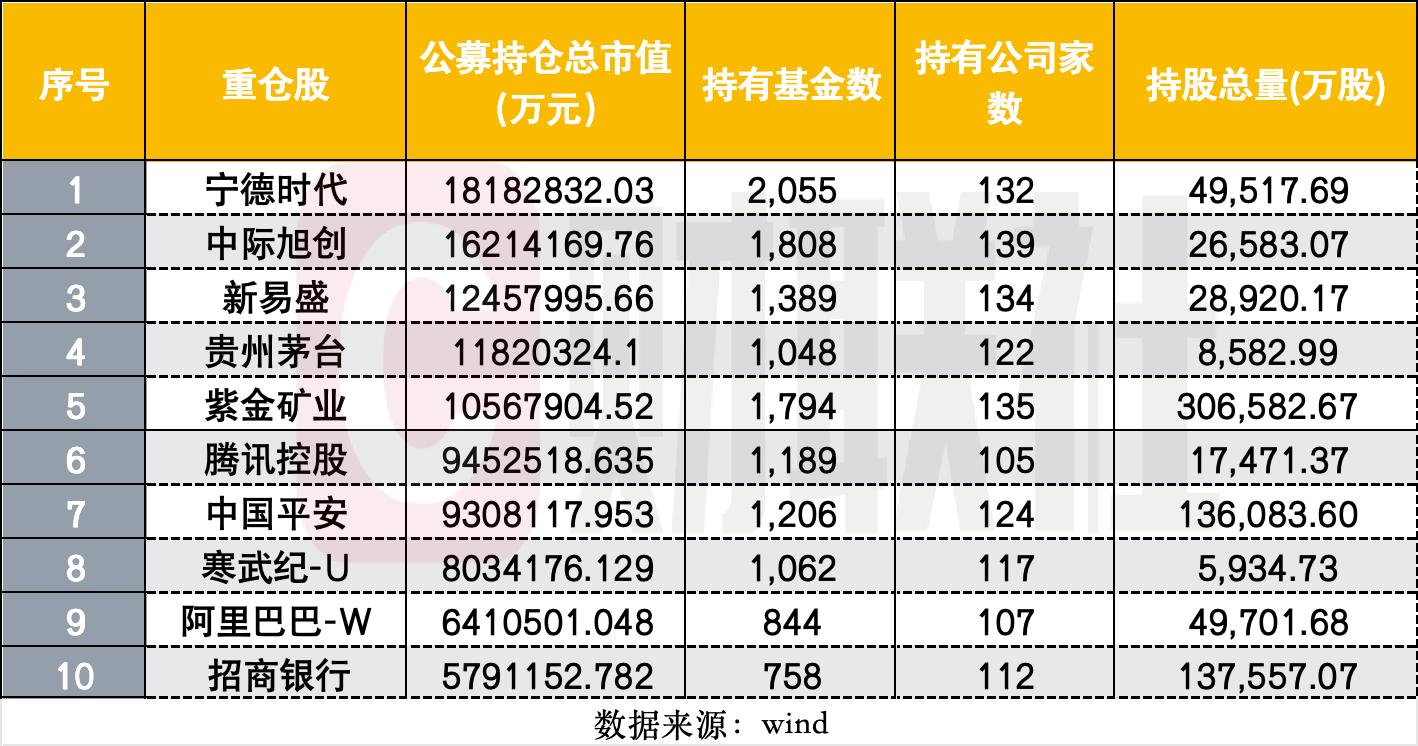
Group 1 - The core viewpoint of the article highlights the changing landscape of public fund heavyweights, with CATL maintaining its top position while Zhongji Xuchuang rapidly closes the gap [1][6] - As of the end of 2025, CATL holds a total market value of 181.83 billion yuan, while Zhongji Xuchuang has reached 162.14 billion yuan, significantly narrowing the gap from 96.01 billion yuan in the previous quarter [6][8] - The top ten heavyweights in public funds include CATL, Zhongji Xuchuang, Xinyi Semiconductor, Kweichow Moutai, Zijin Mining, Tencent Holdings, China Ping An, Cambricon Technologies, Alibaba-W, and China Merchants Bank, with total market values ranging from 57.91 billion yuan to 181.83 billion yuan [6][10] Group 2 - In the active fund category, Zhongji Xuchuang has overtaken CATL to become the top heavyweight, with a total market value of 82.54 billion yuan, while CATL's value is 69.18 billion yuan [3][10] - The active funds show a preference for technology and cyclical stocks, with significant increases in rankings for Xinyi Semiconductor and Zijin Mining, while Tencent Holdings and Alibaba-W have seen declines [3][12] - The top ten heavyweights in active funds include Zhongji Xuchuang, CATL, Xinyi Semiconductor, Tencent Holdings, Zijin Mining, Alibaba-W, Cambricon Technologies, Luxshare Precision, Kweichow Moutai, and Dongshan Precision, with market values ranging from 25.61 billion yuan to 82.54 billion yuan [10][11] Group 3 - The public fund's top ten increased holdings are dominated by "Chinese-character" stocks, focusing on the financial and energy sectors, with notable increases in Industrial Bank, China Cinda, and Industrial and Commercial Bank of China [4][15] - The financial sector saw significant increases in holdings, primarily driven by broad-based ETFs, while the energy sector also experienced collective increases from dividend ETFs [4][15] - The top ten stocks with the largest reductions in holdings are concentrated in the financial, media technology, and traditional cyclical sectors, with Oriental Fortune and Focus Media being the most significantly reduced [5][16] Group 4 - In the fourth quarter, Oriental Fortune and Focus Media were the only two stocks that saw reductions exceeding 60,000 shares, indicating a consensus among institutions to withdraw from these stocks [5][16] - The reduction in Oriental Fortune was primarily driven by multiple broad-based ETFs, while Focus Media faced significant reductions from several well-known active fund managers [5][16] - The reduction list also includes Agricultural Bank of China, Nanjing Steel, and China CITIC Bank, which were primarily affected by dividend-themed ETFs [17]
宁德时代参与投资的博裕新智新产基金完成备案
Xin Lang Cai Jing· 2026-01-23 10:41
Core Viewpoint - CATL has announced its participation in an investment fund, marking a significant step in its investment strategy and compliance with regulatory requirements [1] Group 1: Fund Details - The investment fund "Boyu New Intelligence New Industry (Ningbo) Equity Investment Partnership (Limited Partnership)" has completed its private fund registration with the Asset Management Association of China on January 23, 2026 [1] - The fund's registration code is SBLV67, managed by Boyu Taoran (Shanghai) Equity Investment Management Co., Ltd., and custodied by Shanghai Pudong Development Bank Co., Ltd. [1] Group 2: Investment Commitment - CATL, as a limited partner, has committed to invest RMB 500 million, which represents 12.497% of the fund's total subscribed capital of RMB 4.001 billion after the first closing [1] - The completion of the fund's registration indicates that it is officially established and can begin compliant operations [1] Group 3: Future Disclosure - CATL will continue to disclose subsequent developments of the fund in accordance with relevant regulatory requirements [1]
华商新能源汽车混合A:2025年第四季度利润2838.7万元 净值增长率6.86%
Sou Hu Cai Jing· 2026-01-23 10:32
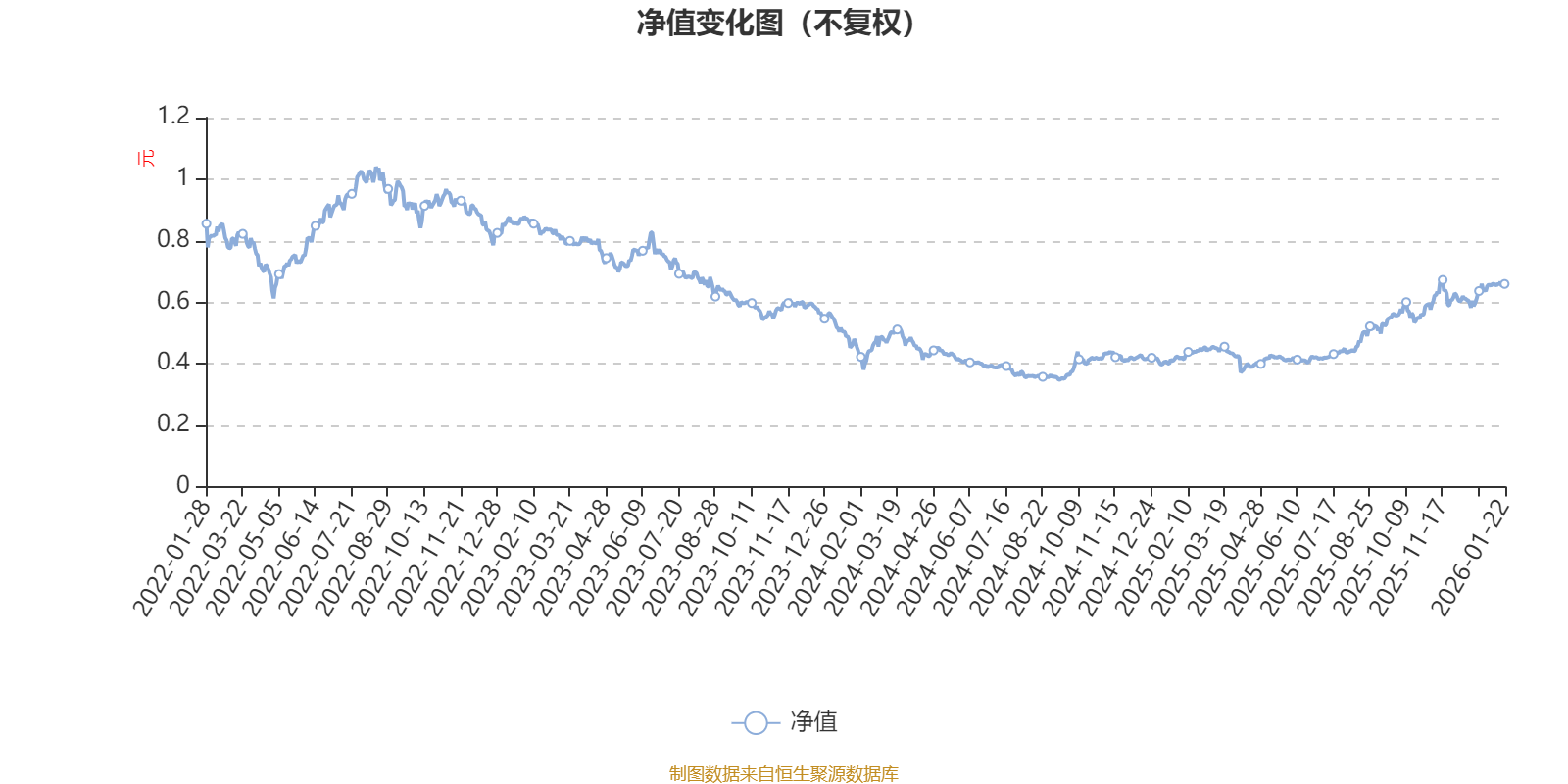
Core Viewpoint - The AI Fund Huashang New Energy Vehicle Mixed A (013886) reported a profit of 28.387 million yuan for Q4 2025, with a weighted average profit per fund share of 0.0407 yuan. The fund's net value growth rate was 6.86%, and its total size reached 448 million yuan by the end of Q4 2025 [2][15]. Fund Performance - As of January 22, the unit net value of the fund was 0.659 yuan. The fund manager, Chen Xiaoqiong, oversees three funds, all of which have shown positive returns over the past year. The highest growth rate among these funds was 105.95% for Huashang High-end Equipment Manufacturing Stock A, while the lowest was 56.95% for Huashang New Energy Vehicle Mixed A [2][3]. Market Overview - In Q4 2025, the A-share market experienced fluctuations, with the Shanghai Composite Index oscillating between 3,800 and 4,030 points, briefly surpassing the 4,000-point mark in October. The Shanghai Composite Index, CSI 300, ChiNext Index, and STAR Market Index saw respective changes of 2.22%, -0.23%, -1.08%, and 10.1% [3]. Investment Strategy - The fund's investment strategy focuses on two main themes: growth and quality. Growth investments are centered around sectors such as lithium batteries, energy storage, solid-state batteries, and AIDC power equipment, with an emphasis on tracking industry developments and selective stock picking. The quality investments are directed towards assets with strong competitive advantages and sustainable profitability [3]. Fund Rankings - As of January 22, the fund's performance over various time frames ranked as follows among comparable funds: 20.14% growth over the last three months (40/621), 51.01% over the last six months (54/621), 56.95% over the last year (141/613), and -24.00% over the last three years (524/535) [3]. Risk Metrics - The fund's Sharpe ratio over the last three years was 0.0231, ranking 495 out of 526 comparable funds. The maximum drawdown during this period was 60.46%, with the largest single-quarter drawdown occurring in Q1 2024 at 32.7% [9][11]. Portfolio Composition - The average stock position of the fund over the last three years was 87.3%, slightly above the comparable average of 85.83%. The fund reached its highest stock position of 92.85% at the end of Q3 2025 and its lowest of 74.26% at the end of H1 2024 [14]. Top Holdings - As of the end of Q4 2025, the fund's top ten holdings included Ningde Times, Sunshine Power, Tianci Materials, Duofluor, Huasheng Lithium, Huayou Cobalt, Guocheng Mining, Xian Dao Intelligent, Penghui Energy, and Nord Shares [18].




宁德时代天行II发布:轻型商用车电动化如何算好账经济账?
高工锂电· 2026-01-23 10:29
Core Viewpoint - The article discusses the launch of CATL's Tianxing II light commercial vehicle battery solutions, emphasizing the importance of tailored battery configurations to enhance operational efficiency and profitability in various usage scenarios [2][5][16]. Group 1: Market Trends and User Needs - As the penetration of new energy increases, light commercial vehicles are shifting towards large-scale operations, leading to a change in user focus towards the compatibility of battery configurations with specific operational scenarios [2][3]. - Different transportation tasks require different battery capabilities, such as daily attendance stability for urban distribution, endurance for intercity transport, and efficiency for last-mile delivery [3]. Group 2: Product Features and Innovations - The Tianxing II series offers four customized battery solutions designed to convert performance into attendance rates and revenue [7]. - The Tianxing II light commercial supercharging version features significant upgrades in cold resistance, power output, and lifespan, allowing for faster charging and improved operational efficiency [7][10]. - The long-range version of the Tianxing II battery boasts a capacity of 253 kWh, enabling a range of 800 kilometers, making it suitable for major intercity routes without the need for mid-route charging [8][10]. - The high-temperature supercharging version addresses the challenges of last-mile logistics by allowing rapid charging and reducing energy consumption [10]. - The low-temperature version is the first mass-produced sodium-ion battery for light commercial vehicles, maintaining high performance even in extreme cold conditions [11]. Group 3: Smart Management Solutions - CATL introduced the "Battery Steward" Tianxing App, which allows users to monitor battery lifecycle, optimize revenue, and manage risks effectively [13][14]. - The app provides real-time data analysis, proactive alerts for potential risks, and direct connections to CATL's service platform for quick support [14]. Group 4: Future Directions and Industry Impact - CATL aims to redefine the ecosystem of the light commercial vehicle industry by focusing on user needs and innovative solutions, promoting sustainable and predictable long-term value [16][18]. - The company emphasizes collaboration with industry partners to drive the electrification of light commercial vehicles towards higher efficiency and stronger certainty [18].

宁德时代(300750) - 关于参与投资的基金完成私募投资基金备案的公告
2026-01-23 10:22
二、投资产业投资基金的进展情况 近日,公司收到基金管理人的通知,基金已根据《中华人民共和国证券投资 基金法》和《私募投资基金监督管理暂行办法》等法律法规的要求完成中国证券 投资基金业协会的私募投资基金备案手续,取得《私募投资基金备案证明》,具 体登记信息如下: 基金名称:博裕新智新产(宁波)股权投资合伙企业(有限合伙) 管理人名称:博裕陶然(上海)股权投资管理有限责任公司 证券代码:300750 证券简称:宁德时代 公告编号:2026-005 宁德时代新能源科技股份有限公司 关于参与投资的基金完成私募投资基金备案的公告 本公司及董事会全体成员保证信息披露的内容真实、准确、完整,没有虚假记载、误 导性陈述或重大遗漏。 一、参与投资产业投资基金概述 宁德时代新能源科技股份有限公司(以下简称"公司")于 2025 年 12 月 1 日 与博裕天枢(宁波)自有资金投资有限责任公司、宁波市甬元投资基金有限公司 等合作方签署了《博裕新智新产(宁波)股权投资合伙企业(有限合伙)有限合 伙合同》,公司作为有限合伙人之一参与投资"博裕新智新产(宁波)股权投资 合伙企业(有限合伙)"(以下简称"基金"),于基金完成首次交割后,基 ...
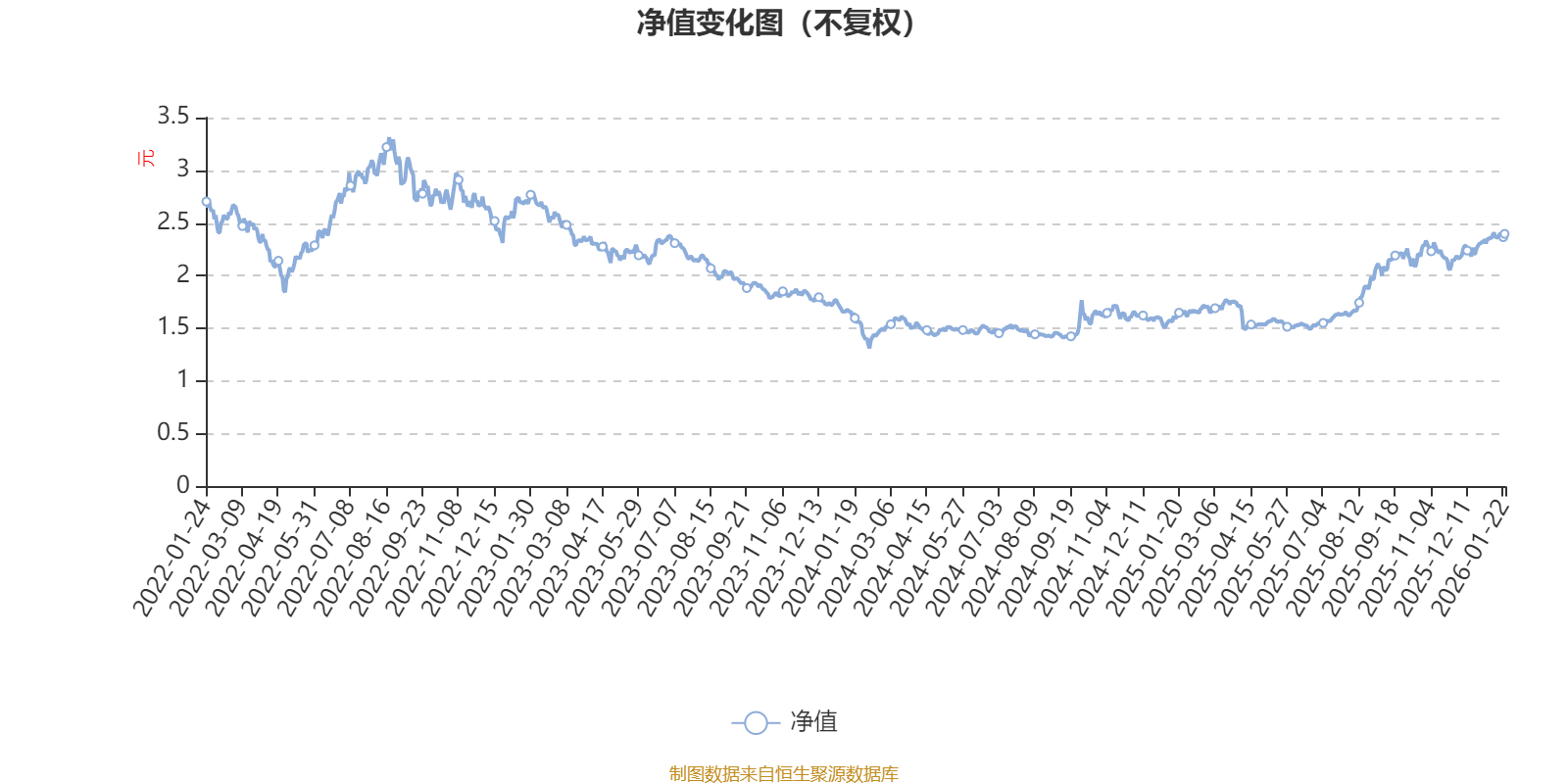
浦银安盛环保新能源A类:2025年第四季度利润247.83万元 净值增长率4.02%
Sou Hu Cai Jing· 2026-01-23 10:20
Core Viewpoint - The AI Fund Puyin Ansheng Environmental New Energy Class A (007163) reported a profit of 2.4783 million yuan for Q4 2025, with a net value growth rate of 4.02% during the reporting period [3]. Fund Performance - The fund's scale reached 62.5804 million yuan by the end of Q4 2025 [16]. - As of January 22, the unit net value was 2.397 yuan [3]. - The fund's performance over different time frames includes: - 3-month net value growth rate: 8.87%, ranking 73 out of 100 among comparable funds [3]. - 6-month net value growth rate: 46.35%, ranking 21 out of 100 [3]. - 1-year net value growth rate: 45.39%, ranking 49 out of 92 [3]. - 3-year net value growth rate: -11.96%, ranking 55 out of 68 [3]. Risk Metrics - The fund's Sharpe ratio over the past three years is 0.0855, ranking 55 out of 66 among comparable funds [9]. - The maximum drawdown over the past three years is 52.94%, with a ranking of 54 out of 66 [11]. - The highest quarterly maximum drawdown occurred in Q1 2020, at 29.78% [11]. Investment Strategy - The fund focuses on advanced manufacturing stocks, particularly in the tight supply chain segments of large storage, solid-state, and lithium batteries [3]. - The management is also monitoring opportunities in the photovoltaic industry and the expansion of new scenarios in wind power enterprises to enhance returns for investors [3]. Portfolio Concentration - The fund has a high concentration of holdings, with the top ten stocks including: - CATL (宁德时代) - Cambricon (寒武纪) - Industrial Fulian (工业富联) - Zhejiang Rongtai (浙江荣泰) - Shenzhen South Circuit (深南电路) - Yangtze Power (长江电力) - Shenghong Technology (胜宏科技) - Sungrow Power (阳光电源) - Topband (拓普集团) - Luoyang Molybdenum (洛阳钼业) [19]. Stock Positioning - The average stock position over the past three years is 81.04%, compared to a comparable average of 87.15% [14]. - The fund reached its highest stock position of 92.74% by the end of 2025, with a lowest position of 62.61% at the end of 2019 [14].