IMEIK(300896)

Search documents
4月社零同比增5.1%,看好新消费机遇
HTSC· 2025-05-20 02:50
Investment Rating - The report maintains an "Overweight" rating for the consumer sector, specifically highlighting the potential in new consumption opportunities and structural growth within the domestic market [6]. Core Insights - In April, the total retail sales of consumer goods reached 3.7 trillion yuan, with a year-on-year growth of 5.1%, indicating resilience in domestic demand despite external pressures [1]. - The report emphasizes the positive impact of government policies aimed at boosting consumption, particularly in sectors such as home appliances, sports, and entertainment [1][4]. - The online retail penetration continues to grow, with a 5.8% year-on-year increase in physical goods sold online, reflecting a shift towards digital consumption [2]. Summary by Sections Retail Performance - In April, the restaurant and retail sectors saw year-on-year growth of 5.2% and 5.1%, respectively, indicating a stable recovery trend [2]. - The online retail sales of physical goods increased by 6.1% year-on-year from January to April, with an online penetration rate rising to 24.3% [2]. Consumer Trends - Various consumer categories showed positive growth, particularly in home appliances (up 38.8%), furniture (up 26.9%), and sports equipment (up 23.3%), driven by policies encouraging consumption upgrades [3]. - Jewelry sales surged by 25.3% year-on-year, attributed to investment-driven demand for gold and silver [3]. Economic Indicators - The Consumer Price Index (CPI) in April decreased by 0.1% year-on-year, with food prices showing a slight decline of 0.2% [4]. - Service prices increased by 0.3% year-on-year, with notable growth in domestic services such as housekeeping and education [4]. Investment Recommendations - The report suggests four main investment themes for 2025: 1. New consumption opportunities driven by domestic brands [5]. 2. High-growth emotional consumption sectors [5]. 3. The burgeoning silver economy [5]. 4. AI-driven consumer innovations [5]. - Specific stock recommendations include brands like 毛戈平 (Mao Geping), 安踏体育 (Anta Sports), and 海澜之家 (HLA) among others, all rated as "Buy" [9][41].



中欧中证全指医疗保健设备与服务指数发起A连续4个交易日下跌,区间累计跌幅1.26%
Sou Hu Cai Jing· 2025-05-19 16:01
Group 1 - The core viewpoint of the news is the performance and structure of the China Europe CSI All-Share Healthcare Equipment and Services Index Fund A, which has experienced a slight decline recently [1] - As of May 19, the fund's latest net value is 1.05 yuan, marking a continuous drop for four trading days with a cumulative decline of 1.26% [1] - The fund was established in August 2024 with a total size of 0.13 billion yuan and has achieved a cumulative return of 4.82% since inception [1] Group 2 - The fund's holder structure shows that institutional investors hold 0.10 billion shares, accounting for 91.94% of the total shares, while individual investors hold 0.01 billion shares, making up 8.06% [1] - As of March 31, 2025, the top ten holdings of the fund account for a total of 41.48%, with major investments in companies such as Mindray Medical (9.10%), Aier Eye Hospital (7.77%), and United Imaging Healthcare (6.36%) [3]






2.94亿元主力资金今日撤离美容护理板块
Zheng Quan Shi Bao Wang· 2025-05-16 11:36
Market Overview - The Shanghai Composite Index fell by 0.40% on May 16, with 15 industries experiencing gains, led by the automotive and machinery sectors, which rose by 1.91% and 0.83% respectively [1] - The beauty and personal care sector had the largest decline, dropping by 1.31%, followed by the non-bank financial sector, which fell by 1.21% [1] Capital Flow Analysis - The net inflow of capital in the two markets was 307 million yuan, with 14 industries seeing net inflows. The automotive sector led with a net inflow of 4.616 billion yuan, while the basic chemical industry had a net inflow of 1.981 billion yuan and a daily increase of 0.60% [1] - Conversely, 17 industries experienced net outflows, with the non-bank financial sector seeing the largest outflow of 1.925 billion yuan, followed by the transportation sector with a net outflow of 1.250 billion yuan [1] Beauty and Personal Care Sector - The beauty and personal care sector saw a decline of 1.31% with a net outflow of 294 million yuan. Out of 31 stocks in this sector, 11 rose while 20 fell [2] - The stocks with the highest net inflow included Qingdao Kingking with 50.67 million yuan, followed by Zhongshun Jierou and Yiyi Co., with net inflows of 20.55 million yuan and 9.64 million yuan respectively [2] - Notable stocks with significant net outflows included Furuida with 151 million yuan, Aimeike with 49.19 million yuan, and Qingsong Co. with 38.32 million yuan [2] Individual Stock Performance - The top stocks in the beauty and personal care sector based on capital flow include: - Furuida: -3.82% with a net outflow of 150.98 million yuan [3] - Aimeike: -2.06% with a net outflow of 49.19 million yuan [3] - Qingsong Co.: -7.34% with a net outflow of 38.32 million yuan [3] - Other notable performers include: - Qingdao Kingking: +1.89% with a net inflow of 50.67 million yuan [3] - Zhongshun Jierou: +0.87% with a net inflow of 20.55 million yuan [3]


医美年报|上游业绩分化严重:玻尿酸三巨头遇业绩滑铁卢、华熙生物再垫底 重组胶原蛋白市场竞争升温
Xin Lang Zheng Quan· 2025-05-16 07:58
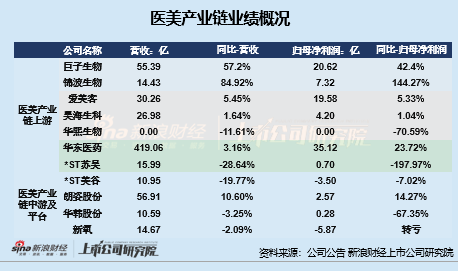
Core Viewpoint - The medical beauty industry is experiencing a significant performance divergence among listed companies, driven by a shift from hyaluronic acid to collagen products, indicating a potential restructuring of industry value logic [1][3]. Group 1: Performance Analysis - In 2024, the performance of upstream medical beauty companies showed significant divergence, with companies like Juzi Biological and Jinbo Biological leading with high growth rates, while major hyaluronic acid players like Aimeike, Huaxi Biological, and Haohai Biological faced pressure [2][3]. - Aimeike's revenue growth slowed to 5.45%, the lowest since its listing, while Huaxi Biological's revenue declined by 11.61% and net profit dropped by 70.59% [3][5]. - Juzi Biological achieved revenue of 5.539 billion, a year-on-year increase of 57.2%, and a net profit of 2.062 billion, up 42.4% [5][7]. Group 2: Market Trends - The market for recombinant collagen products in China is projected to grow from 18.5 billion in 2022 to 108.3 billion by 2027, with a compound annual growth rate of 42.4% [7]. - Companies are increasingly entering the collagen market, including Aimeike and Huaxi Biological, which are exploring new opportunities in this segment [7][8]. - Huaxi Biological is developing proprietary recombinant human collagen products that have entered clinical trials, indicating a strategic shift towards innovative product development [7].


中证全指医疗保健设备与服务指数下跌0.23%,前十大权重包含联影医疗等
Sou Hu Cai Jing· 2025-05-14 15:39
Core Viewpoint - The China Securities Index for Healthcare Equipment and Services has shown a slight decline of 0.23% recently, reflecting a mixed performance over different time frames, with a year-to-date decrease of 0.88% [1]. Group 1: Index Performance - The China Securities Index for Healthcare Equipment and Services closed at 13,568.19 points with a trading volume of 15.409 billion yuan [1]. - Over the past month, the index has increased by 2.13%, while it has decreased by 5.63% over the last three months [1]. - The index has a year-to-date decline of 0.88% [1]. Group 2: Index Composition - The index is composed of listed companies in the healthcare sector, selected from the broader China Securities Index to reflect the overall performance of healthcare-related securities [1]. - The top ten weighted companies in the index include Mindray Medical (9.73%), Aier Eye Hospital (8.29%), and United Imaging Healthcare (7.73%) [1]. - The index is primarily composed of companies listed on the Shenzhen Stock Exchange (61.00%) and the Shanghai Stock Exchange (39.00%) [1]. Group 3: Fund Tracking - Several public funds track the China Securities Index for Healthcare Equipment and Services, including Southern Asset Management's various funds and Tianhong's ETF [2].

大幅反弹!港股医药ETF(159718)高开高走涨超2%!医疗创新ETF(516820)小幅拉升
Xin Lang Cai Jing· 2025-05-13 01:56
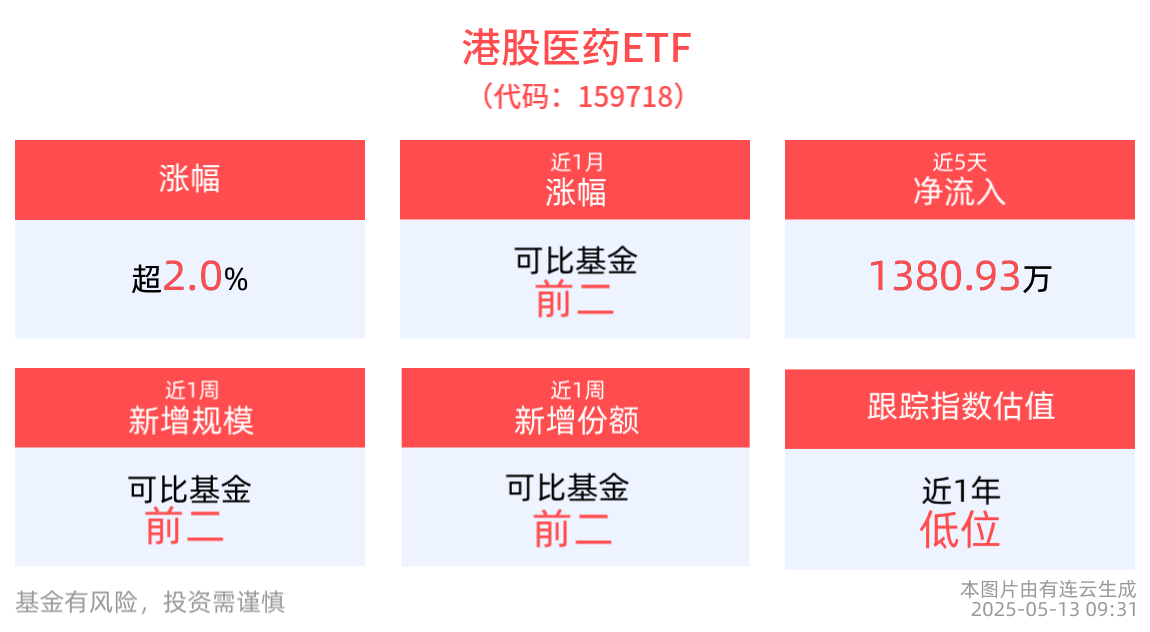
Core Viewpoint - The recent policy announced by Trump to align U.S. drug prices with the lowest global prices could lead to a significant decrease in prescription drug prices in the U.S., potentially by 30% to 80%, raising concerns among pharmaceutical companies, especially those exporting to the U.S. [1][2] Group 1: Market Performance - As of May 13, 2025, the CSI Hong Kong Stock Connect Pharmaceutical and Healthcare Composite Index (930965) rose by 2.42%, with notable increases in stocks such as BeiGene (06160) up 4.15% and Innovent Biologics (01801) up 3.14% [1] - The Hong Kong Pharmaceutical ETF (159718) opened high and increased by 2.04%, with a latest price of 0.70 yuan, and a one-month cumulative increase of 3.32% [1] - The CSI Pharmaceutical and Medical Device Innovation Index (931484) increased by 0.87%, with stocks like East China Pharmaceutical (000963) rising by 2.23% [4] Group 2: Trading Volume and Liquidity - The Hong Kong Pharmaceutical ETF had a turnover of 1.72% during the trading session, with a transaction volume of 4.0999 million yuan, and an average daily transaction volume of 95.7602 million yuan over the past month [1] - The latest scale of the Medical Innovation ETF (516820) reached 1.588 billion yuan [4] Group 3: Index Composition - The top ten weighted stocks in the CSI Hong Kong Stock Connect Pharmaceutical and Healthcare Composite Index accounted for 60.54% of the index, including BeiGene (06160) and WuXi Biologics (02269) [5] - The top ten weighted stocks in the CSI Pharmaceutical and Medical Device Innovation Index represented 66.51% of the index, featuring companies like Hengrui Medicine (600276) and WuXi AppTec (603259) [8]

商贸零售行业周报:关注零售行业中期投资策略:深挖情绪消费景气赛道
KAIYUAN SECURITIES· 2025-05-12 00:23
Investment Rating - The investment rating for the retail industry is "Positive" (maintained) [1] Core Insights - The retail industry is experiencing a slow recovery in social consumption, with overall business pressure on retail enterprises. The report emphasizes the importance of emotional consumption and suggests focusing on high-quality companies in high-growth segments [4][27] - The report identifies key segments within the retail industry, including traditional retail, gold and jewelry, cosmetics, and medical aesthetics, each with unique dynamics and investment opportunities [4][27] Summary by Sections Retail Market Overview - The retail industry index rose by 0.88% during the week of May 6 to May 9, 2025, underperforming the Shanghai Composite Index, which increased by 1.92% [6][15] - The brand cosmetics sector showed the highest growth, with a weekly increase of 2.89% and a year-to-date increase of 15.91% [18][21] Investment Strategy - The report recommends focusing on high-quality companies in segments driven by emotional consumption, including: 1. **Gold and Jewelry**: Emphasizing brands with differentiated products and consumer insights, recommending companies like Laopuhuangjin, Chaohongji, and Zhou Dasheng [7][48] 2. **Offline Retail**: Highlighting companies that are actively transforming and exploring new models, recommending Yonghui Supermarket and Aiyingshi [7][48] 3. **Cosmetics**: Focusing on domestic brands with strong growth potential, recommending brands like Pola, Shangmei, and Juzi Biological [7][49] 4. **Medical Aesthetics**: Suggesting attention to differentiated product manufacturers and leading medical aesthetic institutions, recommending Aimeike and Kedi-B [7][49] Segment Analysis - **Traditional Retail**: The report notes that offline retail must leverage its strengths in customer service and emotional satisfaction to attract consumers back from online channels [4][28] - **Gold and Jewelry**: The industry is shifting from supply-driven to demand-driven, with emotional consumption becoming a key factor. High-end and fashionable gold segments are emerging as significant opportunities [4][36] - **Cosmetics**: The industry is stable in the short term, with a long-term trend favoring domestic brands. Emotional consumption is spreading across various cosmetic categories [4][41] - **Medical Aesthetics**: The industry is experiencing accelerated differentiation, with high-end products showing resilience due to their safety and scarcity [4][44]



关注零售行业中期投资策略:深挖情绪消费景气赛道
KAIYUAN SECURITIES· 2025-05-11 14:41
Group 1: Core Insights - The retail industry is experiencing a slow recovery in social consumption, with overall business pressure on retail enterprises [27][28] - The report emphasizes the importance of emotional consumption, suggesting that companies should focus on enhancing consumer service experiences and emotional satisfaction to drive positive accumulation [28][32] - The investment strategy highlights four main themes: gold and jewelry, offline retail, cosmetics, and medical aesthetics, each with specific recommendations for companies to watch [4][7][49] Group 2: Industry Dynamics - Traditional retail is facing challenges as online traffic growth approaches its peak, and issues like e-commerce tax audits arise, making offline experiences more valuable [4][28] - The gold and jewelry sector is shifting from supply-driven to demand-driven, with emotional needs like self-appreciation and national pride becoming significant [4][36] - The cosmetics industry is witnessing a rise in domestic brands, with emotional consumption trends spreading to various segments, including functional skincare and home fragrances [41][49] Group 3: Company Recommendations - For gold and jewelry, companies like Lao Pu Gold, Chao Hong Ji, and Zhou Da Sheng are recommended for their differentiated product offerings and consumer insights [7][48] - In offline retail, companies such as Yonghui Supermarket and Ai Ying Shi are highlighted for their proactive transformation and exploration of new business models [7][48] - In the cosmetics sector, brands like Pechoin, Mao Ge Ping, and Juzi Biological are noted for their strong performance and ability to adapt to market trends [7][49] Group 4: Market Performance - The retail industry index rose by 0.88% in the week of May 6-9, 2025, but has decreased by 5.81% since the beginning of the year, underperforming the broader market [6][15] - The brand cosmetics sector showed the highest growth, with a weekly increase of 2.89% and a year-to-date increase of 15.91% [18][21] - Individual stocks such as Huazhi Wine and New Xunda saw significant weekly gains of 13.4% and 12.2%, respectively [24][25]


化妆品医美行业周报:聚美丽大会指引美业发展,国际集团在华触底反弹-20250511
Shenwan Hongyuan Securities· 2025-05-11 14:40
Investment Rating - The report maintains an "Overweight" rating for the cosmetics and medical beauty sector, with specific recommendations for various companies based on their market positions and growth potential [5][12][17]. Core Insights - The cosmetics and medical beauty sector has shown weaker performance compared to the market, with the Shenwan Beauty Care Index rising by 1.7% from April 30 to May 9, 2025, which is lower than the Shenwan A Index by 0.6 percentage points [5][6]. - The "Jumeili Conference" held in Shanghai highlighted the industry's development direction amidst a challenging environment, emphasizing the importance of technology-driven beauty, refined operations, and AI assistance [5][12]. - Domestic brands are gaining traction, while international brands are also experiencing growth, with Estee Lauder reporting a return to positive growth in key brands in China during Q1 2025 [5][12][28]. Summary by Sections Industry Performance - The cosmetics and medical beauty sector's performance has been below market expectations, with the Shenwan Cosmetics Index increasing by 2.8%, outperforming the Shenwan A Index by 0.5 percentage points [5][6]. - The report notes a competitive landscape where domestic brands are aggressively entering the market, prompting international brands to rebound [5][12]. Company Analysis - Shanghai Jahwa's Q1 2025 results showed a revenue of 1.704 billion yuan, down 10.59% year-on-year, with a net profit of 217 million yuan, down 15.25% [5][13]. - Estee Lauder's Q3 2025 results indicated a net sales figure of 3.55 billion USD (approximately 25.8 billion yuan), a 10% decline year-on-year, but with a notable increase in gross margin [5][28]. - The report highlights the employee stock ownership plan at Shanghai Jahwa, aimed at binding key personnel and setting profit recovery targets for 2025 [5][17]. Market Trends - The report indicates that the retail sales of cosmetics in Q1 2025 reached 114.9 billion yuan, with a year-on-year growth of 3.2% [22][26]. - The domestic skincare market is projected to continue growing, with local brands capturing a significant market share, reflecting a shift in consumer preferences towards domestic products [36][38]. E-commerce Insights - The report provides data on the performance of domestic brands on e-commerce platforms, with notable growth in GMV for brands like Proya and Marubi [20][19]. - The overall e-commerce landscape for cosmetics is evolving, with brands leveraging social media platforms to enhance visibility and sales [5][12].

3230.19万元资金今日流出美容护理股
Zheng Quan Shi Bao Wang· 2025-05-09 15:45
Market Overview - The Shanghai Composite Index fell by 0.30% on May 9, with seven industries experiencing gains, led by the beauty and personal care sector, which rose by 1.41% [1] - The electronic and computer sectors faced the largest declines, with drops of 2.07% and 1.96% respectively [1] Capital Flow Analysis - The main capital outflow from the two markets totaled 47.4 billion yuan, with only four industries seeing net inflows [1] - The textile and apparel industry had the highest net inflow, amounting to 226 million yuan, while the coal industry saw a modest increase of 0.10% with a net inflow of 18.6 million yuan [1] Beauty and Personal Care Sector - The beauty and personal care industry saw a rise of 1.41%, despite a net outflow of 32.3 million yuan in main capital [2] - Out of 31 stocks in this sector, 18 experienced gains, including one stock that hit the daily limit [2] - The top three stocks with net inflows were Beitaini (35.1 million yuan), Proya (23.1 million yuan), and Shuiyang (13.7 million yuan) [2][3] Notable Stocks in Beauty and Personal Care - Qingdao Kingking had the largest net outflow at 40.9 million yuan, followed by Runben (8.7 million yuan) and Kesi (8.4 million yuan) [2] - Other notable stocks with significant net outflows included Marubi (8.0 million yuan) and Aimeike (7.5 million yuan) [2] - The stock performance varied, with some stocks like Beitaini and Shuiyang showing strong gains, while others faced significant outflows [2][3]