BIDU(BIDU)

Search documents
百度难渡...
Sou Hu Cai Jing· 2025-12-18 12:51
Group 1 - Baidu is undergoing significant layoffs, with reports indicating that some departments are seeing cuts of 30%-40% [2][5][9] - The layoffs are affecting not only older employees but also recent graduates, highlighting a shift in workforce dynamics [2][9] - Baidu is relocating its outsourcing teams to Xi'an, imposing job insecurity on lower-tier workers [2][11] Group 2 - Baidu's third-quarter financial results were disappointing, with a net loss of 11.2 billion RMB and a total revenue of approximately 31.2 billion RMB, marking a year-on-year decline of 7% [12][13] - The company's core revenue also fell by 7% year-on-year, with online marketing revenue dropping by 17.6% [12][13] - Baidu's advertising revenue has been declining for six consecutive quarters, indicating a troubling trend in its core business [12][13] Group 3 - The decline in Baidu's performance is attributed to changing user search habits and increased competition from platforms like Douyin and WeChat [13][15] - Baidu's market position has weakened, with its media index ranking dropping to ninth place, behind competitors [13][15] - The company has struggled to capitalize on the AI sector, with its AI cloud market share being significantly lower than competitors like Alibaba and Huawei [16][17] Group 4 - Baidu's missed opportunities in the mobile internet space have been a critical factor in its current struggles, as highlighted by past comments from CEO Robin Li regarding the challenges of adapting to new technologies [19][20] - Despite having innovative products, Baidu's approach has often been criticized for being reactive rather than proactive in the market [20][22] - Li's recent statements suggest a cautious approach to new projects, emphasizing the importance of technology's decisive role in future endeavors [23]



全球 AI 竞争,为什么越来越多人看好中国?
Ge Long Hui· 2025-12-18 12:48
Core Insights - The article highlights the rapid development and adoption of AI applications in China, marking a shift from mere technological showcases to practical productivity tools across various industries [1][2][3] - Baidu is positioned as a leading player in this AI application landscape, having established a comprehensive system from chips to models to applications, reflecting the broader trajectory of China's AI development [1][2][24] Group 1: AI Application Trends - The global tech community has recognized the innovation in Chinese AI applications, with significant contributions from companies like Baidu and DeepSeek, as evidenced by 22 out of the top 50 AI mobile applications being from China [2] - The differentiation in AI strategies between the US and China is becoming more pronounced, with US companies focusing on model performance while Chinese firms are rapidly deploying diverse applications [2][22] Group 2: Baidu's AI Strategy - Baidu's AI strategy is characterized by a systematic approach, integrating various components of AI technology, which serves as a microcosm of China's overall AI path [1][24] - The launch of the "秒哒" (MiaoDa) no-code application development platform has enabled non-programmers to create AI applications, demonstrating the democratization of AI technology [7][15] Group 3: Economic Impact and Market Response - The economic value generated by AI applications through platforms like 秒哒 has exceeded 5 billion yuan, showcasing the tangible benefits of AI in various sectors [15] - Baidu's stock has seen a positive response in the capital markets, reflecting investor confidence in the company's AI-driven growth potential [3][25] Group 4: Case Studies of AI Applications - The "蜗牛牙牙" (Snail Tooth) application, developed for children's oral health, exemplifies how AI can meet real user needs without requiring complex technical skills [10][11] - The "油气井生产优化设计系统" (Oil and Gas Well Production Optimization System) developed using 秒哒 illustrates how industry professionals can leverage AI tools to address specific operational challenges [11][14] Group 5: Future Prospects and Innovations - Baidu's "伐谋" (FaMou) intelligent agent represents a significant advancement in AI capabilities, enabling self-evolution and optimization in complex industrial scenarios [17][19] - The upcoming launch of new Kunlun chips is expected to enhance Baidu's AI infrastructure, further solidifying its competitive edge in the AI landscape [25][26] Group 6: Global Expansion and Recognition - Baidu's AI applications are not only gaining traction domestically but are also expanding into international markets, with products like 秒哒 and 慧播星 (HuiBoXing) achieving recognition abroad [27] - The comprehensive self-research capabilities across various AI layers position Baidu uniquely in the global tech landscape, allowing it to drive scalable AI applications [24][26]

一图读懂|人形机器人爆发元年!产业链核心标的全梳理
机器人圈· 2025-12-18 10:18
Core Insights - The humanoid robot industry is expected to transition from laboratory experiments to industrialization by 2025, with significant orders already being secured by leading companies like UBTECH, ZhiYuan, and Yushu, including a record order of 250 million yuan by UBTECH in September [1] - The humanoid robot sales in China are projected to exceed 10,000 units this year, representing a year-on-year growth of 125% [1] Group 1: Key Players in the Humanoid Robot Market - The main players in the domestic humanoid robot sector include automotive companies, startups, and tech giants [2] - Notable companies entering the market include UBTECH, Xiaomi, Xiaopeng Motors, and ZhiYuan, with significant product launches and strategic partnerships [3][4] Group 2: Industry Chain and Manufacturing - The manufacturing of humanoid robots can be divided into three main components: "brain" (perception, decision-making, human-machine interaction), "small brain" (cloud motion control), and the physical body [5][6] - Key components in the physical manufacturing include actuators, sensors, batteries, and skin materials [6] Group 3: Notable Companies in the Industry Chain - Companies involved in the "brain" and "small brain" segments include major internet firms like Tesla, Google, and NVIDIA, as well as startups like Youlu Robotics and Qianjue Technology [7] - For physical manufacturing, companies such as UBTECH, Xiaomi, and ZhiYuan are highlighted for their contributions to the development of humanoid robots [9] Group 4: Major Industry Events and Developments - Significant investments and partnerships are being formed, such as the 20.27 billion yuan fundraising by Green Harmonic for new precision transmission devices [11] - Companies like Huazhong University and various tech firms are collaborating on research and development for humanoid robots, indicating a strong focus on innovation in this sector [13][14]





美股科技股大跌,美联储最新发声
Qi Huo Ri Bao· 2025-12-18 10:16
Market Performance - The three major U.S. stock indices closed lower on December 17, with the Dow Jones down 228.29 points (0.47%) at 47,885.97, the Nasdaq down 418.14 points (1.81%) at 22,693.32, and the S&P 500 down 78.83 points (1.16%) at 6,721.43 [1] Sector Performance - Technology stocks led the decline, with ASML, Oracle, and AMD dropping over 5%, while Tesla and Broadcom fell over 4%. Other notable declines included Nvidia, TSMC, Intel, and Google-A, which were down over 3%, and Qualcomm down over 2%. Meta, Apple, Amazon, Boeing, and Microsoft experienced slight declines, while Netflix saw a small increase [1] AI-Related Stocks - AI-related stocks generally fell, with Nvidia down 3.8%, Broadcom down 4.5%, AMD down 5.3%, Oracle down 5.4%, and Tesla down 4.6% [1] Chinese Stocks - Most popular Chinese stocks declined, with the Nasdaq Golden Dragon China Index down 0.73%. Notable declines included Huya, Pinduoduo, NIO, and Li Auto, which fell over 3%, while iQIYI, Tiger Brokers, and Xpeng dropped over 2%. Futu Holdings, Alibaba, NetEase, and Kingsoft fell over 1%, while Baidu and New Oriental saw slight increases, and Ctrip rose over 1% [1] Monetary Policy Insights - Federal Reserve Governor Christopher Waller expressed support for further interest rate cuts to return rates to neutral levels, indicating that current monetary policy rates are up to 100 basis points above neutral levels. He noted that this neutral rate would neither suppress growth nor elevate inflation [2]


百度健康:升级文心健康管家,发布原子开放计划和Dr.Flow 创作平台
Jing Ji Wang· 2025-12-18 09:44
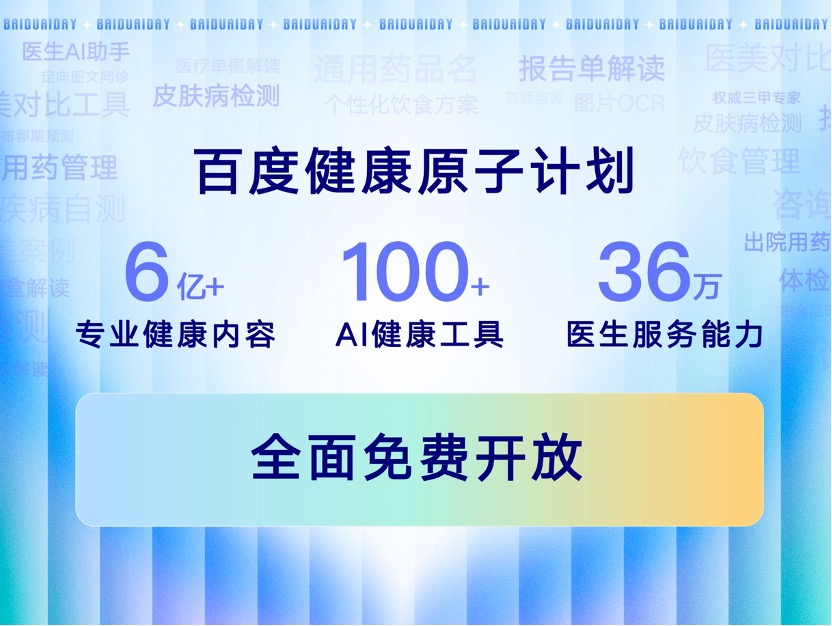
Core Insights - Baidu Health launched three major initiatives at AI DAY: the upgraded Wenxin Health Steward, the Atomic Open Plan, and the Dr.Flow creative platform [1][3][6] Group 1: Wenxin Health Steward - The Wenxin Health Steward aims to provide a one-stop service for families, covering disease prevention, knowledge acquisition, and health management [1] - Since the launch of the Baidu Health AI Steward on October 18, the total order volume for AI and human services has exceeded 47 million, achieving a tenfold increase compared to previous human-only services [3] - The vision is to ensure that every family in China has access to a dedicated doctor, addressing the challenges posed by the current healthcare system, where one general practitioner serves an average of 835 families [3] Group 2: Atomic Open Plan - The Atomic Open Plan is designed to share health AI capabilities across the industry, offering authoritative content, doctor services, and over 100 AI health tools for free [6] - This initiative aligns with national policies promoting the integration of healthcare services with information technology and encourages social participation in health service system construction [6] - The plan includes access to 600 million pieces of professional health content and 360,000 professional doctor services, facilitating collaboration with hospitals, pharmaceutical companies, insurance institutions, and health app developers [6] Group 3: Dr.Flow Creative Platform - Dr.Flow is the first AI creative platform tailored for health professionals, addressing the imbalance between high demand for health education content and the limited supply [8] - The platform allows health professionals to create content efficiently, reducing the time required to produce a video from an average of 10 hours to just 10 minutes [8] - It features a comprehensive library of over 1.5 million compliant medical materials and supports easy distribution and monetization of content, enabling professionals to focus on refining their expertise [8]
国产AI芯片看两个指标:模型覆盖+集群规模能力 | 百度智能云王雁鹏@MEET2026
量子位· 2025-12-18 02:34
Core Viewpoint - The article discusses the challenges and opportunities for domestic AI chips, particularly Baidu's Kunlun chip, in supporting large-scale training for next-generation models, amidst the ongoing dominance of Nvidia in the market [1][5]. Group 1: Challenges in Large-Scale Training - The evaluation of chip capabilities has shifted from mere computational power to the ability to stably support training for models ranging from hundreds of millions to trillions of parameters [1][5]. - The first major challenge is cluster stability, where any interruption in a large-scale training system can lead to significant downtime, especially in systems with thousands of GPUs [7][10]. - The second challenge involves achieving linear scalability in large clusters, which requires advanced communication optimization and system-level coordination [10][11]. - The third challenge is the model ecosystem and precision system, where Nvidia's extensive model ecosystem provides a competitive edge in training accuracy [15][19]. Group 2: Solutions and Strategies - To address cluster stability, the company emphasizes the need for detailed monitoring and verification to preemptively identify potential issues [8][9]. - For scalability, the company has developed a communication strategy that bypasses CPU limitations, allowing for optimized task management across different workloads [14][20]. - The company is focusing on a highly generalized operator system to ensure reliability in large-scale training, adapting to various model sizes and shapes [19][27]. Group 3: Current Developments and Future Directions - The company has successfully implemented large-scale training with its Kunlun chip, achieving significant results with models like Qianfan-VL and Baidu Steam Engine, which have demonstrated state-of-the-art performance in various tasks [28][30]. - The future direction includes expanding the capabilities of domestic chips to support even larger clusters and more complex models, aiming for a comprehensive coverage of major model systems [27][31]. - The article highlights the importance of binding advanced self-developed models to the Kunlun chip to enhance its acceptance and performance in the market [29].

8 个月 50 亿产值,非程序员用秒哒赚疯了?秒哒如何解决后端难、token 贵、屎山烦
AI前线· 2025-12-18 00:40
Core Insights - The article emphasizes that the most valuable opportunity in the industry currently lies in AI Coding, with the no-code tool "秒哒" (MiaoDa) generating significant value and user engagement globally [2] - The tool has been widely adopted, serving over 10 million users and creating more than 5 billion yuan in value across various application scenarios [2] User Demographics and Needs - 81% of MiaoDa's users are non-programmers, primarily from the workforce and academic sectors, highlighting the challenge of articulating complex application needs [3] - The team has designed a unique approach to address this issue, differentiating MiaoDa from similar products by enhancing the "demand communication phase" [4] Demand Communication and User Experience - MiaoDa employs a "Product Manager AI" to facilitate deeper conversations with users, transforming vague requests into structured product documentation [4][6] - This design significantly lowers the barrier for expression and reduces the risk of rework due to unclear requirements [6] Strategy and Development Focus - The current strategy prioritizes building a robust foundational capability to ensure a smooth user experience, with plans to develop vertical versions tailored to specific business needs in the future [7] - MiaoDa also offers a deep research mode for complex business requirements, integrating with mainstream AI platforms for enhanced functionality [7] Backend Challenges and Solutions - The article discusses the challenges in backend capabilities, leading to the emergence of the BaaS (Backend as a Service) concept, with MiaoDa being recognized as a leading player in this space [9] - Key challenges include ensuring stable and efficient cloud database operations, integrating AI with databases, and managing underlying resources effectively [9][10][11] Product Experience and User Accessibility - MiaoDa aims to simplify complex database capabilities into an easy-to-use product experience, achieving a significant advantage by allowing users to complete integrations in one conversation without external configurations [12] - The article highlights the importance of maintaining code quality and preventing "code bloat" through careful review and structured development processes [15] Competitive Landscape and Future Outlook - The article concludes that while China has started its Vibe Coding development 1-2 years later than abroad, the competitive gap is narrowing, with Chinese products expected to catch up rapidly [17] - The core competitive advantages in Vibe Coding products are identified as strong code generation capabilities and superior user experience [17]

武汉人工智能产业规模今年有望破千亿元
Chang Jiang Ri Bao· 2025-12-18 00:34
Core Insights - The 2025 Wuhan Artificial Intelligence Industry Cooperation and Exchange Conference focused on deepening industry cooperation and demand alignment in the AI sector [1] - Wuhan has implemented multiple policies to support breakthroughs in AI technology and industry, positioning itself as a key player in national strategic layouts [1][2] - The city aims to create a top-tier business environment to attract AI companies and ensure their growth and comfort [1] Industry Development - Wuhan's AI industry is projected to reach a scale of 70 billion yuan in 2024, with an annual growth rate exceeding 30% over the past three years, and is expected to surpass 100 billion yuan this year [2] - The city has over 1,000 AI companies, ranking fourth nationally with nine firms listed in the 2025 Forbes China AI Technology Companies Top 50 [2] - Notable products such as the Chucai series humanoid robots and various "national first" innovations in domestic databases and AI chips for smart vehicles have emerged from Wuhan [2] Company Perspectives - Executives from companies like Ruile Wisdom and Qianxun Intelligent expressed strong confidence in Wuhan's AI industry, highlighting its robust advantages and the presence of a national-level cybersecurity base [2] - Qianxun Intelligent plans to establish its Central China headquarters in Wuhan, leveraging the city's industrial radiation capabilities to expand into the central region market [2] - Attendees at the conference unanimously recognized Wuhan's foundational strengths in AI development, including talent, platforms, scenarios, ecosystems, and supportive policies [2]


带“崩了”!科技股,全线大跌!金价,大涨!
Zhong Guo Ji Jin Bao· 2025-12-18 00:28
Core Viewpoint - Oracle's significant stock drop has triggered a collective decline in major tech stocks, with the Nasdaq falling over 400 points, reflecting investor concerns about the company's debt levels and spending [2][3][7]. Group 1: Market Performance - The three major U.S. stock indices closed lower, with the Dow Jones down 0.47%, the S&P 500 down 1.16%, and the Nasdaq down 1.81% [3][4]. - The Nasdaq China Golden Dragon Index fell by 0.73%, with notable declines in Alibaba, JD Group, and Bilibili [12]. Group 2: Oracle's Situation - Oracle's stock dropped by 5.41% after a major investor withdrew from a $10 billion data center project in Michigan, raising concerns about the company's financial health [6][7]. - Blue Owl Capital's withdrawal was attributed to market worries regarding Oracle's debt levels and expenditure, although Oracle denied the report and stated that the project is still progressing [7]. Group 3: Broader Tech Sector Impact - Major tech stocks experienced declines, with Tesla down 4.62%, Nvidia down 3.81%, and Google down 3.14% [9][11]. - Google is reportedly enhancing its AI chip capabilities to better support PyTorch, aiming to challenge Nvidia's dominance in the AI chip market [9]. - Amazon announced a restructuring of its AI-related project teams, integrating its general AI team with its chip development and quantum computing research [10]. Group 4: IPO and Commodity Market - Medline's IPO saw a first-day increase of 41.38%, raising $6.26 billion, indicating strong investor interest in healthcare-related stocks [15]. - International gold prices and crude oil rebounded, with gold prices rising by 0.82% and crude oil prices increasing by nearly 3% due to geopolitical risks and strong demand [17][18].




马斯克预测某车企:必死;“天才少女”罗福莉首秀,称小米开源模型全球前二;好特卖回应新加盟叫停;玛莎拉蒂APP遭下架丨邦早报
创业邦· 2025-12-18 00:07
Group 1 - Elon Musk predicts Ford's electric strategy will lead to its demise, citing a $19.5 billion asset impairment and the halt of F-150 Lightning production as key factors [3] - Tesla's market value surpassed $1.6 trillion, with a single-day increase of $48.5 billion, reflecting investor confidence in electric vehicle technology [3] - Xiaomi's new model, MiMo-V2-Flash, has been released and is capable of deep thinking and real-time data retrieval, indicating advancements in AI capabilities [18] Group 2 - Luckin Coffee is reportedly considering acquiring Blue Bottle Coffee, although Blue Bottle has not confirmed this information [13] - OpenAI is in talks with Amazon for a potential investment of at least $10 billion, which could elevate OpenAI's valuation to over $500 billion [14] - Databricks has completed over $4 billion in Series L funding, raising its valuation to $134 billion, indicating strong investor interest in data and AI sectors [17] Group 3 - BYD has initiated comprehensive testing for L3 autonomous driving in Shenzhen, completing over 150,000 kilometers of real-world validation [18] - The Chinese music theater market is projected to generate over 1.8 billion yuan in ticket revenue by 2025, with a growing number of performances and audience engagement [22] - The foldable smartphone panel shipment is expected to grow by 46% in 2026, driven by Apple's first foldable device, with Samsung Display likely to capture over 50% market share [22]