BIDU(BIDU)

Search documents
百度集团-SW(09888):百度集团-SW(9888.HK)2025年四季报业绩前瞻:广告业务企稳为主,AI云业务支撑中长期逻辑
EBSCN· 2026-02-04 07:07
2026 年 2 月 4 日 4、业务进展:AI 应用与自动驾驶持续推进,商业化仍处早期。自 25Q3 起公 司开始单独披露 AI 应用进展,涵盖文库、网盘、企业级 AI 工具及出海产品 等,对其商业化前景持偏积极态度,强调其与 AI 云、昆仑芯的协同效应。自 动驾驶方面,Robotaxi 订单量保持加速增长,公司已公告与 Uber、Lyft 达 成合作,并明确将于英国推进无人驾驶出租车试运行,标志着其国际化布局迈 出实质性一步;但相关业务仍处于投入与规模扩张阶段,对短期业绩贡献有限。 5、昆仑芯:自研算力平台协同价值提升,短期仍以战略支撑为主。昆仑芯作 为百度自研 AI 芯片与算力平台的重要组成部分,市场关注度持续提升。昆仑 芯深度参与百度智能云的整体交付,同时开始面向通信、金融、能源、制造等 行业,成为"云+算力"解决方案的一部分。26 年初公司公告建议分拆昆仑芯 独立上市,旨在提升昆仑芯在客户、供应商及潜在战略合作伙伴中的形象,并 增强其在业务谈判中的地位,使公司可通过持有的股份受益于昆仑芯的增长。 盈利预测、估值与评级:AI 原生广告提升传统搜索广告变现能力;自研大模 型+计算平台+自研芯片形成软硬协 ...

AI打开2026年新春消费新空
Xin Hua She· 2026-02-04 02:41
Group 1 - Alibaba's Qianwen App has launched a "Spring Festival Treat Plan" with an investment of 3 billion yuan, collaborating with various Alibaba ecosystem businesses to distribute cash red envelopes and offer free order opportunities [1] - Tencent and Baidu have also initiated similar promotional activities, with Tencent distributing 1 billion yuan in cash red envelopes through its Yuanbao App and Baidu offering 500 million yuan in cash red envelopes for users of its app [1] - Multiple internet platforms are engaging in marketing activities to promote their AI capabilities during the Spring Festival, indicating a competitive landscape focused on capturing consumer spending potential [1] Group 2 - AI technology is enhancing consumer demand in the market, with applications providing personalized recommendations based on real-time data, such as air quality and dietary needs [2] - The integration of AI in consumer products is shifting the focus from simple recommendations to understanding consumer needs through contextual awareness [2] - Xiaomi and Ant Group have introduced new functionalities in AI glasses, showcasing the ability to execute consumer decisions in real-world scenarios, indicating a growing trend in AI-driven consumer electronics [3] Group 3 - The demand for AI-driven consumer products is expected to rise significantly, with projections indicating that sales of smart products on JD.com will more than double by 2025 [3] - The Chinese government's "Artificial Intelligence +" initiative aims to enhance consumer quality through the development of smart products and integrated environments [3] - The year 2026 is anticipated to be pivotal for the widespread adoption of AI consumer terminals, as indicated by industry reports [3] Group 4 - The surge in AI-driven consumer activities during the Spring Festival is supported by robust computing power, with Alibaba Cloud preparing for potential traffic spikes to ensure stable operations [4] - The increasing demand for AI applications during peak consumption periods necessitates enhanced computing capabilities to improve consumer experiences and reduce operational costs for businesses [4]



发红包能否换来AI刚需
Bei Jing Ri Bao Ke Hu Duan· 2026-02-04 01:50
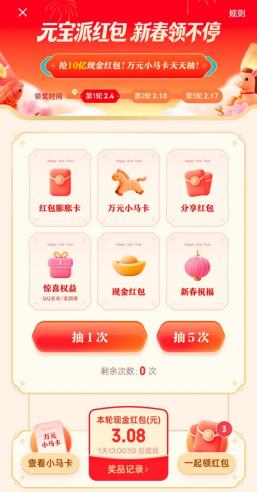
本报记者 袁璐 春节临近,互联网巨头间的"红包大战"再度打响。腾讯元宝抢先出手,撒出10亿元现金红包;百度紧随 其后,投入5亿元加入战局;阿里千问则启动规模达30亿元的"春节请客计划"。 这场亿元级别的"红包雨",背后是大厂对AI(人工智能)流量入口的激烈争夺,各家都想复刻当年微信 通过红包引爆市场的成功。但行业专家指出,若后续产品力不足,热闹可能只是"昙花一现"。唯有把短 期流量转化为真实的用户习惯,才是实现长效增长的关键。 春节红包大战再起 2月2日,阿里巴巴旗下AI助手"千问"宣布将于6日正式上线总额30亿元的"春节请客计划"。该计划联合 淘宝闪购、飞猪、大麦、盒马等阿里系业务,以"免单"形式为用户提供消费福利。 1月25日,腾讯元宝宣布将分10亿元现金红包,活动自2月1日持续至17日,单个红包最高可达万元。同 日,百度也宣布,1月26日至3月12日期间,在百度App使用文心助手可参与瓜分5亿元现金红包,最高 奖励同样为1万元。 记者注意到,与以往"直接撒钱"不同,此次三家公布的红包活动均与AI产品功能进行了深度绑定。 腾讯元宝的红包玩法植根于其社交生态。用户可通过每日登录、完成任务抽奖、分享至微信或Q ...

AI与机器人盘前速递丨百度阿里打响春晚 AI 流量战,人形机器人创新中心融资7亿!
Mei Ri Jing Ji Xin Wen· 2026-02-04 01:16
3.武汉经开区企业武汉市龙点睛智能科技有限公司自研的"龙点睛穿刺手术导航设备",近日获国家药监 局三类医疗器械审批并上市,该设备可助力医生安全、精准、高效开展肺结节活检、肿瘤消融等微创手 术。 【机构观点】 东方证券研报称,机器人板块确定性加强,后续设备性能将大幅提升,有望加速在工业及C端场景的需 求突破,人形机器人市场空间进一步打开,催生投资机会;机器人拟人化趋势将带动传感器、电子皮肤 等相关零部件需求,而国内在汽车、工程机械零部件领域已验证优秀制造与管理能力的公司,有望在该 赛道占据更高份额。 (文章来源:每日经济新闻) 【市场复盘】 本周二(2月3日),A股人工智能与机器人赛道爆发,相关主题ETF强势上涨,普涨格局凸显市场做多热 情。机器人ETF(562500)早盘高开后在日均线附近盘整,午后持续拉升冲高,最新价1.072元,较开盘价 上涨2.682%。持仓层面,66只成分股中62只同步上涨,普涨态势鲜明,科瑞技术强势涨停,中控技术 等4只个股涨超6%形成强劲跟涨梯队,无明显下跌标的拖累盘面。流动性方面,成交额达11.29亿元, 换手率4.54%,成交活跃度稳居高位,量能充分支撑上涨走势。科创人工智能E ...

百度阿里打响春晚 AI 流量战,人形机器人创新中心融资7亿!
Mei Ri Jing Ji Xin Wen· 2026-02-04 01:09
【市场复盘】 本周二(2月3日),A股人工智能与机器人赛道爆发,相关主题ETF强势上涨,普涨格局凸显市场做多热 情。机器人ETF(562500)早盘高开后在日均线附近盘整,午后持续拉升冲高,最新价1.072元,较开盘价 上涨2.682%。持仓层面,66只成分股中62只同步上涨,普涨态势鲜明,科瑞技术(002957)强势涨 停,中控技术等4只个股涨超6%形成强劲跟涨梯队,无明显下跌标的拖累盘面。流动性方面,成交额达 11.29亿元,换手率4.54%,成交活跃度稳居高位,量能充分支撑上涨走势。科创人工智能ETF华夏 (589010)早盘高开后小幅回落,午后震荡上行,最新价1.594元,较开盘价上涨2.179%。持仓层面,30只 成分股做多力量集中释放,28只个股同步走涨,思看科技大涨9.90%领涨,芯原股份等3只个股涨超7% 形成跟涨梯队;仅寒武纪跌超9%形成个别拖累,对盘面影响有限。流动性方面,成交额8889万元,换 手率3.47%,成交活跃度维持高位,场内交投情绪热烈;资金端表现积极,昨日净流入1900万元资金, 彰显市场对赛道上涨的坚定信心。 【热点要闻】 1.2月3日百度、阿里同日官宣2026年春晚相关合 ...
巨头资本支出继续增加,上游普遍涨价,应用持续落地
SINOLINK SECURITIES· 2026-02-04 00:45
Investment Rating - The report indicates a positive investment outlook for the technology sector, particularly in AI and cloud computing, with significant capital expenditures from major players like Meta, Microsoft, and Alibaba [6][31]. Core Insights - Major tech companies are increasing capital expenditures to enhance AI capabilities, with Meta's projected spending reaching between $115 billion and $135 billion for the year [5][31]. - AI demand remains strong, with companies like OpenAI and Anthropic accelerating their growth and preparing for IPOs, indicating a robust market for AI applications [4][11]. - The report highlights a shift in pricing strategies among cloud service providers, with Google Cloud and Amazon AWS raising prices for data transmission and machine learning services, marking a departure from the long-standing trend of price reductions [20][21]. Industry Frontiers - OpenAI has raised over $100 billion in funding, with a valuation of $830 billion, and is preparing for an IPO in Q4 2026 [4][11]. - Anthropic has revised its revenue projections, expecting a threefold increase in sales this year, potentially reaching $18 billion, and over $55 billion next year [11][12]. - ByteDance is set to release a new AI model in mid-February, aiming to capture a larger share of the AI market in China [12][27]. Capital Trends - Google Cloud announced a price increase for global data transmission services effective May 2026, with Amazon AWS also raising prices for its machine learning services by approximately 15% [5][20]. - Meta has secured a $6 billion long-term supply agreement with Corning for fiber optic cables, emphasizing the importance of infrastructure in AI development [21]. - Alibaba is considering increasing its investment in AI infrastructure and cloud computing from 380 billion to 480 billion yuan over the next three years [25][26]. Weekly Perspectives - The report notes that AI investments are yielding positive results for companies like Meta, with improved user engagement and advertising performance [31][32]. - The demand for AI infrastructure is expected to surge, driven by the increasing need for advanced computing capabilities [32]. - The report anticipates a significant growth in the number of ASIC chips required for AI applications, projecting a boom in demand from 2026 to 2027 [32]. Industry Chain Data Updates - In December, China's smartphone market saw a significant decline in sales, with Huawei maintaining the largest market share [34]. - The PC market experienced a mixed performance, with desktop sales increasing while laptop sales declined [35].


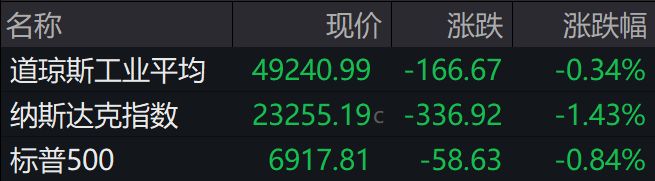
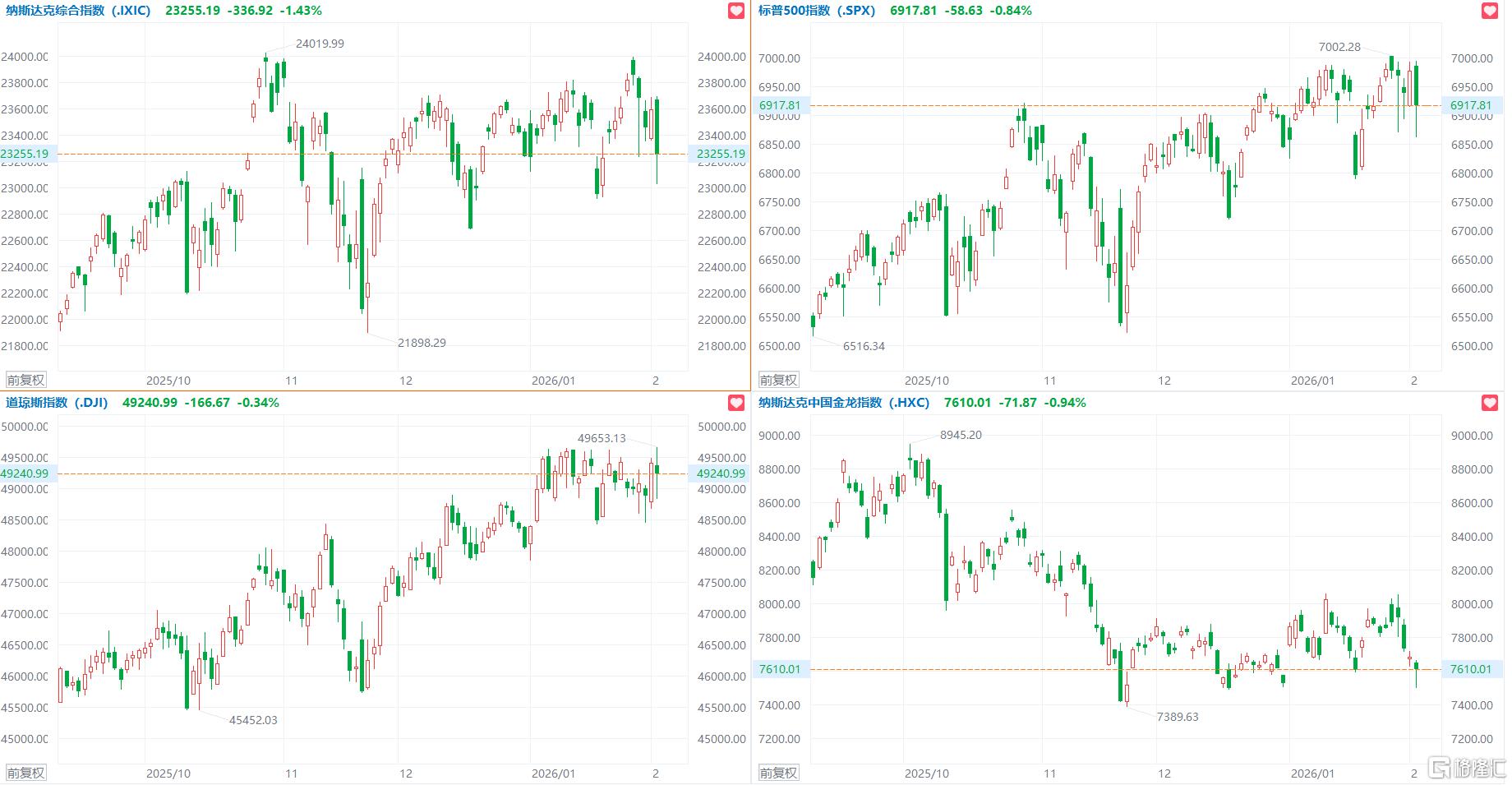
纳指收跌1.43%,沃尔玛市值首次突破1万亿美元,中概指数跌0.94%
Ge Long Hui· 2026-02-04 00:33
Market Overview - The three major U.S. stock indices closed lower, with the Dow Jones down 0.34%, the Nasdaq down 1.43%, and the S&P 500 down 0.83% [1] - Popular technology stocks experienced declines, with Broadcom falling over 3%, and Microsoft, Nvidia, and Meta each dropping over 2% [1] Sector Performance - The rare earth, non-ferrous metals, and precious metals sectors saw significant gains, with gold resources rising over 20%, Southern Copper up over 11%, Americas Silver up over 8%, and Pan American Silver up over 5% [1] - Conversely, application software, cryptocurrency, and weight loss drug stocks faced notable declines, with Novo Nordisk down over 14%, Coinbase and Circle each down over 4%, and Eli Lilly and Pfizer each down over 3% [1] Notable Company Movements - Walmart's stock increased by 2.94%, marking its market capitalization surpassing the $1 trillion milestone for the first time [1] - The Nasdaq Golden Dragon China Index fell by 0.94%, with significant declines in popular Chinese stocks such as Daqo New Energy down 5.6%, Bilibili down 4%, and Kingsoft Cloud down 3.5% [1] - Alibaba dropped 2.9%, while NIO rose 0.8%, Pony.ai increased by 2%, Huazhu up 2.2%, New Oriental up 2.3%, Li Auto up 2.7%, Canadian Solar up 4.1%, and Xpeng up 4.3% [1]


8点1氪:周生生再发声明,回应足金挂坠检测出含铁银钯;大润发母公司辟谣CEO被警方带走;极氪8X信息遭提前泄露
36氪· 2026-02-04 00:18
Group 1 - The core issue revolves around the quality concerns of Chow Sang Sang's gold pendants, which were found to have varying gold content levels, with the highest at 99.99% and the lowest at 64.37%, showing a difference of 35.62% [3][5] - Chow Sang Sang's official response emphasized that all their gold products meet national standards, with a gold content of no less than 990‰, and they are taking the matter seriously by conducting further tests [5][3] - The company has sent the same batch of products for testing to the National Gemstone and Jewelry Testing Center, which confirmed the gold content as 99.99% in multiple tests [5][3] Group 2 - The market is experiencing significant volatility, with various sectors, including precious metals, facing sharp declines due to panic selling and high leverage [17][12] - The domestic automotive market is showing a clear divide, with traditional brands like SAIC and Geely seeing over 20% growth, while new energy vehicle startups are facing collective declines [17] - The gaming industry is under scrutiny for potential tax adjustments, with rumors causing stock price drops among major companies like Tencent, although these rumors have been deemed unreliable [14][12]



红包里的国产AI芯片,才是未来
3 6 Ke· 2026-02-04 00:07
Group 1 - The core point of the article highlights the significant escalation in AI promotion during the Spring Festival, with major companies like Tencent, Baidu, and Alibaba launching massive cash red envelope campaigns to engage users and showcase AI capabilities [1][2][10] - Tencent's Yuanshuo APP initiated a record-breaking 1 billion yuan red envelope campaign, while Baidu followed with a 500 million yuan initiative, and Alibaba's Qianwen APP announced a 3 billion yuan "Spring Festival Treat" plan [2][5][7] - The competition among these tech giants is not just about user acquisition but also about establishing a strong foothold in the AI landscape, with the outcomes of user retention post-festival being crucial for determining market leadership [10][12] Group 2 - The article discusses the underlying "chip war" that supports the AI applications, emphasizing that the high concurrency demands during these promotional events are met by domestic AI chips rather than Nvidia's GPUs [12][13] - The landscape of the Chinese AI chip market is undergoing a dramatic shift, with Nvidia's market share in high-end training chips dropping from 95% to 0% due to U.S. export restrictions, allowing domestic companies to gain ground [14][15][16] - Predictions indicate that by 2026, Huawei is expected to dominate the Chinese AI chip market with a 50% share, while other companies like AMD, Cambricon, and Haiguang will follow with significantly smaller shares [17][18] Group 3 - The rise of domestic AI chips is marked by several companies achieving substantial order volumes, with Huawei Ascend and Baidu Kunlun being among the largest suppliers [23][24] - Despite the rapid growth of domestic AI chips, there remains a significant performance gap compared to Nvidia, prompting a focus on optimizing chip usage and system architecture to enhance competitiveness [25][26][30] - The article concludes that while the promotional activities may end, the advancements in AI chip technology are just beginning, indicating a potential shift in the global AI semiconductor landscape [32][34]

盘前必读丨“十五五”首个中央一号文件来了;美股收跌贵金属逆势大涨
Di Yi Cai Jing Zi Xun· 2026-02-04 00:01
Group 1 - The Chinese central bank announced a reverse repurchase operation of 800 billion yuan to maintain liquidity in the banking system, with a term of 3 months [2] - The Shanghai Stock Exchange reported a significant increase in new A-share accounts, with 4.9158 million new accounts opened in January 2026, a month-on-month increase of approximately 89% and a year-on-year increase of about 213% [2] - The Paris prosecutor's office conducted a search of the office of the social media platform X, owned by Elon Musk, as part of an investigation into cybercrime [3] Group 2 - Major U.S. stock indices experienced declines, with the Dow Jones down 0.34%, S&P 500 down 0.84%, and Nasdaq down 1.43%, nearly erasing gains made since the beginning of the year [3][4] - Large technology stocks faced pressure, with Nvidia down 2.84%, Microsoft down 2.87%, and Amazon down 1.79% [4] - The Nasdaq Golden Dragon China Index fell by 0.94%, with Alibaba down 2.81% and Tencent Holdings ADR down 3.33% [4] Group 3 - Commodity markets saw a rebound in gold and silver prices after two days of significant declines, with spot gold rising 5.2% to $4,906.82 per ounce [5] - Crude oil prices slightly rebounded, with WTI crude oil futures increasing by 1.72% to $63.21 per barrel [5] - Several companies announced significant developments, including a change in controlling shareholder for Jiatang and a fundraising plan for Xuguang Electronics [5]