Goldman Sachs(GS)

Search documents
Goldman Sachs: Buy, Sell, or Hold in 2026?
Yahoo Finance· 2026-01-22 14:05
Core Insights - Goldman Sachs' stock has experienced significant growth, increasing over 232% in the past five years and over 51% in the past year [1] Company Overview - Goldman Sachs is one of the oldest and most prominent investment banks, advising on mergers and acquisitions (M&As) and initial public offerings (IPOs), as well as helping companies raise debt [2] - The company has a strong presence in fixed-income and equities trading [2] Market Conditions - Market conditions significantly influence Goldman's performance; low interest rates and favorable conditions lead to increased M&As and IPOs, resulting in higher fees [3] - Prior to 2025, regulatory challenges and high interest rates hindered M&A and IPO activities [3] - In 2025, a more favorable M&A environment and lower interest rates contributed to a resurgence in IPOs and deal-making activity [4] Operational Improvements - Goldman Sachs has improved operational efficiency by abandoning a consumer lending initiative that was not yielding satisfactory returns and by reducing its on-balance-sheet alternative investment holdings [5] - The company is exploring entry into prediction markets, with a team currently assessing integration opportunities with existing businesses [6] Valuation and Investment Outlook - The stock is currently trading at a high valuation, which is justified by expectations of a strong year for M&As and IPOs [8] - While the stock's valuation is high, it is suggested that current investors hold the stock, with potential buying opportunities on dips [8]

高盛上调今年黄金目标价:从4900美元升到5400美元!我们普通人现在入场还来得及吗?
Sou Hu Cai Jing· 2026-01-22 13:55
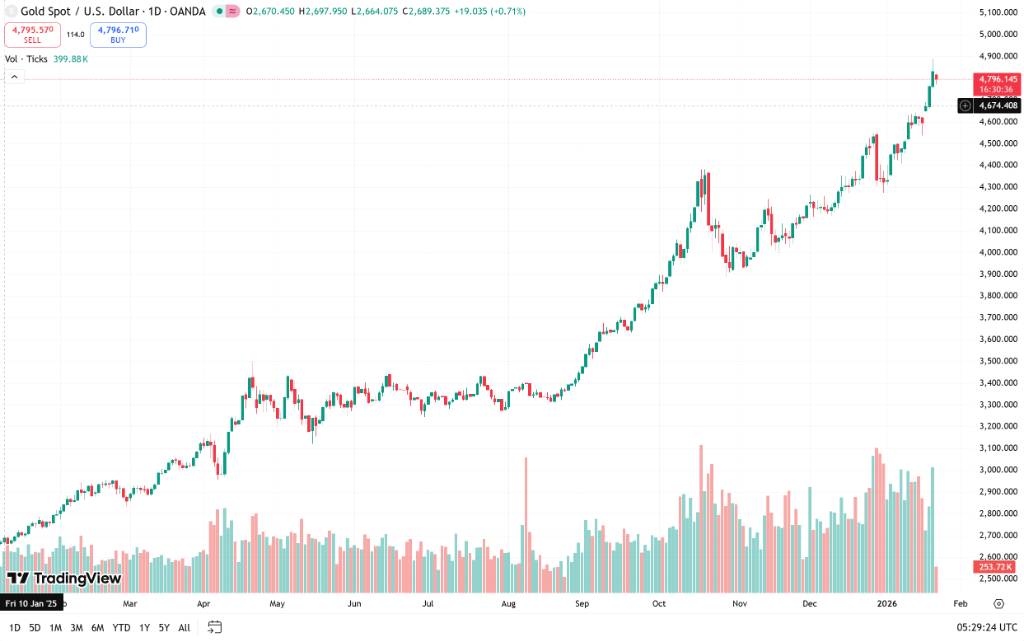
王爷说财经讯:看好,十分看好!上调预期! 你敢信吗?就在今天,华尔街的"带头大哥"高盛彻底掀翻了桌子! 发生了什么?1月22日,高盛突然发布了一份让整个金融圈炸锅的研报, 直接把2026年底的黄金目标价,从之前的4900美元/盎司,硬生生拔高到了5400美 元!这可是整整500美元的涨幅,相当于目前很多人好几个月的工资! 什么情况?现在的金价不是还在4800美元附近震荡吗?高盛凭什么敢拍着胸脯说还能大涨30%?这究竟是机构的"诱多"陷阱,还是真正的财富大风口?我们 普通人到底还能不能上车? 01、黄金大涨背后:谁在背后疯狂"扫货"? 别被那些复杂的K线图吓住了,高盛这次调价的逻辑其实简单得可怕: 买的人太多了,根本停不下来! 这背后主要有两股"神秘力量"在抢筹码。 第一股力量,是 各国央行,尤其是新兴市场的央行。 你以为只有大妈才爱买金子? 错!现在的央行才是最大的"金主"。 高盛预测,光是2026年这一年,全球央行平均每个月就要买走 60吨黄金! 为什么? 因为他们不傻。 在全球局势动荡、美元信用摇摇晃晃的今天,黄金就是最硬的"压舱石"。 这就好比家里存粮,平时觉得现金好用,真到了荒年,手里有粮才不慌。 各 ...

松资本、弱监管、轻压力测试……特朗普推进华尔街大行步入“去监管时代”?
Hua Er Jie Jian Wen· 2026-01-22 12:48
Core Viewpoint - The article discusses a significant regulatory overhaul in the U.S. banking sector under Trump's administration, aiming to reduce restrictions on banks to foster economic growth and market competitiveness. This "deregulation" movement focuses on loosening capital and operational constraints on banks, which has immediate positive effects on investor returns and bank activities [1][2]. Group 1: Deregulation Measures - The Federal Reserve has reduced the size of its bank regulatory department by approximately 30% and is now focusing only on "significant" risks affecting banks' solvency, rather than administrative details [1]. - The Federal Reserve has approved a comprehensive reform of the annual stress testing process, allowing banks to know the testing standards in advance and provide feedback, which critics argue undermines the rigor of the tests [1][3]. - Major Wall Street firms have responded to the expectations of deregulation by increasing dividends and announcing significant stock buyback plans, with JPMorgan Chase revealing its largest stock repurchase program in history [1]. Group 2: Capital Requirements Changes - New risk capital measurement rules are being negotiated, which will determine required capital based on the risk level of bank assets, significantly reducing capital requirements for large U.S. banks compared to previous proposals [4]. - The regulatory body has finalized plans to relax the supplementary leverage ratio, which previously constrained banks' ability to purchase U.S. Treasury securities and act as market intermediaries [4]. Group 3: Inclusion of Cryptocurrency - Regulatory agencies are actively working to integrate cryptocurrency into the traditional banking system, with the FDIC drafting guidelines on how deposit insurance applies to blockchain digital deposits [5]. - The OCC has approved requests from five cryptocurrency companies to obtain U.S. banking licenses, marking a significant shift from previous regulatory stances that viewed the industry with skepticism [5]. Group 4: Concerns Over Financial Stability - Despite the positive reception from the banking industry regarding deregulation, there are concerns from academics and former officials about potential systemic risks, with warnings that reduced oversight could allow banks to transfer risks to the public [7]. - Critics argue that the current policies represent a reckless combination of deregulation, which could lead to a catastrophic financial crisis, particularly highlighting the bubbles forming in cryptocurrency and artificial intelligence sectors as potential triggers [7].


4900→5400美元!高盛大幅上调黄金目标价
美股研究社· 2026-01-22 11:11
Core Viewpoint - The rules of the gold market have changed, with private sector players entering the market to hedge against global policy risks, alongside central banks [3]. Group 1: Central Bank and Private Sector Dynamics - Goldman Sachs has raised its gold price target for December 2026 to $5,400 per ounce from $4,900, driven by strong central bank purchases, favorable conditions for ETFs due to Federal Reserve rate cuts, and increased demand for safe-haven assets amid geopolitical and policy uncertainties [3][4]. - The past three years of gold price increases can be divided into two phases: 2023-2024, driven by central bank purchases, and 2025 onwards, where the competition for limited bullion between central banks and private investors accelerates the price increase [5][6]. Group 2: Demand Channels and Price Dynamics - The acceleration in gold prices from 2025 is attributed to a "cumulative effect" of demand from both traditional channels, such as Western gold ETFs, and new channels, including high-net-worth families' physical gold purchases and the use of less quantifiable hedging tools like call options [6][7]. - Goldman Sachs emphasizes that the new buying in gold resembles "long-term insurance" rather than event-driven trading, with private sector holdings expected to remain stable through 2026 [8][9]. Group 3: Price Forecast and Contributions - The forecast indicates a 17% increase in gold prices by the end of 2026, with contributions primarily from central bank purchases (approximately 60 tons per month) and a rebound in Western ETF holdings due to anticipated Federal Reserve rate cuts [12][13]. - The report highlights that the "sticky hedges" from private sector demand will help sustain high gold prices, making them a new benchmark rather than a bubble [13][14]. Group 4: Risk Signals and Monitoring - Goldman Sachs notes that while risks exist on both sides, the outlook remains significantly upward, driven by continued private sector demand for gold amid ongoing uncertainties [16]. - Key signals to monitor include whether central bank gold purchases decline, if the Federal Reserve's monetary policy shifts from easing to tightening, and whether macroeconomic policy uncertainties are resolved, as these factors could trigger a reduction in private sector gold holdings [16][17].

黄金牛市难歇,高盛“撕报告”:年底目标价上调至5400美元
Feng Huang Wang· 2026-01-22 10:48
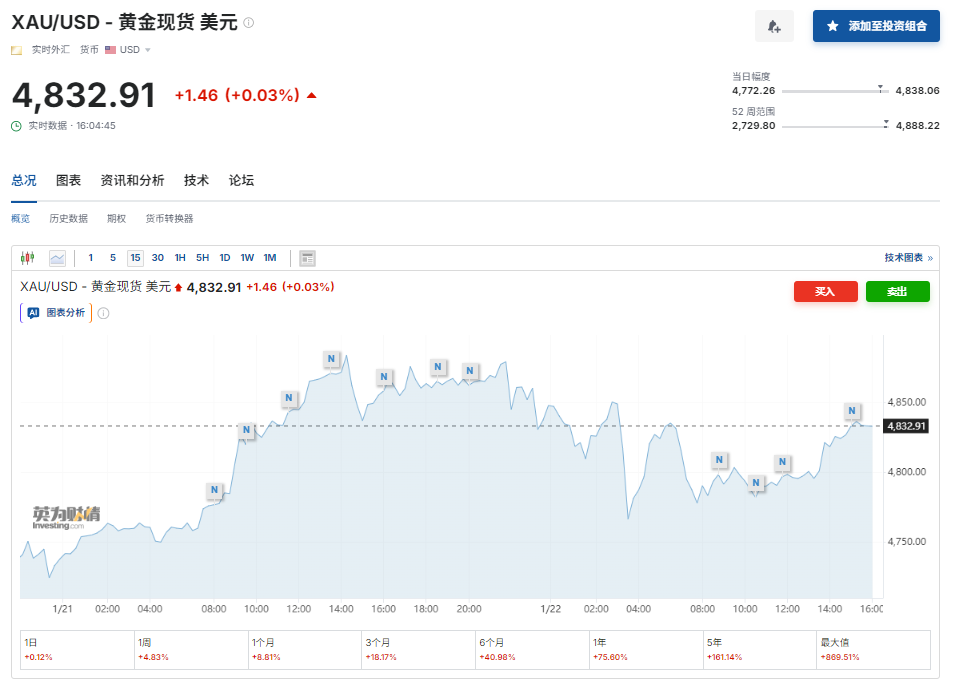
Core Viewpoint - The price of gold is expected to rise significantly, with Goldman Sachs raising its year-end forecast to $5,400 per ounce, reflecting strong demand from private investors and central banks [2][6]. Group 1: Price Trends - Gold prices have surged over 60% since 2025, marking the largest increase since 1979, despite some fluctuations this year [1]. - As of the latest report, gold prices are hovering around $4,830 per ounce, having increased approximately 11% this year and more than doubled since early 2023 when prices were around $1,865 per ounce [2][6]. - Analysts predict that gold prices will break the $5,000 mark this year due to declining real interest rates and ongoing diversification efforts away from the dollar [8][9]. Group 2: Demand Drivers - The demand for gold is being driven by private sector investments, with high-net-worth families purchasing physical gold and investors buying call options [6]. - Central banks are expected to average monthly gold purchases of 60 tons, as they diversify their assets and compete with private investors for limited gold supplies [6]. - The demand for gold as a hedge against global macroeconomic risks is anticipated to remain stable, with private investors showing increased "stickiness" in their positions [6]. Group 3: Supply Dynamics - The supply of gold remains stable, as the majority of gold already exists and new production accounts for only about 1% of the total global supply [7]. - Gold prices typically only stop rising when demand weakens, such as during geopolitical easing or when central banks feel less need to diversify [7]. Group 4: Market Sentiment - There is a growing optimism on Wall Street regarding gold prices, with analysts expecting a continued upward trend due to geopolitical tensions and the search for safe-haven assets [8][9]. - The London Bullion Market Association's survey indicates that analysts expect gold prices to reach $5,400 per ounce this year, reflecting a robust long-term trend rather than speculative peaks [9].
高盛:黄金价格预测上调至5400美元/盎司
Zheng Quan Shi Bao· 2026-01-22 08:29
高盛最新发布的研报中提到,将2026年12月的黄金价格预测上调至5400美元/盎司(此前为4900美元/盎 司),判断主要假设私人部门投资者为对冲全球政策风险进行多元化配置,且在2026年不会抛售其黄金 持仓,从而有效抬升了价格预测的起点。 高盛研究团队预测,到2026年底,金价将较1月当月至今均价上涨17%(或较现货价格上涨13%)。支 撑因素主要包括:2026年央行购金月均将达到60吨,因为新兴市场央行可能继续将黄金作为其储备结构 性多元化选择;随着美联储在2026年将基金利率下调50个基点,西方市场黄金ETF持仓将上升;预计全 球宏观政策风险的对冲头寸将保持稳定,因为财政可持续性等风险在2026年可能不会完全化解。 此外,高盛研究团队提示称,若市场对全球财政/货币政策长期路径的感知风险大幅降低,并导致宏观 政策对冲头寸被平仓,则将构成金价下行风险。 责任编辑:刘万里 SF014 高盛最新发布的研报中提到,将2026年12月的黄金价格预测上调至5400美元/盎司(此前为4900美元/盎 司),判断主要假设私人部门投资者为对冲全球政策风险进行多元化配置,且在2026年不会抛售其黄金 持仓,从而有效抬升了价格 ...
黄金牛市未完?高盛上调年底金价预测至5400美元
智通财经网· 2026-01-22 07:12
高盛分析师Daan Struyven和Lina Thomas在1月21日的一份报告中写道,高盛上调的前提是,那些将黄金 作为对冲宏观政策风险工具的私人投资者将在今年年底前继续持有这些仓位。 分析师表示,与以往针对特定事件(例如2024年11月美国大选)的对冲策略不同,针对诸如财政可持续性 等预期风险而采取的仓位可能不会在今年完全消除,因此更具"粘性"。 过去12个月,黄金价格上涨超过70%,在持续到今年年初的强劲涨势中屡创新高。随着全球力量格局发 生剧烈变化,以及特朗普再次抨击美联储,动摇了人们对美联储独立性的信心,资本正涌向避险资产。 智通财经APP获悉,高盛将年底黄金价格预测上调超过10%,反映出再各大央行和交易所交易基金 (ETF)需求强劲的基础上,私人部门对黄金的投资日益多元化。高盛将2026年12月的黄金价格目标从之 前的每盎司4900美元上调至5400美元。 与此同时,自2025年初以来,西方ETF持有的黄金数量已增加约500吨,超过了仅基于美国降息预期得 出的预测。高盛预计美联储将在2026年进一步放松货币政策50个基点。 高盛表示,随着市场对主要经济体长期货币和财政政策走向的担忧加剧,与所谓" ...
高盛首席中国经济学家闪辉:看好2026年中国出口增长
Zhong Guo Jing Ying Bao· 2026-01-22 06:48
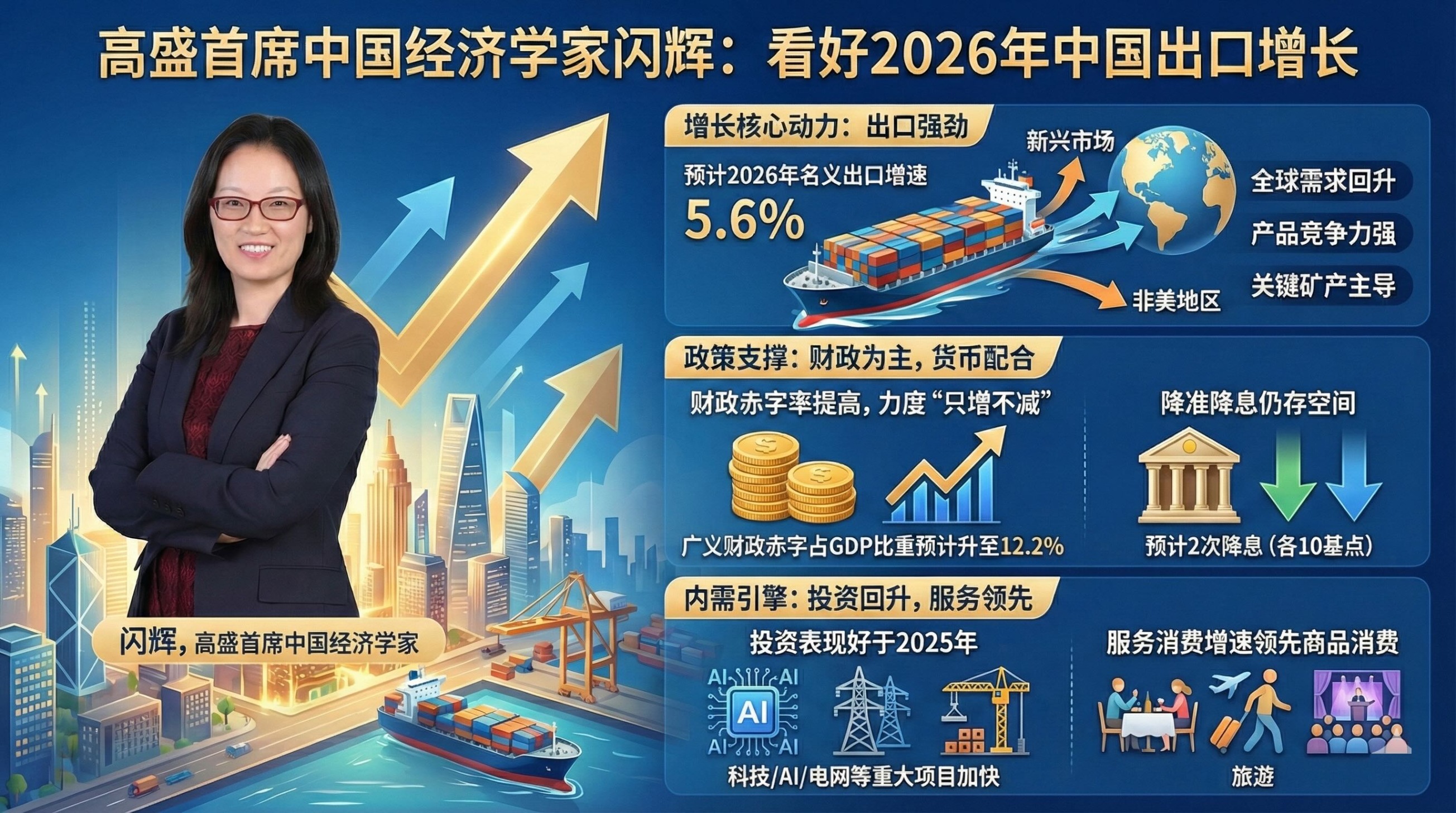
Monetary Policy - The People's Bank of China is expected to implement two interest rate cuts in 2026, each by 10 basis points, with room for further reductions in reserve requirements and interest rates [3][4] - The average reserve requirement ratio for financial institutions is currently 6.3%, indicating potential for a reduction [3] Fiscal Policy - The fiscal deficit rate is projected to increase from 11% of GDP in 2025 to 12.2% in 2026, with overall spending expected to increase in key areas [3][4] - The Ministry of Finance emphasizes that the total scale of fiscal deficits, debt, and expenditures will be maintained at necessary levels to ensure spending does not decrease [4] Economic Growth - China's exports are anticipated to remain strong in 2026, driven by global economic growth, expansion into emerging markets, and China's competitive product strength [5] - In 2025, China's total foreign trade reached 45.47 trillion yuan, a 3.8% increase year-on-year, maintaining its position as the world's largest goods trader [4][5] Investment Outlook - Investment performance in 2026 is expected to improve compared to 2025, with significant projects in technology, AI, and power grids likely to accelerate [5] Consumer Trends - Consumption is expected to show structural differentiation, with service consumption growth outpacing that of goods consumption in 2026 [6]
高盛上调2026年底金价目标至5400美元
Sou Hu Cai Jing· 2026-01-22 06:38
高盛表示,此次调价的核心逻辑在于私人部门为对冲全球宏观与政策不确定性而进行的黄金多元化配置 正在兑现,且相关"对冲持仓"在2026年可能保持稳定。(第一财经记者 葛唯尔) 高盛在周三发布的最新研报中,将2026年12月的黄金目标价从先前的4900美元/盎司上调至5400美元/盎 司。 (本文来自第一财经) ...
5400美元!高盛大幅上调黄金目标价:富豪们正跑步入场,与央行争夺“有限实物储备”
Hua Er Jie Jian Wen· 2026-01-22 06:03
Core Viewpoint - The rules of the gold market have changed, with private sector investors entering the market to hedge against global policy risks, leading to a significant upward revision of gold price targets by Goldman Sachs from $4,900 to $5,400 per ounce for the year [1] Group 1: Market Dynamics - The competition for physical gold is intensifying as central banks and private capital vie for limited supplies, accelerating the upward trend in gold prices [2] - In 2023 and 2024, gold prices are expected to rise by 15% and 26% respectively, primarily driven by panic buying from central banks following the freezing of Russian reserves [2] - By 2025, gold prices are projected to surge by 67%, as central banks are no longer the sole major buyers, leading to increased competition with private investors [2] Group 2: Investment Behavior - Analysts note a significant increase in physical gold purchases by high-net-worth families and a surge in bullish options buying, contributing to the upward pressure on gold prices [4] - The gap between actual gold prices and Goldman Sachs' traditional model predictions has widened since 2025, indicating a shift in buying behavior [4] - The demand for new hedging tools against global macro policy risks has surged, reflecting a change in investor sentiment [4] Group 3: Price Projections - Goldman Sachs forecasts a 17% increase in gold prices by the end of 2026, with emerging market central banks' diversification contributing 14 percentage points to this growth [5] - The average monthly gold purchases by central banks are expected to remain high at 60 tons, significantly above the pre-2022 average of 17 tons [5] - A return of funds to Western ETFs, driven by anticipated Fed rate cuts, is expected to contribute an additional 3 percentage points to gold price increases [5] Group 4: Signals for Reversal - Despite the upward price target revision, the risk distribution for gold prices remains skewed towards the upside, with potential for increased private sector allocation [7] - Two key signals for a potential reversal in gold prices include a decline in central bank gold purchases to pre-2022 levels and a shift in Fed policy from rate cuts to rate hikes [7] - The lack of elasticity in gold supply means that high prices alone cannot resolve supply issues, and demand collapse would be necessary for a price reversal [7]