Goldman Sachs(GS)

Search documents
Goldman Sachs raises dividend 50% after major change
Yahoo Finance· 2026-01-21 17:47
Goldman Sachs (GS) just sent Wall Street a clear message: we're done experimenting with consumer banking, and we're doubling down on what we do best. The investment banking powerhouse also announced a whopping 50% dividend increase, raising its quarterly payout to $4.50 per share from $3 just a year ago. That's a bold move for any bank, but especially striking given that Goldman simultaneously reported selling off its troubled Apple Card business to JPMorgan Chase. The aggressive dividend hike signals ...

Exclusive: Goldman Sachs promotes consumer retail bankers, Ben Frost named chairman of investment banking
Reuters· 2026-01-21 15:17
Goldman Sachs has elevated top consumer retail banker Ben Frost to chairman of investment banking, according to an internal memo, after leading the bank's work on two of the biggest deals in the secto... ...

利好!高盛最新发声
中国基金报· 2026-01-21 12:55
【导读】高盛研判 2026 年中国经济和股市 中国基金报记者 吴娟娟 1 月 20 日,高盛首席中国经济学家闪辉在媒体会上表示, 2026 年预计中国 GDP 增速为 4.8% ,出口保持强劲增长为经济提供支撑。高盛首席中国股票策略师刘劲津预计 MSCI 中 国指数年底目标点位为 100 点,沪深 300 指数年底目标点位为 5200 点。 2026 年,南向 资金净流入预计达 2000 亿美元(约 1.4 万亿元),再创新高。 出口有三大支撑 闪辉表示,过去 25 年来,中国在全球贸易中的地位发生了巨大变化。从 2000 年占美国进 口比例的 7.5% ,一路攀升至超过 20% 。 2018 年之后,中国主动进行贸易对手多元化, 中国出口占美国进口比例回到 7.5% 。 谈及未来出口走势,闪辉预测未来几年中国出口增速将维持在 5%—6% ,显著高于全球贸易 2%—3% 的增速。这一判断基于三大核心因素。 首先,全球经济稳步回升,商品需求提振。其次,中国商品在成本方面仍具优势,不同行业 领域的成本均低于竞争对手。第三,中国在稀土及供应链领域具有独特能力,国际上对华施 加关税的难度增加。 谈及人民币汇率,闪辉认 ...

QIA and Goldman Sachs agree $25bn investment collaboration
Yahoo Finance· 2026-01-21 11:53
Group 1 - The Qatar Investment Authority (QIA) and Goldman Sachs Asset Management have entered a memorandum of understanding to commit $25 billion from QIA to various Goldman Sachs managed funds and co-investment opportunities [1] - QIA aims to enhance access to world-class investment opportunities, particularly in sectors such as AI, fintech, digital infrastructure, and private credit [2] - Goldman Sachs will expand its operations in Doha, increasing staffing to better serve local clients and facilitate access for global investors [3] Group 2 - The partnership will provide strategic advice on capital formation, mergers and acquisitions, and the development of Qatar's economy and financial markets [4] - The initiative is designed to encourage greater foreign direct investment and support the growth of leading Qatari businesses [4] - Both parties are exploring additional areas for collaboration that could be mutually beneficial [5] Group 3 - Goldman Sachs chairman and CEO David Solomon highlighted Qatar's economic diversification and the development of its capital markets as significant opportunities for investment [5] - The partnership aims to enhance Qatar's global connectivity and attractiveness as an investment partner [6] - Goldman Sachs recently launched its onshore private wealth management services in Riyadh, Saudi Arabia, indicating a broader regional strategy [6]
桥水达利欧警告:特朗普政策可能引发“资本战”
华尔街见闻· 2026-01-21 10:37
Core Viewpoint - Ray Dalio, founder of Bridgewater Associates, warns that President Trump's policies may lead to a "capital war," causing foreign governments and investors to reduce their investments in U.S. assets [2][5] Group 1: Economic and Market Implications - Dalio highlights that escalating trade tensions and increasing fiscal deficits could undermine confidence in U.S. debt, prompting investors to shift towards hard assets like gold [2][6] - He emphasizes the importance of diversification in investment portfolios, recommending that investors allocate 5% to 15% of their portfolios to gold as a key hedge [2][6] - Following Dalio's remarks, gold prices surged, reaching over $4,760 for the first time, reflecting a flight to safety amid fears of a potential tariff war between the U.S. and Europe [2] Group 2: Potential European Responses - Deutsche Bank warns that Europe, holding over $8 trillion in U.S. assets, could "weaponize" capital in response to U.S. tariffs, escalating the conflict beyond mere trade disputes [5][12] - The European Union is considering three levels of response to U.S. tariffs, including postponing trade agreements, imposing tariffs on $108 billion worth of U.S. goods, and activating the Anti-Coercion Instrument (ACI) to counter economic pressure [8][9][10] Group 3: Capital War Risks - Dalio expresses concern that countries holding significant amounts of U.S. dollars and debt may become reluctant to finance U.S. deficits if trust erodes [6][12] - Historical precedents show that economic conflicts can escalate from trade disputes to capital and currency conflicts, leading to a preference for hard currencies over holding each other's debt [6][12] - Deutsche Bank notes that if the ACI is activated, it could lead to regulatory tightening and tax investigations on U.S. assets in Europe, potentially causing asymmetric damage to U.S. businesses [12] Group 4: Market Reactions and Predictions - Market tensions have already emerged, with U.S. stock futures, European markets, and the dollar under pressure, while gold and safe-haven currencies like the Swiss franc and euro have gained [14] - Goldman Sachs estimates that a 10% tariff could reduce the GDP of affected countries by 0.1% to 0.2%, with Germany facing a relatively larger impact [13]


高盛沟通会:超配中国,2026年股票是“明确高配”的资产
Hua Er Jie Jian Wen· 2026-01-21 04:03
Group 1: Market Outlook - Goldman Sachs views Chinese stocks as a key focus area within its global asset allocation strategy for 2026, indicating a bullish outlook for the Chinese stock market [1] - The firm anticipates a sustained "slow bull" market in China, benefiting insurance companies' allocation to equity assets, which is expected to enhance overall investment returns [1] - The current global economic environment, characterized by no recession in the U.S. and ample liquidity, historically favors stock markets [2] Group 2: Earnings Growth Drivers - Goldman Sachs identifies three main themes driving earnings growth in China: AI, overseas expansion, and anti-involution [4][5] - AI is projected to contribute approximately 2% to 3% annual earnings growth for the entire market over the next 3 to 5 years as Chinese tech companies benefit from its application [4] - The overseas revenue share for Chinese companies is currently around 16%, indicating significant room for growth compared to the 28% for S&P 500 companies [5] Group 3: Valuation and Market Performance - The MSCI China Index's current dynamic P/E ratio is approximately 13, aligning with historical averages, while the CSI 300 Index is around 15, also near its historical median [3] - Goldman Sachs forecasts an overall return range of 15% to 20% for the year, driven primarily by earnings growth rather than valuation expansion [3] - The firm expects a substantial inflow of capital into the stock market, estimating around $200 billion in southbound capital flow into Hong Kong stocks this year [6] Group 4: Investment Themes and Strategies - Goldman Sachs maintains a high allocation to AI-related sectors, including software, internet, and hardware, while also favoring materials and insurance [8] - The firm emphasizes the importance of shareholder returns through dividends and buybacks, which have proven effective in other markets [8][9] - The insurance sector is highlighted as a favorable investment due to its stable returns and potential for higher equity asset allocation in a slow bull market [9] Group 5: Investor Sentiment and Behavior - There is a growing interest among overseas investors in the Chinese market, although actual investment actions have yet to materialize [6][7] - The firm notes that personal investors currently allocate only about 10% of their assets to stocks, suggesting a potential shift towards higher equity allocation if the market enters a sustained bull phase [10] - The anticipated improvement in inflation expectations may further drive demand for risk assets among individual investors [10]
3 Things Investors Need to Know About Goldman Sachs Stock in 2026
The Motley Fool· 2026-01-21 00:30
Core Insights - Goldman Sachs stock has surged 51% over the past year, driven by strong fourth-quarter earnings and a recovery in capital markets activity [1][3] - The company is well-positioned for further growth in 2026, particularly in investment banking, which is expected to accelerate [5][10] Investment Banking Performance - Goldman Sachs reported earnings per share (EPS) of $14.01, exceeding analysts' expectations of $11.65, with investment banking fees growing 25% year over year to $2.58 billion [3] - The investment banking backlog is at its highest level in four years, supported by a favorable regulatory environment and significant private equity capital [5] Strategic Changes - Goldman Sachs is exiting its Apple Card business, transitioning $20 billion in balances to JPMorgan Chase at a $1 billion discount, as part of a strategic pivot away from consumer banking [6][7] - The company is focusing on asset and wealth management, which are expected to provide more stable revenue and profitability [7] Technological Advancements - Goldman Sachs is implementing AI-driven efficiencies through the "One Goldman Sachs 3.0" operating model, aiming to enhance productivity and capital allocation [8][9] - Management has identified six work streams for potential disruption and reengineering using AI to support growth in asset and wealth management [9]
8点1氪:小米通报两起汽车起火事件;嫣然基金会已筹款超2300万;信用卡分期还款能享受财政贴息
36氪· 2026-01-21 00:05
Group 1 - Xiaomi reported two incidents of vehicle fires, emphasizing that the battery status was normal during both events [3][5] - In the first incident on January 19, a vehicle in Haikou experienced a fire shortly after being parked, but no injuries were reported [3] - The second incident involved a collision on a highway in Henan, where the vehicle caught fire after the accident, with no casualties [5] Group 2 - Gree Electric plans to mass-produce silicon carbide chips for automotive use, with expectations that half of the chips used by GAC Group will come from Gree [4] - The company is expanding its production capabilities to include chips for photovoltaic storage and logistics vehicles [4] Group 3 - OpenAI's CFO announced that the company's annual revenue for 2025 is projected to exceed $20 billion, a significant increase from $6 billion in 2024 [16] - The growth is attributed to the expansion of computing capabilities and the introduction of advertising in ChatGPT [16] Group 4 - Hikvision reported a net profit of 14.188 billion yuan for 2025, representing an 18.46% year-on-year increase [22] - The company's total revenue reached 92.518 billion yuan, with a slight growth of 0.02% [22] Group 5 - Zhaoyan New Drug expects a significant increase in net profit for 2025, projecting a rise of approximately 214% to 371% [23] - The company anticipates a decrease in revenue, estimating between 1.573 billion to 1.738 billion yuan, a decline of about 13.90% to 22.10% [23] Group 6 - Hongyuan Green Energy forecasts a turnaround in net profit for 2025, estimating between 180 million to 250 million yuan [24] - The improvement is attributed to a vertically integrated supply chain and the sale of equity in a subsidiary, contributing approximately 291 million yuan to profits [24] Group 7 - Bright Dairy expects a net loss of 120 million to 180 million yuan for 2025, a significant decline from a profit of 722 million yuan in the previous year [25] - The loss is primarily due to production issues at its overseas subsidiary, leading to increased costs and inventory write-offs [25]





美国股债汇三杀,纳指跌超2%,芯片股、中概股普跌,晶科能源跌超12%,黄金白银再创新高
2 1 Shi Ji Jing Ji Bao Dao· 2026-01-20 23:15
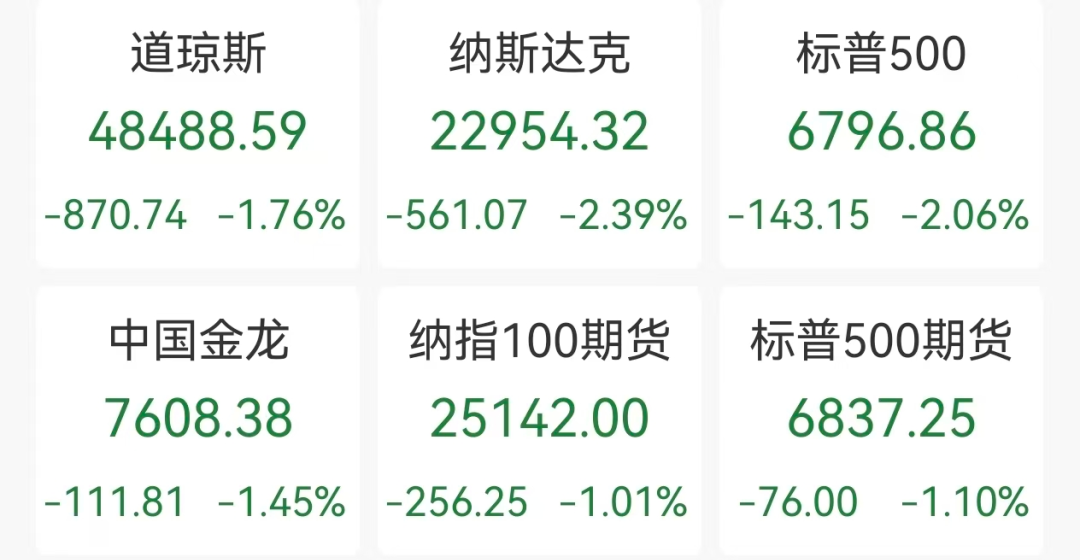
Market Overview - US stock indices experienced a significant decline, with the Dow Jones falling by 870 points (1.76%), the S&P 500 down by 143.15 points (2.06%), and the Nasdaq dropping by 561.07 points (2.39%) [1] - The Chicago Board Options Exchange Volatility Index (VIX), known as Wall Street's "fear index," surged above 20, reaching recent highs [1] Technology Sector - Major tech stocks saw substantial losses, with Nvidia and Tesla both dropping over 4%, while Apple and Amazon fell more than 3% [2][3] - Nvidia's stock price was reported at $178.07, down 4.38%, and Tesla at $419.25, down 4.17% [3] Streaming and Media - Netflix's post-market decline expanded to nearly 5% due to disappointing first-quarter earnings outlook and adjustments to its acquisition proposal for Warner Bros. assets to an all-cash offer totaling $82.7 billion [4] Semiconductor Industry - The semiconductor sector faced widespread declines, with Broadcom and Skyworks Solutions dropping over 5%, while TSMC fell more than 4% [4] Banking Sector - Bank stocks also fell across the board, with Citigroup down over 4% and JPMorgan and Morgan Stanley both declining more than 3% [4] Chinese Stocks - Chinese stocks mostly declined, with JinkoSolar down 12.5% and CenturyLink down over 10% [4][5] Bond Market - US Treasury yields rose to a four-month high, while the dollar index fell by 0.41%, marking its worst two-day performance in about a month [6] Precious Metals - Gold and silver prices reached new highs, with spot gold exceeding $4,763 per ounce and silver surpassing $94 per ounce [8][9] Cryptocurrency Market - The cryptocurrency market experienced a significant downturn, with Bitcoin dropping below $90,000 and Ethereum falling below $3,000, affecting approximately 163,000 traders [10][11]


Goldman Sachs Raising Price Targets 10%+ on Tech and Financial Blue Chip Giants
247Wallst· 2026-01-20 19:19
Group 1 - Goldman Sachs was founded in 1869 and is recognized as the world's second-largest investment bank by revenue [1] - The company is ranked 55th on the Fortune 500 list of the largest U.S. companies [1]