Goldman Sachs(GS)

Search documents
高盛沟通会:超配中国,2026年股票是“明确高配”的资产
Hua Er Jie Jian Wen· 2026-01-21 04:03
Group 1: Market Outlook - Goldman Sachs views Chinese stocks as a key focus area within its global asset allocation strategy for 2026, indicating a bullish outlook for the Chinese stock market [1] - The firm anticipates a sustained "slow bull" market in China, benefiting insurance companies' allocation to equity assets, which is expected to enhance overall investment returns [1] - The current global economic environment, characterized by no recession in the U.S. and ample liquidity, historically favors stock markets [2] Group 2: Earnings Growth Drivers - Goldman Sachs identifies three main themes driving earnings growth in China: AI, overseas expansion, and anti-involution [4][5] - AI is projected to contribute approximately 2% to 3% annual earnings growth for the entire market over the next 3 to 5 years as Chinese tech companies benefit from its application [4] - The overseas revenue share for Chinese companies is currently around 16%, indicating significant room for growth compared to the 28% for S&P 500 companies [5] Group 3: Valuation and Market Performance - The MSCI China Index's current dynamic P/E ratio is approximately 13, aligning with historical averages, while the CSI 300 Index is around 15, also near its historical median [3] - Goldman Sachs forecasts an overall return range of 15% to 20% for the year, driven primarily by earnings growth rather than valuation expansion [3] - The firm expects a substantial inflow of capital into the stock market, estimating around $200 billion in southbound capital flow into Hong Kong stocks this year [6] Group 4: Investment Themes and Strategies - Goldman Sachs maintains a high allocation to AI-related sectors, including software, internet, and hardware, while also favoring materials and insurance [8] - The firm emphasizes the importance of shareholder returns through dividends and buybacks, which have proven effective in other markets [8][9] - The insurance sector is highlighted as a favorable investment due to its stable returns and potential for higher equity asset allocation in a slow bull market [9] Group 5: Investor Sentiment and Behavior - There is a growing interest among overseas investors in the Chinese market, although actual investment actions have yet to materialize [6][7] - The firm notes that personal investors currently allocate only about 10% of their assets to stocks, suggesting a potential shift towards higher equity allocation if the market enters a sustained bull phase [10] - The anticipated improvement in inflation expectations may further drive demand for risk assets among individual investors [10]

3 Things Investors Need to Know About Goldman Sachs Stock in 2026
The Motley Fool· 2026-01-21 00:30
Core Insights - Goldman Sachs stock has surged 51% over the past year, driven by strong fourth-quarter earnings and a recovery in capital markets activity [1][3] - The company is well-positioned for further growth in 2026, particularly in investment banking, which is expected to accelerate [5][10] Investment Banking Performance - Goldman Sachs reported earnings per share (EPS) of $14.01, exceeding analysts' expectations of $11.65, with investment banking fees growing 25% year over year to $2.58 billion [3] - The investment banking backlog is at its highest level in four years, supported by a favorable regulatory environment and significant private equity capital [5] Strategic Changes - Goldman Sachs is exiting its Apple Card business, transitioning $20 billion in balances to JPMorgan Chase at a $1 billion discount, as part of a strategic pivot away from consumer banking [6][7] - The company is focusing on asset and wealth management, which are expected to provide more stable revenue and profitability [7] Technological Advancements - Goldman Sachs is implementing AI-driven efficiencies through the "One Goldman Sachs 3.0" operating model, aiming to enhance productivity and capital allocation [8][9] - Management has identified six work streams for potential disruption and reengineering using AI to support growth in asset and wealth management [9]


8点1氪:小米通报两起汽车起火事件;嫣然基金会已筹款超2300万;信用卡分期还款能享受财政贴息
36氪· 2026-01-21 00:05
Group 1 - Xiaomi reported two incidents of vehicle fires, emphasizing that the battery status was normal during both events [3][5] - In the first incident on January 19, a vehicle in Haikou experienced a fire shortly after being parked, but no injuries were reported [3] - The second incident involved a collision on a highway in Henan, where the vehicle caught fire after the accident, with no casualties [5] Group 2 - Gree Electric plans to mass-produce silicon carbide chips for automotive use, with expectations that half of the chips used by GAC Group will come from Gree [4] - The company is expanding its production capabilities to include chips for photovoltaic storage and logistics vehicles [4] Group 3 - OpenAI's CFO announced that the company's annual revenue for 2025 is projected to exceed $20 billion, a significant increase from $6 billion in 2024 [16] - The growth is attributed to the expansion of computing capabilities and the introduction of advertising in ChatGPT [16] Group 4 - Hikvision reported a net profit of 14.188 billion yuan for 2025, representing an 18.46% year-on-year increase [22] - The company's total revenue reached 92.518 billion yuan, with a slight growth of 0.02% [22] Group 5 - Zhaoyan New Drug expects a significant increase in net profit for 2025, projecting a rise of approximately 214% to 371% [23] - The company anticipates a decrease in revenue, estimating between 1.573 billion to 1.738 billion yuan, a decline of about 13.90% to 22.10% [23] Group 6 - Hongyuan Green Energy forecasts a turnaround in net profit for 2025, estimating between 180 million to 250 million yuan [24] - The improvement is attributed to a vertically integrated supply chain and the sale of equity in a subsidiary, contributing approximately 291 million yuan to profits [24] Group 7 - Bright Dairy expects a net loss of 120 million to 180 million yuan for 2025, a significant decline from a profit of 722 million yuan in the previous year [25] - The loss is primarily due to production issues at its overseas subsidiary, leading to increased costs and inventory write-offs [25]






美国股债汇三杀,纳指跌超2%,芯片股、中概股普跌,晶科能源跌超12%,黄金白银再创新高
2 1 Shi Ji Jing Ji Bao Dao· 2026-01-20 23:15
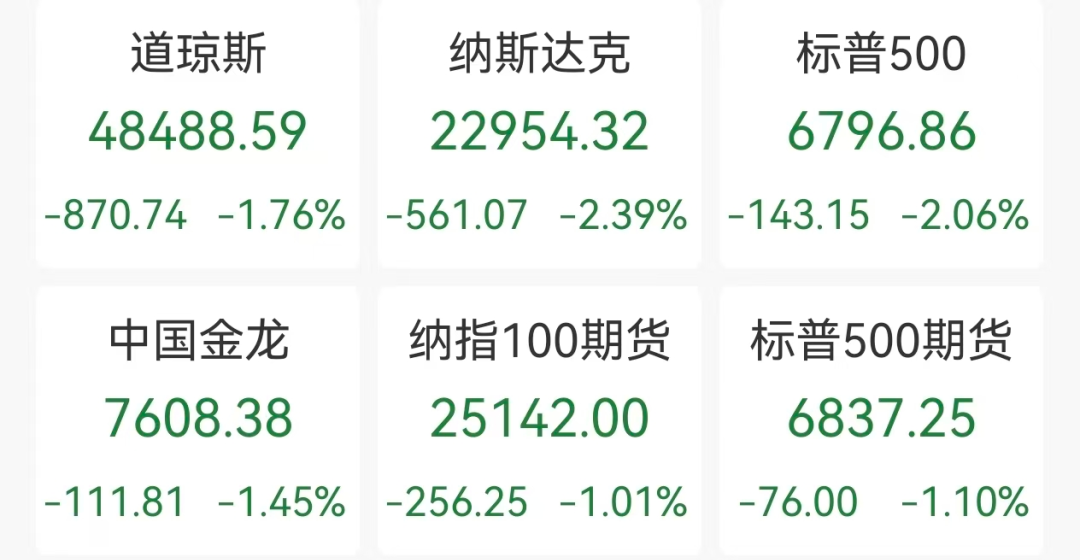
Market Overview - US stock indices experienced a significant decline, with the Dow Jones falling by 870 points (1.76%), the S&P 500 down by 143.15 points (2.06%), and the Nasdaq dropping by 561.07 points (2.39%) [1] - The Chicago Board Options Exchange Volatility Index (VIX), known as Wall Street's "fear index," surged above 20, reaching recent highs [1] Technology Sector - Major tech stocks saw substantial losses, with Nvidia and Tesla both dropping over 4%, while Apple and Amazon fell more than 3% [2][3] - Nvidia's stock price was reported at $178.07, down 4.38%, and Tesla at $419.25, down 4.17% [3] Streaming and Media - Netflix's post-market decline expanded to nearly 5% due to disappointing first-quarter earnings outlook and adjustments to its acquisition proposal for Warner Bros. assets to an all-cash offer totaling $82.7 billion [4] Semiconductor Industry - The semiconductor sector faced widespread declines, with Broadcom and Skyworks Solutions dropping over 5%, while TSMC fell more than 4% [4] Banking Sector - Bank stocks also fell across the board, with Citigroup down over 4% and JPMorgan and Morgan Stanley both declining more than 3% [4] Chinese Stocks - Chinese stocks mostly declined, with JinkoSolar down 12.5% and CenturyLink down over 10% [4][5] Bond Market - US Treasury yields rose to a four-month high, while the dollar index fell by 0.41%, marking its worst two-day performance in about a month [6] Precious Metals - Gold and silver prices reached new highs, with spot gold exceeding $4,763 per ounce and silver surpassing $94 per ounce [8][9] Cryptocurrency Market - The cryptocurrency market experienced a significant downturn, with Bitcoin dropping below $90,000 and Ethereum falling below $3,000, affecting approximately 163,000 traders [10][11]


Goldman Sachs Raising Price Targets 10%+ on Tech and Financial Blue Chip Giants
247Wallst· 2026-01-20 19:19
Group 1 - Goldman Sachs was founded in 1869 and is recognized as the world's second-largest investment bank by revenue [1] - The company is ranked 55th on the Fortune 500 list of the largest U.S. companies [1]


国际机构集体看好中国经济增长前景
Zheng Quan Ri Bao· 2026-01-20 16:09
Group 1: Economic Growth Outlook - The International Monetary Fund (IMF) has raised China's economic growth forecast for 2025 by 0.2 percentage points to 5% and has also upgraded the 2026 growth expectations [1] - Multiple international financial institutions have similarly increased their growth forecasts for China, indicating a resilient economic performance among major global economies [1] - Deutsche Bank's chief economist for China predicts a more balanced economic growth driver in 2026, with consumption being further activated, investment contributions rebounding, and exports expected to maintain growth [1] Group 2: Export Resilience - In 2025, China's goods trade is projected to grow rapidly, with total foreign trade reaching 45.47 trillion yuan, a 3.8% increase, and exports at 26.99 trillion yuan, up 6.1% [2] - Goldman Sachs forecasts that China's exports will continue to be a core driver of economic growth, with nominal export growth expected to rise by 5% to 6% annually in the coming years [2] - The resilience of Chinese exports is attributed to strong competitiveness, dominance in rare earth and key mineral sectors, and growth potential in high-tech exports driven by policy support and global AI-related capital expenditure cycles [2] Group 3: Consumer Spending Trends - Domestic consumption recovery and upgrade are becoming significant supports for China's economic growth, with Goldman Sachs estimating a stable consumer growth rate of around 4.5% this year [3] - Service consumption is expected to outpace goods consumption growth in 2026, driven by policy emphasis on service sector development and the potential for a virtuous cycle of employment and income growth [3][4] - The shift in consumer spending from goods to services is evident, with households increasingly willing to spend on leisure, dining, and lifestyle experiences [4] Group 4: Investment Focus - Investment is seen as a crucial lever for stabilizing growth, with key sectors becoming focal points for future growth opportunities [5] - Goldman Sachs anticipates a rebound in fixed capital formation growth to 3.5% in 2026, targeting high-tech, strategic emerging industries, urban renewal, and basic livelihood infrastructure [5] - Traditional industries are expected to undergo digital and intelligent upgrades, with significant potential in sectors like brain-computer interfaces and robotics, although they are still in early stages [5][6]
高盛首席中国股票策略师刘劲津:看好AI、“反内卷”、出海等题材
Zheng Quan Ri Bao Wang· 2026-01-20 13:29
Group 1 - Goldman Sachs maintains a positive outlook on Chinese stocks for 2026, expecting southbound capital to reach a new high of $200 billion and northbound capital to achieve a net inflow of $20 billion, driven by demand for physical AI and a stronger RMB [1] - The growth drivers identified include artificial intelligence, "anti-involution," and overseas expansion, which are expected to push the earnings per share growth rate between 10% and 15% [1] - China's strong export performance is anticipated to increase market share for Chinese companies, with overseas revenue share rising from 12% in 2015 to 16% currently, and projected to reach 20% by the end of 2030 [1] Group 2 - Chinese listed companies' cash returns are expected to reach a new high of approximately 4 trillion yuan in 2026, with net buybacks enhancing earnings per share growth [2] - The two main investment themes for 2026 and beyond are policy support and AI, which are expected to reshape sector allocations [2] - The technology hardware sector has been upgraded to overweight due to its diverse product supply chain, with a focus on smartphones, AI servers, data centers, semiconductors, and physical AI stocks, which are seen as key enablers and beneficiaries of AI development in China [2]
Jim Cramer Shares Trading Strategy For Goldman Sachs (GS)’s Shares
Yahoo Finance· 2026-01-20 11:01
Group 1 - Goldman Sachs Group, Inc. (NYSE:GS) is highlighted as a top stock in the banking sector, with positive sentiment due to increasing M&A and IPO activities expected in 2025 [2] - The fourth-quarter earnings report for Goldman Sachs revealed a 25% increase in investment banking fees, reaching $2.58 billion [2] - HSBC has adjusted its price target for Goldman Sachs from $608 to $604 while maintaining a Hold rating, and has raised earnings expectations for the banking sector for 2026 and 2027 [2] Group 2 - Jim Cramer suggests that while Goldman Sachs has potential, there are AI stocks that may offer higher returns with less risk [3] - Cramer emphasizes a trading strategy where investors should consider buying bank stocks like Goldman Sachs when they are down, as market sentiment often leads to selling on news [3]
Argus上调高盛目标价至1066美元
Ge Long Hui· 2026-01-20 09:47
Group 1 - Argus Research raised Goldman Sachs' target price from $863 to $1066, maintaining a "Buy" rating [1]
华尔街对黄金的看法
Jin Tou Wang· 2026-01-20 09:27
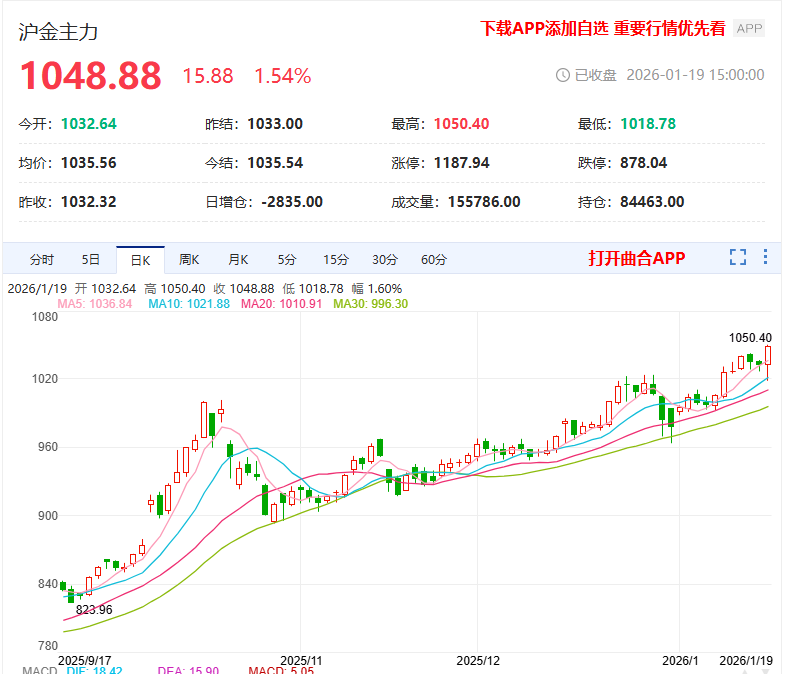
Group 1 - Citigroup predicts a bullish scenario where gold could reach $5,000 within three months, with a potential test of $4,700-$4,750 this week due to trade tensions from Trump's tariff policies and a surge in investments into gold ETFs for hedging, leading to localized shortages in physical gold [1] - JPMorgan anticipates a strong market this week with a target of $4,750, and if stabilized, a push towards $5,000 next month, driven by a 26% probability of a Fed rate cut in March, declining 10-year Treasury yields, and an average monthly gold purchase of 70 tons by emerging market central banks, providing a "safety cushion" for gold prices [1] - Goldman Sachs expects a potential pullback this week with a buying range of $4,600-$4,650, maintaining a year-end target of $4,900, while expressing concerns over profit-taking by hedge funds that may lead to increased short-term volatility despite a long-term bullish outlook [1] Group 2 - Morgan Stanley adopts a conservative stance, projecting a trading range of $4,620-$4,690 this week, emphasizing that central bank gold purchases provide strong support, and highlighting the acceleration of de-dollarization in emerging markets, suggesting that buying gold is not merely for hedging but a strategic move against dollar dominance, with this trend expected to continue at least until Q3 [1] - Current data indicates that while U.S. employment and inflation are slowing, some sectors are improving under the potential influence of Fed rate cuts, leading to a cautious but optimistic outlook for gold prices in the medium to long term, supported by increased allocations from institutional investors amid rising geopolitical risks [3] - The market is likely to be influenced more by U.S. economic data affecting Fed policy expectations and geopolitical disturbances, with a general view that short-term news impact is diminishing, maintaining a strong oscillating trend for gold prices, while suggesting holding long positions above the 20-day moving average and selling out-of-the-money put options to capture time value [3]