
LI AUTO(LI)

Search documents
纳斯达克金龙中国指数收平
Xin Lang Cai Jing· 2025-10-30 10:08
Group 1 - Major Chinese concept stocks such as Alibaba, TSMC, and NIO saw a maximum increase of 1.8% [1] - New Oriental, Li Auto, and Pony.ai experienced declines of over 1%, while Wenyan Zhixing dropped by 4.6% [1] - In the ETF sector, ASHS rose by 1.4%, CQQQ increased by 0.8%, and KWEB gained 0.2% [1]


汽车之家回应小米YU7等车冬测质疑:一直在做京津冀低温区续航测试,还原冬季真实用车场景
Xin Lang Ke Ji· 2025-10-30 08:17
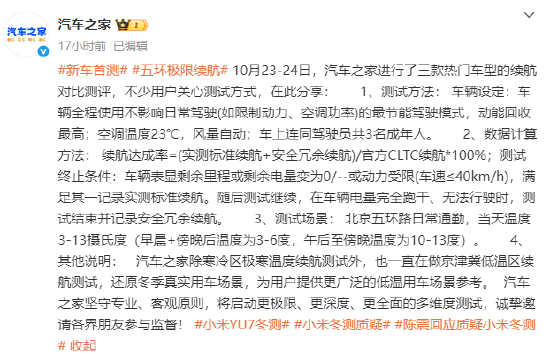
Core Viewpoint - The article discusses the winter range testing results of popular electric SUVs, specifically the Xiaomi YU7, Li Auto i6, and Tesla Model Y, highlighting the methodologies and outcomes of the tests conducted by Autohome [1][3]. Group 1: Testing Methodology - The testing method involved using the most energy-efficient driving mode without affecting daily driving, with a focus on maximum energy recovery and a controlled environment [1]. - Data calculation for range achievement was defined as the ratio of measured standard range plus safety reserve range to the official CLTC range, expressed as a percentage [1]. - The testing scenario took place on Beijing's Fifth Ring Road under typical commuting conditions, with temperatures ranging from 3 to 13 degrees Celsius [1]. Group 2: Test Results - Xiaomi YU7 achieved a measured standard range of 687 km and a safety reserve of 11 km, resulting in a final range achievement rate of 83.59% [3]. - Li Auto i6 recorded a standard range of 573.9 km and a safety reserve of 16.6 km, leading to a range achievement rate of 82.01% [3]. - Tesla Model Y had a standard range of 469.8 km and a safety reserve of 16.1 km, with a final range achievement rate of 81.94% [3]. Group 3: Public Response and Criticism - Xiaomi's founder, Lei Jun, shared the winter testing data, emphasizing that the Xiaomi YU7 had the highest range and achievement rate [3]. - Automotive reviewer Chen Zhen expressed skepticism about the winter testing conditions, arguing that testing at 10 degrees Celsius may not accurately represent winter conditions [3].



【金融街发布】理想汽车联合多家机构发布《高级别智能辅助驾驶保险创新研究白皮书》
Zhong Guo Jin Rong Xin Xi Wang· 2025-10-30 08:12
Core Viewpoint - The collaboration among Li Auto, PICC Beijing Branch, Yuanbao Technology, and Shanghai Vehicle Inspection aims to innovate insurance solutions for high-level intelligent assisted driving, responding to the strategic deployment of financial technology and the evolving policies in the automotive industry [1][2]. Group 1: Industry Context - Intelligent driving is identified as a core engine for the transformation and upgrading of the automotive industry, significantly contributing to the integration of artificial intelligence and automotive innovation for high-quality development [1]. - Since 2025, China's intelligent assisted driving technology has accelerated, with the government actively promoting the development of the intelligent connected vehicle industry through various policies [1]. Group 2: White Paper Characteristics - The white paper is the first systematic research focusing on high-level intelligent assisted driving insurance, addressing the current immaturity of insurance products and lack of systematic solutions in this field [2]. - It features foresight and originality, filling a research gap in risk protection and product innovation for high-level intelligent assisted driving insurance, and aims to influence the formulation of related standards and policies [2]. - The white paper is comprehensive, covering industry trends, legal regulations, consumer rights, insurance development paths, risk management technologies, and pricing models, establishing a solid foundation for future financial product optimization [2]. Group 3: Practicality and Collaboration - The white paper's compilation involved collaboration among automakers, insurance companies, and third-party technology platforms, integrating practical experiences and expertise from various sectors [3]. - The proposed solutions are based on industry practices and aim to promote cross-industry collaboration, enhancing the operational feasibility and industry guidance value of the insurance products [3]. - The release of the white paper is expected to fill the gap in high-level intelligent assisted driving insurance policies and product development in China, supporting the implementation of industry policies and responding to the requirements of "financial technology" [3].

新势力车企死亡报告
3 6 Ke· 2025-10-30 08:07
Core Insights - The article discusses the rise and fall of several new energy vehicle companies in China, particularly focusing on Neta, WM Motor, and HiPhi, highlighting their initial successes and subsequent failures due to strategic missteps and market competition. Group 1: Neta's Rise and Fall - Neta achieved remarkable success in 2022, selling 152,000 vehicles and becoming the top-selling new energy vehicle brand, leveraging its "high value for money" strategy with models like Neta V and Neta U [1][40]. - The Neta V, priced between 70,000 to 90,000 yuan, offered significant space and features compared to competitors, which were mostly microcars [4][10]. - However, Neta's reliance on low pricing and high volume led to low profit margins, and its sales strategy heavily depended on dealers, resulting in inflated sales figures that did not reflect actual consumer demand [41][40]. Group 2: Strategic Errors - Neta faced critical strategic errors in 2023, particularly during a price war initiated by Tesla, which led to a significant drop in sales, with a year-on-year decline of over 30% starting in June 2023 [42][46]. - Instead of adjusting prices to remain competitive, Neta launched a new model, the Neta S, at a higher price point, which failed to attract consumers in a highly competitive market [47][48]. - The company continued to pursue a "brand upgrade" strategy with the introduction of the Neta GT, which diverted resources from more viable projects and ultimately led to a decline in overall sales [50][55]. Group 3: WM Motor's Challenges - WM Motor, founded by industry veteran Shen Hui, initially gained traction with its EX5 model, but failed to establish a strong brand identity compared to competitors like NIO and Xpeng [14][60]. - The company struggled with quality issues, including multiple recalls and incidents of vehicle fires, which undermined its reputation for reliability [80][87]. - WM Motor's lack of a distinctive market position and reliance on traditional automotive strategies contributed to its decline, as it could not compete effectively against brands with clearer identities [88][62]. Group 4: HiPhi's Strategy and Market Position - HiPhi attempted to replicate Tesla's high-end strategy with its HiPhi X and HiPhi Z models, but faced challenges due to overlapping market segments and increased competition [28][32]. - The company invested heavily in marketing and infrastructure but failed to achieve significant sales, leading to financial difficulties and a lack of market presence [38][39]. - HiPhi's inability to adapt to the rapidly changing market dynamics and its reliance on a narrow product strategy ultimately led to its downfall [36][55]. Group 5: Market Dynamics and Conclusion - The article emphasizes that the new energy vehicle market in China is highly competitive, with companies needing to adapt quickly to changing consumer preferences and pricing pressures [44][45]. - The ability to secure funding and successfully navigate the IPO process has proven crucial for survival, as seen with companies like NIO and Xpeng, which managed to leverage market conditions to their advantage [92][93]. - In contrast, Neta, WM Motor, and HiPhi's failures highlight the importance of strategic flexibility and the risks of adhering to outdated business models in a fast-evolving industry [55][94].

李想聊如何看待理想被当作汽车公司估值
理想TOP2· 2025-10-30 06:34
Core Viewpoint - The company is positioned as an artificial intelligence terminal company, but its performance is still heavily reliant on vehicle sales, which raises questions about the correlation between AI development and sales performance [1][2]. Group 1: AI Development and Business Model - The company aims to achieve Level 4 autonomous driving, emphasizing that the true value of AI will be realized when users can engage in other activities during their commutes [1]. - The company is exploring the potential to generate $100 billion in revenue with a significantly reduced workforce, indicating that successful AI implementation could validate its strategic direction [2]. Group 2: Product and Technology Strategy - The company is diversifying its operations by developing operating systems, chips, and foundational models, similar to Apple's early product ecosystem, suggesting that such expansion is reasonable given its revenue scale [2]. - The company believes that investments in technology will lead to substantial cost savings, making the diversification strategy financially beneficial [2]. Group 3: Risk Factors and Organizational Capability - The company identifies three critical factors that could lead to its failure: failure to understand user needs, lack of superior products and technology, and significant organizational capability issues [3]. - These factors are interrelated, and a comprehensive assessment of all three is necessary for effective risk management and strategic planning [3].

理想汽车
数说新能源· 2025-10-30 06:32
Core Viewpoint - The recent incident of the Li Auto MEGA catching fire raises concerns about the company's investment potential, despite its strong understanding of family user needs and market positioning [1][6]. Group 1: Growth Potential - Li Auto's growth is slowing but remains stable, driven by the strong demand from family users. The penetration rate of new energy vehicles has reached 55%, but the market for six-seat vehicles priced between 300,000 to 500,000 yuan is only slightly above 12%, indicating significant market space [1][2]. - The user profile for Li Auto is well-defined, targeting families with children and elderly members who require spacious and intelligent vehicles for long-distance travel, addressing pain points with specific features [1][2]. Group 2: Industry Outlook - The new energy vehicle industry is characterized by slowing overall growth and intense competition. In the first ten months, sales reached 8.2 million units, a 28% year-on-year increase, with the top 10 brands holding 65% market share, leading to increased market concentration [2][3]. - Li Auto's competitive advantage lies in its differentiation strategy, holding a 41% market share in the high-end range-extended market above 300,000 yuan, and has already laid the groundwork for its pure electric vehicle segment [2][3]. Group 3: Technological Innovation - Li Auto's technological innovations focus on practical solutions for family users, with features like laser radar and advanced driving assistance systems enhancing user experience [4]. - However, the recent fire incident has exposed potential safety issues with the battery technology, raising concerns about the reliability of their safety measures despite previous safety testing claims [4]. Group 4: Management Capability - The management team, led by Li Xiang, demonstrates strong strategic judgment, successfully pivoting the company's focus to family SUVs and adjusting to market demands for pure electric vehicles [5]. - Nonetheless, the management faces criticism regarding the design and public relations response to the fire incident, which has affected brand trust and raised questions about crisis management capabilities [5]. Group 5: Summary - Investing in Li Auto essentially means investing in the demand for improved family travel experiences in China. While growth potential and differentiation remain, the company must address safety concerns and improve crisis management to maintain its market position [6].

理想MEGA起火,电池预警是否失灵成谜
第一财经· 2025-10-30 05:28
Core Viewpoint - The article discusses a recent incident involving a Li Auto MEGA vehicle catching fire, raising concerns about the effectiveness of battery management systems (BMS) in alerting drivers to potential battery issues before they escalate into dangerous situations [3][5]. Group 1: Incident Overview - A Li Auto MEGA vehicle experienced a fire during operation, resulting in total destruction of the vehicle and its contents, but fortunately no injuries occurred [3]. - There are conflicting reports regarding whether the vehicle had previously issued fault codes and whether the owner was informed about the need for service [3][5]. Group 2: Role of BMS - The BMS is crucial for monitoring battery health, collecting data on temperature and voltage, and issuing warnings if parameters exceed safe thresholds [4][7]. - Different automakers have varying BMS designs, which affects how and when battery warnings are communicated to drivers [5][8]. Group 3: Battery Warnings vs. Alarms - "Battery warnings" indicate minor issues that allow continued operation, while "battery alarms" signal serious problems that require immediate action [9]. - The distinction between warnings and alarms is significant, as many drivers may not take warnings seriously, potentially leading to more severe issues [8][9]. Group 4: Regulatory Standards and Safety - The article highlights the lack of standardized battery warning protocols across manufacturers, which can lead to inconsistencies in how battery issues are communicated [10][11]. - Recent updates to national safety standards for electric vehicle batteries have been made, focusing on improving safety measures and testing protocols [11][12]. Group 5: Industry Insights - Industry experts emphasize the importance of enhancing BMS capabilities to improve early detection of battery issues, which can help mitigate risks [13]. - The article suggests that improving battery design and materials can also contribute to overall safety and reduce the likelihood of thermal runaway incidents [13].
无锡振华(605319):冲压分拼伴随核心客户成长,精密电镀启动新增量
Guoxin Securities· 2025-10-30 05:25
Investment Rating - The report assigns an "Outperform the Market" rating for the company [4][6]. Core Views - The company has a clear structure with four major business segments: stamping parts, molds, assembly processing, and precision electroplating, which are supported by high-quality customer resources [1][14]. - The stamping and assembly processing businesses are benefiting from the recovery and growth of core customers, particularly SAIC Motor, and the expansion into new energy vehicle clients such as Tesla, Li Auto, and Xiaomi [2][20]. - The precision electroplating business is seen as a new growth driver, with significant margins and a recent entry into the power semiconductor sector [3][25]. Summary by Sections Business Overview - The company has been deeply involved in the automotive parts industry for over 30 years, establishing a diversified product matrix that includes stamping parts, assembly processing, precision electroplating, and mold design and manufacturing [14][17]. - The company completed the acquisition of Wuxi Kaixiang in 2022, marking its entry into the precision electroplating business, which is expected to drive future growth [14][25]. Financial Performance - The company forecasts revenues of CNY 25.31 billion for 2024 and CNY 31.02 billion for 2025, with a projected net profit of CNY 5.01 billion for 2025, reflecting a year-on-year growth rate of 32.5% [4][5]. - The gross margin is expected to improve, reaching 29.04% in the first half of 2025, driven by product mix optimization and cost control [4][42]. Customer Base and Market Position - The company has a solid customer base, with major clients including SAIC Group, Tesla, Li Auto, and Xiaomi, which collectively contribute significantly to its revenue [54][30]. - The company’s stamping business has over 3,500 products, with a focus on both traditional fuel vehicles and new energy vehicles, ensuring a stable order flow [20][31]. Growth Drivers - The precision electroplating segment is projected to grow significantly, with sales of precision electroplated parts expected to increase from 71.66 million units in 2021 to 122.21 million units by 2024, achieving a gross margin of 80% [3][49]. - The company is also investing in power semiconductor components, which are anticipated to provide new growth opportunities [3][25]. Market Trends - The automotive stamping parts market in China is expected to maintain a scale of around CNY 250 billion from 2025 to 2027, driven by the increasing demand for lightweight and high-safety vehicles [59][60]. - The report highlights a trend towards outsourcing assembly processing as automotive manufacturers seek to enhance operational efficiency [57].


理想MEGA起火,电池预警是否失灵成谜
Di Yi Cai Jing· 2025-10-30 05:09
Core Viewpoint - The incident involving the Ideal MEGA vehicle raises concerns about the effectiveness of battery warning systems and communication with vehicle owners regarding potential risks [1][2]. Group 1: Incident Overview - A fire incident occurred with an Ideal MEGA vehicle, resulting in total destruction of the vehicle and its contents, but no injuries were reported [1]. - There are conflicting reports regarding whether the vehicle owner received prior warning signals about battery issues before the incident [1][2]. Group 2: Battery Management System (BMS) - The BMS plays a crucial role in monitoring battery conditions, collecting data on temperature and voltage, and issuing warnings if thresholds are exceeded [2][3]. - Different automakers have varying BMS designs, leading to inconsistencies in how battery warnings are communicated to vehicle owners [3][4]. Group 3: Warning and Alarm Distinction - There is a distinction between "battery warning" (indicating minor issues) and "battery alarm" (indicating serious problems), with the former allowing continued vehicle operation under certain conditions [5][6]. - The probability of a vehicle experiencing a fault increases significantly if it continues to operate after receiving a battery warning [5]. Group 4: Regulatory and Safety Standards - The number of electric vehicle fire incidents has been significant, with 640 reported in the first quarter of 2022 alone [5]. - Recent updates to national standards for battery safety have introduced stricter requirements for thermal management and emergency response [5][6]. Group 5: Industry Insights - The effectiveness of battery safety measures relies on the design and implementation of BMS systems, which vary by manufacturer [6][7]. - Enhancements in BMS technology and battery design are essential for improving safety and reducing the likelihood of thermal runaway incidents [7].
理想汽车电池公司在浙江成立新公司,注册资本7000万
Zhong Guo Neng Yuan Wang· 2025-10-30 02:59
Core Insights - Zhejiang Ideal Automotive Battery Co., Ltd. has been established with a registered capital of 70 million RMB, focusing on battery manufacturing, sales, and new energy technology research and development [1][1][1] Company Overview - The legal representative of Zhejiang Ideal Automotive Battery Co., Ltd. is Liu Liguo [1] - The company is wholly owned by Shandong Ideal Automotive Battery Co., Ltd., which is jointly held by Beijing Ideal Automotive Co., Ltd. and Xinwangda Power Technology Co., Ltd. [1][1] Business Scope - The business operations include battery manufacturing, battery sales, new energy technology research and development, electric vehicle charging infrastructure operation, and manufacturing of power distribution and control equipment [1][1][1]