Morgan Stanley(MS)

Search documents
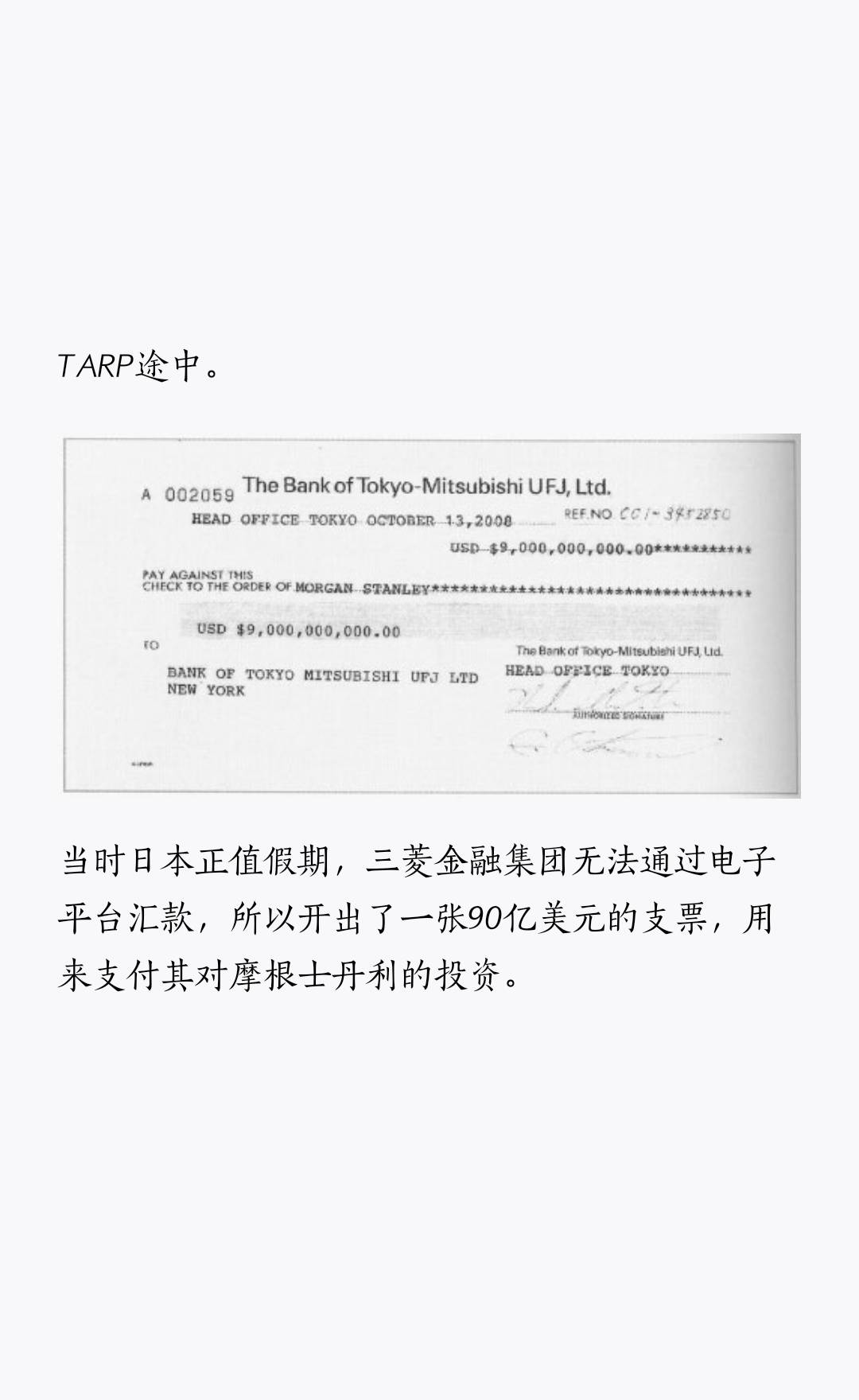
历史上一张面额最大的支票
Sou Hu Cai Jing· 2025-07-28 19:05
Group 1 - The 2008 financial crisis had a global impact, leading to the bankruptcy of Lehman Brothers and the bailout of Fannie Mae and Freddie Mac, with the Federal Reserve committing to guarantee $29 billion [1] - American International Group faced liquidity issues and received a total of $40 billion and $70 billion in two rounds of bailout from the Federal Reserve [1] - Major financial institutions like Morgan Stanley, Goldman Sachs, and Citigroup were at risk of collapse, prompting the Federal Reserve and Treasury to seek partners for Morgan Stanley [2] Group 2 - Mitsubishi UFJ Financial Group collaborated with Morgan Stanley, despite initial negotiations with China Investment Corporation, which Morgan Stanley found too stringent [2] - Mitsubishi's investment included a historic $9 billion check, which was crucial for Morgan Stanley's survival during the crisis [2][6] - This investment by Mitsubishi ultimately resulted in significant profits for the bank, highlighting the strategic advantage of their timely decision [3] Group 3 - The Federal Reserve and Treasury received congressional authorization to rescue major Wall Street firms, preventing a catastrophic global financial disaster [4]


资本市场高水平制度型开放蹄疾步稳 中国资产吸引力不断增强
Zheng Quan Ri Bao· 2025-07-28 17:13
Core Viewpoint - The China Securities Regulatory Commission (CSRC) is advancing high-level institutional opening of the capital market, focusing on enhancing cross-border cooperation and attracting foreign investment [1][2][5] Group 1: Capital Market Opening - The CSRC is continuously improving policies for foreign investment, easing access for qualified foreign institutional investors (QFII), and expanding their investment scope [2][5] - The A-share market has successfully been included in major international indices such as MSCI and FTSE Russell, indicating a growing integration with global markets [2][3] Group 2: Foreign Investment Confidence - Foreign institutions, including Morgan Stanley and UBS, have expressed increased confidence in China's economic growth and stock market potential, particularly in the technology sector [4] - The overall foreign ownership in the Chinese capital market is steadily increasing, supported by favorable policies and the market's resilience [3][4] Group 3: Future Policy Directions - The CSRC plans to introduce more policies to enhance capital market openness, including optimizing the QFII system and expanding the range of products available for foreign investors [5][6] - Future recommendations include broadening cross-border investment channels, enhancing the derivatives market, and improving regulatory cooperation to create a more robust open ecosystem [6]

(经济观察)熊猫债密集发行 更多国际参与者进入中国债市
Zhong Guo Xin Wen Wang· 2025-07-28 12:00
Core Viewpoint - The issuance of panda bonds by Morgan Stanley and the Hungarian government marks a significant development in the Chinese interbank market, enhancing the diversity of issuers and promoting the high-quality development of the panda bond market [1][2]. Group 1: Panda Bond Issuance - Morgan Stanley issued its first panda bond, totaling 2 billion RMB with a 5-year term and a coupon rate of 1.98%, attracting strong interest from domestic investors [1]. - Hungary issued 4 billion RMB in panda bonds, consisting of a 3-year bond at a 2.5% rate and a 5-year bond at a 2.9% rate, setting records for the largest single issuance by a foreign government and the first 5-year foreign government panda bond [1]. - The total issuance of panda bonds by Hungary has reached 11 billion RMB across six issuances, making it the largest foreign government issuer in terms of both issuance and outstanding amounts [1]. Group 2: Market Trends and Growth - The panda bond market has seen a steady increase in the number of issuers, now including international development institutions, foreign governments, foreign financial institutions, and non-financial enterprises [2]. - In 2023, the issuance scale of panda bonds in the Chinese interbank market reached 111.2 billion RMB, with foreign government institutions, international development agencies, and multinational corporations accounting for 50% of the total issuance, a 27 percentage point increase from the previous year [2]. - Since its launch in 2005, the panda bond market has entered a phase of institutionalization and normalization, particularly accelerating since 2015 to promote the use of the RMB in cross-border transactions [3].
摩根士丹利:欧美贸易协议对航空航天业有利
news flash· 2025-07-28 09:47
摩根士丹利:欧美贸易协议对航空航天业有利 金十数据7月28日讯,摩根士丹利分析师在给客户的报告中写道,美国和欧盟之间的贸易协定对航空航 天业有利,因为飞机和零部件免征关税。根据该协议,美国将对绝大多数欧盟出口产品设定15%的基准 关税,但华盛顿和布鲁塞尔同意对包括所有飞机和零部件在内的一些战略产品征收零对零关税。分析师 们表示:"虽然市场对航空航天业恢复零关税环境抱有高度预期,但最终正式实施仍具有积极意义。"空 客对该交易表示欢迎,称稳定和可预测的环境对高度一体化的全球航空航天业至关重要。 ...

首单美企熊猫债发行:摩根士丹利20亿元人民币债,利率1.98%
Di Yi Cai Jing· 2025-07-28 08:18
中国债市制度型开放深化。 7月24日,摩根士丹利在中国银行间市场成功发行20亿元5年期定向债务融资工具,票面利率1.98%。作 为首单由美国总部企业发行的熊猫债,此次发行吸引了境内多元化投资者踊跃认购,不仅为市场注入优 质资产,更标志着中国债券市场高水平开放迈出新步伐。 据交易商协会透露,下一步,将在人民银行指导下,继续落实金融业高水平开放政策,进一步丰富境外 发行人类型,助力债券市场高质量发展与制度型开放。 熊猫债是境外机构在境内发行的人民币计价债券,作为境外主体人民币融资的重要渠道,熊猫债市场的 发展与中国金融开放进程紧密相连。 在近期发行案例中,多家国际机构的参与备受关注。除摩根士丹利外,亚洲基础设施投资银行于7月14 日发行20亿元2年期熊猫债;匈牙利政府则成功发行40亿元3年期及10亿元5年期债券,票面利率分别为 2.5%、2.9%,创下"单笔最大外国政府熊猫债"及"首单5年期外国政府熊猫债"两项纪录。作为首个与中 国签署"一带一路"合作文件的欧洲国家,匈牙利已累计发行6笔熊猫债,规模达110亿元,成为外国政府 中发行及存量规模最大的主体。 外国政府类机构中,除了日前发行熊猫债券的匈牙利,还有韩国、 ...
利好来了!外资,出手!
天天基金网· 2025-07-28 05:12
Core Viewpoints - Global asset management giants are increasing investments in China's real estate market, signaling confidence in the sector's recovery [1][4] - Multiple foreign financial institutions have raised their economic growth forecasts for China following the release of Q2 economic data, indicating a positive outlook for the Chinese economy [2][3] Group 1: Foreign Investment in Real Estate - Schroders Capital has partnered with Zhejiang-based Xizi International to launch a private real estate equity investment fund with a total scale of approximately 3 billion yuan, focusing on prime office buildings and consumer infrastructure in core cities of the Yangtze River Delta [4] - Other foreign entities, such as the Hans Group and Temasek, are also establishing private funds in China, reflecting a growing interest and investment willingness from foreign institutions [4][5] Group 2: Economic Growth Forecasts - Morgan Stanley and Goldman Sachs have adjusted their GDP growth forecasts for China, with increases of 0.3 and 0.6 percentage points for 2025, respectively [2] - Nomura and JPMorgan have also raised their GDP growth predictions for 2025 by 0.5 and 0.7 percentage points, respectively, indicating a consensus among foreign institutions regarding China's economic recovery [2] Group 3: Manufacturing Sector Insights - China's manufacturing sector remains a highlight of the economy, supported by a complete industrial system that provides a solid foundation for both domestic and global markets [3] - The acceleration of high-end, intelligent, and green development in manufacturing is drawing significant attention from foreign analysts, particularly in sectors like semiconductors and electric vehicles [3] Group 4: Market Trends and Investment Strategies - The A-share market has shown a recent upward trend, with a slight adjustment observed on July 25, indicating a potential for continued growth [6] - Analysts suggest that the "anti-involution" policy could become a sustained investment theme, with a focus on high-quality housing and core urban areas [7]



中国:反内卷-通缩解药?
2025-07-28 01:42
Summary of Key Points from the Conference Call Industry Overview - **Industry**: Chinese Economy - **Focus**: Addressing deflation challenges and overcapacity through anti-involution policies Core Insights and Arguments 1. **Deflation Challenges**: China has faced deflation for nine consecutive quarters, with the GDP deflator remaining negative and the Producer Price Index (PPI) in deflation for 33 months. This situation is attributed to overcapacity in the context of high investment-to-GDP ratios [7][8][32] 2. **Policy Response**: The government is expected to intensify policy measures to combat overcapacity, with a focus on demand-side solutions rather than solely supply-side adjustments. Historical comparisons are made to the 2015-16 supply-side reforms that helped the economy recover from deflation [7][9][10] 3. **Investment Dynamics**: The report highlights that the current economic strategy relies heavily on manufacturing and infrastructure investments to maintain GDP growth, especially in light of the structural slowdown in the real estate sector [8][15][31] 4. **Private Sector Role**: A significant portion of overcapacity is found in emerging industries, with 50-90% of capacity in the private sector. This complicates the management of supply-side reforms [7][44] 5. **Need for Demand Support**: The report emphasizes that merely reducing supply will not suffice; boosting demand through social welfare spending and consumption support is crucial for sustainable economic recovery [10][42] Additional Important Insights 1. **Historical Context**: The report draws parallels between the current economic situation and past deflationary periods, noting that previous recoveries were driven by strong external demand and real estate market rebounds, which are currently lacking [11][41] 2. **Population Dynamics**: The declining population and structural issues in the real estate market are expected to hinder future economic growth and complicate demand management [23][26] 3. **Sector-Specific Overcapacity**: The report identifies specific sectors, such as solar energy and electric vehicles, where supply significantly exceeds demand, complicating efforts to manage overcapacity [45][48] 4. **Long-Term Growth Strategy**: A shift in growth strategy is suggested, moving from investment-driven growth to a more balanced approach that includes consumption as a key driver [42][46] Conclusion - The report outlines a complex landscape for the Chinese economy, where addressing deflation and overcapacity requires a multifaceted approach that includes both supply-side reforms and demand stimulation. The historical context and current challenges highlight the need for a strategic shift in economic policy to ensure sustainable growth moving forward [42][50]
外资出手!
证券时报· 2025-07-27 00:32
Group 1: Positive Sentiment Towards Chinese Economy - Global asset management giant Schroders Capital has launched a private real estate equity investment fund with a total scale of approximately 3 billion yuan, focusing on investment opportunities in core cities of the Yangtze River Delta [1] - Following the release of China's Q2 economic data, over ten foreign financial institutions and international investment banks have raised their growth forecasts for the Chinese economy, indicating a positive outlook [2][6] - Morgan Stanley and Goldman Sachs have both adjusted their GDP growth forecasts for China, with Morgan Stanley increasing its 2025 growth forecast by 0.3 percentage points and Goldman Sachs raising its predictions for Q2 and the second half of the year [4][5] Group 2: Manufacturing Sector Strength - Experts from multiple foreign institutions highlight the resilience of China's manufacturing sector, which is supported by a complete industrial system and competitive advantages in cost and quality [9] - The acceleration of high-end, intelligent, and green development in domestic manufacturing is drawing significant attention from foreign analysts [10] - China is significantly enhancing the added value of its manufacturing sector, focusing on high-tech and green products, achieving notable success in global technology advancement [11] Group 3: Real Estate Investment Opportunities - The collaboration between Schroders Capital and Zhejiang's Xizi International aims to invest in high-quality office buildings and consumer infrastructure in key cities [13] - There is a growing trend of foreign capital entering the Chinese real estate market, with several foreign firms establishing private fund management companies, indicating increased interest and investment willingness [13] - Analysts suggest that the real estate sector is currently at a historical low in valuation, with policies aimed at stabilizing the market and creating opportunities for top-tier real estate companies [14][15] Group 4: Market Trends and Investment Strategies - The A-share market has shown a recent upward trend, with a slight adjustment noted on July 25, indicating a short-term market outlook of steady upward movement [3][16] - Analysts recommend focusing on sectors such as semiconductors, cultural media, software development, and internet services for investment opportunities [17] - Insurance capital is becoming a significant incremental funding source for A-shares, with projections of annual investments ranging from 347.7 billion to 659.8 billion yuan starting in 2025 [17]


利好来了!外资,出手!
券商中国· 2025-07-26 14:45
Core Viewpoint - The article highlights a positive sentiment towards China's economy and real estate market, driven by foreign investment and optimistic economic forecasts from international financial institutions. Group 1: Foreign Investment in Real Estate - Global asset management giant Schroders Capital has partnered with Zhejiang-based Xizi International to launch a private real estate equity investment fund with a total scale of approximately 3 billion yuan, focusing on investment opportunities in core cities of the Yangtze River Delta [1][10] - Other foreign investment firms, such as the American commercial real estate group Hines and Temasek, have also established private funds in China, indicating a growing interest and investment willingness from foreign institutions [11] - The real estate sector is currently at a historical low in valuation, and policies are being implemented to stabilize the market, creating opportunities for foreign capital to enter [12] Group 2: Economic Growth Forecasts - Following the release of China's Q2 economic data, over a dozen foreign financial institutions and international investment banks have raised their growth forecasts for the Chinese economy, with Morgan Stanley and Goldman Sachs among those increasing their GDP growth predictions for 2025 by 0.3 and 0.6 percentage points, respectively [4][5] - The consistent policy support aimed at boosting domestic consumption and stabilizing financial markets has been a key factor in attracting foreign investment and improving economic outlooks [6] Group 3: Manufacturing Sector Strength - Experts from various foreign institutions emphasize the resilience of China's manufacturing sector, which benefits from a complete industrial chain and competitive advantages in cost and quality [8] - The acceleration of high-end, intelligent, and green development in domestic manufacturing is highlighted, with a focus on high-tech and green products such as semiconductors and electric vehicles [9] - China's advancements in high-end manufacturing, particularly in the field of new energy vehicles, are noted as significant achievements in global technology progress [10] Group 4: A-Share Market Trends - The A-share market has shown a recent upward trend, with a slight adjustment noted on July 25, where the Shanghai Composite Index closed down 0.33% [15] - Analysts predict that the market will continue to experience a steady upward trend, driven by moderate economic recovery and increased long-term capital inflows [16] - The "anti-involution" policy is expected to become a sustained investment theme, with a focus on sectors such as semiconductors and internet services [16]


外资金融机构连续上调中国经济增速预期:制造业展现强劲发展势头,“韧性”成核心关键词
Yang Shi Wang· 2025-07-26 03:48
Economic Growth Predictions - Several foreign financial institutions have raised their forecasts for China's economic growth following the release of Q2 economic data, with many making consecutive adjustments within six months [1] - Morgan Stanley increased its 2025 growth forecast by 0.3 percentage points, while other institutions like DBS, Nomura, and Goldman Sachs raised their forecasts by 0.3, 0.5, and 0.6 percentage points respectively [1] Industrial Performance - The strong performance of the industrial sector, including electricity, construction, and manufacturing, has been a key driver of economic activity, maintaining growth for 15 consecutive months [3] - Policies such as the appliance replacement program and consumer subsidies have effectively boosted retail sectors, particularly in home appliances, smartphones, and automobiles [3] International Trade - Demand for Chinese exports from economies outside the U.S. remains robust, contributing to a trade surplus in the first half of the year [5] - High net inflows of trade funds and strong export data have been noted by foreign financial institutions [3] Manufacturing Sector - China's manufacturing sector is highlighted as a key strength, supported by a complete industrial system that provides solid backing for the domestic market and serves global markets [10] - The acceleration of high-end, intelligent, and green development in manufacturing is a focal point for foreign research reports [10] Technological Advancements - China is significantly enhancing the added value of its manufacturing, focusing on high-tech and green products such as semiconductors, artificial intelligence, electric vehicles, lithium batteries, and robotics [10] - The country is making substantial progress in global technological advancement and introducing high-quality new products to the global market [10] Economic Resilience - Foreign financial institutions describe China's economy with the term "resilience," attributing this to continuous policy support, improving macroeconomic conditions, and various micro-level highlights [12] - The economy is characterized as "flexible," capable of adapting to various domestic and international economic situations while maintaining stable growth [15][16]