
Morgan Stanley(MS)

Search documents
兴业银行石家庄分行:兴业银行助力摩根士丹利成功发行熊猫债
Zhong Guo Jin Rong Xin Xi Wang· 2025-08-04 13:08
Core Viewpoint - Industrial Bank successfully assisted Morgan Stanley in issuing the first tranche of Panda bonds in the Chinese interbank market, marking a significant milestone as the first Panda bond issued by a US-based company [1] Group 1: Panda Bonds - The bond issuance has a scale of 2 billion RMB, a maturity of 5 years, and a coupon rate of 1.98% [1] - Panda bonds are a crucial fundraising tool for foreign institutions in the Chinese domestic market, denominated in RMB [1] Group 2: Industrial Bank's Role - Industrial Bank acted as a joint lead underwriter and bookrunner, showcasing its commitment to the opening of China's bond market [1] - The bank has served over 30 foreign clients, facilitating the issuance of more than 100 billion RMB in Panda bonds, covering various issuers including corporations, financial institutions, and multilateral organizations [1] - Over the past three years, Industrial Bank has maintained the leading position in the underwriting scale of foreign bonds among Chinese joint-stock banks [1] Group 3: International Business Strategy - The bank is building a comprehensive international business service system, integrating domestic and foreign, online and offline, and various currencies, contributing to China's high-level opening-up [1]


大摩继续看涨美股:盈利前景强劲,建议逢低买入
Zhi Tong Cai Jing· 2025-08-04 11:05
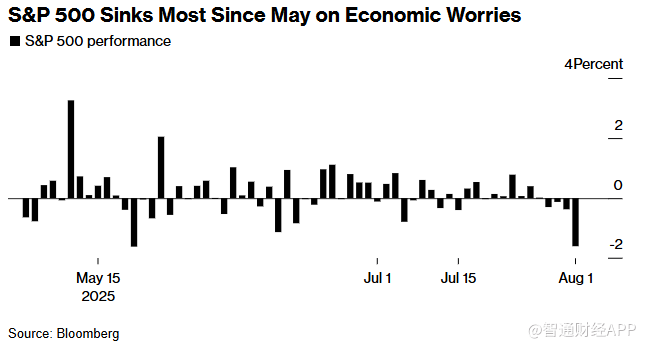
经济担忧加剧,标普500指数创5月以来最大单日跌幅 摩根士丹利策略师Michael Wilson周一表示,由于未来一年的企业盈利前景强劲,投资者应该趁美国股 市抛售之际买入。 Wilson在报告中写道,尽管标普500指数面临劳动力市场疲软和关税相关通胀的压力,这可能会推迟美 联储的降息行动,但投资者应将任何回调视为买入良机。 Wilson表示:"正如我们对盈利修正广度的分析所证明的那样,持续复苏已经开始。尽管美联储目前仍 维持利率不变,但今年晚些时候通胀势头减弱以及劳动力市场疲软,应会促成一轮强劲的降息周期。" 美国股市创纪录的涨势上周戛然而止,标普500指数先是连续六个交易日创下历史新高,随后却遭遇了 四连跌。上周五,由于数据显示美国就业增长放缓、失业率上升,以及美国总统唐纳德.特朗普对贸易 伙伴加征了一系列关税,股市应声下跌。 高盛集团策略师David Kostin表示,公司高管们迄今似乎对自身能够减轻关税对利润的影响充满信心。 他表示,尽管下半年关税对营收增长的压力应该会加大,但大型科技股的盈利以及2026年的财政政策应 该会为股市带来支撑。 摩根士丹利的Wilson表示,人工智能的广泛应用、美元的走弱 ...

每日机构分析:8月4日
Xin Hua Cai Jing· 2025-08-04 09:11
Group 1 - The expectation of interest rate cuts in the US is likely to persist due to a weak labor market, with disappointing non-farm employment data reinforcing market predictions for a rate cut in September [1] - Continuous low non-farm employment numbers below 50,000 for six months could signal an economic recession, leading to increased market expectations for further rate cuts by the Federal Reserve [1][2] - Barclays predicts the European Central Bank will cut rates in December instead of September, influenced by anticipated weak economic activity in the second half of the year [2] Group 2 - Concerns over the independence and reliability of official economic data have intensified following President Trump's claims of data manipulation and the dismissal of the Labor Statistics Bureau director [3][4] - The Korea Export-Import Bank forecasts a decline in South Korea's export value in Q3 2025 due to the impact of tariffs, projecting exports to reach approximately $167 billion, a year-on-year decrease of about 3% [3] - Analysts from Danske Bank expect the Bank of England to announce a rate cut in the upcoming decision, which may exert downward pressure on the British pound [4]


摩根士丹利:未来数月关税将使美国物价上涨约1个百分点
Xin Hua Cai Jing· 2025-08-04 05:41
Core Insights - The actual tariff rate for U.S. imports in May was 8.3%, significantly lower than Morgan Stanley's baseline forecast of 10% to 15% [1] - It is anticipated that the tariff rates will trend towards the forecasted levels in June and July, with implications for inflation [1] - Key factors contributing to the lower-than-expected actual tariff rate include transportation delays, higher-than-expected import volumes from Mexico and Canada under the USMCA, and a significant decline in imports from emerging markets [1] Economic Impact - The expected increase in effective tariff rates in June and July is likely to have a more pronounced effect on U.S. inflation [1] - Historically, the actual impact of tariffs on consumer prices typically manifests 3 to 5 months after implementation, while the economic growth repercussions are observed within 3 months [1] - Morgan Stanley projects that tariffs could lead to a price increase of approximately 1 percentage point in the coming months, which may gradually dissipate as demand weakens [1]
非农大幅下修确实“历史罕见”,但大摩不认为这意味着美国衰退
Hua Er Jie Jian Wen· 2025-08-04 01:55
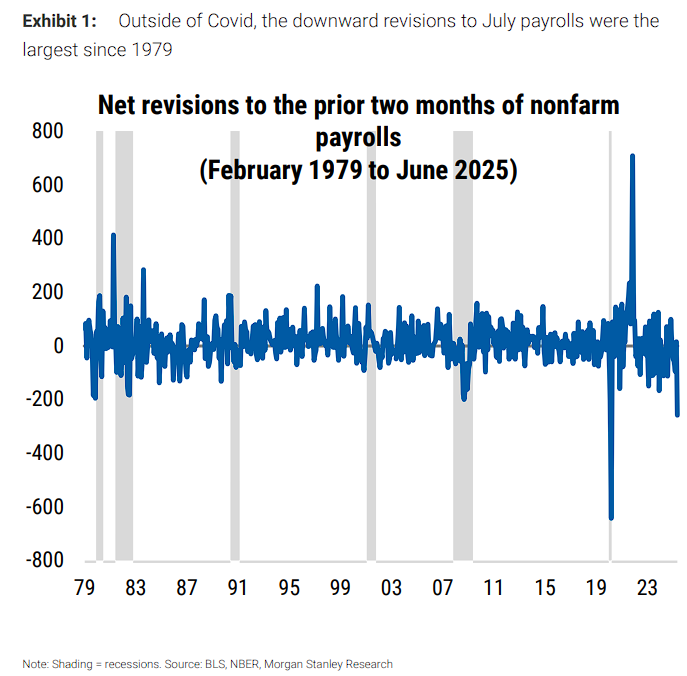
Core Insights - Morgan Stanley reports a significant downward revision of 258,000 jobs, the largest since 1979, which is 4-5 times the normal adjustment range [1][2][5] - The analysis indicates that current employment data holds more predictive power regarding economic trends than historical revisions, maintaining the expectation of no interest rate cuts until 2025 [1][9] Employment Data Revision - The July employment report revealed unexpected large downward revisions for the previous two months: June's non-farm employment was revised from 147,000 to only 14,000, a reduction of 133,000; May's data was adjusted from 144,000 to 19,000, a drop of 125,000, totaling a net revision of 258,000 [2][3] - Historically, from March 1979 to July 2025, the average net revision has been an upward adjustment of 1,200 jobs, making this downward revision the largest in 46 years when excluding the impact of the COVID-19 pandemic [3] Statistical Analysis - The average absolute value of historical revisions is 56,000 jobs, with a standard deviation of 61,000; thus, the 258,000 job revision is statistically significant and considered an outlier [5] - Using a Probit regression model, Morgan Stanley found that while the large downward revision correlates with an increased recession probability, the effect is limited, raising the likelihood of recession by only 9 percentage points [9] Current Employment Signals - The July report showed an addition of 73,000 jobs, which is deemed more critical than the previous downward revisions; the current employment data is viewed as a stronger indicator of economic health [9] - Other indicators from the July report, such as moderate wage growth, slight increases in hours worked, and low unemployment rates, suggest that these current signals are more relevant than the historical downward adjustments [9] - Despite acknowledging that the downward revisions indicate a faster-than-expected slowdown in labor demand, Morgan Stanley maintains its forecast of no interest rate cuts through 2025, suggesting that recession risks remain elevated but not at a level that would alter the overall economic outlook [9]
关税效应仍不明朗 今晚非农必须“够坏但不崩”!
Hua Er Jie Jian Wen· 2025-08-01 11:01
Group 1 - The upcoming non-farm payroll data for July is crucial for assessing the labor market and determining the Federal Reserve's interest rate decisions in September [1] - The market expects 104,000 new jobs in July, a decrease from 147,000 in June and below the three-month average of 150,000 [1] - The unemployment rate is anticipated to rise to 4.2%, slightly worse than the previous 4.1%, but still below the Fed's year-end forecast of 4.5% [1] Group 2 - Initial jobless claims fell to 221,000, down from 246,000, indicating a potential improvement in the job market [2] - The Challenger job cuts increased by 62,000 in July, up from 48,000 in June, signaling rising layoffs [2] - The labor market sentiment index dropped to a cycle low of 11.3 percentage points, significantly below the 2019 average of 33.2 percentage points [2] Group 3 - Bank of America predicts a 60,000 increase in jobs for July, primarily due to a decline in government employment [3] - Morgan Stanley forecasts a total of 100,000 new jobs, with the private sector contributing all of this growth [3] - Analysts note that tariff policies may negatively impact manufacturing employment in the coming months [3] Group 4 - Bank of America suggests that the impact of immigration restrictions may not be fully realized in July, but they expect negative effects on industries like leisure and hospitality [4] Group 5 - The Federal Reserve aims for a balanced labor market rather than a sharp decline, with market reactions dependent on the strength of the employment data [6] - High employment numbers could delay interest rate cuts, while weak data may raise recession concerns [6] - Market reactions to employment data are categorized by ranges of job growth, with specific predicted impacts on the S&P 500 index [6]


兴业银行助力摩根士丹利成功发行熊猫债
Zhong Jin Zai Xian· 2025-07-31 09:16
熊猫债是由境外机构在中国境内发行、以人民币计价的债券品种,是境外机构在中国本土市场募资的重 要途径。兴业银行积极参与我国债券市场对外开放,发挥"商行+投行"优势,以专业优质的服务助力海 外机构来华发行债券。截至6月末,兴业银行已服务超30家境外客户发行超1000亿元人民币熊猫债,涵 盖企业、金融机构、多边机构等各类发行主体。过去三年,兴业银行境外债承销规模持续位居中资股份 制银行首位。 近年来,兴业银行顺应出海浪潮,持续构建境内外、线上下、本外币、离在岸、投商行"五位一体"的国 际业务服务体系,国际化经营迈出更大步伐,为我国高水平对外开放贡献金融力量。 近日,兴业银行作为联席主承销商、联席簿记管理人成功协助摩根士丹利(Morgan Stanley)在中国银行 间市场发行2025年第一期熊猫债。本次债券发行规模20亿元人民币,期限5年,票面利率1.98%,是首 单由总部位于美国的公司发行的熊猫债券。 ...
美国GDP“虚假繁荣”:进口暴跌推高整体增长,但核心需求增速骤降
Hua Er Jie Jian Wen· 2025-07-31 06:56
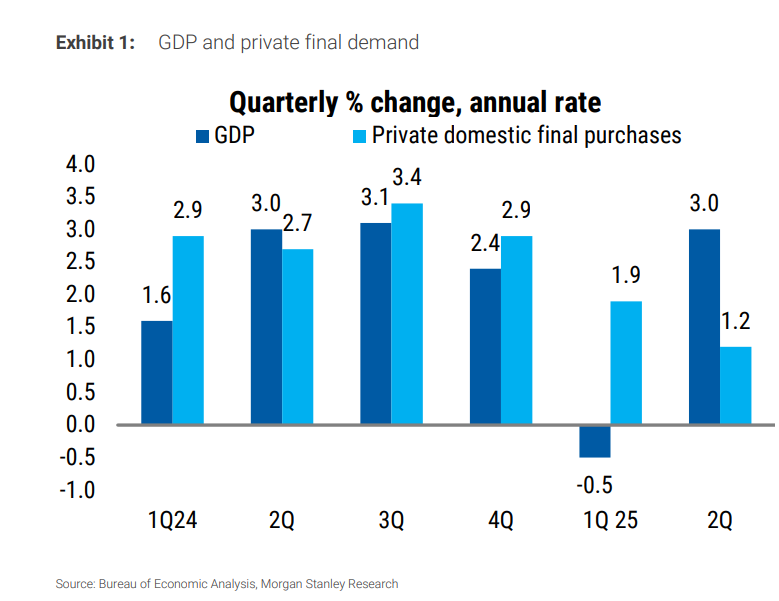
Core Insights - The apparent growth in the US GDP for Q2 is misleading, primarily due to a significant drop in imports which artificially inflated the overall data, masking a slowdown in domestic demand [1][2][4] - Morgan Stanley's report indicates that the Q2 GDP grew at an annualized rate of 3.0%, surpassing market expectations of 2.5%, but this figure is heavily distorted by trade fluctuations [2][4] Domestic Demand and Consumption - The core indicator of domestic economic strength, private final domestic purchases, saw a sharp decline in growth from 2.7% the previous year to 1.2%, indicating a cooling in both household consumption and business investment [5] - Consumer spending showed a modest recovery, with actual personal consumption rising from 0.5% in Q1 to 1.4% in Q2, yet it remains significantly below 2024 levels [5] Investment Trends - Non-residential fixed investment growth significantly slowed in Q2, with construction investment declining by 10.3% following a 2.4% drop in Q1, and residential investment also fell by 4.6% [6] - Unexpectedly, business investment related to artificial intelligence underperformed expectations, with declines in power plant investments and a slowdown in data center and IT investments [6] Economic Outlook - Despite the better-than-expected Q2 GDP data, Morgan Stanley maintains a forecast of economic slowdown, predicting that the negative impacts of restrictive trade and immigration policies will outweigh the benefits from fiscal policy and deregulation [7] - The forecast for Q4 2025 shows a year-on-year growth rate of 1.0%, with 2026 growth expected at 1.1%, significantly lower than the strong performance anticipated in 2024 [7]
有望再涨至少10%!华尔街开始新一轮唱多美股
Di Yi Cai Jing Zi Xun· 2025-07-31 00:48
Group 1 - The U.S. and EU have agreed on a trade agreement framework, leading to a rise in U.S. stock indices [1][2] - Oppenheimer raised its year-end target for the S&P 500 index to 7100 points, indicating an expected increase of 11.1% for the remainder of the year [2] - Morgan Stanley set a 12-month target for the S&P 500 at 7200 points, based on resilient earnings and cash flow [5] Group 2 - Oppenheimer's strategist noted that the progress in trade negotiations has reduced market uncertainty, leading to a more positive outlook [2] - The upcoming earnings season will see 161 S&P 500 companies reporting this week and 126 next week, with 84% of companies exceeding market expectations in the previous quarter [2] - Morgan Stanley's analysis suggests that the potential for further interest rate cuts by the Federal Reserve will benefit the stock market [5] Group 3 - The S&P 500 index has rebounded nearly 30% since early April, driven by cyclical sectors such as technology, industrials, and communication services [3] - Other financial institutions, including Goldman Sachs and Bank of America, have also raised their S&P 500 targets [4] - Morgan Stanley's strategist highlighted that the industrial sector has been the best-performing sector in the S&P 500 so far in 2025 [5]
时报观察丨熊猫债发展势头强劲 人民币国际化再添新动能
Sou Hu Cai Jing· 2025-07-30 00:17
Core Insights - The Panda bond market has seen its first successful issuance by a U.S. company, Morgan Stanley, which issued a 5-year Panda bond worth 2 billion yuan with a coupon rate of only 1.98, indicating strong investor demand [1] - Hungary has also entered the Panda bond market with a 3-year bond of 4 billion yuan and a 5-year bond of 1 billion yuan, marking the largest single issuance by a foreign government and the first 5-year foreign government Panda bond [1] Group 1 - The issuance scale of Panda bonds in the interbank market has exceeded 100 billion yuan this year, reflecting the growing willingness of foreign capital to enter the domestic bond market for RMB financing [2] - The comparative advantage of financing costs under the low-interest RMB environment has been highlighted, especially as the China-U.S. interest rate differential continues to widen since 2021 [2] - The stability of the RMB exchange rate amid international trade tensions has enhanced the investment appeal of Panda bonds for both foreign issuers and investors [2] Group 2 - The growth of the Panda bond market is driven by deeper financial institutional openness and the expansion of international economic and trade partnerships [2] - Recent policy changes since 2022 have facilitated Panda bond issuance by optimizing registration mechanisms and relaxing regulations on the use of raised funds, allowing for more flexible fund allocation [2] - China's ongoing high-level opening-up and the widespread use of RMB in cross-border trade transactions have bolstered confidence in holding and using RMB, further promoting the development of the Panda bond market [2][3] Group 3 - The Panda bond market is demonstrating greater depth and diversity, with each successful issuance and enthusiastic subscription contributing to the internationalization of the RMB [3] - Continuous financial reform and opening-up in China are expected to make RMB assets more attractive to global investors [3]
