
小米

Search documents
投中榜·2025年度长三角地区榜单发布
投中网· 2025-11-21 08:22
Core Viewpoint - The article highlights the dynamic economic growth and innovation in the Yangtze River Delta region, emphasizing its role as a hub for emerging industries and young entrepreneurs, which contributes to its competitive edge globally [2]. Group 1: Economic Growth and Innovation - The Yangtze River Delta is recognized as an economic beacon in Eastern China, with GDP growth rates consistently ranking among the highest in the country [2]. - The region's industrial structure is shifting towards the tertiary sector, showcasing significant innovation-driven effects [2]. - Emerging industries such as advanced manufacturing, information technology, and biomedicine are attracting capital market interest, becoming core engines for high-quality growth [2]. Group 2: Investment Institutions Ranking - The "2025 Annual Yangtze River Delta Best Investment Institutions List" was released, evaluating over 300 equity investment institutions based on quantitative and qualitative metrics [3]. - The list includes three major awards: Top 30 Best Venture Capital Institutions, Top 30 Best Private Equity Institutions, and Top 10 Best Early-Stage Venture Capital Institutions [3]. Group 3: Notable Investment Institutions - The top venture capital institutions include: - Northern Light Venture Capital with ¥20 billion under management, notable investments in Meituan and Hezhima Intelligent [7]. - Bo Yuan Capital with approximately ¥10 billion, investing in Aike Medical and Lixin Pharmaceutical [7]. - HLC HOHLIGHT with about ¥19 billion, known for investments in Mindray Medical and Weigao Blood Purification [8]. - The top private equity institutions feature: - Wu Yufeng Technology with ¥32 billion, investing in Hu Silicon Industry and Guangliwei [12]. - DCP & Dehong Capital with ¥65 billion, known for investments in Gaoxin Retail and New秀丽 [12]. - The top early-stage venture capital institutions include: - Tu Gan Sheng Capital with ¥7 billion, investing in Saiwei Microelectronics and Ding Sheng New Materials [19]. - Longshi Capital with ¥2.5 billion, known for investments in Suzhou Tianmai and Zhuhai Guanyu [19].


荣耀小米加码,全屋智能大乱战升级:家电巨头才是终极话事人?
3 6 Ke· 2025-11-21 07:52
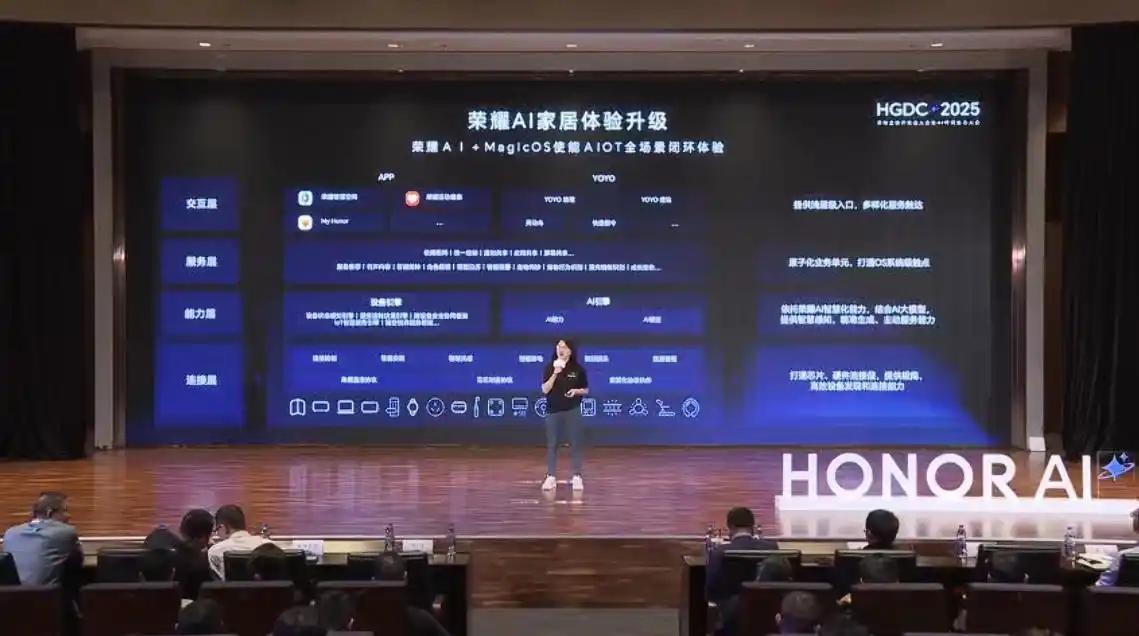
Core Insights - The smart home sector is witnessing an influx of players, with companies like Honor officially entering the market by adapting to Home Assistant and supporting the Matter protocol, while Xiaomi's AIoT platform has connected over 1 billion IoT devices for the first time, marking a year-on-year growth of over 20% [1][3][8]. Group 1: Company Strategies - Xiaomi has evolved from a mobile phone manufacturer to a comprehensive consumer electronics brand with a complete ecosystem of home appliances and IoT products, including smart speakers, air conditioners, and more, all integrated under the Mi Home app [5][8]. - Huawei's strategy focuses on creating a unified operating system, HarmonyOS, which integrates various devices into a distributed system, aiming to transform homes into "super devices" [9][11]. - Apple maintains a strong user experience with its HomeKit but is limited by its ecosystem, relying on third-party manufacturers for device compatibility, which restricts its market reach compared to competitors [12][15]. - Honor aims to be a coordinator of smart devices rather than a manufacturer of home appliances, focusing on interoperability through industry-standard protocols like Home Assistant and Matter [16][18]. Group 2: Competitive Landscape - Traditional home appliance giants like Midea, Haier, and Gree are shifting their focus to whole-home smart solutions, leveraging their hardware expertise and understanding of user needs to maintain a competitive edge [19][21]. - The competition is evolving from single smart products to system collaboration, allowing mobile manufacturers to re-enter the market, but traditional appliance manufacturers still hold significant advantages in hardware performance and user experience [22][25]. - New entrants in the smart home market, such as Euribot and Green米, are focusing on foundational smart home components, while emerging players like Chasing are rapidly expanding their product offerings across various categories [23][24]. Group 3: Future Outlook - The future of the smart home market is expected to be characterized by coexistence among various players, with mobile manufacturers offering flexible product choices and traditional appliance manufacturers providing reliable performance and integrated solutions [25][27].




鑫椤锂电一周观察 | 碳酸锂:10月需求超12万吨,明年增幅近30%
鑫椤锂电· 2025-11-21 07:52
Industry Insights - In October, domestic lithium carbonate demand reached 120,000 tons, an 8% month-on-month increase, while inventory fell below 120,000 tons, indicating a supply-demand reversal [2] - The sentiment in the market is driven by expectations that lithium carbonate prices may exceed 150,000 yuan if demand grows by 30% by 2026, with a projected global lithium resource demand of 1.8 million tons (LCE equivalent) [2] - The lithium carbonate market is experiencing a strong upward trend, with futures prices surpassing 100,000 yuan per ton, supported by a lack of new supply [6] Company Developments - Rongbai Technology has been designated as the first supplier of sodium battery cathode powder for CATL, marking a significant partnership [3] - Wanrun New Energy announced a shift in its fundraising project from a 120,000 tons/year lithium iron phosphate project to a high-voltage lithium iron phosphate project, with completion expected by December 2026 [4] Market Prices - As of November 20, battery-grade lithium carbonate prices range from 92,000 to 94,000 yuan per ton, while industrial-grade prices are between 90,500 and 91,500 yuan per ton [7] - The price of ternary materials has seen a slight increase, driven by rising lithium carbonate prices, with 5-series single crystal materials priced at 155,000 to 160,000 yuan per ton [8] - Phosphate lithium prices have also risen slightly, with power-type phosphate lithium priced at 37,400 to 38,800 yuan per ton [9] Electric Vehicle Market - In October, China's automobile exports reached 666,000 units, a 2.1% month-on-month increase and a 22.9% year-on-year increase, with a cumulative export of 5.616 million units from January to October, up 15.7% year-on-year [16] - The penetration rate of new energy vehicles reached 62.5%, indicating strong market demand [16] Energy Storage Sector - The domestic energy storage market is experiencing robust supply and demand, with new projects being launched in Inner Mongolia and upcoming subsidy policies expected in over ten provinces [17]

加密货币全线大跌,超25万人爆仓,近68亿元蒸发
2 1 Shi Ji Jing Ji Bao Dao· 2025-11-21 06:31
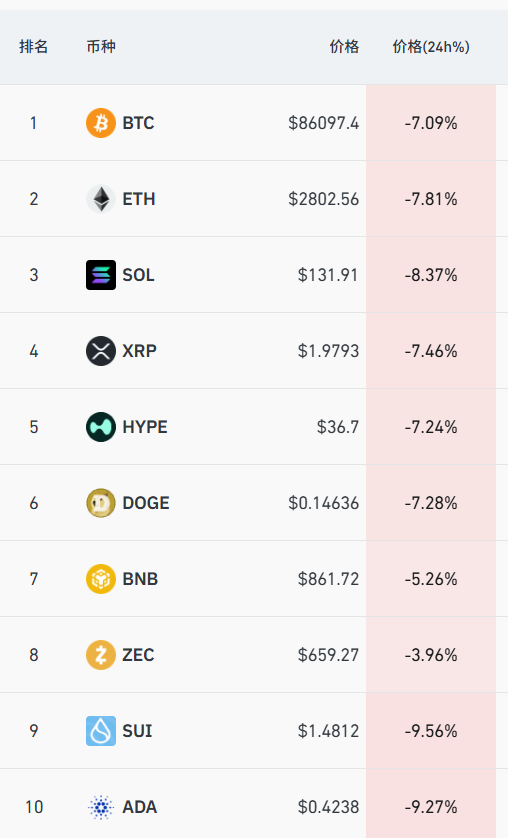
Core Viewpoint - The cryptocurrency market is experiencing a significant downturn, with Bitcoin dropping over 7% and falling below $87,000 for the first time since April, indicating a broader sell-off across major cryptocurrencies [1][2]. Market Performance - Bitcoin (BTC) is priced at $86,097.4, down 7.09% in the last 24 hours - Ethereum (ETH) is at $2,802.56, down 7.81% - Solana (SOL) is priced at $131.91, down 8.37% - Dogecoin (DOGE) is at $0.14636, down 7.28% [2]. Liquidation Data - Over the past 24 hours, the total liquidation in the cryptocurrency market exceeded $900 million (approximately 6.79 billion RMB), affecting 252,000 traders - The 12-hour liquidation reached $328 million, while the 1-hour liquidation was $7.3169 million [3]. Market Trends and Influences - Bitcoin has erased all its gains for the year, with a cumulative decline of 7.8% year-to-date, marking the first annual drop since 2022 - The recent decline is attributed to tight macro liquidity, decreased market risk appetite, and cyclical factors within the cryptocurrency industry [3][4]. - Uncertainty regarding U.S. fiscal and monetary policy has heightened traders' cautious sentiment, leading to a synchronized decline across risk assets, including stocks and gold [4]. Institutional Involvement - Institutional investors have been a key support for Bitcoin prices throughout the year, but there are signs of recent outflows from institutional funds - Despite short-term volatility influenced by macro liquidity and policy environment, the long-term outlook for Bitcoin remains positive due to global asset diversification trends and increasing institutional participation [4].
汽车有“魂”,AI如何重塑用车体验?
2 1 Shi Ji Jing Ji Bao Dao· 2025-11-21 00:30
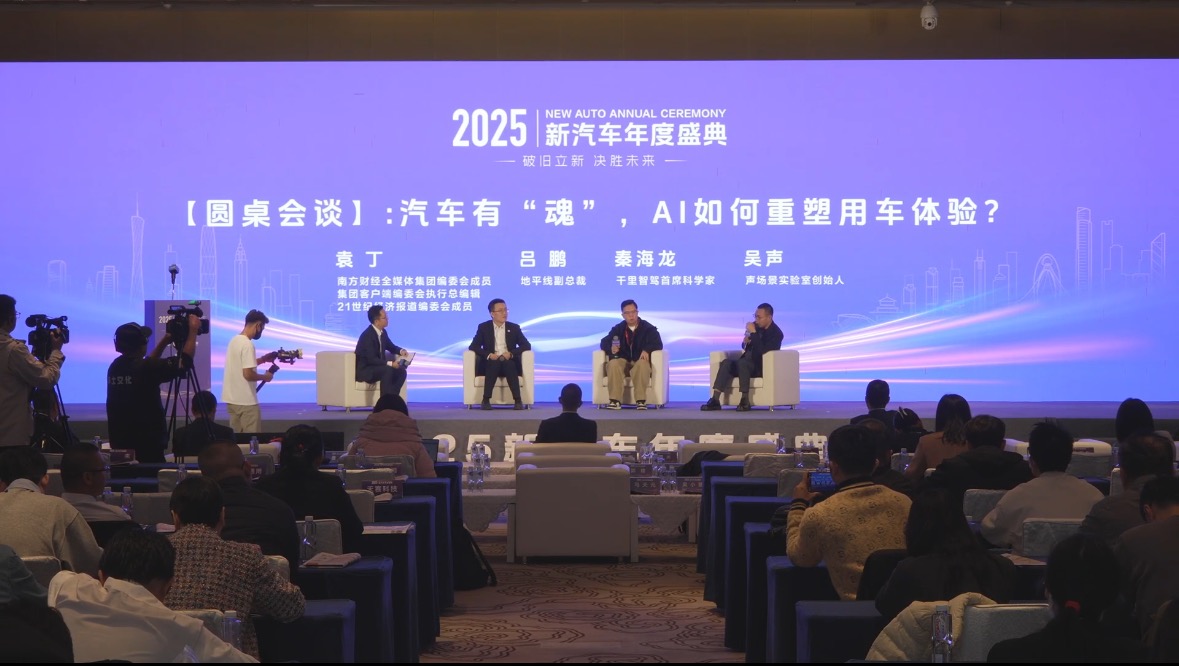
当人工智能的浪潮从虚拟世界涌向物理现实,汽车产业正站在这场变革的最前沿。自动驾驶领域技术路线纷繁复杂,"端到端"、"世界模型"、"VLA"等术语 层出不穷,业界对于何为"最优解"莫衷一是。 在由南方财经全媒体集团指导、21世纪经济报道主办的2025新汽车年度盛典上,南方财经全媒体集团编委会成员、集团客户端编委会执行总编辑、21世纪经 济报道编委会成员袁丁主持题为《汽车有"魂",AI如何重塑用车体验?》的圆桌论坛,邀请到地平线副总裁吕鹏、千里智驾首席科学家秦海龙和场景实验室 创始人吴声三位业界专家,旨在穿透技术路线的迷雾,深入探讨AI如何超越工具属性,为汽车注入可进化、可感知的"灵魂",从而彻底重塑人类的用车体 验。 场景实验室创始人吴声旗帜鲜明地指出,AI驾驶已超越"工具"范畴,正成为一种真实的生活方式,是通向AGI(通用人工智能)的最佳实践。 袁丁:当AI加速渗透物理世界,自动驾驶领域正处在充满分歧的路口。端到端、世界模型、VLA路线,哪条路线是自动驾驶的"最优解"?我们还要等待多久 才能迎来物理AI的曙光?吴声老师曾提出"AI场景革命元年"的概念,在汽车行业,AI场景应如何定义?目前是处于元年,还是已进入 ...
雷军不再温和,仍有两场硬仗要打
36氪· 2025-11-21 00:02
Core Viewpoint - Xiaomi is navigating a dual battle in the automotive and IoT sectors, achieving profitability in its electric vehicle division while facing challenges in regaining consumer trust and adapting its business model from a "traffic-driven" to a "value-driven" approach [4][30]. Automotive Battle: Profitability and Challenges - Xiaomi's revenue for Q3 2025 reached 113.1 billion yuan, a year-on-year increase of 22.3%, with adjusted net profit hitting a record high of 11.3 billion yuan, up 80.9% [8]. - The electric vehicle division achieved its first quarterly profit of 700 million yuan, a significant milestone compared to competitors like Li Auto and NIO, which took longer to reach profitability [9]. - Xiaomi's automotive production and delivery are ramping up, with Q3 2025 deliveries reaching 108,796 vehicles, marking a new high [13]. - The gross margin for the electric vehicle division stands at 25.5%, with an average post-tax price of around 260,000 yuan, comparable to luxury brands [14]. - Despite these achievements, challenges loom, including a potential decline in gross margin due to reduced government subsidies and increased competition in the automotive sector [16]. IoT and Home Appliances: Growth and Competition - Xiaomi's IoT and home appliance business generated 27.6 billion yuan in revenue for Q3 2025, a 5.6% year-on-year increase, with a gross margin of 23.9% [22]. - The company has seen a significant rise in its air conditioning market share, reaching 16.71% in July 2025, surpassing Gree and ranking second behind Midea [21]. - However, the smart home appliance segment experienced a 15.7% year-on-year revenue decline, attributed to subsidy reductions and intensified competition [23]. - Xiaomi is investing in smart manufacturing, with a new factory in Wuhan aimed at enhancing production capabilities and efficiency [26]. Rebuilding Consumer Trust - Xiaomi faces significant challenges in restoring consumer trust following several incidents, including a tragic accident involving its SU7 model and subsequent safety concerns [28]. - The company is under pressure to redefine its brand image and ensure product safety as it transitions from a smartphone-centric business to a broader technology and manufacturing focus [30]. - Xiaomi's strategy involves a shift from being an internet-driven company to a mission-driven technology firm, emphasizing safety and user-centric values [30].
美股深夜跳水,纳指跌近500点,英伟达跌超3%,百度、拼多多、小米跌超4%
2 1 Shi Ji Jing Ji Bao Dao· 2025-11-21 00:01
贵金属方面,现货黄金基本平收,报4077.91美元/盎司;现货白银跌1.4%,报50.6407美元/盎司。国际 贵金属期货普遍收跌,COMEX黄金期货跌0.15%报4076.7美元/盎司,COMEX白银期货跌0.98%报 50.355美元/盎司。 分析称,贵金属走势主要受美元走强与美联储降息预期降温双重压制。 北京时间21日凌晨,欧美股市走势分化,欧洲三大股指收盘全线上涨,美股则上演过山车式行情,集体 高开而后一路下行,三大指数悉数收跌。 截至美股收盘,道指跌0.84%报45752.26点,标普500指数跌1.56%报6538.76点,纳指跌2.15%报22078.05 点。 大型科技股集体下跌,万得美国科技七巨头指数下跌1.74%。个股方面,英伟达跌超3%,亚马逊、特斯 拉跌逾2%,微软、谷歌跌逾1%,苹果跌近1%,脸书跌0.19%。 银行股全线走低,摩根大通、高盛跌超1%,花旗、摩根士丹利跌超2%。 芯片股表现疲软,费城半导体指数跌4.77%,美光科技跌超10%,超威半导体跌逾7%,拉姆研究跌超 6%。 中概股普遍下跌,纳斯达克中国金龙指数跌3.26%,万得中概科技龙头指数跌2.72%。个股方面,阿特 斯 ...

纳指跌近500点,科技巨头集体下挫,英伟达跌超3%,中概股普跌,百度、拼多多、小米跌超4%
2 1 Shi Ji Jing Ji Bao Dao· 2025-11-20 23:28
| 脸书(META PLATF | 589.215 | -0.19% | | --- | --- | --- | | META.O | | | | 苹果(APPLE) | 266.250 | -0.86% | | AAPL.O | | | | 谷歌(ALPHABET). | 289.980 | -1.03% | | GOOG.O | | | | 微软(MICROSOFT | 478.430 - | -1.60% | | MSFT.O | | | | 特斯拉(TESLA) | 395.045 | -2.21% | | TSLA.O | | | | 亚马逊(AMAZON) | 217.140 | -2.49% | | AMZN.O | | | | 英伟达(NVIDIA) | 180.640 | -3.15% | | NVDA.O | | | 银行股全线走低,摩根大通、高盛跌超1%,花旗、摩根士丹利跌超2%。 芯片股表现疲软,费城半导体指数跌4.77%,美光科技跌超10%,超威半导体跌逾7%,拉姆研究跌超6%。 北京时间21日凌晨,欧美股市走势分化,欧洲三大股指收盘全线上涨,美股则上演过山车式行情,集体高开而后一路 ...

11月21日热门路演速递 | 中信建投、浙商证券共话AI赋能主线,小米、名创优品揭晓最新答卷
Wind万得· 2025-11-20 23:16
Group 1 - The core focus of the INTU earnings call is on the sustainability of high growth driven by AI and TurboTax Live, as well as the performance improvement of Mailchimp [2] - Xiaomi's press conference will highlight the official launch of the Xiaomi HAD enhanced version, an in-house developed end-to-end all-scenario driving assistance system aimed at improving perception, decision-making, and control in complex road conditions [4] - The annual strategy report by the chief analyst of Zhejiang Merchants Securities will provide in-depth analysis on the changes in the internet (AI and instant retail), gaming (future profit expectations and valuation trends), film and television (post-policy changes), education (AI in education), and new directions such as short dramas and interactive dramas [6] Group 2 - The investment strategy outlook for the telecommunications sector emphasizes the importance of computing power and new technological breakthroughs, with a positive outlook on AI-driven demand for computing power and applications [8] - The traditional telecommunications industry is facing challenges due to declining capital expenditures from telecom operators, but the development of key 6G technologies and increased focus on AI by operators are areas of interest [9] - Miniso's earnings call will focus on whether overseas store growth can exceed expectations, the impact of IP collaborations and membership systems on gross margin, and the potential rebound of the Chinese market amid consumer fatigue [11]
金杯汽车拟取得中拓科技控股权
Zheng Quan Ri Bao· 2025-11-20 15:57
Core Viewpoint - Jinbei Automotive is accelerating its investment pace, with a recent announcement of a 158 million yuan investment to acquire a 52% stake in Changchun Zhongtuo Molding Technology Co., Ltd, marking a strategic move towards high-value sectors [1][2]. Group 1: Investment Strategy - The investment strategy includes both fund investments and direct acquisitions, reflecting a systematic approach to penetrate high-value areas [1]. - The acquisition of Zhongtuo Technology will be executed in two steps: first, a cash subscription of 89.58 million yuan for new registered capital, followed by a cash transfer of 68.80 million yuan for existing shares [1]. Group 2: Company Profile and Financials - Zhongtuo Technology is the largest Tier 2 supplier in Northeast China's automotive industry, serving major clients including Ideal Auto, BMW, and Xiaomi [2]. - In 2024 and the first five months of this year, Zhongtuo Technology reported revenues of 251 million yuan and 123 million yuan, with net profits of 4.26 million yuan and 11.40 million yuan respectively [2]. Group 3: Strategic Implications - The acquisition allows Jinbei Automotive to quickly enter the lightweight automotive parts sector, enhancing its technical reserves and product diversification [2]. - The integration with Zhongtuo Technology is expected to reduce procurement costs and improve quality control, facilitating a transition from traditional parts supplier to a comprehensive provider of electrified and intelligent systems [2][3]. Group 4: Financial Health and Future Plans - As of September, Jinbei Automotive's cash reserves reached 1.951 billion yuan, providing a solid foundation for business development and external investments [3]. - The company aims to enhance value scale through internal and external market projects, focusing on new strategic projects while also seeking external growth opportunities [3].
