美的集团

Search documents
研判2025!中国清洁电器软管行业产业链、市场规模、竞争格局和未来趋势分析:清洁电器市场恢复增长,拉动清洁电器软管配套需求增加[图]
Chan Ye Xin Xi Wang· 2026-01-09 01:37
Core Viewpoint - The clean appliance hose market in China is experiencing significant growth, projected to increase from 1.1 billion yuan in 2019 to 1.7 billion yuan by 2024, with a compound annual growth rate (CAGR) of 8.4% driven by rising demand for clean appliances and improved living standards [1][6]. Industry Overview - Clean appliance hoses are flexible pipes that connect the main unit of cleaning appliances to accessories, affecting cleaning efficiency and user experience. They are primarily made from flexible materials and designed to minimize pressure loss during operation [2][3]. - The market for clean appliance hoses is expected to continue growing due to advancements in material science and manufacturing processes [6]. Industry Chain - The upstream of the clean appliance hose industry includes raw materials such as polyethylene, PVC, and various additives. The midstream involves the production of hoses, while the downstream encompasses the cleaning appliance sector, including vacuum cleaners, dishwashers, and washing machines [3][4]. Market Trends - The clean appliance market has shown an upward trend, with sales volume and revenue expected to rise significantly in 2024 due to policies like "old-for-new" exchanges and national subsidies. The sales volume is projected to increase by 22.8% to 30.35 million units, with revenue rising by 24.4% to 42.3 billion yuan [5]. - The vacuum cleaner market, a key application for clean appliance hoses, is expected to reach a market size of 43.2 billion yuan in 2024, reflecting a 12.5% year-on-year increase [5]. Competitive Landscape - The competitive landscape of the clean appliance hose industry is evolving, with increasing concentration as larger companies with advantages in scale, product quality, and technology gain market share. Key players include companies like Jinhua Chunguang Rubber and Plastic Technology Co., Ltd. and Hangzhou Taihe Plastic Co., Ltd. [7][8]. Development Trends - There is a trend towards high-end materials and structural upgrades in clean appliance hoses, with a shift from traditional PVC to high-performance polymers like TPU and silicone, enhancing durability and functionality [10]. - Customization is becoming a significant growth driver, with manufacturers responding to specific requirements for hose dimensions and designs to create differentiated products [11]. - The demand for environmentally friendly products is increasing, presenting opportunities for companies to develop eco-friendly hose solutions to meet consumer expectations [13].


A股去年回购增持规模超2200亿元
2 1 Shi Ji Jing Ji Bao Dao· 2026-01-09 01:29
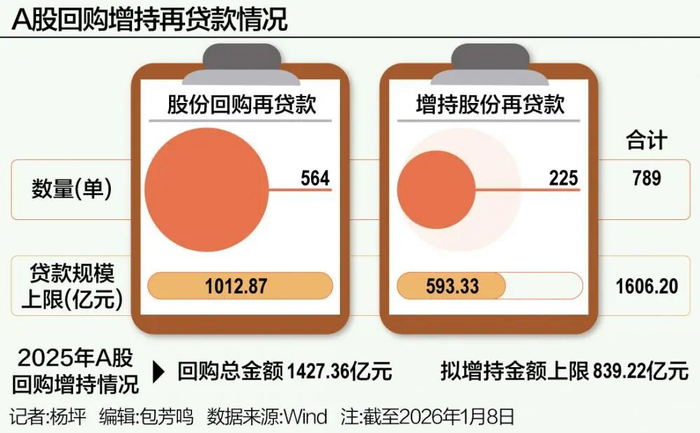
Core Viewpoint - The A-share market in 2025 shows a positive trend, with the Shanghai Composite Index returning to 4000 points and nearly 80% of listed companies experiencing stock price increases, supported by a record total transaction amount of 42 trillion yuan [1] Group 1: Market Performance - In 2025, a total of 1494 listed companies in the A-share market conducted buybacks, with a total amount reaching 142.736 billion yuan [1] - Additionally, 534 companies announced shareholding increases, with a maximum proposed increase amount of 83.922 billion yuan [1] - The total scale of buybacks and increases in 2025 reached 226.658 billion yuan [1] Group 2: Major Companies' Actions - Among the companies that conducted buybacks, 293 had buyback amounts exceeding 100 million yuan, with 15 companies exceeding 1 billion yuan, and one company surpassing 10 billion yuan [5] - Midea Group led the buybacks with a total amount of 11.545 billion yuan, being the only company to exceed 10 billion yuan in 2025 [5] - Guizhou Moutai followed with a total buyback amount of 6 billion yuan, marking its first-ever cancellation buyback since its listing [6] Group 3: Financing Support - The special refinancing loans for buybacks and increases provided significant support, with a total of 789 companies or major shareholders disclosing buyback and increase refinancing loan situations, amounting to 160.62 billion yuan [9] - The People's Bank of China optimized the refinancing policy, reducing the self-funding ratio requirement from 30% to 10% and extending the maximum loan term from 1 year to 3 years [9] - The refinancing loan interest rate is approximately 2.25%, providing a low-cost funding source for companies to conduct buybacks and increases [10] Group 4: Recommendations for Future Actions - Suggestions for banks to expand the coverage of refinancing loans to include more quality enterprises and to support diverse needs such as mergers and acquisitions [11] - Emphasis on improving policy precision, optimizing pricing mechanisms, and enhancing service efficiency to transition refinancing from a temporary tool to a normalized mechanism [11]
彭剑锋:拥抱AI不是选择题,而是生存题
3 6 Ke· 2026-01-09 01:17
Core Insights - The article emphasizes the need for companies to rethink their foundational logic and values in the context of the digital civilization era [1][3][5] Group 1: Current Economic Landscape - China's economy is undergoing a substantial transformation, moving away from the outdated "software" of the industrial civilization that cannot adapt to the new "hardware" of digital civilization [3][7] - The future competition will be between ecosystems, necessitating an altruistic mindset to build one's ecosystem, where altruism ultimately serves self-interest [3][8] Group 2: Cognitive and Philosophical Shifts - The most critical challenge for companies is "cognitive lag," which requires a fundamental overhaul of their value systems [7][9] - Companies must adopt four new cognitive frameworks: long-termism, productism, altruism, and innovation for good, which differ significantly from industrial-era thinking [7][8] - Great entrepreneurs are essentially philosophers, whose decisions are rooted in deep philosophical reflection [4][15] Group 3: Embracing AI - Embracing AI is not optional but essential for survival, as it represents a revolutionary leap in efficiency across various sectors [11][12] - Companies must learn to integrate AI with human capabilities, leveraging the strengths of both to enhance creativity and efficiency [11][12] Group 4: Entrepreneurial Spirit - The core elements of entrepreneurial spirit—innovation, risk-taking, and resilience—must evolve to include ethical considerations and a deeper understanding of risks [13][14] - New generations of entrepreneurs should cultivate a sense of national and communal responsibility, moving beyond individualistic goals [14][15] Group 5: Future Leadership - Successful leaders must engage in lifelong learning and be willing to pass on responsibilities to capable successors, ensuring the continuity of their vision [15][16] - The article concludes that practical experience remains the greatest teacher for companies navigating the complexities of the digital age [17]

A股去年回购增持规模超2200亿元
21世纪经济报道· 2026-01-09 01:16
Core Viewpoint - The A-share market in 2025 shows a positive trend, with the Shanghai Composite Index returning to 4000 points and nearly 80% of listed companies experiencing stock price increases, supported by a total transaction volume reaching a historical record of 420 trillion yuan [1] Group 1: Buybacks and Increases - In 2025, a total of 1494 listed companies in the A-share market conducted buybacks, with a total amount of 142.736 billion yuan. Additionally, 534 companies announced shareholding increases, with a maximum proposed increase amounting to 83.922 billion yuan [1][4] - Among the companies that conducted buybacks, 293 had buyback amounts exceeding 100 million yuan, with 15 companies exceeding 1 billion yuan, and one company surpassing 10 billion yuan [4] - Midea Group led the buybacks with a total amount of 11.545 billion yuan, marking the only company with buybacks exceeding 10 billion yuan in 2025 [5] Group 2: Key Players in Buybacks - Guizhou Moutai followed Midea Group with a total buyback amount of 6 billion yuan, marking its first-ever cancellation-style buyback since its listing [5][6] - Other notable companies include CATL, which planned to buy back between 4 billion and 8 billion yuan, and several companies like XCMG, Muyuan Foods, and COSCO Shipping Holdings, which also had buybacks exceeding 2 billion yuan [6] Group 3: Support from Special Loans - The special loans for buybacks and increases provided significant support, with a total of 789 companies or major shareholders obtaining commitments for buyback and increase loans, amounting to 160.62 billion yuan [8] - The People's Bank of China optimized the policy for stock buyback and increase loans, reducing the self-funding ratio requirement from 30% to 10% and extending the maximum loan term from 1 year to 3 years [8][9] - The interest rate for these loans is approximately 2.25%, providing a low-cost funding source for companies to effectively manage their market value [9] Group 4: Recommendations for Future Actions - Suggestions for banks to enhance buyback and increase loans include expanding coverage to more quality enterprises, diversifying funding uses, and improving policy precision and service efficiency [10]

朝闻国盛:对当前房地产困境的三点思考
GOLDEN SUN SECURITIES· 2026-01-09 00:08
Group 1: Core Conclusions - The report presents three key thoughts on the current real estate dilemma, emphasizing that the existing supply exceeds demand, making "net supply" reduction crucial for stabilizing the market [2] - The report highlights that second-hand housing prices provide stronger guidance and leading signals compared to new housing prices, which can be understood from the perspectives of supply, demand, price, and policy [2] - It stresses the importance of recognizing the tail risks associated with the current real estate adjustment, particularly concerning developers, homebuyers, and banks, indicating potential risks may concentrate on banks, especially smaller banks [2] Group 2: Policy Recommendations - Four feasible policy measures are suggested to reduce net supply: optimizing land acquisition, revitalizing distressed and idle properties for public service needs, accelerating the replacement of aging housing, and allowing market forces to phase out "ghost town" housing in lower-tier cities [2] Group 3: Industry Performance Insights - The report provides insights into industry performance, noting that the defense and military industry showed a 59.9% increase over the past year, while the non-ferrous metals sector increased by 103.4% [1] - It also indicates that the banking sector experienced a decline of 2.3% in January, with a modest annual growth of 6.3%, reflecting ongoing challenges in the financial landscape [1]
外资集体唱多中国:资金与信心双轮驱动,重点关注科技创新与AI产业
Sou Hu Cai Jing· 2026-01-08 23:41
Group 1 - Global capital markets are focusing on China, with strong confidence in its economic resilience and market potential from multiple foreign institutions [1][4] - Goldman Sachs predicts that the MSCI China Index and the CSI 300 Index will rise by 20% and 12% respectively in 2026, maintaining a high allocation to Chinese A-shares and Hong Kong stocks [1][4] - UBS expects a 14% profit growth for the MSCI China Index in 2026, driven mainly by internet platforms, high-end manufacturing, and companies with global expansion capabilities [1][5] Group 2 - There is a clear trend of capital returning to China, with international long-term funds continuing to flow in and a strong recovery in the Hong Kong IPO market [2] - UBS's China president noted that 2025 was a pivotal year for international investors' attitudes towards Chinese assets, shifting from passive observation to active participation [2] - Goldman Sachs forecasts that net buying from southbound funds could reach $200 billion in 2026, setting a new historical high [2] Group 3 - Global hedge funds currently have a net allocation of 7.6% and a total allocation of 6.5% to Chinese stocks, significantly below previous cycle peaks [3] - The MSCI China Index is expected to trade at a forward P/E ratio of 13 times by the end of 2026, indicating significant upside potential not yet reflected in current valuations [3] - The MSCI China Index currently trades at a discount of 38% compared to developed markets and 11% compared to other emerging markets, making it attractive for foreign investment [3] Group 4 - The positive outlook for Chinese assets is supported by fundamental improvements, reasonable valuations, and policy benefits [4][5] - Goldman Sachs emphasizes that the stock market's rise in 2026 will be driven by earnings growth, with expected profit growth of 14% for both the MSCI China Index and the CSI 300 Index [4][5] - The anticipated policy support will focus on accelerating investment in advanced technologies to enhance self-sufficiency and productivity [5] Group 5 - The technology innovation and AI sectors are identified as core growth areas attracting foreign investment [6] - China's AI technology companies have a total market value of approximately $5 trillion, which is only one-sixth of that of the U.S., indicating significant growth potential [6] Group 6 - Goldman Sachs recommends focusing on three core areas for investment: private enterprises benefiting from AI development, stocks supported by the "14th Five-Year Plan," and leading companies in export [7] - The top ten private leading enterprises in China, including Tencent and Alibaba, represent 40% of the MSCI China Index's weight and have a daily trading volume of $7.5 billion [7] - Companies with strong balance sheets and cash flows that are well-positioned for international market expansion are expected to perform well [7]





A股回购增持潮涌 去年规模超2200亿元,产业资本传递信心
2 1 Shi Ji Jing Ji Bao Dao· 2026-01-08 23:08
Core Viewpoint - The A-share market in 2025 shows a positive trend, with the Shanghai Composite Index returning to 4000 points and total trading volume reaching a historical record of 420 trillion yuan, indicating a recovery in market confidence [2] Group 1: Market Performance - In 2025, nearly 80% of listed companies saw their stock prices rise, contributing to the overall positive market sentiment [2] - The total repurchase and increase in shareholding by industrial capital reached 2266.58 billion yuan, providing strong momentum to the market [2][4] Group 2: Share Buybacks and Increases - A total of 1494 listed companies conducted share buybacks in 2025, with a total amount of 1427.36 billion yuan, while 534 companies announced shareholding increases with a maximum proposed amount of 839.22 billion yuan [2] - Notably, Midea Group led the buybacks with a total amount of 115.45 billion yuan, making it the only company to exceed 10 billion yuan in buybacks for the year [4][5] Group 3: Policy Support and Financing - The People's Bank of China optimized policies for stock repurchase and increase loans, reducing the self-funding ratio requirement from 30% to 10% and extending the loan term from 1 year to 3 years [7] - By the end of 2025, the total amount of special loans for stock repurchase and increases reached 1606.20 billion yuan, with 789 companies or major shareholders obtaining loan commitments [7][8] Group 4: Industry Leaders and Trends - Leading companies such as Kweichow Moutai and CATL also engaged in significant buybacks, with Kweichow Moutai repurchasing 60 billion yuan worth of shares [6] - The trend of share buybacks and increases is becoming normalized, supported by both policy guidance and companies' proactive actions to boost market confidence [4][6]

关注CES展新品催化-重视智能眼镜和困境反转机会
2026-01-08 16:02
Summary of Conference Call Records Industry Overview - **Home Appliances**: The adjustment of subsidy policies for home appliances is expected to impact sales strategies and profit expectations for related companies. The overall subsidy ratio is set at 15%, with a cap reduced to 1,500 yuan, aligning with market expectations [1][2] - **Air Conditioning**: The air conditioning industry has seen collective price increases at the beginning of the year, with companies like Midea and Haier raising prices by 5%-10%. Gree has temporarily committed to not raising prices. Companies are adopting technologies like aluminum substitution for copper to manage cost pressures [1][3] - **AI Glasses**: Companies such as TCL Electronics, Hisense, and XGIMI launched new AI glasses at CES, expected to enter the market in Q2, potentially creating new revenue streams. The AI glasses market is projected to grow significantly, with shipments expected to double from 10 million units in 2025 to 20 million in 2026 [1][5][6] Key Company Insights - **Midea**: Acquired the international business of Reiko Medical to expand its medical segment. Midea's revenue growth for Q4 is expected to be between 0-5% [1][4] - **Haier**: Achieved growth through overseas acquisitions, with Q4 revenue growth also projected at 0-5% [1][4] - **Ninebot**: Launched new national standard models and an electric motorcycle strategy, aiming to capture a significant share of the global motorcycle market. Expected sales growth for 2026 is 40%-50%, despite a potential short-term revenue decline of 10%-15% due to inventory clearance [1][9][10] Market Dynamics - **Two-Wheeler Industry**: The industry is facing challenges due to the transition to new national standards, but market education is helping acceptance. Ninebot is positioned as a strong competitor with advanced battery technology and plans for significant store expansion [1][8][9] - **Robotics**: Companies like Roborock and Ecovacs are highlighted for their innovative products. Roborock's revenue is expected to grow by 35% in Q4, while Ecovacs is expanding its product lineup [1][11] Investment Opportunities - **Tool Industry**: Companies like Juxing and Quanfeng are seen as having strong investment potential due to expected recovery in the U.S. housing market, which will drive tool demand. Juxing's revenue growth is projected at 20%-30%, while Quanfeng is expected to return to double-digit growth [1][12] Additional Insights - **Copper Price Impact**: The air conditioning sector is particularly sensitive to copper price fluctuations, which have led to price increases across major manufacturers [1][3] - **AI Glasses Supply Chain**: Upstream suppliers like Guangfeng Technology and Biying Co. are expected to benefit from the growth in the AI glasses market [1][6][7]
空调铝代铜的挑战与机遇
2026-01-08 16:02
Summary of Key Points from Conference Call on Air Conditioning Industry and Aluminum-Copper Replacement Technology Industry Overview - The air conditioning industry is facing cost pressures, prompting leading companies to actively promote aluminum-copper replacement technology to reduce production costs [1][2] - Major players like Wanbao and Midea have been working on this technology since 2009, laying the groundwork for its rapid adoption [1][2] Core Insights and Arguments - **Copper and Aluminum Price Trends**: - Copper prices are driven by multiple factors including interest rate cuts, economic resonance between China and the US, supply disruptions, and emerging demand, potentially reaching $15,000/ton (approximately 120,000 RMB) [1][4] - Aluminum pricing is primarily influenced by supply and demand, with current prices around 24,000 RMB/ton due to a widening domestic marginal gap [1][4] - The current copper-aluminum price ratio is 4.4:1, significantly encouraging the adoption of aluminum in air conditioning systems [1][5] - **Cost Reduction Potential**: - Replacing components like evaporators and condensers with aluminum can reduce costs by approximately 100 RMB for just the indoor unit and about 300 RMB for a full replacement [3][6] - In extreme cases, a complete switch to aluminum could lower costs by over 400 RMB per unit [3][6] - **Market Acceptance**: - The acceptance of aluminum-copper technology is higher in overseas markets such as Japan (50% penetration), South Korea (20%-30%), and North America (20%), while domestic consumers remain cautious due to brand quality concerns [3][7] - **Future Projections**: - In the next 1-3 years, most companies will remain cautious, but if market responses are positive, leading firms may begin to introduce aluminum-copper products [12][13] - Long-term projections suggest that the domestic market could reach levels similar to overseas markets within ten years [13] Additional Important Insights - **Impact on Supply Chain**: - The shift to aluminum may not significantly benefit midstream component suppliers, as major companies like Midea produce their own aluminum heat exchangers [15] - Upstream demand for aluminum and related materials is expected to increase, benefiting companies involved in aluminum production and processing [17] - **Technological and Competitive Landscape**: - Smaller firms may have opportunities to close the gap with larger companies through technological innovation in aluminum-copper applications [10] - The transition to aluminum may not drastically alter the competitive landscape in the short term, but it represents a clear long-term trend [18] - **Processing Costs and Efficiency**: - The efficiency loss and yield issues during processing could reduce the overall cost savings by about 10%, indicating that while aluminum offers cost benefits, the transition requires careful management of production processes [18] This summary encapsulates the key points discussed in the conference call regarding the air conditioning industry's shift towards aluminum-copper technology, highlighting market dynamics, cost implications, and future trends.
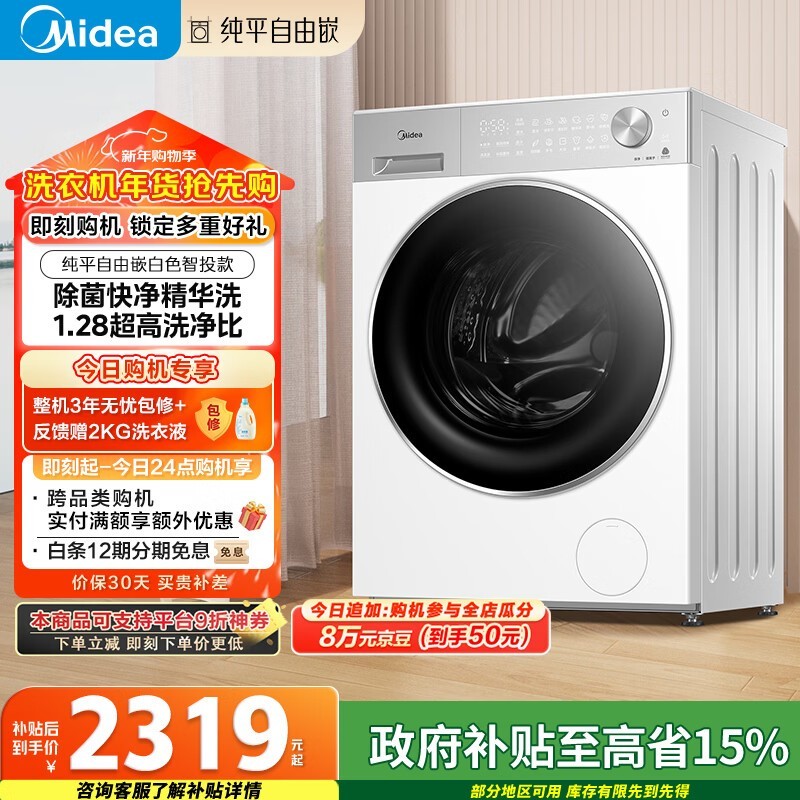
美的10kg滚筒洗衣机京东特惠低至2027.65
Xin Lang Cai Jing· 2026-01-08 14:51
具备资讯 下载APP > (Midea | 阿里中带自由嵌 Quide T NE N 70 G 新年购物季 液衣机套毛绿色完成 即刻购机 锁定多重好礼 纯平自由嵌白色智投款 除菌快净精华洗 1.28超高洗净比 今日两和气事 整机3年无忧包修+ 日 即刻起-今日24点购机享 · 跨品类购机 实付满额享额外优惠 · 白条12期分期免息 28 价保30天 买贵补差 今日追加:购机参与全店瓜分 本商品可支持平台9标 8万元京豆 (到手50元) 下单立减 即刻下单价更低 神贴后 政府补贴至高省15% 元起 到主机 咨询客服了解补贴详情 部分地区可用 库存有限先到先得 ( Midea Quide 新年购物季 波农机年佳综合完换 即刻购机 锁定多重好礼 纯平自由嵌白色智投款 除菌快净精华洗 1.28超高洗净比 合目两加拿事 整机3年无忧包修+ 20 即刻起-今日24点购机享 · 跨品类购机 实付满额享额外优惠 · 白条12期分期免息 绘图 价保30天 买贵补差 今日追加:购机参与全店瓜分 本商品可支持平台9旅 8万元京豆 (到月50元) 下单立减 即刻下单价更低 神贴后 政府补贴窒高省15% 元起 到主机 咨询客服了解补贴 ...