
科沃斯

Search documents
山西证券研究早观点-20260205
Shanxi Securities· 2026-02-05 03:40
研究早观点 2026 年 2 月 5 日 星期四 市场走势 资料来源:常闻 国内市场主要指数 | 指数 | | 收盘 | 涨跌幅% | | | --- | --- | --- | --- | --- | | 上证指数 | | 4,102.20 | 0.85 | 降,其余环节持平 | | 深证成指 | | 14,156.27 | 0.21 | | | 沪深 | 300 | 4,698.68 | 0.83 | | | 中小板指 | | 8,526.31 | 0.02 | | | 创业板指 | | 3,311.51 | -0.40 | | | 科创 | 50 | 1,453.48 | -1.20 | | | 资料来源:常闻 | | | | | 分析师: 彭皓辰 执业登记编码:S0760525060001 邮箱:penghaochen@sxzq.com 【公司评论】科沃斯(603486.SH):科沃斯:盈利能力改善,加速迈向 多品类、全场景服务机器人 【行业评论】【山证电新】20260204 光伏产业链价格跟踪- 硅片价格下 降,其余环节持平 2019 年 2 月 21 日 星期四 请务必阅读最后股票评级说明和免责声 ...
如何看当前时点地产链投资机会
2026-02-05 02:21
Summary of Conference Call Records Industry: Real Estate Key Points - The real estate industry has undergone a deep cleansing of its fundamentals, with positive policy signals expected to gradually restore holdings, leading to valuation elasticity. In January, the second-hand housing market in core cities showed signs of recovery, with increased transaction volumes and decreased listing volumes, optimizing supply-demand relationships and narrowing price declines [1][2][3] - Multiple authoritative media outlets have released positive signals regarding the financial asset attributes of real estate and the cancellation of restrictive measures. Many real estate companies are no longer required to report the "three red lines" indicators monthly, indicating a period of intensive policy implementation, which enhances the investment value of the real estate sector [3] - The investment strategy for the building materials industry chain should focus on balance and early layout of related opportunities. Global expansion of balance sheets and marginally increasing liquidity in the A-share market support potential excess return opportunities in the building materials sector [1][4] - The A-share market's IPO financing is expected to be at historical average levels, but the second half of the year may see quarterly financing amounts exceeding expectations, which could signal a warning for the technology sector as relative returns may decrease [5] - The current economy is at the end of a Kondratiev wave depression, with non-ferrous metals and commodities being favorable investment options. The adjustment in the real estate market is nearing its end, with potential investment opportunities expected to emerge [6] Additional Insights - The real estate sector is currently in a core configuration window with high win rates and odds. As of Q4 2025, the sector's holdings accounted for approximately 0.43% of stock investment value, indicating a significant underweight that has persisted for 24 quarters [2] - The recovery of the Hong Kong real estate sector serves as a reference for the mainland market, with historical data suggesting that the adjustment in actual housing prices in China has been sufficient, leading to an increase in the sector's win rate [2] - The building materials sector's investment strategy emphasizes early positioning in response to market changes, with a focus on companies with low valuations and strong resource reserves, such as China Trade and Greentown China [4] - The cement industry is highlighted for its potential, with profitability closely tied to capacity utilization rates. Companies like Conch Cement are expected to see significant profit increases if prices rise [10] - The home appliance sector is anticipated to recover as real estate data stabilizes, which will directly boost demand for white goods and kitchen appliances [13] Industry: Building Materials Key Points - The investment strategy for the building materials industry should focus on both expansion and balance, with an emphasis on early positioning in real estate-related opportunities [4] - Companies with low valuations and strong resource reserves, such as China Trade and Greentown China, are recommended for investment [4] - The cement industry is expected to enter a new recovery cycle, with significant profit potential linked to price increases [10] Industry: Home Appliances Key Points - The home appliance sector is nearing the end of its darkest period, with potential investment opportunities arising as real estate data stabilizes and consumer demand is expected to recover [13] - The sector's current low valuations present opportunities for growth, particularly in white goods and kitchen appliances, which are closely tied to real estate performance [13] Additional Insights - Companies like Midea, Haier, and Gree are highlighted for their strong dividend yields, making them attractive investment options [13] - Newer companies in the market, such as Roborock and Ecovacs, are also noted for their competitive positioning and potential for valuation recovery [13]
追觅创始人“豪言不断”!下一个马斯克,还是下一个贾跃亭?
Sou Hu Cai Jing· 2026-02-04 16:36
Core Viewpoint - The CEO of Chasing Technology, Yu Hao, has made bold predictions about the future of Tesla and the ambitions of his own company, positioning himself as a controversial figure in the tech industry [2][5][23] Group 1: Company Ambitions and Predictions - Yu Hao predicts that in 20 years, Tesla will face significant challenges similar to those of iRobot, which went bankrupt in 2025 [5] - He aims for Chasing Technology to become the world's first trillion-dollar company ecosystem, claiming that competitors like Musk and Huang Renxun will not surpass a valuation of 8-10 trillion [7][8] - The company plans to launch a high-end smartphone and has ambitious goals in the automotive sector, including a luxury electric vehicle to rival Bugatti by 2027 [19][20] Group 2: Financial Performance and Market Position - Chasing Technology's revenue is projected to reach 15 billion yuan in 2024, with significant growth expected in 2025, where it has already surpassed its previous year's total by mid-year [15] - The company holds a 12% market share in the global robotic vacuum market, ranking third behind competitors like Roborock and Ecovacs [15] - Despite rapid growth, the Chinese robotic vacuum market is showing signs of decline, with retail sales dropping by approximately 7% from 2021 to 2024 [17] Group 3: Challenges and Consumer Feedback - Chasing Technology faces over 4,200 complaints on consumer platforms, primarily related to after-sales service and product quality [17][18] - The company is under pressure to find new growth avenues as the market for its core products becomes increasingly competitive [19][22] - Yu Hao's aggressive expansion into various sectors, including automotive and smart home devices, raises questions about the sustainability of such rapid diversification [22]


自断主营业务、营收砍半,一家老牌OEM扫地机器人公司的转型豪赌|Insight全球
36氪· 2026-02-04 09:39
Core Viewpoint - ILIFE has transitioned from being an OEM manufacturer to focusing entirely on its own brand, showcasing the evolution of Chinese manufacturing from export-oriented to brand-oriented strategies. The company's sales on AliExpress increased by over 300% in 2025, with significant success in the Polish market, where it became a leading cleaning brand [4][5][18]. Group 1: Company Transformation - ILIFE was previously a typical OEM factory, producing over 2 million units annually for various brands, including Ecovacs and Lukas [7][13]. - In 2024, ILIFE made a decisive choice to stop OEM operations and concentrate on its own brand, despite a short-term revenue decline from over 1 billion yuan to below 500 million yuan [17]. - The shift allowed ILIFE to gain direct market feedback, enhancing product development and responsiveness to consumer needs [17][18]. Group 2: Market Strategy - ILIFE chose to avoid the trend of adding excessive features to its products, instead focusing on the core cleaning function and cost-effectiveness [21][23]. - The company targets the mid to lower market segments, offering competitive pricing by integrating advanced features typically found in higher-end models into more affordable products [23][25]. - ILIFE's cost control measures, including in-house production and logistics, enable it to offer products that are generally 10-20 USD cheaper than competitors [24][25]. Group 3: Consumer Engagement - ILIFE utilizes direct communication with consumers through platforms like AliExpress, allowing for rapid product iteration based on real-time feedback [17][25]. - The company has successfully addressed specific consumer needs, such as the demand for "live water washing" technology, by being proactive in product development [25]. - This approach has positioned ILIFE as a significant player in the overseas market, demonstrating the potential for Chinese brands to thrive internationally [25].

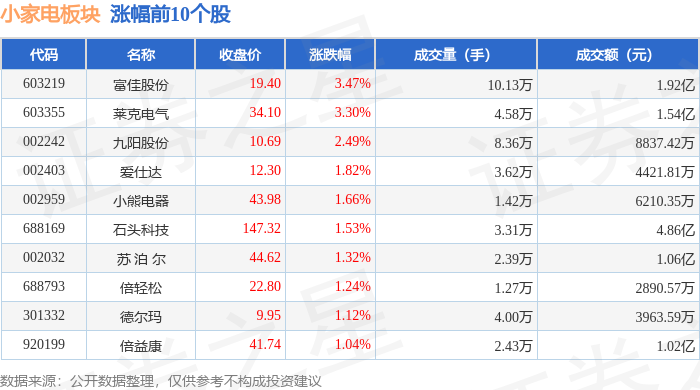
小家电板块2月4日涨0.89%,富佳股份领涨,主力资金净流出5684.65万元
Zheng Xing Xing Ye Ri Bao· 2026-02-04 08:56
Market Performance - The small home appliance sector increased by 0.89% on February 4, with Fujia Co., Ltd. leading the gains [1] - The Shanghai Composite Index closed at 4102.2, up 0.85%, while the Shenzhen Component Index closed at 14156.27, up 0.21% [1] Stock Performance - Fujia Co., Ltd. (603219) closed at 19.40, up 3.47% with a trading volume of 101,300 shares and a transaction value of 192 million [1] - Lek Electric (603355) closed at 34.10, up 3.30% with a trading volume of 45,800 shares and a transaction value of 154 million [1] - Joyoung Co., Ltd. (002242) closed at 10.69, up 2.49% with a trading volume of 83,600 shares and a transaction value of 88.37 million [1] - Other notable stocks include Stone Technology (688169) which closed at 147.32, up 1.53% with a transaction value of 486 million [1] Capital Flow - The small home appliance sector experienced a net outflow of 56.84 million from institutional investors, while retail investors saw a net outflow of 6.16 million [2] - Conversely, speculative funds recorded a net inflow of 63.01 million [2] Individual Stock Capital Flow - Fujia Co., Ltd. had a net inflow of 29.21 million from institutional investors, but a net outflow of 28.55 million from retail investors [3] - Joyoung Co., Ltd. saw a net inflow of 6.15 million from institutional investors, with a net outflow of 4.35 million from retail investors [3] - Lek Electric had a net inflow of 4.43 million from institutional investors and a net inflow of 9.39 million from speculative funds [3]


商用清洁机器人行业报告 | 全球与中国市场现状及未来发展趋势
QYResearch· 2026-02-04 04:01
Core Viewpoint - The commercial cleaning robot market is rapidly evolving, driven by advancements in technology and increasing demand for automation in various sectors, including healthcare, retail, and public spaces [2][13]. Group 1: Product Features and Development - Commercial cleaning robots are designed for autonomous navigation and obstacle avoidance, utilizing technologies such as LiDAR and AI visual recognition [2]. - The robots can perform integrated cleaning tasks on hard surfaces and are capable of operating 24/7, significantly reducing labor costs and addressing workforce shortages [2]. - The development timeline shows a progression from semi-automated machines in the 1990s to fully autonomous robots with advanced navigation and cleaning capabilities by 2023 [4][5]. Group 2: Market Size and Growth - The global market for commercial cleaning robots is projected to reach approximately $522 million by 2024, with a compound annual growth rate (CAGR) of about 10.90% from 2020 to 2024 [8]. - By 2031, the market size is expected to approach $1.046 billion, with a CAGR of 11.27% from 2025 to 2031 [8]. - The Asia-Pacific region, particularly China, dominates the market, accounting for 35.67% of global sales in 2024 [8][10]. Group 3: Industry Drivers and Opportunities - Rising labor costs in developed countries are pushing companies to adopt robots to reduce long-term labor expenses [13]. - The post-pandemic era has seen a surge in demand for high-frequency, contactless cleaning in public spaces such as hospitals and shopping malls [13]. - Technological advancements, including fast-charging and long-lasting batteries, are enhancing operational efficiency and reducing the need for human intervention [13]. Group 4: Competitive Landscape - Major players in the market include companies like Gaoxian Robotics, Tennant, Softbank, Ecovacs, and Pudu Robotics, which collectively hold a market share of 52.78% in 2024 [10]. - The competition is expected to intensify in China over the coming years as more companies enter the market [10]. Group 5: Policy and Regulatory Environment - The Chinese government is increasingly integrating cleaning robots into urban management and public service frameworks, recognizing them as essential components of smart infrastructure [15][16]. - There is a push for standardization in the industry, with various safety and operational standards being developed to ensure the reliability and effectiveness of cleaning robots [16].

自断主营业务、营收砍半,一家老牌OEM扫地机器人公司的转型豪赌|Insight全球
3 6 Ke· 2026-02-04 01:25
Core Insights - ILIFE, once an OEM factory with an annual output of over 2 million units, has decided to completely cease its OEM business and focus on its own brand starting in 2024 [3][12] - In 2025, ILIFE's sales on AliExpress grew by over 300% year-on-year, with sales in Poland exceeding $10 million, indicating a significant shift in brand strategy [2][13] - The transition from OEM to a consumer-focused brand reflects a broader evolution in Chinese manufacturing from "exporting" to "brand exporting" [5][12] Company Strategy - ILIFE's decision to stop OEM production was driven by the need to shift from a client-order dependency to a user-centric approach, allowing for direct consumer feedback and product development [11][12] - The company has adopted a strategy of focusing on the essential cleaning functions of its products rather than adding excessive features, targeting the mid to lower market segments [15][16] - Cost control measures have been implemented across all stages of production, resulting in competitive pricing that is typically $10-20 cheaper than similar products [16][18] Market Position - ILIFE has positioned itself as a "national-level" cleaning brand in Poland, achieving significant market penetration with one in ten households using its products [2][13] - The brand's growth is supported by a strong performance on e-commerce platforms, where it has outperformed competitors like Amazon during key sales events [2][13] - The company has effectively utilized real-time consumer feedback to iterate on product design, enhancing features based on direct user input [12][18]


激光雷达,是怎么被中国打成白菜价的?
Xin Lang Cai Jing· 2026-02-03 12:53
Core Insights - The laser radar industry, once mocked by Elon Musk, is experiencing a resurgence, with Chinese companies capturing 70-80% of the global market share [4][32] - The growth of laser radar is not primarily driven by the automotive sector but by applications in household appliances and robotics, such as sweeping and mowing robots [4][6] - Chinese companies have significantly reduced the cost of laser radar technology, with prices dropping from several thousand dollars to around 200 dollars, enabling mass production [6][34] Industry Developments - Hesai Technology announced plans to double its production capacity from 2 million units in 2025 to 4 million units in 2026 and has been selected as a partner for NVIDIA's DRIVE AGX Hyperion 10 platform [2][30] - The global market for robotic lawn mowers saw a 327% year-on-year increase in sales in the first half of 2025, while the overall smart cleaning robot market grew by 33% [4][32] Competitive Landscape - American laser radar company Luminar has filed for bankruptcy, struggling with high production costs and competition from Chinese manufacturers [6][34][35] - Luminar's technology, which relies on a more complex and expensive 1550nm FMCW solution, could not compete with the simpler and cheaper 940nm VCSEL technology used by Chinese firms [34][35] Technological Advancements - The principle of laser radar is straightforward, but the implementation requires four core components: light source, detector, scanning mechanism, and algorithms [39][41] - Chinese companies have achieved cost reductions through chip integration, combining the functions of emission, reception, and signal processing into a single chip, significantly lowering production costs [42][49] Cost Reduction Strategies - The BOM (Bill of Materials) cost for domestic laser radar has decreased by 52% from 2019 to 2025, transforming the technology from a luxury item to a consumer product [49][56] - The integration of components allows for a reduction in the number of parts needed, leading to lower costs and improved efficiency [42][49] Future Implications - The advancements in laser radar technology are expected to benefit various sectors, including eVTOL (electric vertical takeoff and landing) and smart infrastructure, enhancing safety and operational capabilities [55][56] - The integration technology developed by Chinese firms is set to revolutionize the perception and accessibility of sensing technologies, making them standard in various applications [56]

整个社会都在喊没钱了,为什么这些公司反而年赚百亿?
创业家· 2026-02-03 10:39
Core Insights - The article emphasizes that despite the prevailing narrative of economic hardship, certain industries are thriving and generating substantial profits, particularly in Japan and China [3][4]. - It identifies eight key sectors that are capitalizing on changing consumer behaviors and preferences, presenting significant business opportunities [5]. Group 1: Key Industries - **Second-Hand Economy**: The second-hand luxury market in Japan, exemplified by companies like Daikokuya, has seen explosive revenue growth. In China, platforms like Hongbulin and Panghu are experiencing similar success, indicating a shift in consumer spending from new luxury goods to second-hand items [6][7][8]. - **Pet Economy**: With declining birth rates, young consumers are increasingly spending on pet products. Companies like Inaba in Japan and Guobao in China are witnessing strong stock performance due to rising demand for pet food and healthcare products [12][13][15]. - **Adult Care**: The adult diaper market in Japan has surpassed $10 billion, highlighting the economic potential of the aging population. This sector is viewed as a significant opportunity rather than a burden [17][18][19]. Group 2: Health and Wellness - **Health Food and Beverages**: The rise in health consciousness and demographic changes have led to increased demand for sugar-free beverages and functional foods. Brands like Suntory and various Chinese counterparts are experiencing significant growth in this area [21][22]. - **Beauty and Aesthetics**: The demand for beauty products, including collagen supplements and at-home beauty devices, remains strong. Companies like Jinbo Biological and U like are achieving substantial sales, indicating that consumers prioritize beauty even in economic downturns [23][24][26]. Group 3: Outdoor and Leisure - **Outdoor Recreation**: Companies in the outdoor equipment sector, such as Snow Peak in Japan and various Chinese brands, are benefiting from a growing interest in outdoor activities and camping, with significant sales increases reported [29][31]. - **Convenience Economy**: The trend towards convenience is driving growth in frozen food and smart home appliances. Brands like Anjijia and various AI-driven home devices are gaining traction as consumers seek to save time [39][40][42]. Group 4: Market Dynamics - The article posits that the current low-desire economic environment presents unique opportunities for businesses that can identify and invest in counter-cyclical trends. Companies that adapt to changing consumer needs and preferences are likely to emerge as winners in this landscape [44].

黑猫投诉2025年日用电器领域投诉数据报告:投诉量超3万件 智能清洁机器人投诉量居首
Xin Lang Cai Jing· 2026-02-03 07:52
Group 1 - The core complaint volume in the daily appliance industry exceeded 32,000 cases in 2025, marking a 23.07% increase compared to 2024, driven by enhanced national subsidy policies that expanded appliance consumption [1][11] - The complaint trend showed a clear pattern of "promotion-driven, summer peak," with significant spikes during major promotional events like "618" and "Double 11," and a peak of 192 complaints per day in July due to the arrival of the second batch of subsidy funds and high summer temperatures [1][11] Group 2 - The main complaint issues in the daily appliance industry include after-sales service problems, product quality issues, and difficulties with returns/refunds [2][12] - After-sales service problems accounted for 40.33% of complaints, while product quality issues made up 25.52%, and difficulties with returns/refunds constituted 25.31% [3][13] Group 3 - Smart cleaning robots had the highest complaint rate at 23.33%, primarily due to issues with navigation and obstacle avoidance, while air conditioning complaints accounted for 17.91%, focusing on installation fee disputes and cooling/heating failures [4][15] - Complaints involving amounts between 1,001 and 5,000 yuan represented the highest proportion at 42.17%, with issues centered on high-end smart appliances and major appliances like air conditioners and refrigerators [5][16] Group 4 - The overall complaint handling situation was positive, with a high response rate from most companies, exceeding 98%, including brands like Tineco, Ecovacs, and Midea, which had response rates above 99% [6][17]