长安汽车

Search documents
比亚迪蝉联三冠!长安创9年新高!10大汽车集团2025年12月及全年成绩单来了
Zhong Guo Qi Che Bao Wang· 2026-01-04 03:07
Group 1 - In 2025, BYD achieved a total vehicle sales of 4,602,436 units, securing the titles of China's automotive market sales champion, brand sales champion, and global new energy vehicle sales champion [4][6] - BYD's overseas sales surpassed 1 million units for the first time, reaching 1,049,601 units, a year-on-year increase of 145% [4][6] - In December 2025, BYD sold 420,398 vehicles, with 414,784 being passenger cars [4][6] Group 2 - China FAW's total vehicle sales for 2025 exceeded 3.3 million units, marking a year-on-year growth of 3.2% [8] - The sales of FAW's self-owned brands reached 940,080 units, up 15% year-on-year, while new energy vehicle sales surged by 71% to 366,417 units [8] - The Hongqi brand achieved sales of over 460,000 units, with a year-on-year growth of 11.7% [8] Group 3 - Geely Auto's total sales for 2025 reached 3,024,567 units, a year-on-year increase of 39%, exceeding the annual target of 3 million units [11][12] - Geely's new energy vehicle sales for the year reached 1,687,767 units, marking a 90% increase year-on-year [12] - In December 2025, Geely sold 236,817 vehicles, with new energy vehicle sales of 154,264 units [12] Group 4 - Changan Automobile's total sales for 2025 reached 2.913 million units, a year-on-year increase of 8.5%, marking the highest sales in nearly nine years [14] - New energy vehicle sales reached 1.109 million units, up 51% year-on-year [14] - Changan's overseas sales reached 637,000 units, a year-on-year increase of 18.9% [14] Group 5 - Chery Group's total sales for 2025 reached 2,806,393 units, a year-on-year increase of 7.8% [18] - Chery's new energy vehicle sales reached 903,847 units, up 54.9% year-on-year [18] - Chery achieved record exports, with 1,344,020 units exported in 2025, a 17.4% increase [18] Group 6 - Great Wall Motors sold 1,323,672 vehicles in 2025, a year-on-year increase of 7.33%, achieving record sales [19][20] - New energy vehicle sales reached 403,653 units, a year-on-year increase of 25.44% [20] - Great Wall's overseas sales reached 506,066 units, marking an 11.68% increase [20] Group 7 - Dongfeng Motor's new energy vehicle sales reached 1.04 million units in 2025, a year-on-year increase of 21% [24] - Dongfeng's self-owned brand sales exceeded 1.5 million units, with an increase of over 9% [24] - Dongfeng's overseas exports reached 295,000 units [24] Group 8 - SAIC Group's total retail sales for 2025 surpassed 919,000 units, with a year-on-year increase of over 12% [27] - SAIC's new energy vehicle sales reached 1,000,066 units, marking the first time annual sales exceeded 1 million [27] - SAIC-GM-Wuling's total sales reached 1,635,066 units, a year-on-year increase of 6.2% [27] Group 9 - GAC Group's AION brand achieved record sales in December 2025, reaching 40,066 units [32] - GAC's new energy vehicle sales are expected to continue growing with the launch of new models [32] - GAC Toyota's Aion brand secured a strong position in the competitive market [32] Group 10 - BAIC Group's new energy vehicle sales surpassed 200,000 units in 2025, with a year-on-year increase of 84% [35] - BAIC's new energy sales in December reached 35,205 units, a 115% increase [35] - The Arcfox brand achieved significant growth, with sales exceeding 160,000 units in 2025 [35]



比亚迪跃居EV世界第一,增长在放缓
日经中文网· 2026-01-04 02:39
Core Viewpoint - BYD is set to become the world's largest seller of electric vehicles (EVs) in 2025, with projected sales of 2.25 million units, significantly surpassing Tesla's expected sales of 1.64 million units. However, BYD is experiencing a slowdown in growth, particularly in the domestic market, where competition is intensifying in terms of price and technology [2][4][6]. Group 1: Sales Performance - BYD's EV passenger car sales are expected to grow by 28% year-on-year in 2025, reaching 2.25 million units, while overall new car sales, including plug-in hybrid vehicles (PHVs), are projected to increase by 8% to 4.6 million units [4]. - Since 2021, BYD has seen rapid growth in new car sales, with 2021 sales at 740,000 units, and is expected to surpass Honda and Nissan in 2024. However, the growth rate is noticeably slowing compared to previous years [4][6]. Group 2: Market Challenges - BYD's domestic sales have begun to decline, with a notable drop in September sales, marking the first year-on-year decrease in 18 months. The company has revised its annual sales target down by 10% from 5.5 million to 4.6 million units [6][8]. - Chairman Wang Chuanfu indicated that the slowdown is partly due to a decrease in technological leadership and increasing market homogenization, which aligns with the cyclical nature of product and technology development [6]. Group 3: Competitive Landscape - In terms of pricing, BYD's main model, the low-cost EV "Seagull," faces competition from Geely's "Star Wish" and SAIC-GM-Wuling's "Hongguang MINI," which are priced competitively [7]. - Competitors are also catching up in technology, particularly in the rapidly advancing field of driver assistance systems, with major automakers like Beijing Automotive Group and Changan Automobile receiving government approval for mass production of their EVs equipped with Level 3 autonomous driving capabilities [7]. Group 4: Financial Impact - The company's net profit for the first nine months of 2025 has decreased by 8% year-on-year to 23.3 billion yuan, marking the first profit decline in four years for the same period. Revenue and profit both declined in the third quarter, exacerbated by rising R&D costs outpacing revenue growth [8]. Group 5: Future Outlook - The domestic market environment is expected to become more challenging in 2026, with the full exemption of vehicle purchase tax for EVs set to be halved. The proportion of new energy passenger vehicles in the Chinese market is projected to increase to 50%, but the pace of adoption is expected to slow [9]. - Despite these challenges, Wang Chuanfu remains optimistic about future technology releases and the performance of subsidiaries like "Equation Leopard," which focuses on off-road vehicles. The ability to maintain domestic market leadership while expanding into overseas markets will be crucial for stable growth in 2026 [9].
“数说”2025:10组数据看中国汽车的韧性与潜能
Zhong Guo Qi Che Bao Wang· 2026-01-04 01:40
Core Insights - The year 2025 is pivotal for the automotive industry in China, showcasing resilience and potential despite external challenges such as trade friction and technological bottlenecks [1] Group 1: Market Performance - China's automotive industry achieved three milestones of 30 million vehicles, with FAW-Volkswagen reaching its 30 millionth vehicle on October 30, and Changan Automobile achieving the same on December 10, highlighting the market's vitality [2] - In the first 11 months of the year, China's automotive production and sales exceeded 31 million units, indicating strong market performance [2] Group 2: Vehicle Replacement and Sales - Over 11 months, over 11.2 million vehicles were replaced through trade-in programs, with approximately 60% being new energy vehicles, and the total trade-in market expected to reach 180 billion yuan in 2025 [3] - New energy vehicle sales reached 1.823 million units in November, a year-on-year increase of 20%, with a market share of 53.2%, and the share of new energy passenger vehicles approaching 60% [5] Group 3: Export Growth - In November, China exported 728,000 vehicles, marking a record high and a year-on-year increase of 48.5%, with total exports from January to November reaching 6.343 million units, a growth of 18.7% [4] Group 4: Technological Advancements - The penetration rate of L2-level driving assistance systems reached 64% in the first three quarters, with a significant increase in new car sales featuring these technologies [6][7] - The introduction of megawatt fast charging technology by companies like BYD and Huawei has revolutionized charging capabilities, allowing for rapid charging of electric vehicles [9] Group 5: Infrastructure Development - As of November 2025, China has built 19.32 million charging piles, a 52% year-on-year increase, establishing the largest and most comprehensive charging infrastructure globally [10] Group 6: Market Trends - The heavy-duty truck market has seen eight consecutive months of growth, with November sales reaching 113,000 units, a year-on-year increase of 65.4%, driven by infrastructure investment and strong export performance [12]

新年开新局 两江新区企业生产、项目建设“火力全开”
Xin Lang Cai Jing· 2026-01-04 01:19
Group 1 - The article highlights the active production and construction efforts of various companies in the Liangjiang New Area during the New Year holiday, aiming for a strong start to the year [2][16] - Lingyun Southwest Industrial Co., Ltd. has approximately 400 employees working on the production of new energy battery shells for multiple vehicle models, primarily serving major automotive manufacturers [4][18] - The company specializes in key automotive body components, including high-strength and ultra-high-strength steel cold-formed welded parts, and is a significant player in the automotive supply chain in Southwest China [4][18] Group 2 - Huabang Pharmaceutical's production facility is operational with around 50 employees working during the holiday to meet order demands, producing various pharmaceutical products [6][22] - During the New Year holiday, a total of 86 companies in the Liangjiang New Area, including major firms like BOE and Corning, had over 17,000 employees engaged in production activities [8][22] - The construction sites in Longsheng Water Soil New City are bustling, with 173 projects continuing as planned [9][23] Group 3 - The first phase of the Automotive Electronics Industrial Park is under construction, with over 200 workers focused on advancing the project, which covers an area of 84.56 acres and aims to attract R&D and manufacturing projects in automotive electronics [10][24] - The project is currently over 90% complete, with a target completion date set for March 2026 [11][25] - The second phase of the Longxing Intelligent Manufacturing Industrial Park has over 900 workers on-site, with the project progressing through structural and finishing stages, aiming for completion by June this year [13][27]

研判2025!中国共享出行行业发展背景、产业链、交易规模、竞争格局及未来前景:共享出行交易规模稳步提升,正向智能化、绿色化方向深度演进[图]
Chan Ye Xin Xi Wang· 2026-01-04 01:17
Core Insights - The shared economy model, leveraging internet technology and resource sharing, has rapidly emerged, significantly impacting various sectors including transportation and finance [1] - The shared mobility sector has seen a recovery in transaction volume, reaching 234.5 billion yuan in 2024, a year-on-year increase of 9.07% [1][9] - Future growth is expected as shared mobility integrates with advanced technologies like autonomous driving and electric vehicles, enhancing service intelligence and sustainability [1][9] Shared Mobility Industry Overview - Shared mobility refers to transportation methods where users do not own vehicles but share them, including ride-hailing services and bike-sharing [2] - The industry encompasses various innovative models such as ride-hailing, bike-sharing, and car-sharing services [2] Development Background of Shared Mobility - The shared economy, centered around internet platforms, optimizes resource allocation and enhances efficiency [4] - China's shared economy market size is projected to grow from 19.6 trillion yuan in 2015 to 44.6 trillion yuan in 2024, with a compound annual growth rate of 9.57% [4] Shared Mobility Industry Chain - The industry chain includes hardware suppliers (vehicle manufacturers, battery suppliers) at the upstream, platform operators in the middle, and end-users at the downstream [5] Current State of Shared Mobility - The user base for shared mobility in China has grown from 380 million in 2016 to 710 million in 2024, with a compound annual growth rate of 8.13% [8] - The shared mobility sector is becoming a vital part of urban transportation, driven by urbanization and increasing environmental awareness [8] Competitive Landscape and Key Players - The shared mobility industry features a competitive landscape with major players like Didi Chuxing, Cao Cao Mobility, and others in ride-hailing, while bike-sharing is dominated by companies like Hello Bike and Meituan Bike [9] Future Trends in Shared Mobility - The integration of services and the emergence of Mobility as a Service (MaaS) will enhance user experience and operational efficiency [13] - Technological advancements will improve user experience and operational intelligence, with AI and autonomous driving playing key roles [14] - The green transition in shared mobility will involve collaboration with urban energy systems, enhancing sustainability [15]



汽车早报|特斯拉电动车年销量首次被比亚迪超越 小米汽车2026年全年交付目标55万辆
Xin Lang Cai Jing· 2026-01-04 00:40
Group 1: Global Electric Vehicle Market - In the period from January to November 2025, global automobile sales are projected to reach 87.66 million units, with new energy vehicles (NEVs) accounting for 20.33 million units, representing 30% of total sales, an increase of 3.7 percentage points from 2024 [1] - By November 2025, China's share of the global NEV market is expected to reach 68.4%, with a notable 73.7% share in November alone [1] - The contribution of China to the global increase in NEV sales from January to November 2025 is estimated at 68%, with Germany and India contributing 5% and 4% respectively [1] Group 2: China's Electric Vehicle Market Performance - In the same period, China's share of the global pure electric vehicle market is projected to be 64.3%, a slight increase of 1 percentage point from 2024 [2] - China's share of the global plug-in hybrid market is expected to reach 76.4%, indicating strong performance in this segment [2] - The overseas market share of Chinese NEV manufacturers is reported to be 20% in November 2025, up 1.3 percentage points from October [2] Group 3: Company-Specific Developments - Tesla's global vehicle deliveries for 2025 are reported at 1.636 million units, marking an 8.6% decline year-on-year, and for the first time, Tesla's sales have been surpassed by BYD [3] - Xiaomi aims to deliver 550,000 vehicles in 2026, with a target of over 410,000 units in 2025, exceeding the initial plan of 300,000 [4] - BYD's December 2025 NEV sales reached approximately 420,398 units, a year-on-year decline of 18.2%, while total annual sales for 2025 were 4,602,436 units, reflecting a 7.73% increase [5] - Chery's total sales for 2025 reached 2,631,381 units, an 8% increase from the previous year [6] - Changan's sales for 2025 were reported at 2.913 million units, a growth of 8.5%, with NEV sales increasing by 51% to 1.109 million units [8] Group 4: Market Trends and Innovations - Stellantis has decided to resume production of the V8-powered Ram TRX pickup truck due to relaxed U.S. federal emissions regulations, with the 2027 model expected to launch in late 2026 at a price of approximately $100,000 [9]



2025年新势力成绩单出炉,零跑小米小鹏完成年度目标
3 6 Ke· 2026-01-04 00:37
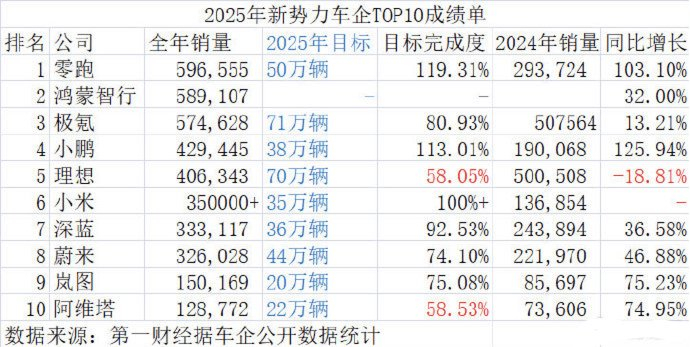
Core Insights - In 2025, only three new energy vehicle brands, Leap Motor, Xiaomi, and Xpeng, achieved their annual sales targets, with Leap Motor emerging as the top performer with nearly 600,000 units sold, exceeding its target by over 19% [1][4] - The performance of traditional leading brands, often referred to as "Wei Xia Li" (Weilai, Xiaopeng, and Li Auto), showed significant divergence, with Xpeng achieving a 125.94% year-on-year growth, while Li Auto experienced an 18.81% decline in sales [2] - State-owned enterprises like Changan and Dongfeng are also facing challenges in scaling their new energy vehicle brands, with Deep Blue and Avita struggling to meet their revised sales targets [3] Group 1: Performance of New Energy Vehicle Brands - Leap Motor sold 596,555 units, achieving a target completion rate of 119.31% and a year-on-year growth of 103.10% [4] - Hongmeng Zhixing delivered 589,107 units, marking a 32% increase year-on-year [1][4] - Zeekr, after merging with Lynk & Co, reported a total delivery of 574,628 units, but fell short of its target with an 80.93% completion rate [4] Group 2: Performance of Traditional Leading Brands - Xpeng sold 429,445 units, achieving a target completion rate of 113.01% and a year-on-year growth of 125.94% [2][4] - Li Auto's sales reached 406,343 units, but this represented a significant decline of 18.81% compared to the previous year, with a completion rate of only 58.05% against its initial target of 700,000 units [2][4] - NIO delivered 326,028 units, reflecting a year-on-year growth of 46.88%, but its main brand saw a decline in performance compared to the previous year [2][4] Group 3: Performance of State-Owned Enterprises - Deep Blue, a brand under Changan, sold 333,117 units, achieving a completion rate of 92.53% after revising its target down to 360,000 units [3][4] - Avita's sales remained low at 128,772 units, with a completion rate of only 58.53% against its target of 220,000 units [3][4] - Dongfeng's brand, Lantu, sold 150,169 units, achieving a completion rate of 75.08% [3][4]


瞄准5万亿美元市场:跨界布局机器人,时代的新共识
3 6 Ke· 2026-01-04 00:26
Core Insights - The Chinese robotics industry is poised for significant growth by the end of 2025, with humanoid robots transitioning from experimental concepts to practical applications, achieving over 50% growth and indicating a trillion-yuan industry on the horizon [1] - The entry of major players from various sectors such as automotive, electronics, and the internet into the robotics field marks a shift from niche exploration to widespread competition, creating a unique trend of "cross-industry integration" [1] Group 1: Market Dynamics - In the first eight months of 2025, the primary market financing in the robotics sector reached 38.624 billion yuan, 1.8 times the total for 2024, highlighting the blue ocean effect attracting significant investment [2] - The global industrial robot sales are projected to reach 542,000 units in 2024, with China accounting for 295,000 units, representing 54% of the global market [2] - By 2025, the Chinese robotics market is expected to exceed 150 billion yuan, capturing 35% of the global market share, with predictions suggesting the market for embodied intelligence could reach 400 billion yuan by 2030 and over a trillion yuan by 2035 [2] Group 2: Industry Trends - At least 20 automotive companies have entered the humanoid robot market by the end of 2025, with notable developments including Chery's humanoid robot Mocha and BYD's production line for core robot components [3] - The automotive industry's supply chain overlaps significantly with robotics, with a 60% compatibility rate, driving car manufacturers to invest in robotics as they view vehicles as "mobile intelligent robots" [3] - Home appliance manufacturers are transitioning from traditional manufacturing to smart ecosystems, with companies like Midea establishing dedicated innovation centers for humanoid robots and developing comprehensive R&D systems [7] Group 3: Strategic Shifts - The automotive sector is seen as a key player in the transition to robotics, with companies like Geely planning to invest 5 billion yuan over three years to develop critical components and establish an ecosystem covering all robotics applications [6] - Internet giants are leveraging their technological and capital advantages to enter the robotics space, with ByteDance and Huawei making significant investments in developing advanced robotic models and systems [8] - The competition in the robotics sector is viewed as a strategic restructuring driven by technological advancements, with companies aiming to activate existing technological capabilities and build new ecosystems [9] Group 4: Challenges Ahead - Despite the enthusiasm for entering the robotics market, cross-industry players face challenges such as adapting core competencies to the robotics field, where technology paths are still being defined [10] - The high precision and stability required for industrial applications pose significant challenges for companies transitioning from other sectors, as they may struggle to meet the diverse demands of various operational environments [11] - Cost remains a critical issue, with companies like BYD and GAC aiming to reduce the production cost of humanoid robots to below 200,000 yuan, which requires overcoming substantial supply chain and process optimization challenges [11]


从这里读懂中国车企老大们的心思
汽车商业评论· 2026-01-03 23:04
Core Viewpoint - The Chinese automotive industry in 2025 is characterized by a focus on "progress" rather than just sales figures, emphasizing product quality and brand value enhancement [5][10][13]. Group 1: Sales and Market Position - BAIC Group announced that its self-owned brand sales have returned to over one million units after six years, highlighting a significant increase in the proportion of new energy vehicles [5]. - Changan Automobile reported that its new energy vehicle sales have surpassed one million units for the first time, marking the establishment of its three-brand matrix: Avita, Deep Blue, and Qiyuan, which target different market segments [7]. - Dongfeng Motor also achieved over one million new energy vehicle sales, with its self-owned brand accounting for over 60% of total sales, driven by strategic adjustments [10]. Group 2: Technological Advancements - The industry is focusing on technological breakthroughs, with companies like GAC and Dongfeng establishing solid-state battery pilot lines and achieving significant advancements in key components such as high-efficiency engines and hybrid transmission systems [13][15]. - Companies are enhancing their AI technology capabilities, with Geely and GAC developing comprehensive AI systems to improve vehicle decision-making and environmental understanding [14]. - The progress in autonomous driving is notable, with BAIC and Changan receiving the first L3 autonomous driving licenses in China, indicating a new phase in regulatory acceptance [15]. Group 3: Global Expansion and Collaboration - Chinese automakers are shifting from merely selling cars abroad to establishing roots in foreign markets, exemplified by Geely's technical cooperation with Renault in Brazil [16]. - Companies like CATL are making strides in overseas manufacturing, while Chery is focusing on cultural integration in international markets [17]. - The industry is moving towards collaborative efforts, with BAIC easing financial pressures on suppliers and GAC partnering with major tech firms to build a smart electric vehicle ecosystem [17][18]. Group 4: Internal Reforms and Strategic Focus - Automakers are undergoing significant internal reforms, transitioning from broad growth strategies to lean operations and collaborative efforts [26][30]. - GAC has relocated its headquarters to its manufacturing base to enhance operational efficiency, while BAIC is implementing top-down management strategies to improve marketing and quality [29][30]. - The focus is on building resilient and efficient systems rather than just increasing sales, with companies emphasizing user-centric approaches in product development [30][35]. Group 5: Future Outlook - The competition in the automotive industry is evolving from individual companies to ecosystems, where collaboration and strategic partnerships will determine success [20][24]. - The industry is at a critical juncture, with companies emphasizing the importance of strategic determination amidst changing external environments and user expectations [22][23]. - The long-term winners will be those who focus on core values and sustainable growth rather than opportunistic trends [24][35].



节假日消费观察 | “试驾排到凌晨一两点” 20余家车企推购置税托底吸引客流
Di Yi Cai Jing· 2026-01-03 14:29
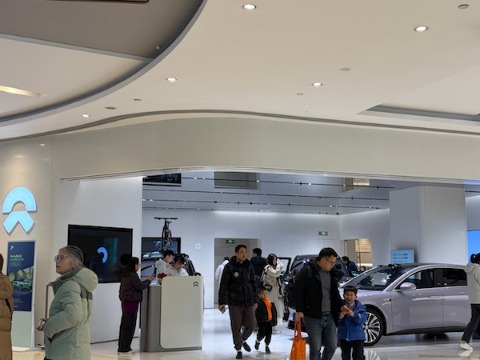
Core Insights - The sales performance of NIO and other new energy vehicle (NEV) brands remains strong despite upcoming policy changes regarding purchase tax and subsidies [3][4][6] Group 1: Sales Performance - NIO's store in Shanghai experienced high customer traffic and demand for test drives during the New Year holiday, indicating robust consumer interest [1] - Other new energy brands such as Tesla, Zeekr, and Hongmeng Zhixing also reported high foot traffic, with sales representatives noting increased customer numbers compared to typical weekends [3] Group 2: Policy Changes - In 2026, two significant policy changes will affect the NEV market: the reduction of the vehicle purchase tax from full exemption to a 5% rate, and a shift in subsidy structure from fixed amounts to percentage-based subsidies [3] - Despite these changes, many new energy vehicle sales representatives indicated that the impact on sales has been limited, as many vehicles are priced above the thresholds for maximum subsidies [3] Group 3: Manufacturer Responses - NIO is offering a subsidy of 2,000 yuan to offset the increased purchase tax, which is approximately 6,000 yuan for a vehicle priced at 119,800 yuan [4] - Zeekr has implemented a direct price reduction strategy to counteract the tax increase, effectively reducing the tax burden for consumers [4] - Hongmeng Zhixing and Xiaomi are also providing cash discounts and attractive financing options to mitigate the impact of the new tax policy [4] Group 4: Market Coverage - Over 20 car manufacturers, including major players like Li Auto, NIO, and Chery, have introduced purchase tax "safety net" policies to support consumers [4] - Tesla, while a leading player in the NEV market, has not introduced any such measures, yet its sales performance remains unaffected during the holiday period [5][6]