
伊利股份

Search documents
2025年1-9月酒、饮料和精制茶制造业企业有5906个,同比下降0.97%
Chan Ye Xin Xi Wang· 2025-11-16 01:57
Core Insights - The report highlights a slight decline in the number of enterprises in the liquor, beverage, and refined tea manufacturing industry, with a total of 5,906 companies reported for the period from January to September 2025, representing a decrease of 58 companies or 0.97% year-on-year [1]. Industry Overview - The number of large-scale industrial enterprises in the liquor, beverage, and refined tea manufacturing sector has been adjusted from a minimum annual main business income of 5 million yuan to 20 million yuan since 2011, indicating a shift in industry standards [1]. - The proportion of liquor, beverage, and refined tea manufacturing enterprises within the total industrial enterprises stands at 1.13% [1]. Market Research - The report titled "2026-2032 China Beverage Industry Market Operation Pattern and Future Prospects Analysis Report" was published by Zhiyan Consulting, a leading industry consulting firm in China, which has been engaged in industry research for over a decade [1]. - Zhiyan Consulting provides comprehensive industry research reports, business plans, feasibility studies, and customized services, focusing on delivering complete industry solutions to empower investment decisions [1].


食品饮料行业周报 20251110-20251114:板块关注度回升,重申进入战略配置期-20251115
Shenwan Hongyuan Securities· 2025-11-15 15:27
Investment Rating - The report maintains a positive investment outlook for the food and beverage industry, particularly highlighting the strategic configuration period for quality companies [3][7]. Core Insights - The food and beverage sector has shown signs of recovery, with retail sales growth of 2.9% year-on-year in October and a 3.8% increase in restaurant revenue, indicating a rebound from previous declines [3][7]. - Major liquor companies have experienced significant revenue declines, but the market is actively seeking a balance between volume and price, suggesting a potential bottoming out of the market [3][7]. - The report emphasizes the importance of patience regarding fundamental performance and notes that individual stock performance will vary during this adjustment phase [3][7]. Summary by Sections Food and Beverage Weekly Insights - The food and beverage sector rose by 2.82% last week, outperforming the Shanghai Composite Index by 2.99 percentage points [6]. - Key stocks such as Huanyujia and Sanyuan have shown significant gains, while Dongpeng Beverage and Qianwei Yangchun faced declines [6]. Liquor Sector Analysis - The report indicates that the liquor sector is entering a strategic configuration phase, with expectations of a fundamental turning point in Q3 2026 [8]. - The average price for Moutai is reported at 1655 RMB for loose bottles, with a week-on-week increase of 15 RMB, while the price for Wuliangye remains stable at approximately 830 RMB [8][26]. - The report anticipates continued pressure on sales volume in early 2026, but a stabilization and recovery in prices as inventory clears and demand rebounds [8]. Consumer Goods Sector Insights - The performance of consumer goods companies has been mixed, with leading firms like Yili and Qingdao Beer maintaining stable operations, while some companies in the snack and beverage sectors have seen a slowdown in revenue growth [9]. - The report recommends focusing on high-dividend yielding companies and those with sustainable growth potential, particularly in the snack and beverage segments [9]. Valuation Metrics - As of November 14, 2025, the food and beverage sector has a dynamic PE of 20.85x, with a premium rate of 27%, while the liquor sector has a dynamic PE of 19.51x, with a premium rate of 18% [27].






信用债周度观察(20251110-20251114):信用债发行量环比增加,各行业信用利差涨跌互现-20251115
EBSCN· 2025-11-15 07:06
Report Industry Investment Rating - Not mentioned in the report Core Viewpoints - From November 10 to November 14, 2025, the issuance volume of credit bonds increased month - on - month, and the industry credit spreads showed mixed trends [1] Summary by Directory 1. Primary Market 1.1 Issuance Statistics - From November 10 to November 14, 2025, 330 credit bonds were issued, with a total issuance scale of 455.379 billion yuan, a month - on - month increase of 25.31% [1][11] - In terms of issuance scale, 161 industrial bonds were issued, with a scale of 169.68 billion yuan, a 4.09% month - on - month decrease, accounting for 37.26% of the total credit bond issuance scale; 122 urban investment bonds were issued, with a scale of 81.729 billion yuan, a 19.25% month - on - month decrease, accounting for 17.95% of the total scale; 47 financial bonds were issued, with a scale of 203.97 billion yuan, a 139.20% month - on - month increase, accounting for 44.79% of the total scale [1][11] - In terms of issuance term, the average issuance term of credit bonds was 2.75 years. The average issuance term of industrial bonds was 2.25 years, urban investment bonds was 3.51 years, and financial bonds was 2.13 years [1][15] - In terms of issuance coupon rate, the average issuance coupon rate of credit bonds was 2.12%. The average issuance coupon rate of industrial bonds was 2.06%, urban investment bonds was 2.26%, and financial bonds was 1.94% [2][19] 1.2 Cancellation of Issuance Statistics - Two credit bonds cancelled issuance this week, namely "25 Huadian Jiangsu SCP027" and "25 Xingmei 01" [3][24] 2. Secondary Market 2.1 Credit Spread Tracking - This week, industry credit spreads showed mixed trends. Among Shenwan primary industries, the largest upward movement in AAA - rated industry credit spreads was in agriculture, forestry, animal husbandry and fishery, up 6.5BP, and the largest downward movement was in steel, down 3.5BP; for AA + - rated industry credit spreads, the largest upward movement was in electronics, up 1.4BP, and the largest downward movement was in the automobile industry, down 16.6BP; for AA - rated industry credit spreads, the largest upward movement was in transportation, up 0.9BP, and the largest downward movement was in mining, down 3.9BP [3][26] - For urban investment bonds by region, among AAA - rated bonds, the largest upward movement in credit spreads was in Zhejiang, up 3BP, and the largest downward movement was in Yunnan, down 10.2BP; for AA + - rated bonds, the largest upward movement was in Fujian, up 2.6BP, and the largest downward movement was in Yunnan, down 10.6BP; for AA - rated bonds, the largest upward movement was in Chongqing, up 3.1BP, and the largest downward movement was in Henan, down 5.7BP [3][29] 2.2 Trading Volume Statistics - The total trading volume of credit bonds was 1219.783 billion yuan, a 5.53% month - on - month decrease. The top three in terms of trading volume were commercial bank bonds, corporate bonds, and medium - term notes. Specifically, the trading volume of commercial bank bonds was 375.608 billion yuan, a 3.93% month - on - month increase, accounting for 30.79% of the total credit bond trading volume; the trading volume of corporate bonds was 414.081 billion yuan, a 7.86% month - on - month decrease, accounting for 33.95% of the total volume; the trading volume of medium - term notes was 243.078 billion yuan, a 16.01% month - on - month decrease, accounting for 19.93% of the total volume [4][30] 2.3 Active Bonds Traded This Week - The report selects the top 20 urban investment bonds, industrial bonds, and financial bonds in terms of trading volume this week for investors' reference, including information such as bond codes, names, trading volumes, average trading yields, and issuers [32][33][34]
重要信号!顶级资本正在“抄底”消费
证券时报· 2025-11-15 00:14
Core Viewpoint - The article discusses the recent surge in mergers and acquisitions (M&A) in the consumer sector, highlighting the contrast between significant capital investments by top firms and the sluggish growth of the consumer market in China. It explores the underlying investment logic driving this trend. Group 1: M&A Activity - Recent strategic partnerships and acquisitions include CPE Yuanfeng's collaboration with Burger King, Dazhang Capital's potential bid for Costa Coffee, and Boyu Capital acquiring a 60% stake in Starbucks China. KKR also completed the acquisition of the national soda brand, Diao Soda [1][2]. - The consumer market is experiencing a slowdown, with retail sales growth at 4.5% year-on-year for the first three quarters, which is below the 8% growth seen in 2019 [2][3]. Group 2: Financial Performance of Companies - Major companies like KFC China reported a 4% increase in revenue to $3.2 billion, while Yili's revenue grew by 1.71% to 90.564 billion yuan, but its net profit fell by 4.07% [3]. - Smaller food and beverage companies are facing significant operational pressures, with many reporting declines in both revenue and net profit [3]. Group 3: Investment Logic - Four key investment rationales are identified: 1. Target companies have strong cash flows and solid foundations, with examples like Starbucks maintaining over $6 billion in cash flow [5]. 2. The brands involved possess significant brand equity and established networks, making them attractive to investors [6]. 3. The current market downturn presents a "buying opportunity" for capital, allowing for acquisitions at lower prices [6]. 4. The consumer sector remains promising, with potential for growth despite current challenges [6]. Group 4: Future Trends in Consumer Market - The article identifies three trends in the consumer market: 1. Emphasis on cost-performance innovation as consumers prioritize practical value [8]. 2. Increased interest in niche products that provide immediate satisfaction [8]. 3. Growth in self-improvement sectors, including health investments and knowledge-based spending [8]. Group 5: Exit Strategies for Capital - The challenges of exiting investments in the consumer sector are noted, with a shift towards long-term strategies rather than quick exits through IPOs. This includes designing preferential dividend clauses to ensure returns even without an IPO [9].

重要信号!顶级资本正在“抄底”消费
Zheng Quan Shi Bao· 2025-11-14 17:47
Core Viewpoint - The recent surge in mergers and acquisitions in the consumer sector contrasts with the sluggish growth of the consumption market, raising questions about the underlying investment logic of top-tier capital entering this space [1][4]. Group 1: Mergers and Acquisitions Activity - Major capital firms are actively acquiring well-known consumer brands despite a weak consumption market, indicating a strategic move to capitalize on perceived undervaluation [1][4]. - Recent notable transactions include CPE Yuanfeng's partnership with Burger King, Hillhouse Capital's potential bid for Costa Coffee, and Boyu Capital's acquisition of a 60% stake in Starbucks China [1][2]. Group 2: Market Performance and Company Earnings - The retail sales growth in China for the first three quarters was 36.59 trillion yuan, reflecting a year-on-year increase of 4.5%, which is still below the 8% growth rate of 2019 [1]. - A significant performance disparity exists among consumer companies, with leading firms like Kweichow Moutai and Yum China showing slowed growth compared to previous years [2]. - Smaller food and beverage companies are facing greater operational pressures, with many reporting declines in both revenue and net profit [2]. Group 3: Investment Logic Behind Acquisitions - Four key investment rationales support the trend of capital entering the consumer sector: 1. Target companies possess strong cash flow and stable foundations, making them attractive despite slower growth [4]. 2. The brands being targeted have significant market influence and established networks, providing a solid base for future growth [5]. 3. The current market downturn presents a favorable opportunity for capital to acquire these brands at lower prices, allowing for potential value enhancement through improved governance [6]. 4. The consumer sector remains promising, with a large market potential and a low concentration of major brands, indicating future growth opportunities [6]. Group 4: Future Trends in the Consumer Market - The consumer market is expected to face challenges due to slowing income growth and increased savings, which will test the resilience of companies [7]. - Key trends to watch include a focus on cost-effective innovations, the rise of niche products that provide immediate satisfaction, and growth in self-improvement sectors such as health investments and knowledge-based services [7]. - Companies are increasingly optimizing their business structures by divesting non-core assets and consolidating resources to enhance operational quality [7][8].

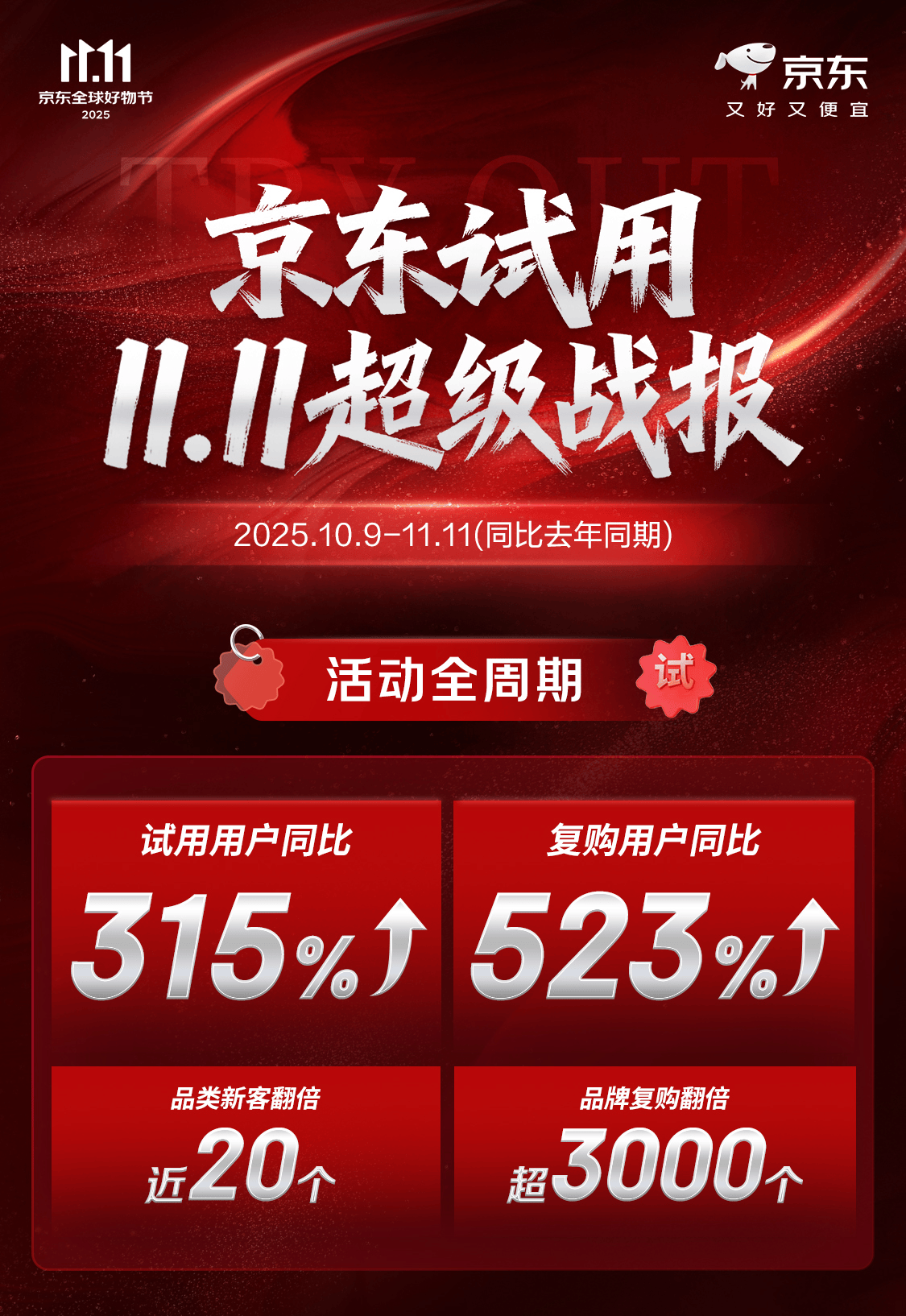
京东试用频道复购用户提升523% 伊利登顶“用户爱试榜”
Sou Hu Cai Jing· 2025-11-14 16:43
Core Insights - JD.com achieved significant growth during the 11.11 shopping festival, with a 40% increase in the number of users placing orders and nearly a 60% increase in order volume by November 11, 2025 [1] - The "try before you buy" model has effectively stimulated consumer enthusiasm, with trial channel user numbers increasing by 315% and repeat purchase users rising by 523% [1][3] - The trend of "sample economy" is expanding beyond beauty products, enhancing experiential consumption across various categories [3] Group 1: Sales Performance - JD.com led the growth in sales during the 11.11 period, particularly in the 3C digital and home appliance sectors, where it held the highest market share [1] - The trial channel saw nearly 20 categories of new customers double in number, with over 3,000 brands experiencing a doubling of repeat purchase users [3] Group 2: Consumer Behavior - The top three categories for user trial preferences were beauty and skincare, personal care, and maternal and infant products, with healthcare and household cleaning products following closely [3] - The "try and love" list showed that beauty and skincare remained the leading category, with maternal and infant products, personal care, nutrition, and pet care also performing well [3] Group 3: Brand Engagement - Brands are leveraging JD.com's trial capabilities to efficiently attract new customers at a low trial cost, with notable success from brands like Yili, which topped the new customer acquisition list during the 11.11 event [5][6] - The trial channel is positioned as a "gathering place for genuine brand samples," helping brands effectively reach target users while providing consumers with a more secure and cost-effective shopping experience [7]

保龄宝:技术破壁+政策赋能 HMOs解锁发展新空间
Zheng Quan Shi Bao Wang· 2025-11-14 09:09
Core Insights - The recent approval of infant formula products with upgraded formulations, particularly focusing on the addition of 2'-fucosyllactose (2'-FL) and lacto-N-neotetraose (LNnT), indicates a significant shift in the market for infant nutrition products in China [1][2]. Regulatory Developments - The approval process for Human Milk Oligosaccharides (HMOs) began in 2016, with 2023 marking a milestone year as the National Health Commission officially approved 2'-FL and LNnT as food nutrition fortifiers for infant formula and other specialized products [2][3]. - By October 2023, nearly 20 HMO products had received approval, with multiple companies claiming the ability to supply HMO products [2]. Market Dynamics - The approval of HMO formulations by leading dairy companies such as Yili, Feihe, and Junlebao signifies the establishment of a complete industrial cycle from raw material approval to product launch, transitioning the industry into a phase of large-scale application [3]. - The market for HMOs, previously dominated by foreign companies, is experiencing a shift due to breakthroughs in domestic synthetic biology, significantly reducing production costs and enabling local companies to compete effectively [4]. Technological Advancements - Domestic advancements in synthetic biology have led to a substantial decrease in the production cost of 2'-FL, with prices dropping below 500,000 yuan per ton, making it feasible for local dairy companies to upgrade their formulas [4]. - Companies like Baolingbao have developed proprietary strains and enzyme immobilization processes, achieving international standards in purity and production capacity [4]. Customer and Market Strategy - Baolingbao's extensive customer base in the infant formula sector positions it well to capitalize on the growing demand for HMO products, with major brands already preparing to launch HMO-enhanced products [5]. - The company is diversifying its product offerings beyond infant formula to include HMO and other prebiotic products, catering to a broader range of dairy and beverage clients [5]. Market Projections - According to QYResearch, the global HMO market is projected to reach $704 million in 2024 and exceed $3.21 billion by 2031, with a CAGR of 24.6% from 2025 to 2031, indicating a much higher growth rate in the Chinese market compared to the global average [6].

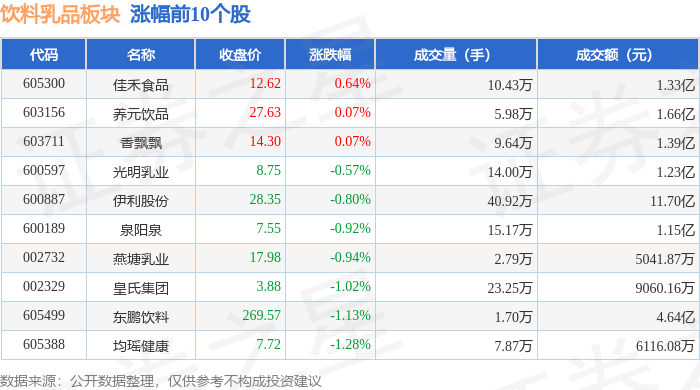
饮料乳品板块11月14日跌1.46%,欢乐家领跌,主力资金净流出5.02亿元
Zheng Xing Xing Ye Ri Bao· 2025-11-14 08:51
Core Viewpoint - The beverage and dairy sector experienced a decline of 1.46% on November 14, with the leading stock, Huanlejia, dropping significantly by 11.26% [1][2]. Market Performance - The Shanghai Composite Index closed at 3990.49, down 0.97%, while the Shenzhen Component Index closed at 13216.03, down 1.93% [1]. - Key stocks in the beverage and dairy sector showed mixed performance, with notable declines in major companies such as Yili and Guangming Dairy [1]. Stock Performance Summary - Huanlejia (300997) closed at 26.09, down 11.26% with a trading volume of 326,100 shares and a transaction value of 882 million yuan [2]. - Sanyuan (600429) closed at 6.55, down 10.03% with a trading volume of 1,676,700 shares and a transaction value of 1.136 billion yuan [2]. - Other notable declines included Qishi Dairy (920786) down 4.92% and Yiming Foods (605179) down 3.96% [2]. Capital Flow Analysis - The beverage and dairy sector saw a net outflow of 502 million yuan from institutional investors, while retail investors contributed a net inflow of 456 million yuan [2][3]. - The capital flow data indicates that major stocks like Yili and Guangming Dairy experienced significant net outflows from institutional investors [3]. Individual Stock Capital Flow - Yili (600887) had a net outflow of 34.7 million yuan from institutional investors, while retail investors contributed a net inflow of 13.1 million yuan [3]. - Other stocks like Xiangpiaopiao (603711) and Zhuangyuan Ranch (002910) showed varying capital flows, with Xiangpiaopiao experiencing a net inflow from institutional investors [3].


食品饮料行业双周报(2025、10、31-2025、11、13):10月CPI同比转正,关注需求恢复进程-20251114
Dongguan Securities· 2025-11-14 08:43
Investment Rating - The report maintains an "Overweight" rating for the food and beverage industry, expecting the industry index to outperform the market index by more than 10% in the next six months [54]. Core Insights - The October CPI turned positive year-on-year, indicating a recovery in demand, with a 0.2% increase compared to the previous month [51]. - The SW food and beverage industry index rose by 4.28% from October 31 to November 13, outperforming the CSI 300 index by approximately 4.45 percentage points [12]. - All sub-sectors within the food and beverage industry outperformed the CSI 300 index during the same period, with the pre-processed food sector showing the highest increase of 13.07% [13]. - Approximately 96% of stocks in the industry recorded positive returns, with notable gainers including Huanlejia (+76.90%) and Sanyuan Shares (+49.79%) [16]. - The overall PE (TTM) for the SW food and beverage industry is about 22.00 times, which is below the five-year average of 32 times [19]. Summary by Sections Market Review - The SW food and beverage industry index outperformed the CSI 300 index, with a rise of 4.28% from October 31 to November 13, ranking eleventh among the primary sectors [12]. - All sub-sectors outperformed the CSI 300 index, with the pre-processed food sector leading at 13.07% [13]. - About 96% of stocks in the industry achieved positive returns, with significant increases from Huanlejia, Sanyuan Shares, and Zhu Laoliu [16]. Industry Data Tracking - **Baijiu Sector**: The price of Feitian decreased to 1640 RMB/bottle, down 20 RMB from October 30, while the prices of Puwu and Guojiao 1573 remained stable [24]. - **Condiment Sector**: Prices for soybean meal and white sugar increased, while the price of glass packaging rose slightly [27]. - **Beer Sector**: The price of barley decreased to 2210 RMB/ton, while the prices of glass and aluminum increased [33]. - **Dairy Sector**: The average price of fresh milk fell to 3.02 RMB/kg, a decrease of 0.01 RMB from October 31 [38]. - **Meat Products Sector**: The average wholesale price of pork rose to 18.12 RMB/kg, an increase of 0.16 RMB from October 30 [39]. Industry News - Meituan Flash Purchase reported a 562% year-on-year increase in baijiu transaction volume on November 1 [42]. - The export value of baijiu from Zunyi increased by 551.8% from January to September [43]. - In October, the national baijiu price index fell by 0.17% month-on-month [46]. Company Announcements - Guizhou Moutai announced a share repurchase plan with a budget of 15 to 30 billion RMB [49]. - The company plans to distribute a cash dividend of 23.957 RMB per share, totaling approximately 300.01 billion RMB [50]. Weekly Industry Perspective - The report emphasizes the importance of monitoring the recovery of demand following the positive CPI in October, with a focus on the baijiu sector's performance amid weak consumption recovery [51].
CPI结构变化趋势对消费影响分析
Haitong Securities International· 2025-11-14 08:25
Investment Rating - Investment advice: Prioritize growth, supply-demand balance signals a turning point [2][12][19] Core Insights - Service CPI rises, food CPI stabilizes, future PPI increase may drive further CPI improvement, benefiting mass products first [12][19] - Economic transformation leads to a rise in service consumption, with service CPI consistently outperforming food CPI since 2012, indicating a shift from product to service consumption [4][19] - Moderate inflation is expected to promote consumption recovery, with autumn-winter related consumption anticipated to strengthen due to sudden cold weather [4][19] Summary by Sections CPI Trends - Service CPI has been consistently higher than food CPI since 2012, reflecting a structural shift in consumption patterns [4] - Service CPI is relatively stable while goods CPI is more volatile, influenced by supply-demand dynamics [4] - Non-food CPI remains stable, whereas food CPI is more volatile, primarily affected by pork prices [4] Investment Recommendations - Recommended stocks in the baijiu sector include Shanxi Xinghuacun Fen Wine Factory, Gujing Distillery, and Kweichow Moutai among others [12][19] - For beverages, Eastroc Beverage and Nongfu Spring are highlighted, with a focus on low valuation high dividends stocks like China Foods and Tingyi [12][19] - Snack and food raw material growth targets include Bailong Chuangyuan, Yankershop Food, and Three Squirrels [12][19] - Beer recommendations include Yanjing Brewery and Tsingtao Brewery [12][19] - Stable condiment companies recommended include Haitian Flavouring & Food and Yili Industrial Group [12][19]