奔驰

Search documents
德国酝酿新建旅级战斗队
Ren Min Wang· 2025-07-28 01:22
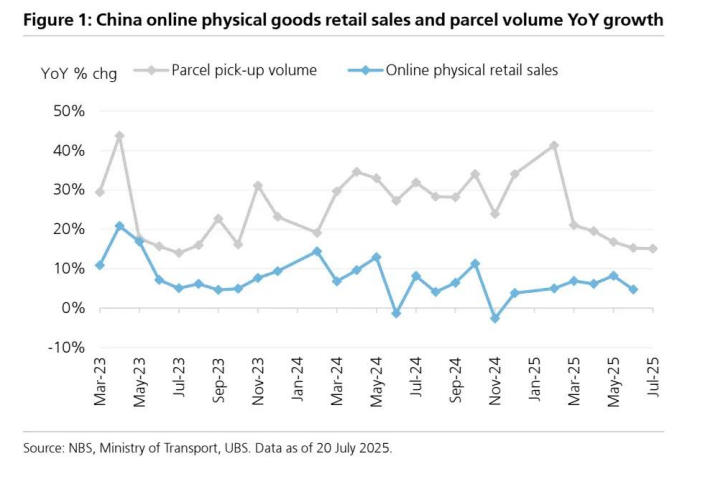
Core Insights - Germany is planning a significant military procurement initiative, with a total order value expected to reach €25 billion (approximately $29.2 billion) for tanks and armored vehicles [3][4] - The procurement aims to enhance the capabilities of the Bundeswehr and prepare for the establishment of new brigade-level combat teams [4][5] Procurement Plans - Germany intends to purchase 1,000 Leopard-2 main battle tanks and 2,500 Boxer wheeled armored vehicles, with production involving KNDS and Rheinmetall [4] - The German parliament is expected to approve the procurement plan within the year, which is part of a broader commitment to strengthen NATO forces [4][5] Military Expansion - The Bundeswehr currently operates eight brigade-level combat teams and is preparing to establish a ninth, requiring an increase of 50,000 to 60,000 active soldiers to meet NATO's enhanced deterrence and defense goals [5] - The planned expansion includes the formation of at least seven brigade-level combat teams, with a target operational readiness by 2029 [5][8] Funding and Economic Impact - Germany is initiating its largest-ever debt plan to support military upgrades, including a special fund of €500 billion, with defense spending projected to rise to 5% of GDP over the next decade [7] - The transition to a "war economy" model aims to boost industrial capacity and provide financial resources for economic development [7] Challenges and Constraints - The military expansion faces challenges such as limited industrial capacity, with Rheinmetall having a backlog of €62.6 billion in orders, and difficulties in recruiting personnel [8] - Public opinion shows a generational divide regarding military service, with younger demographics less supportive of military engagement [8]

美国要“打仗”就奉陪到底,德国为何态度大变?中国这3件法宝太给力
Sou Hu Cai Jing· 2025-07-27 11:16
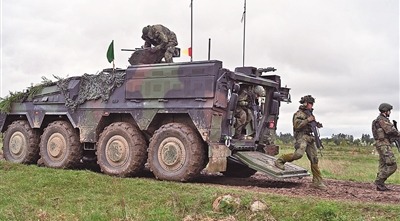
Core Viewpoint - The recent escalation in trade tensions between the EU and the US, particularly driven by Trump's ultimatum for increased tariffs, has led Germany to adopt a surprisingly aggressive stance in defense of its economic interests [1][3][4]. Group 1: Trade Relations and Tariffs - Trump has threatened to raise tariffs on EU imports to 15% starting August 1, which could impose additional costs exceeding 100 billion euros on EU businesses [3]. - Germany, as the EU's largest exporter, faces significant risks, particularly in its automotive sector, where a 15% tariff could severely undermine price competitiveness in the US market [4]. - The German government has responded with a strong commitment to explore all options in retaliation against US trade policies, indicating a readiness for a trade conflict [4][11]. Group 2: Germany's Strategic Shift - Germany is seeking to strengthen ties with China, as evidenced by high-level visits aimed at enhancing cooperation in trade, climate, and technology [4][6]. - The planned visit by German Chancellor Merz to China, accompanied by CEOs from major German companies, aims to secure Chinese investments and deepen bilateral cooperation [6]. - Germany's observation of China's resilience during the US-China trade war has prompted a reevaluation of its own economic strategies, focusing on self-reliance and independence from US influence [8][9]. Group 3: Lessons from China - China's experience in navigating trade conflicts has shown that maintaining control over key industries and supply chains is crucial for economic stability [8][9]. - Germany recognizes the need to reduce dependency on US technology and components, particularly in high-tech sectors where over 60% of critical components are sourced from the US [9]. - The shift in Germany's approach reflects a broader trend among nations seeking to assert more control over their economic destinies and reduce reliance on a single dominant power [11].
欧洲头条丨大众承压 美加关税拖累“德国制造”
Yang Shi Xin Wen Ke Hu Duan· 2025-07-27 09:40
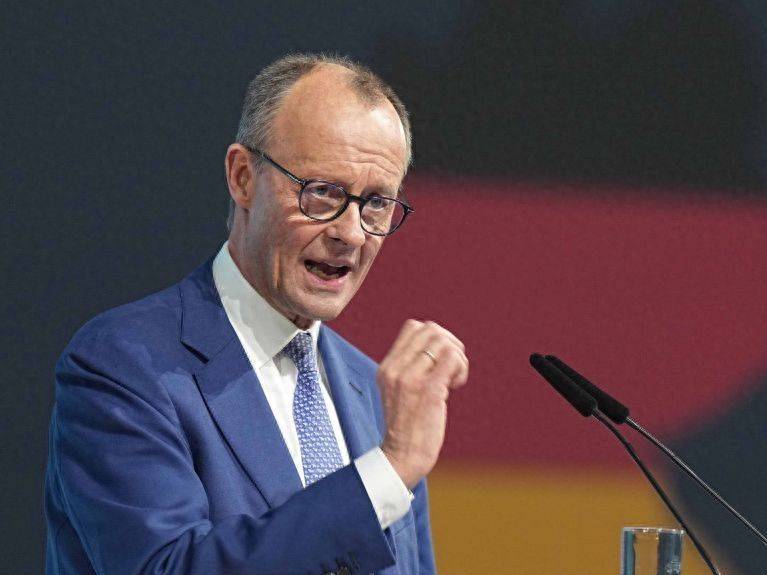
Core Viewpoint - Volkswagen Group's recent financial report for the first half of 2025 reveals a significant profit drop of nearly 40%, high restructuring costs, and pressures on the global supply chain, reflecting broader challenges faced by German manufacturing amid geopolitical and economic shifts [1][25]. Group 1: Profit Decline and Costs - Volkswagen's revenue for the first half of 2025 reached €158.4 billion, remaining stable year-on-year, but operating profit fell by 33% to €6.7 billion, with net profit dropping over 38% to €4.47 billion, significantly below market expectations [2]. - A key factor for the profit decline is the new round of import tariffs imposed by the U.S. government on electric vehicles and components, resulting in an additional cost burden of €1.3 billion for Volkswagen [2][4]. Group 2: Supply Chain Challenges - The global automotive supply chain is undergoing forced restructuring due to the U.S. tariff policies, which disrupt the collaboration needed for electric vehicle production that relies on cross-border component integration [12]. - The inability to achieve "closed-loop production" for electric vehicles due to high precision component requirements exacerbates the impact of policy barriers, leading to increased uncertainty in strategic planning and financial cost control [12]. Group 3: Role of China in Global Market - Despite a 3% year-on-year decline in sales in China, Volkswagen emphasizes the importance of the Asian market for long-term growth, focusing on collaborations in software and battery technologies [13]. - China is transitioning from being merely a sales market to becoming an innovation engine for German automakers, with partnerships in electric and intelligent vehicle technologies expected to enhance Volkswagen's global strategy [16]. Group 4: Institutional Cooperation - Amidst the fragmentation of international trade rules, institutional cooperation between China and Europe is seen as a crucial stabilizing factor for the global manufacturing system [17]. - The collaboration between Germany and China in high-tech and green industries is deepening, with Chinese advancements in technology becoming a key driver for German automotive companies' global strategies [21][24].
准备开战?奉陪到底!德国不再忍让,中方打出三张王牌
Sou Hu Cai Jing· 2025-07-27 04:52
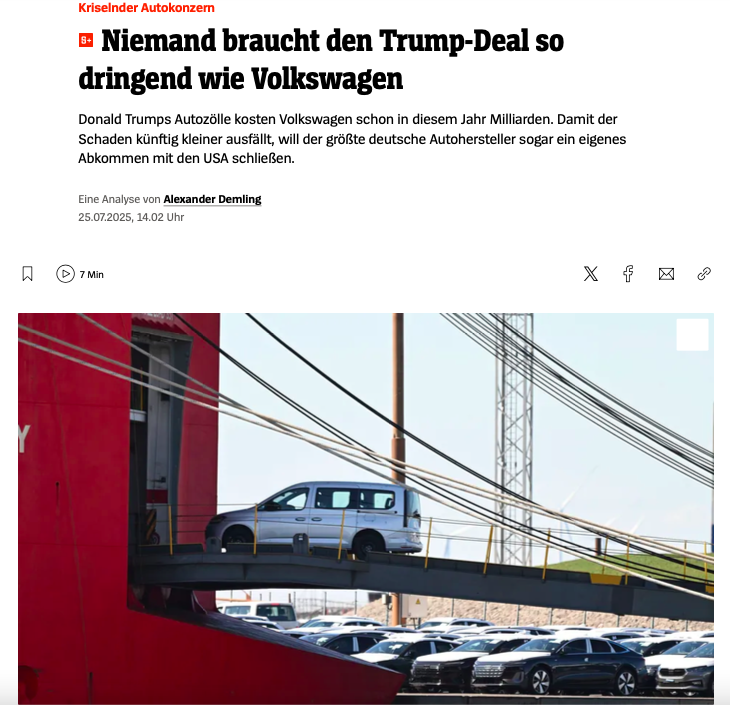
Group 1 - The transatlantic alliance is experiencing unprecedented fractures, with Germany taking a strong stance against U.S. tariffs, marking a significant shift in global trade dynamics [1][2] - The U.S. tariff policy, particularly the proposed 30% tariff on EU automobiles, threatens to cause losses of up to €100 billion for German automotive exports, impacting major companies like Daimler, BMW, and Volkswagen [2] - Germany's response includes halting discussions with the U.S. and adopting a "cold treatment" strategy, indicating a shift in power dynamics in trade relations [2] Group 2 - China is providing strategic support to Germany through three key advantages: access to a large market, control over rare earth resources, and a model for strategic autonomy [4][5] - The Chinese market is crucial for German automotive companies, with significant sales percentages coming from China, highlighting the importance of this relationship for maintaining profitability [5] - Germany's unique position in rare earth material production gives it leverage in negotiations with the U.S., especially in light of U.S. dependency on Chinese supply chains [7] Group 3 - Germany's strategic response to U.S. tariffs includes a proposal targeting U.S. sectors such as electric vehicles, medical devices, and smart manufacturing, aiming to limit U.S. market access in Europe [10] - Public sentiment in Germany is shifting towards questioning reliance on the U.S., with mainstream media and social movements advocating for a strategic transformation [9] - The global trade landscape is evolving into a tripartite structure, with China positioning itself as a key player, facilitating trade partnerships while not forcing alignment with either the U.S. or Europe [9][11]
最新发声!淡水泉赵军,罕见露面!
券商中国· 2025-07-27 02:17
Core Viewpoint - The article discusses the recent online communication meeting held by the well-known private equity fund, Dongshuiquan, highlighting its investment strategies and market outlook for the second half of the year [2][4][11]. Group 1: Investment Strategies - Dongshuiquan emphasizes a top-down macro allocation framework that complements its bottom-up stock selection strategy, enhancing adaptability to market changes [2][10]. - The firm is focusing on three main investment directions for the second half of the year: 1. Revaluation of quality Chinese assets due to market changes and increased global capital allocation [4][11]. 2. Globalization of China's advantageous industries, with leading companies showing strong individual alpha [5][11]. 3. Opportunities in technology with a focus on domestic substitution in critical areas and investment opportunities arising from breakthroughs in AI technology [6][12]. Group 2: Market Conditions and Outlook - Since September 2022, the A/H stock market has seen an increase in risk appetite, with structural opportunities emerging despite overall index stability [8]. - The first half of the year exhibited a "barbell" market structure, with strong performance in value dividend assets, particularly bank stocks, and rapid rotation in emerging growth assets like AI and new consumption [8][10]. - Economic conditions show that while government efforts to stabilize growth continue, confidence among businesses and consumers remains fragile [8]. Group 3: Sector-Specific Opportunities - In the new consumption sector, there is a notable shift towards female consumer participation, which is influencing various industries, including gaming and beauty [13][18]. - The technology sector remains a key focus, particularly in AI, where Chinese companies are deeply involved in the global AI supply chain, presenting significant profit opportunities [19]. - The automotive industry is witnessing a trend towards high-end and intelligent vehicles, with domestic brands experiencing a surge in demand and profitability [21].
晚买3天怒亏10多万!“豪车税”门槛降低,高端国产车的春天来了?
电动车公社· 2025-07-26 15:59
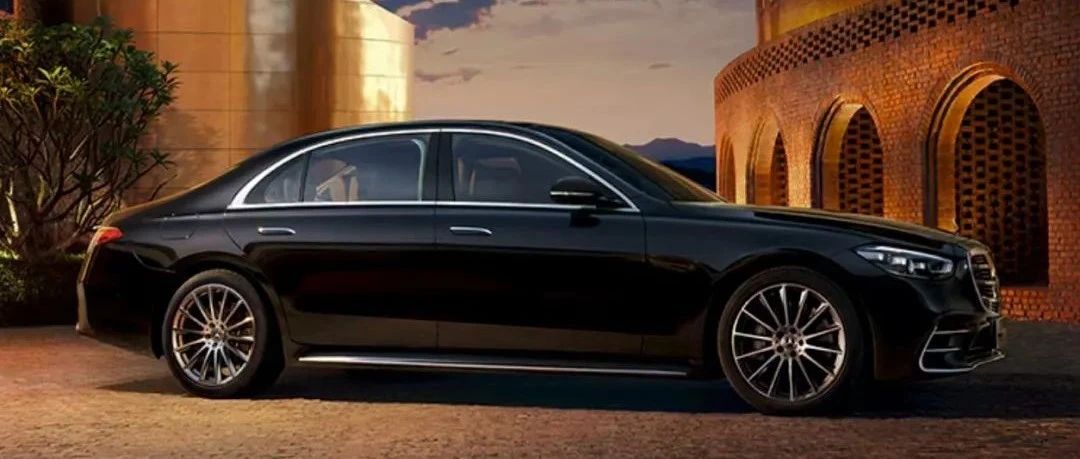
Core Viewpoint - The luxury car market has experienced a significant shift due to a new tax policy that lowers the consumption tax threshold for super luxury cars from 1.3 million yuan to 900,000 yuan, effective from July 20, 2023, leading to increased consumer urgency to purchase luxury vehicles before the tax takes effect [1][2][3]. Group 1: Tax Policy Impact - The new tax policy means that vehicles priced between 1.017 million yuan and 1.469 million yuan will now incur an additional luxury car tax, resulting in an estimated extra cost of 90,000 yuan for consumers purchasing luxury cars after the policy change [3][18]. - The luxury car tax has been in place since 2016, and the recent adjustment aims to include more vehicles that previously evaded the tax due to price reductions [11][16]. Group 2: Market Dynamics - The luxury car market is seeing a surge in demand as consumers rush to purchase vehicles before the tax increase, with reports of crowded showrooms and increased sales activity [1][5]. - The price reductions across various luxury brands have made many models fall below the new tax threshold, indicating a shift in market pricing strategies [10][15]. Group 3: Brand Responses - Some brands, like Jaguar Land Rover, have introduced promotional policies to absorb the new tax costs for consumers, while others, such as Porsche, have not announced similar measures [20][25]. - The luxury car market is expected to face long-term changes as the increased tax burden may deter potential buyers, leading to a reevaluation of pricing and sales strategies among luxury brands [28][30]. Group 4: Shift to Domestic Brands - The decline in imported luxury car sales is evident, with a reported 33% year-over-year drop in 2023, while domestic brands, particularly in the new energy vehicle sector, are gaining traction [34][60]. - The competitive landscape is shifting as domestic brands offer advanced technology and better value propositions, challenging traditional luxury brands [54][62].
利润暴跌,汽车巨头向美国“低头”?
汽车商业评论· 2025-07-26 14:40
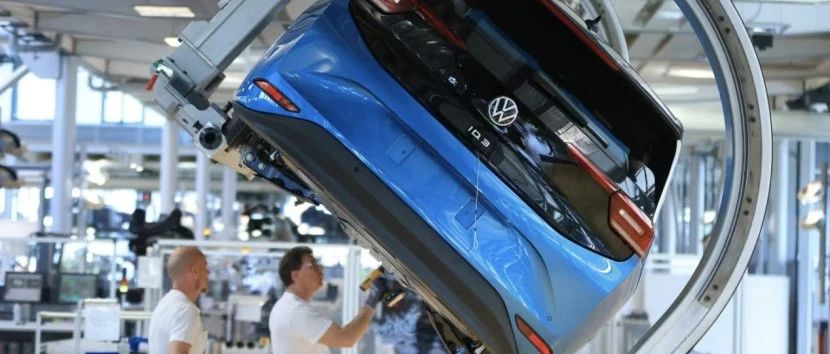
Core Viewpoint - The article discusses the significant impact of the Trump administration's tariff policies on Volkswagen, emphasizing the urgency for the EU and the US to reach a trade agreement to mitigate these effects [2][4]. Financial Performance - Volkswagen reported a revenue of €158.4 billion (approximately $185.7 billion) for the first half of 2025, remaining stable compared to the previous year, but operating profit fell by one-third to €6.7 billion (about $7.86 billion) [3]. - The decline in operating profit is attributed mainly to increased costs from US import tariffs, amounting to €1.3 billion (approximately $1.52 billion), along with an additional loss of €0.7 billion (around $0.82 billion) from restructuring and other expenses [5]. - The company has adjusted its full-year revenue forecast from a 5% increase to flat growth compared to last year, with an expected operating profit margin of 4% to 5%, down from a previous estimate of 5.5% to 6.5% [5][33]. Market Dynamics - Despite a 1.5% increase in global deliveries in the first half of 2025, Volkswagen's deliveries in the US dropped by nearly 10%, with North America accounting for 18.5% of the group's global sales [6]. - The performance of luxury brands under Volkswagen, such as Porsche and Audi, has been particularly poor, with Porsche's operating profit plummeting over 90% to €154 million and Audi's profit down 64% to €550 million [6][27]. Electric Vehicle Sales - Volkswagen has become the leader in the European electric vehicle market, surpassing Tesla, with a notable increase in sales of electric vehicles in Europe [6][8]. - In Germany, electric vehicle sales reached a record high in the first half of 2025, with a 35% year-on-year increase, totaling 249,100 units, despite a 4.7% decline in overall new car sales [8][9]. Tariff Negotiations - Volkswagen and its competitors are urging European trade negotiators to reach an agreement to lower the 25% US tariffs imposed since April [17]. - There is optimism that an agreement could be reached to impose a 15% tariff on most imported products, which would alleviate some financial pressure on the automotive sector [17][18]. - The company’s CFO indicated that if a deal similar to the US-Japan agreement is reached, profit margins could stabilize within the expected range [18]. Strategic Adjustments - Volkswagen is considering local production of Audi vehicles in the US and increasing exports from its Chattanooga plant to mitigate tariff impacts [31][26]. - The company is also exploring partnerships with Rivian and Xpeng to enhance product competitiveness, although new models from these collaborations are not expected until next year [34].
三千万辆中国车利润真不如丰田吗
Jing Ji Ri Bao· 2025-07-25 21:59
Core Viewpoint - The comparison of profits between 30 million Chinese cars and Toyota's 9 million cars highlights the imbalance between production capacity and profitability in China's automotive industry [1] Group 1: Profit Comparison - In 2022, China's automotive sales reached 31.436 million units with a total profit of 462.26 billion yuan, while Toyota's global sales for the 2024 fiscal year were 10.27 million units with a net profit of 4.765 trillion yen (approximately 237.62 billion yuan) [1] - The total net profit of 18 major listed Chinese car companies was less than 80 billion yuan, only about one-third of Toyota's profit [1] Group 2: Causes of Profit Imbalance - The large number of car manufacturers in China, exceeding 200, leads to intense competition and a mix of quality, with some underperforming companies surviving through low-price strategies, which pressures the profitability of better companies [2] - The transition from fuel vehicles to electric and intelligent vehicles is not synchronized, leading to compressed profits from fuel vehicles while investments in new technologies do not yield immediate returns [2] Group 3: Market Structure and Product Positioning - The majority of Chinese car exports are concentrated in lower-end markets, with over 60% going to Southeast Asia and the Middle East, and less than 5% in high-end markets in Europe and the US, indicating a need for Chinese brands to move up the value chain [3] - Most Chinese car companies, except for a few like BYD and Li Auto, are still in the investment phase in the new energy sector, making short-term profitability challenging [3] Group 4: Industry Trends - The global profits of major multinational car companies, including Toyota, Volkswagen, and General Motors, have been declining, particularly in the Chinese market, which is seen as a significant factor affecting their overall performance [4] - China's automotive industry is undergoing a historic shift from traditional fuel vehicles to leading in new energy vehicles, indicating a structural change in profitability from reliance on foreign investment to self-creation and from fuel vehicles to intelligent electric vehicles [4]

默克尔早有预警,欧洲偏要制裁,如今2400亿教训来了
Sou Hu Cai Jing· 2025-07-25 14:00
Group 1 - The European Union has implemented its 18th round of sanctions against Russia, which includes a permanent ban on the Nord Stream 1 and 2 gas pipelines, affecting energy supply to Europe [1][4][12] - The economic loss for Germany due to the Russia-Ukraine conflict is estimated at approximately €240 billion, translating to over ¥1.8 trillion, indicating significant financial strain on the country [12][14] - 77% of German households report being overwhelmed by high energy bills, with 44% having to dip into savings to pay for electricity, highlighting the direct impact on ordinary citizens [14][16] Group 2 - The loss of affordable Russian gas has led to increased production costs for German industries, with major companies like BASF and Volkswagen relocating production to the United States, resulting in technology loss and job reductions [16][17] - Europe's political dependence on the U.S. has deepened, with countries like Hungary and Slovakia initially resistant to sanctions but ultimately conforming under pressure, indicating a loss of European autonomy [19][36] - The U.S. has profited significantly from the situation, selling liquefied natural gas to Europe at three times the price and attracting European companies to relocate, thereby gaining technology and jobs [25][27] Group 3 - The sanctions against Russia have not severely impacted Russia as anticipated; instead, it has successfully opened new markets in Asia, particularly with China and India, mitigating the effects of Western sanctions [29][32] - The trade volume between China and Europe is ten times that of Europe and Russia, emphasizing the critical economic relationship that could be jeopardized by potential European policies aimed at reducing reliance on China [48][50] - German industry leaders are advocating for deeper cooperation with China, recognizing the importance of the Chinese market for their exports and production [56][59]
瑞银:“反内卷”下的中国汽车经销商、保险业、互联网巨头们
Zhi Tong Cai Jing· 2025-07-25 10:30
Group 1: Chinese Luxury Car Dealers - UBS analysts noted a recent stock price increase for Zhongsheng Group and Yongda Automotive, with respective rises of approximately 20% and 5% over the past five days, attributed to expectations of improved new car profit margins and market speculation on industry consolidation [2][3] - The Chinese government's crackdown on irrational competition is expected to stabilize retail prices and improve profit margins for dealers, which are sensitive to changes in new car profit margins [3][4] - Traditional luxury car brands are facing declining sales, with a 14% year-on-year drop in the first half of 2025, as domestic brands capture a larger market share, leading to potential further retail price discounts [4][5] Group 2: Chinese Insurance Industry - Following recent anti-involution measures, the Chinese life insurance sector saw a 9.1% increase in H-shares over four trading days, outperforming the Hang Seng Index [7] - Rising interest rates are expected to benefit life insurance companies in the long term, enhancing net asset value and reducing risks associated with interest spreads [8] - UBS anticipates that the upcoming lower pricing interest rate benchmark may make dividend-type policies more attractive, benefiting insurers with strong investment and distribution capabilities [8][9] Group 3: Chinese E-commerce Industry - The second quarter saw a 6.3% year-on-year increase in online retail sales, indicating a shift towards high-quality growth, with improved return rates attributed to policy changes on e-commerce platforms [11][12] - Instant retail investments by Alibaba and JD.com have led to a recovery in daily active users, although the conversion rate of new traffic remains lower compared to traditional channels [13][14] - UBS favors Alibaba in the e-commerce sector due to its potential in artificial intelligence-related businesses and expects significant value realization if execution is successful [18]