中国生物制药

Search documents
苏州基金:医疗投资八年征途
投资界· 2025-08-05 03:15
Core Viewpoint - The article discusses the strategic investments and developments of Suzhou Fund in the biopharmaceutical sector, highlighting its role in shaping the industry landscape and facilitating exits for investors through significant mergers and acquisitions [2][19]. Investment Landscape - Suzhou Fund has invested in over 20 sub-funds in the biopharmaceutical sector, with a cumulative paid-in capital exceeding 3 billion yuan (approximately 0.43 billion USD) [2][3]. - The fund's investment strategy includes a mix of established "blue-chip" funds and emerging "dark horse" funds, allowing it to cover various stages and segments of the biopharmaceutical industry [6][7]. Historical Context - The biopharmaceutical industry in Suzhou began to take shape in the 1990s with the establishment of international pharmaceutical companies in the Suzhou Industrial Park [4]. - The introduction of the American Cold Spring Harbor Laboratory's first Asian branch in 2006 marked a significant milestone in the development of Suzhou as a biopharmaceutical hub [5]. Fund Structure and Strategy - Suzhou Fund operates on a "mother fund + sub-fund" model, collaborating with top-tier general partners (GPs) to ensure stable performance and comprehensive coverage of the biopharmaceutical value chain [5][6]. - The fund has also established a direct investment team to enhance market sensitivity and understanding, with a direct investment fund of approximately 0.71 billion yuan (about 0.1 billion USD) launched in early 2021 [7][8]. Ecosystem Development - Suzhou Fund aims to create a unique industrial ecosystem by collaborating with various stakeholders across the biopharmaceutical value chain, including CROs and clinical research organizations [8][9]. - The fund actively assists portfolio companies in navigating local resources and securing financing, particularly during challenging market conditions [9][11]. Market Outlook - Despite recent market downturns, Suzhou Fund believes that the biopharmaceutical industry remains undervalued and presents significant investment opportunities [16][18]. - The resurgence of the Hong Kong stock market for biopharmaceutical companies indicates a potential recovery, with several companies successfully listing and raising substantial capital [17][18]. Conclusion - Suzhou Fund's strategic investments and ecosystem-building efforts position it as a key player in the biopharmaceutical industry, with a long-term vision of fostering innovation and growth in this critical sector [19].

大行评级|里昂:中国医疗健康行业流动性及基本面持续改善,偏好领先大型药厂
Ge Long Hui· 2025-08-05 02:33
该行偏好领先大型药厂,短期而言避开过度依赖生物仿制药的公司。该行选股包括石药集团、新诺威、 翰森制药、爱尔眼科、恒瑞医药、康方生物、中生制药、国药控股、康哲药业、大参林、华东医药、泰 格医药及药明康德。 里昂发表研究报告指,中国医疗健康行业流动性及基本面持续改善,维持对医疗健康板块正面看法。该 行指出,行业基本面持续复苏,7月院内处方量按月提升,随着更多创新药放量,第三季行业盈利有望 实现显著增长,加上美债不确定性可能促使资金重新配置,进一步改善创新药资产流动性,相信行业拐 点已过,未来将迎来盈喜等正面催化剂。 ...
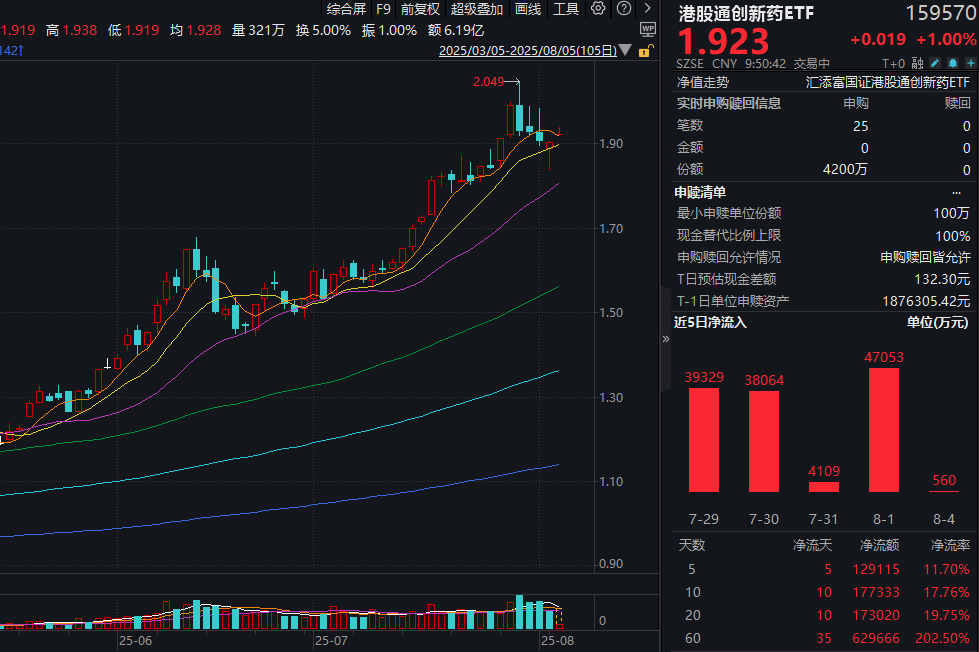
在研创新管线密集兑现,创新药表现强劲!100%创新药含量的港股通创新药ETF(159570)涨1%,近10日狂揽净申购超17亿元!
Sou Hu Cai Jing· 2025-08-05 02:32
Group 1 - The core viewpoint emphasizes optimism towards the long-term development of innovative drugs in China, driven by domestic engineer advantages, rich clinical resources, and supportive policies [2] - The innovative drug industry is transitioning into a 2.0 era, with significant improvements in quality and a strong pipeline expected to enhance profitability and cash flow for domestic companies [2][5] - The market for innovative drugs is experiencing a revival in investment and financing activities, particularly in the second quarter of the year, indicating a positive shift from previous years [2][4] Group 2 - Recent policies related to commercial health insurance are anticipated to accelerate medical payment reforms, alleviating supply-demand conflicts and promoting domestic innovation [3] - The introduction of childcare subsidies is expected to stimulate consumption related to infants and young children, addressing long-term demographic pressures [3] - Increased fiscal policies in the second half of the year are likely to boost market interest in domestic medical equipment stocks [3] Group 3 - The Hong Kong stock market has shown a collective rise, with the Hong Kong Innovative Drug ETF (159570) experiencing significant net inflows and reaching a record scale of over 12 billion [4] - The ETF's underlying index is fully focused on the innovative drug industry, with a notable increase of over 109% in the past year, outperforming other indices [7][8] - Major pharmaceutical companies in China are actively engaging in overseas licensing deals, indicating a pivotal moment for the realization of innovative drug pipeline values [5][6]
港股创新药ETF(513120)早盘冲高涨近2%,近5日累计“吸金”3.54亿元
Xin Lang Cai Jing· 2025-08-05 02:21
Group 1 - The Hong Kong Innovation Drug ETF (513120) has shown strong performance, with a recent increase of 1.90% and a total scale reaching 15.257 billion [1] - The ETF has attracted significant capital inflow, accumulating 354 million over the last five trading days, and has a one-year net value increase of 127.14% [1][2] - The index tracks up to 50 listed companies involved in innovative drug research, with a high concentration in biopharmaceuticals and chemical pharmaceuticals, accounting for 92.5% of the index [2] Group 2 - The top ten weighted stocks in the index account for 70.59%, including companies like 康方生物 (09926) and 信达生物 (01801) [2] - The innovation drug sector is entering a phase of "clinical value reassessment," shifting from a narrative-driven valuation to a profit-driven approach, indicating long-term investment potential [2] - The sector is expected to maintain its growth due to policy support, enhanced global competitiveness, and successful commercialization [3] Group 3 - The ETF allows T+0 trading, enhancing liquidity and efficiency for investors [3]
账面资金不足1亿, 旺山旺水能“旺”起来吗?
阿尔法工场研究院· 2025-08-05 00:06
Core Viewpoint - The article discusses the potential IPO of Wangshan Wangshui, focusing on its flagship product "domestic Viagra" Angweida, while highlighting the company's broader portfolio of nine innovative assets in three key areas: antiviral, neuropsychiatric, and reproductive health [2][3]. Group 1: Company Overview - Wangshan Wangshui has a valuation of 4.45 billion yuan and is preparing for an accelerated IPO process after submitting its prospectus to the Hong Kong Stock Exchange [2][3]. - The company faces significant challenges, including tight cash flow, idle production capacity, high debt levels, and a concentrated customer base [3][11]. Group 2: Market Trends - The core trends in the industry include innovative drug development targeting RNA viruses and new antidepressant mechanisms, international expansion leveraging the Belt and Road Initiative, and increasing price pressures due to dynamic adjustments in the national medical insurance catalog [5][6]. Group 3: Competitive Landscape - The antiviral drug market is projected to grow from 203 billion yuan in 2024 to 403 billion yuan in 2035, with a compound annual growth rate (CAGR) of 6.3%, while the neuropsychiatric and reproductive health sectors face intense competition with lower growth rates [7]. - Wangshan Wangshui's reliance on a single major customer, which accounted for over 70% of its revenue, poses a significant risk [11][12]. Group 4: Financial Performance - The company reported a net profit of 6.4 million yuan in 2023, primarily from licensing income, but is projected to incur a net loss of 218 million yuan in 2024 due to increased R&D expenses and the termination of licensing income [16]. - Cash flow has deteriorated, with operating cash flow turning negative in 2024, and total liabilities increasing from 488 million yuan in 2023 to 641 million yuan in 2025 [17][16]. Group 5: R&D and Commercialization - Wangshan Wangshui's R&D spending is only 10% of the industry average, and it has significantly fewer patents compared to leading competitors [13]. - The company plans to use IPO proceeds primarily for product development and capacity expansion, including clinical trials for its core products [19][20]. Group 6: Risks and Challenges - The company faces potential issues such as underutilization of existing production capacity, long R&D cycles without core product approvals, and a heavy reliance on self-research and production strategies [22][23]. - Historical examples from peers indicate that unprofitable biotech companies face stringent valuation scrutiny, raising concerns about Wangshan Wangshui's ability to navigate similar challenges [24].

港股&海外周观察:策略点评:全球为何普跌?
Soochow Securities· 2025-08-04 12:48
Market Performance - Developed and emerging markets both declined by 2.5% during the week of July 28 to August 1, 2025[1] - The Hang Seng Index fell by 3.5%, while the Hang Seng Tech Index dropped by 4.9%[1] - The S&P 500 decreased by 2.4%, and the Dow Jones Industrial Average led the decline with a 2.9% drop[4] Economic Indicators - U.S. non-farm payrolls added only 73,000 jobs in July, significantly below the expected 104,000 and previous month's 147,000[4] - The U.S. manufacturing PMI fell to 48 in July, below the expected 49.5, indicating a contraction in the manufacturing sector[4] - The U.S. Q2 GDP growth rate was 3.0%, surpassing expectations of 2.4%[4] Market Sentiment and Trends - There is a consensus to focus on dividend-paying stocks and identify sectors with growth potential, particularly in healthcare[1] - Concerns remain regarding internet technology stocks due to consumer spending factors, although some funds are increasing their allocations[1] - The market is experiencing increased volatility due to rising overseas risks and expectations of interest rate cuts in the U.S.[1] Tariff Impacts - The U.S. is set to implement reciprocal tariffs starting August 7, affecting various countries with rates as high as 39% for some[5] - The market's sensitivity to tariff issues appears to be diminishing, but ongoing monitoring is necessary[1] Fund Flows - Global equity ETFs saw a net inflow of $29.579 billion, with the U.S. leading at $19.55 billion[11] - Chinese equity ETFs experienced the largest outflow, totaling $5 billion[11] - Institutional investors are slightly reducing gold holdings, while retail investors are marginally increasing their positions[10]
华源晨会精粹20250804-20250804
Hua Yuan Zheng Quan· 2025-08-04 12:04
Fixed Income - The new tax regulation will reinstate VAT on interest income from newly issued government and financial bonds starting August 8, 2025, which may affect pricing and yield spreads between new and old bonds [2][10][12] - The bond market is expected to remain a favorable investment direction, with the 10Y government bond yield projected to gradually return to around 1.65% in August [2][20] - The new tax regulation is likely to enhance the scarcity of existing government and financial bonds, potentially leading to a temporary decrease in yields as banks seek to acquire these older bonds [2][13][20] Pharmaceutical Industry - The pharmaceutical index rose by 2.95%, outperforming the CSI 300 by 4.7%, with a focus on innovative drugs and companies with strong business development (BD) catalysts [26][27] - Heng Rui Pharmaceutical's recent agreement with GSK for a potential total of $12 billion in rights for innovative drugs highlights the company's strong innovation capabilities and future growth potential [26][28] - The report suggests a positive outlook for the pharmaceutical sector, driven by innovation, international expansion, and an aging population increasing demand for healthcare [29][30] Media and Entertainment - The China Joy exhibition showcased high industry enthusiasm, with 800 companies participating, indicating a robust market for gaming and related sectors [32][33] - Recent box office performance shows a recovery in the film market, with significant daily earnings from major releases, suggesting a positive trend for cinema attendance and revenue [32][34] - The report emphasizes the importance of AI applications in various sectors, including education and marketing, as key areas for future growth [32]
全国生物类似药集采启动:8个品种涉及300亿市场,影响有多大?
Xin Lang Cai Jing· 2025-08-04 11:08
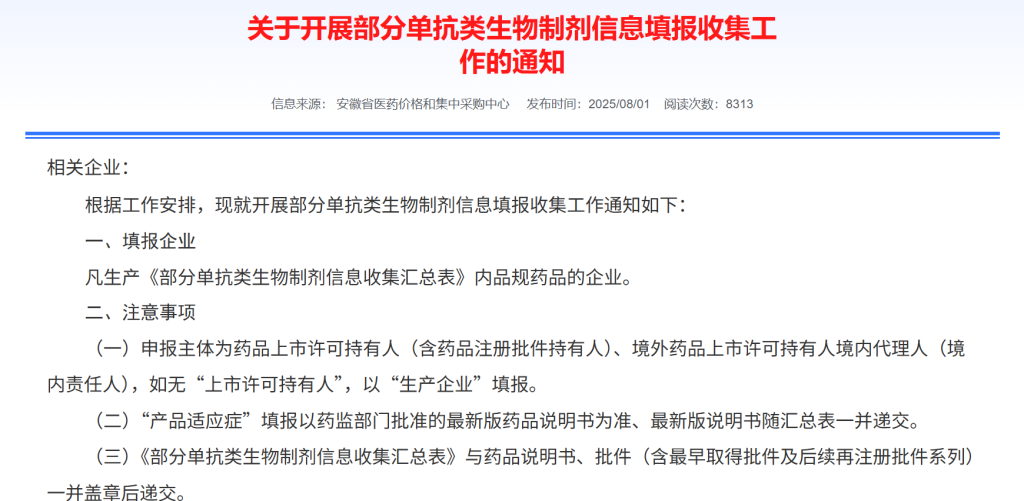
Core Viewpoint - The announcement by Anhui Province regarding the collection of information for the centralized procurement of eight monoclonal antibody biosimilars indicates a significant shift towards nationwide biosimilar drug procurement, which could impact the market dynamics and competition in the pharmaceutical industry [1][3][4]. Group 1: Centralized Procurement Overview - The centralized procurement initiative is not limited to Anhui Province but is a nationwide effort led by Anhui, aiming to enhance the procurement of biosimilars [3]. - The collection of information from manufacturers includes sales data, production capacity, approved indications, and pricing information, which is expected to take 1-2 months before formal bidding begins [3][4]. - The first batch of biosimilar procurement is anticipated to have a substantial market impact, with an estimated market size of nearly 300 billion yuan involved in the procurement of the eight selected monoclonal antibodies [4][6]. Group 2: Market Dynamics and Competition - The competition for the selected biosimilars is expected to be intense, with major players like Innovent Biologics, China National Pharmaceutical Group, and Hengrui Medicine having multiple products included in the procurement list [4][6]. - The sales figures for key biosimilars indicate significant market potential, with Rituximab projected to generate sales of 5.2 billion yuan in 2024, while Bevacizumab is expected to exceed 10 billion yuan [6][7]. - The procurement process is likely to lead to price reductions, although the extent of these reductions may be less severe compared to previous chemical drug procurements, reflecting a more moderate pricing strategy [7][8]. Group 3: Industry Response and Future Outlook - Companies are proactively adjusting their strategies in anticipation of the procurement, with some focusing on domestic sales and others exploring international markets to enhance their competitive positioning [8]. - The regulatory environment is evolving, with indications that future procurement rules may prioritize sustainability and reasonable pricing, which could influence how companies approach their pricing strategies [7][8]. - The overall sentiment in the industry suggests a cautious optimism regarding the balance between price reductions and the need for sustainable growth in the biosimilar sector [7][8].
港股、海外周观察:全球为何普跌?
Soochow Securities· 2025-08-04 09:12
Group 1 - Developed and emerging markets experienced a simultaneous decline, with both down by 2.5% during the week of July 28 to August 1, 2025 [1][10] - The Hang Seng Technology Index fell by 4.9%, while the Hang Seng Index decreased by 3.5% [1] - The healthcare sector led the industry performance, indicating potential resilience in this area amidst broader market declines [1] Group 2 - The U.S. stock market faced pressure from economic slowdown, with the Dow Jones down 2.9%, S&P 500 down 2.4%, and Nasdaq down 2.2% [2][4] - Non-farm payroll data showed a significant drop, with only 73,000 jobs added in July, well below expectations of 104,000 [2][21] - The U.S. manufacturing PMI fell to 48 in July, indicating contraction, as it remained below the neutral level for five consecutive months [2][27] Group 3 - The Federal Reserve maintained interest rates but faced internal dissent, with two members voting against the decision, advocating for a 25 basis point cut [3][19] - The reintroduction of tariffs under the Trump administration has created a dual structure, with varying rates applied to different countries, impacting market sentiment [3][19] Group 4 - Short-term outlook for U.S. stocks suggests a period of adjustment due to economic data showing weakness, particularly in employment and manufacturing [4][5] - Historical trends indicate that August is typically a weak month for U.S. stocks, often leading to corrections post-earnings season [4] - The S&P 500's market breadth has declined to 55%, reflecting a decrease in overall market participation [5][30] Group 5 - Gold ETFs saw mixed inflows, with significant increases in certain funds like Huaan Yifu Gold ETF (+$223 million) and Invesco Physical Gold ETC (+$195 million) [6][34] - Institutional investors slightly reduced their gold holdings, while retail investors increased theirs, indicating a shift in market sentiment towards gold [6][34] Group 6 - Global stock ETFs experienced a net inflow of $29.579 billion, with the U.S. leading at $19.55 billion, while Chinese stock ETFs saw a significant outflow of $5 billion [7][44] - The technology, financial, and communication sectors saw the highest net inflows, while healthcare, energy, and consumer discretionary sectors faced outflows [7][46]
高盛维持理想汽车买入评级
Xin Lang Cai Jing· 2025-08-04 07:53
Group 1 - Goldman Sachs maintains a "Buy" rating for Li Auto-W with a target price of HKD 138, expecting monthly sales of 6,000 units for its new electric SUV i8 [1] - China Biologic Products is rated "Outperform" by CMBI, highlighting its strong innovation pipeline and growth in biosimilars and generics [1] - JPMorgan upgrades Hang Lung Properties to "Overweight" with a target price of HKD 10, citing attractive dividend yield and improved sales outlook [2] Group 2 - Citi maintains a "Outperform" rating for China Overseas Property but lowers the target price to HKD 6.1, focusing on service quality improvement [3] - UBS maintains a "Buy" rating for Ping An Insurance, raising the target price to HKD 66, driven by improved macro conditions and growth in asset management [4] - UBS maintains a "Buy" rating for GCL-Poly Energy with a target price of HKD 1.9, benefiting from supply cuts and strong product quality [5] Group 3 - Macquarie maintains a "Outperform" rating for Prada but lowers the target price to HKD 60, citing lower-than-expected sales growth [6] - Goldman Sachs maintains a "Neutral" rating for CATL, adjusting the target price to HKD 436 due to expected declines in battery gross margins [7] - Goldman Sachs maintains a "Buy" rating for Kuaishou-W with a target price of HKD 68, anticipating significant revenue growth in the AI sector [8] Group 4 - Morgan Stanley maintains an "Overweight" rating for HSBC, raising the target price to HKD 107.1 due to improved earnings forecasts [9]