伊利股份

Search documents
遵义白酒出口激增776%!食品ETF(515710)下挫0.7%!机构:白酒板块短期承压但中长期或回暖
Xin Lang Ji Jin· 2025-11-04 01:53
Group 1 - The food ETF (515710) showed weak performance with a decline of 0.7% and a trading volume of 6.5633 million yuan, while the fund's latest scale is 1.477 billion yuan [1] - Key stocks in the ETF include Qianhe Flavor Industry, Tongchen Baijian, and Meihua Biological, which saw increases of 0.42%, 0.39%, and 0.26% respectively [1] - Conversely, XinNuoWei, Chengde Lulu, and Dongpeng Beverage experienced declines of 3.01%, 2.54%, and 2.05% respectively [1] Group 2 - The white liquor export value from Zunyi increased by 776.17% year-on-year from January to August 2025, indicating an acceleration in the internationalization of regional liquor [1] - Guizhou Moutai reported a significant recovery in the terminal sales of its sauce-flavored liquor in September, reflecting resilient market demand for core products [1] - The Hubei liquor market has a scale of 35 billion yuan, showing continuous release of regional consumption potential [1] Group 3 - The food and beverage sector's revenue decreased by 4.8% year-on-year in Q3 2025, with the white liquor industry's revenue growth at -18.4%, primarily due to weak market demand [2] - High-end liquor remains resilient but is entering a phase of financial clearing, while mid-range and real estate liquor are under pressure [2] - The snack sector performed well with a growth of 22.4%, and soft drinks increased by 14.4%, while traditional consumer goods maintained low growth [2] Group 4 - The food ETF (515710) and its linked funds passively track a segmented food index, with the top ten weighted stocks including Guizhou Moutai, Wuliangye, and Yili Group [2]

白酒三季报加速出清,食品ETF(515710)近5日吸金超1.1亿元!吃喝板块配置窗口开启?
Xin Lang Ji Jin· 2025-11-04 01:35
Group 1 - The food and beverage sector is experiencing low-level fluctuations, with significant capital inflow into the Food ETF (515710), which has seen a net inflow of 116 million yuan over the last five trading days and over 220 million yuan in the last 20 trading days [1][3] - The liquor industry continues to adjust, with Q3 2025 revenue at 78.69 billion yuan, down 18.4% year-on-year, and net profit at 28.06 billion yuan, down 22% year-on-year, indicating increased pressure on overall industry profitability [3] - The valuation of the food and beverage sector is at a historical low, with the food index's price-to-earnings ratio at 20.77 times, placing it in the 8.63% percentile of the last decade, suggesting a good opportunity for left-side layout [3][4] Group 2 - The market outlook indicates that the liquor sector is undergoing a release of pressure, with valuations at a relatively low level, presenting opportunities for alpha in high-performing stocks [4] - The Food ETF (515710) tracks the CSI segmented food and beverage industry theme index, with approximately 60% of its holdings in leading high-end and mid-range liquor stocks, and nearly 40% in leading stocks from beverages, dairy, seasonings, and beer [4] - Investors can also access core assets in the food and beverage sector through the Food ETF linked funds (Class A 012548/Class C 012549) [4]




不仅熬过低谷 还要“创”出未来——伊利900亿元营收背后的“抗周期”启示
Shang Hai Zheng Quan Bao· 2025-11-03 18:16
Core Viewpoint - The performance of Yili Group in the first three quarters of 2025 exceeded expectations, with a revenue of 90.564 billion yuan, a year-on-year increase of 1.71%, and a net profit of 10.103 billion yuan, up 18.73% [1] Business Performance - Yili's liquid milk segment remains the industry leader, generating revenue of 54.939 billion yuan, with products like organic milk becoming popular in the gifting market [1] - The company has successfully expanded its market share in infant formula, achieving the highest market share in China for the first time [3][4] Anti-Cyclical Strategies - Yili's approach to anti-cyclicality involves optimizing both profit quality and business structure rather than merely expanding scale [1][2] - The deep processing of milk is highlighted as a key strategy to convert surplus raw milk into high-value products, enhancing the value chain and addressing consumer demand for personalized products [2] Technological Innovation - Yili has implemented smart farming technologies, resulting in over a 10% increase in milk production per cow and a 12% reduction in labor costs [5][6] - The company has completed the digital transformation of all its factories, enabling real-time data collection and analysis to ensure product quality [6] Industry Collaboration - Yili has supported its partner farms by providing financial assistance totaling 185.215 billion yuan and technical support, significantly reducing operational costs [8] - The company has established a strategic partnership with Tongrentang to explore functional food markets, leading to a 45% year-on-year increase in revenue from functional dairy products [9] Future Outlook - Yili plans to focus on deep processing of dairy, functional foods, and health beverages, with an annual R&D investment growth of at least 20% over the next five years [9]
多地工业游“出圈”
Zheng Quan Ri Bao· 2025-11-03 15:46
Core Insights - Industrial tourism is emerging as a new trend in cultural and tourism consumption, with initiatives from various government bodies to promote and expand industrial tourism resources [1][2][3] Group 1: Government Initiatives - The Guangdong Provincial Government has launched a plan to promote 51 industrial tourism routes and aims to expand the number of industrial tourism resources to around 300 by the end of 2025 [1] - Beijing's implementation plan for 2025-2027 aims to encourage industrial enterprises and cultural tourism institutions to develop resources such as factories, industrial parks, and museums, targeting 20 million annual visitors and 3 billion yuan in revenue by 2027 [1] Group 2: Industry Development - The Ministry of Industry and Information Technology and other departments have previously issued a plan to promote industrial culture development, emphasizing the establishment of standards for industrial tourism and the creation of demonstration bases [2] - Cities like Shenyang are leveraging their industrial heritage and modern factories to create "industrial cultural experience tours," showcasing production processes and corporate culture [2] Group 3: Market Trends - Notable companies like Baosteel, Midea Group, and Haitian Flavoring have opened their production facilities to visitors, becoming popular tourist spots [3] - The rise of industrial tourism aligns with consumer demand for knowledge-based, experiential, and personalized travel, transitioning from niche interests to mainstream appeal [3] - The industrial tourism market in China is projected to exceed 300 billion yuan by 2029, with a focus on cultural storytelling and interactive experiences [3]
中国必选消费品10月需求报告:双节并未带动商品消费改善
Haitong Securities International· 2025-11-03 15:27
Investment Rating - The investment rating for the consumer staples sector in China is "Outperform" for multiple companies including Guizhou Moutai, Wuliangye, and Yili [1]. Core Insights - In October 2025, five out of eight key consumer goods sectors maintained positive growth, while three sectors experienced negative growth. The sectors with single-digit growth included frozen foods, soft drinks, beer, condiments, and catering services. The declining sectors were mid-to-high-end and premium baijiu, mass-market and lower-tier baijiu, and dairy products. Despite the extended holiday period due to the overlap of National Day and Mid-Autumn festivals, consumer spending remained sluggish, with goods consumption growing by 3.9% and services consumption by 7.6% during the holiday [3][29]. Summary by Sector 1. Mid-to-High-End Baijiu - In October, the revenue for mid-to-high-end baijiu was 27.7 billion yuan, a year-on-year decline of 11.7%. Cumulative revenue from January to October was 325.2 billion yuan, down 5.6% year-on-year. The consumption structure is shifting downwards, with products priced between 100-300 yuan accounting for 60% of sales [4][12]. 2. Mass-Market and Lower-Tier Baijiu - The revenue for mass-market and lower-tier baijiu in October was 16.3 billion yuan, a year-on-year decline of 3.0%. Cumulative revenue from January to October was 162.1 billion yuan, down 9.1% year-on-year. The production of baijiu in September was 306,000 kiloliters, a year-on-year decline of 15.0% [5][14]. 3. Beer - The beer sector reported revenue of 10.3 billion yuan in October, a year-on-year increase of 2.0%. Cumulative revenue from January to October was 152.9 billion yuan, up 0.5% year-on-year. The sector is experiencing a mild recovery, although regional performance varies significantly [6][16]. 4. Condiments - The revenue for the condiment sector in October was 37.6 billion yuan, a year-on-year increase of 1.0%. Cumulative revenue from January to October was 371.1 billion yuan, up 1.3% year-on-year. Demand from the catering sector is gradually recovering, but profitability remains under pressure [7][18]. 5. Dairy Products - The dairy sector's revenue in October was 36.5 billion yuan, a year-on-year decline of 4.2%. Cumulative revenue from January to October was 387.5 billion yuan, down 2.0% year-on-year. Demand remains under pressure, and inventory levels are high post-holiday [8][20]. 6. Frozen Foods - The frozen food sector reported revenue of 7.77 billion yuan in October, a year-on-year increase of 5.0%. Cumulative revenue from January to October was 88.2 billion yuan, up 2.0% year-on-year. Demand is supported by catering recovery and stable growth in customized products [9][22]. 7. Soft Drinks - The soft drink sector's revenue in October was 46.7 billion yuan, a year-on-year increase of 2.6%. Cumulative revenue from January to October was 619.5 billion yuan, up 4.3% year-on-year. The competitive landscape has softened post-peak season [10][24]. 8. Catering - The catering sector reported revenue of 16.2 billion yuan in October, a year-on-year increase of 1.2%. Cumulative revenue from January to October was 148.1 billion yuan, down 0.5% year-on-year. The sector is showing signs of stabilization, benefiting from holiday demand [11][26].



比亚迪等百家上市公司发布ESG委员会细则 | ESG热搜榜
2 1 Shi Ji Jing Ji Bao Dao· 2025-11-03 14:00
Group 1 - Li Auto announced a recall of 11,411 units of the MEGA 2024 model due to insufficient corrosion resistance of the coolant, which could lead to safety hazards such as battery thermal runaway [1] - The recall affects vehicles produced between February 18, 2024, and December 27, 2024, and will begin on November 7, 2025 [1] - Li Auto's chairman emphasized the proactive nature of the recall, stating that the company cannot wait for the investigation results given the potential risks [1] Group 2 - A total of 99 A-share listed companies, including BYD and Yili, have released ESG committee work guidelines from October 24 to 31 [2] - Some companies have rebranded their strategic committees to ESG committees, integrating ESG considerations into core decision-making processes [2] - Companies like Jinling Mining have revised their guidelines to clarify the responsibilities of the chairman in convening ESG committee meetings [2] Group 3 - Five banks, including China Bank and Agricultural Bank of China, received fines for various management failures, totaling millions in penalties [3] - The fines were primarily due to imprudent management in areas such as corporate governance, loan management, and asset quality [3] Group 4 - China's Ministry of Ecology and Environment called for a financing roadmap of $1.3 trillion ahead of COP30, highlighting dissatisfaction with the current funding targets set for developed countries [5] - The report emphasizes the need for substantial progress on financing commitments to support global adaptation goals [5] Group 5 - Zhejiang Securities reported a significant divergence in ESG investment trends between the US and Europe, with large-scale withdrawals from passive ESG funds in Europe [6] - BlackRock has transformed approximately $48 billion of institutional client index products into "ESG dedicated accounts" to meet specific ESG requirements [6] Group 6 - An interview with Zhong Hongwu highlighted that China's ESG evaluation system is transitioning from a follower to a leader, focusing on value creation rather than just risk avoidance [7] - The emphasis is on aligning ESG efforts with national strategic goals, providing a new inclusive development option for global ESG governance [7] Group 7 - Roland Berger's senior partner emphasized the need for businesses to integrate ESG and green transformation into product development systems [7] - The current phase of green low-carbon transformation requires overcoming challenges in standards and collaboration, with CCUS technology being crucial for achieving net-zero goals [7]

伊利净利下滑,静待周期反转
YOUNG财经 漾财经· 2025-11-03 12:50
Core Viewpoint - Yili's revenue has slightly increased while net profit has declined, indicating ongoing pressure in its core liquid milk business, despite growth in milk powder and ice cream segments. The industry faces challenges from weak consumption and a declining population dividend, raising questions about the sustainability of Yili's growth logic and whether investors should continue to hold or reassess their positions [2][3][4]. Financial Performance - In the first three quarters of 2025, Yili achieved revenue of 905.64 billion yuan, a year-on-year increase of 1.71%, while net profit was 104.26 billion yuan, down 4.07% [3]. - The revenue growth rate has slowed, with Q1 at 1.46%, Q2 rebounding to 5.77%, and Q3 showing a decline of 1.63% [3]. - The company announced a dividend plan of 0.48 yuan per share, totaling approximately 30.36 billion yuan, which represents 29.12% of net profit [4]. Industry Context - The overall dairy industry is under pressure, with over 60% of A-share listed dairy companies facing revenue declines. Yili remains the industry leader with 903.41 billion yuan in revenue and 104.26 billion yuan in net profit [5]. - The third quarter saw a decline in revenue and net profit, with Q3 revenue at 285.64 billion yuan, down 1.63%, and net profit at 32.26 billion yuan, down 3.35% [5]. Cost and Expense Management - Yili has been cautious with sales expenses, which decreased by 5.5% in Q3 to 52.2 billion yuan, while management expenses rose by 10.58% to 11.39 billion yuan [6]. - R&D expenses increased by 15.1% to 2.47 billion yuan, reflecting ongoing investment in product innovation [6]. Cash Flow and Inventory - Operating cash flow decreased by 32.23% to 94 billion yuan, attributed to a decline in pre-received payments from distributors, indicating potential inventory buildup and weakened market confidence [7]. Business Segment Analysis - The liquid milk segment is the main drag on Yili's overall performance, with revenue down 4.5% to 549.4 billion yuan in the first three quarters [8]. - The milk powder and dairy products segment showed strong growth, with revenue of 242.61 billion yuan, up 13.74%, and the ice cream segment also performed well with a 13% increase in revenue [10][11]. Market Outlook - The dairy industry is experiencing an oversupply of raw milk, with a projected surplus of 636,000 tons in 2024, indicating ongoing challenges for the sector [12]. - The long-term outlook is complicated by a declining birth rate, which is expected to shrink the market for infant formula, a key growth area for Yili [14]. Investor Sentiment - Following the earnings report, Yili's stock price reacted negatively, reflecting market skepticism about the company's future performance [12][15]. - Despite past profit growth, the company's market valuation has not increased, indicating a "valuation kill" phenomenon [15]. Future Prospects - Yili expresses confidence in benefiting from a potential industry turnaround as raw milk prices stabilize and consumer demand gradually recovers [16].
又一巨头宣布:分红194.71亿!A股投资者,迎来“大红包”
Zhong Guo Ji Jin Bao· 2025-11-03 11:39
Core Viewpoint - The number of A-share companies planning to implement interim dividends has reached a record high, with China Shenhua proposing a cash dividend of 19.471 billion yuan [1][2]. Group 1: Interim Dividend Announcements - As of November 3, 845 A-share companies announced plans for interim dividends in 2025, marking a year-on-year increase of 20.03%, with 325 companies issuing interim dividend proposals for the first time [1][14]. - China Shenhua plans to distribute a cash dividend of 0.98 yuan per share, totaling 19.471 billion yuan [1]. - Yili Co. announced its first interim dividend plan, proposing a cash dividend of 0.48 yuan per share, amounting to 3.036 billion yuan [4]. - Industrial Fulian plans to distribute a cash dividend of 3.3 yuan per 10 shares, totaling 6.551 billion yuan [8]. Group 2: Financial Performance and Profitability - Many A-share companies are able to declare interim dividends due to their robust financial health and strong profitability [2][7]. - As of November 3, 31 A-share companies with a net profit exceeding 3 billion yuan in the first three quarters of 2025 are planning interim dividends [3][14]. - Hikvision plans to distribute a cash dividend of 4 yuan per 10 shares, totaling 3.666 billion yuan, with a net profit of 9.319 billion yuan in the first three quarters, reflecting a year-on-year increase of 14.94% [14]. Group 3: Market Trends and Regulatory Environment - The trend of increasing interim dividends is supported by policies aimed at enhancing investor returns, with the number of companies announcing interim dividends rising significantly from 194 in 2023 to 845 in 2025 [14][16]. - The unique value of interim dividends is gaining attention, as they shorten the investment return cycle and allow investors to share in corporate growth more quickly [16].

又一巨头宣布:分红194.71亿!A股投资者,迎来“大红包”
中国基金报· 2025-11-03 11:34
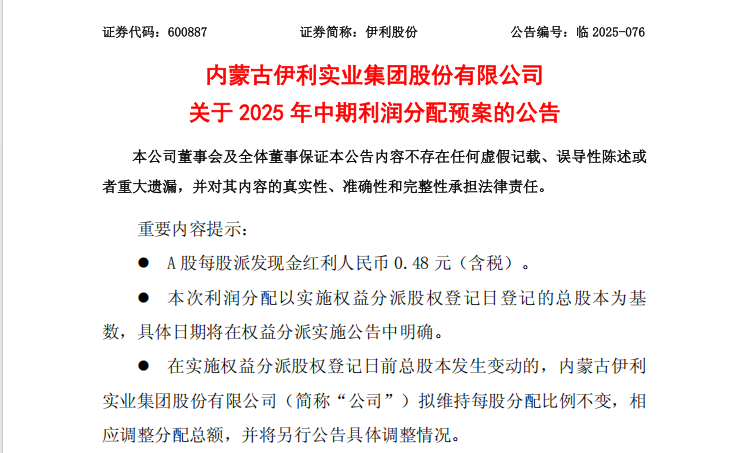
Core Viewpoint - The number of A-share companies planning mid-term dividends has reached a record high, with China Shenhua planning to distribute a cash dividend of 19.471 billion yuan [2][3]. Group 1: Mid-term Dividend Trends - As of November 3, 845 A-share companies announced plans for mid-term dividends in 2025, a year-on-year increase of 20.03%, with 325 companies announcing mid-term dividends for the first time [5]. - The robust financial health and strong profitability of many A-share companies underpin the trend of mid-term dividends [6]. - Notable mid-term dividend plans include China Shenhua's 0.98 yuan per share cash dividend, totaling 19.471 billion yuan, and Industrial Fulian's 3.3 yuan per 10 shares, totaling 6.551 billion yuan [3][15]. Group 2: Company Performance and Dividend Policies - Yili's first mid-term dividend proposal includes a cash dividend of 0.48 yuan per share, totaling 3.036 billion yuan, continuing its tradition of high dividend levels [8][9]. - Industrial Fulian reported a 48.52% year-on-year increase in net profit to 22.487 billion yuan for the first three quarters of 2025, driven by the expanding AI server market [17]. - Yili's net profit for the first three quarters of 2025 decreased by 4.07% to 10.426 billion yuan, but the company aims for a dividend payout ratio of no less than 70% in the coming years [19]. Group 3: Regulatory and Market Implications - Recent policies, including the new "National Nine Articles," have emphasized the importance of enhancing investor returns, leading to an increase in mid-term dividend announcements [24][27]. - Mid-term dividends allow for a shorter investment return cycle, enabling investors to share in corporate growth more quickly and promoting reinvestment of funds [27].




11月3日投资时钟(399391)指数涨0.23%,成份股星辉娱乐(300043)领涨
Sou Hu Cai Jing· 2025-11-03 11:10
Core Points - The Investment Clock Index (399391) closed at 3364.41 points, up 0.23%, with a trading volume of 95.671 billion yuan and a turnover rate of 0.98% [1] - Among the index constituents, 66 stocks rose, with Xinghui Entertainment leading at a 9.29% increase, while 33 stocks fell, with Lingnan Holdings leading the decline at 5.24% [1] Index Constituents Summary - Major constituents include: - Kweichow Moutai (16.68% weight) at 1435.00 yuan, up 0.35%, with a market cap of 1797.008 billion yuan [1] - China Merchants Bank (15.74% weight) at 41.79 yuan, up 2.20%, with a market cap of 1053.937 billion yuan [1] - Zijin Mining (7.34% weight) at 30.00 yuan, down 1.64%, with a market cap of 797.327 billion yuan [1] - Wuliangye (5.26% weight) at 118.98 yuan, down 0.01%, with a market cap of 461.834 billion yuan [1] - Hengrui Medicine (4.84% weight) at 63.40 yuan, down 1.17%, with a market cap of 420.798 billion yuan [1] Capital Flow Summary - The index constituents experienced a net outflow of 2.407 billion yuan from institutional investors and 0.251 billion yuan from retail investors, while retail investors saw a net inflow of 2.658 billion yuan [3] - Notable capital flows include: - China Merchants Bank with a net inflow of 433.16 million yuan from institutional investors [3] - China Petroleum with a net inflow of 326 million yuan from institutional investors [3] - China Shipbuilding with a net inflow of 284 million yuan from institutional investors [3]