东鹏饮料

Search documents
白酒近况更新
2025-09-22 01:00
Summary of Conference Call Notes Industry Overview - The conference call primarily discusses the liquor industry, particularly focusing on the performance and strategies of major companies like Guizhou Moutai and Wuliangye during the recent sugar and liquor fair [1][2][3][4]. Key Points and Arguments 1. **Market Feedback from the Sugar and Liquor Fair**: Overall feedback from the fair was in line with expectations, with some channel operations exceeding expectations. Most liquor companies emphasized price stability in their channel operations [1]. 2. **Valuation Changes**: Post-Spring Festival, the market's perception of real estate stability has led to an increase in Guizhou Moutai's valuation from 18x to 22x, with many other stocks also experiencing valuation upgrades [2]. 3. **Seasonal Performance**: Despite being the off-season, banquet consumption has continued to show growth similar to the Spring Festival, with business consumption also receiving positive feedback due to a more favorable operating environment for private enterprises [3]. 4. **Confidence in Price Recovery**: There is a growing confidence in price recovery, although it remains untested during the off-season. The overall sentiment is that the liquor sector is not facing a downturn but is on an upward trend [4][7]. 5. **Foreign Investment Interest**: Foreign investors are likely to increase their allocation in liquor stocks, particularly Guizhou Moutai, due to strong earnings growth and attractive dividend yields. In contrast, domestic investors are more cautious due to previous significant gains in other sectors [5][6]. 6. **Inventory and Pricing Strategies**: Most liquor companies are maintaining stable prices and avoiding aggressive discounting to ensure natural sales growth. This strategy is crucial for maintaining market share in the mid-to-high price segments [14][15]. 7. **Channel Operations**: Wuliangye is undergoing significant channel reforms, focusing on reducing traditional channel volumes while enhancing direct sales and new market channels. The success of these reforms depends heavily on management execution [19][20][21]. 8. **Sales and Payment Trends**: The first quarter's sales performance is expected to show a mid-single-digit growth rate, with most companies nearing completion of their payment collection for the quarter [18][39]. 9. **Consumer Behavior Insights**: There is a notable recovery in consumer demand, particularly in banquet and business settings, although the overall market remains cautious about confirming a definitive recovery point [10][11][12]. Additional Important Insights - **Regional Performance Variations**: The performance of liquor sales varies significantly by region, with southern regions showing stronger recovery compared to northern areas [27]. - **Emerging Trends in Consumer Preferences**: There is a shift towards premium products, with some companies reporting substantial growth in high-end liquor sales [10][11]. - **Future Outlook**: The overall sentiment is cautiously optimistic, with expectations of gradual recovery in consumer demand and potential for further valuation increases in the liquor sector [6][12][13]. This summary encapsulates the key discussions and insights from the conference call, providing a comprehensive overview of the current state and future outlook of the liquor industry.
食品饮料行业跟踪报告:供需拐点渐进,结构亮点频出——秋季策略会交流反馈报告
Huachuang Securities· 2025-09-21 12:45
Group 1: Industry Overview - The food and beverage industry is experiencing a gradual supply-demand turning point, with structural highlights emerging [4][6] - The overall market performance shows a total market value of 48,501.92 billion, with a circulating market value of 47,287.20 billion [2] - The absolute performance over the last 12 months is 25.0%, while the relative performance has decreased by 17.6% [2] Group 2: Wine Sector Insights - Demand for wine has improved on a month-on-month basis, although there is still a year-on-year decline [4][6] - Wine companies are pragmatically adjusting growth targets, focusing on channel health and providing support to improve channel profits [4][6] - The report suggests paying attention to the health of channels and the quality of receivables as companies are expected to release operational pressure in the second half of the year [4][6] Group 3: Consumer Goods Sector Insights - Traditional leading brands in the consumer goods sector are emerging from the bottom, with clear trends in industry prosperity [4][6] - The dairy industry is facing ongoing supply-demand contradictions, with expectations for gradual bottoming out in 2026 [6][9] - Companies like Chongqing Beer are exploring new growth avenues while maintaining stable operational strategies [6][9] Group 4: Investment Recommendations - Emphasis on the bottom-catalyzing of the wine sector and selective investment in consumer goods based on industry trends [10][12] - Recommendations include focusing on companies with strong performance and those undergoing significant transformations, such as Moutai and Gujing [10][12] - In the consumer goods sector, strategic recommendations include investing in yeast products and the yellow wine market, which is expected to see significant growth [10][12]
广东富豪的饮料帝国:半年狂赚107亿分红13亿,林氏家族独得8亿多
Sou Hu Cai Jing· 2025-09-21 10:28
Core Insights - The article highlights the success story of Lin Muqin, who transformed a struggling beverage factory into a billion-yuan empire, achieving a revenue of 10.737 billion yuan in the first half of the year [3][16]. Company Overview - Lin Muqin started as a technician in a construction company and later became the general manager of a failing state-owned beverage factory, which eventually became Dongpeng Beverage [8][9]. - In 2003, Lin seized the opportunity presented by state-owned enterprise reforms, investing 1.46 million yuan to take over the struggling factory with 19 other employees [9]. Business Strategy - Initially, Dongpeng focused on tea drinks but struggled with profitability, leading Lin to pivot to the energy drink market, launching Dongpeng Special Drink in 2009 at a lower price than competitors like Red Bull [10][12]. - The product was marketed aggressively, adopting a similar branding strategy to Red Bull, which drew criticism but ultimately helped the company survive and grow [12][13]. Market Positioning - Dongpeng targeted lower-tier cities and working-class consumers, utilizing innovative marketing strategies such as promotions and improved consumer experiences [14]. - The brand gained significant recognition after celebrity endorsements, notably from actor Nicholas Tse, which helped attract younger consumers [14]. Financial Performance - Dongpeng Beverage went public in 2021, achieving a market valuation exceeding 100 billion yuan, with Lin Muqin's personal wealth rising to 20 billion yuan [16]. - The company reported a revenue of over 10.7 billion yuan in the first half of the year, marking a year-on-year growth of over 40% [16]. Operational Insights - The company allocates over 1 billion yuan annually for sales expenses, while research and development spending remains relatively low at under 40 million yuan, indicating a focus on branding and distribution channels [17]. - The substantial cash dividend of 1.3 billion yuan reflects the company's strong cash flow and the family's significant control over strategic decisions [18]. Competitive Landscape - Dongpeng's success has inspired competitors like Dali Food's Lehu, which has adopted similar product offerings and pricing strategies, intensifying market competition [18]. - Despite facing criticism for being a "copycat," Lin Muqin acknowledges the importance of learning from industry leaders while also developing differentiated products over time [19]. Industry Context - The rise of Dongpeng Beverage is closely tied to the rapid expansion of the functional beverage market in China, with Lin's ability to understand and cater to the needs of lower-tier markets being a key factor in the company's success [20].


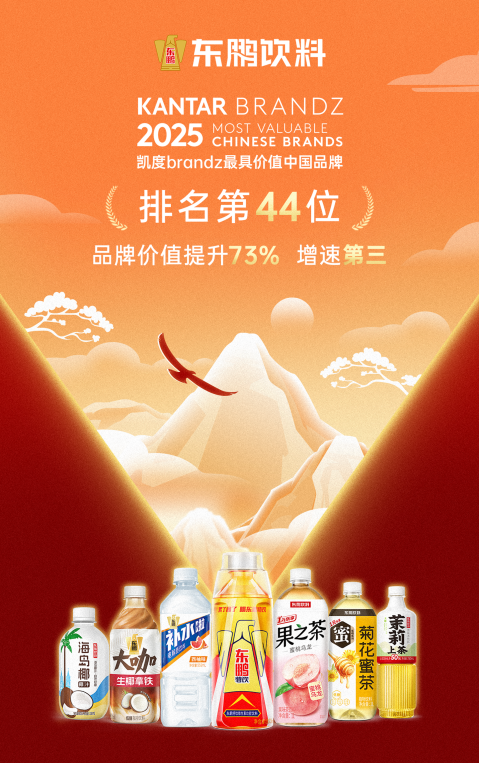
排名第44,东鹏饮料连续四年登榜凯度BrandZ中国品牌百强榜
Sou Hu Wang· 2025-09-21 00:30
Core Insights - The 2025 Kantar BrandZ Top 100 Most Valuable Chinese Brands list was released, showing a total brand value of $1.21 trillion, with a growth rate of 25% in a complex macroeconomic environment [1] Company Performance - Dongpeng Beverage has been listed for four consecutive years, significantly rising 25 places to rank 44th, with a brand value of $4.218 billion and a growth rate of 73%, making it the third on the growth list [4] - In 2024, Dongpeng Beverage achieved a total revenue of 15.84 billion yuan, a year-on-year increase of 40.63%, and a net profit of 3.327 billion yuan, up 63.09% [7] - For the first half of 2025, Dongpeng Beverage reported revenue of 10.737 billion yuan, with its flagship product Dongpeng Special Drink growing at 21.97% to achieve revenue of 8.361 billion yuan, and Dongpeng Water achieving a remarkable growth rate of 213.71% [10] Brand Strategy - The Vice President of Dongpeng Beverage, Jiang Weiwei, emphasized the importance of brand visibility, sales increase, and loyalty through a three-dimensional approach to "traffic" [5] - The company utilizes product display as a key marketing strategy, transforming shelves and coolers into advertising spaces, and employs digital systems for optimal resource allocation [5] - Dongpeng Beverage enhances brand awareness through strategic partnerships with major events like the World Cup and by utilizing various advertising platforms [6] - The company has developed a precise marketing strategy targeting specific consumer groups, which has proven effective in building brand loyalty and increasing repurchase rates [6] Industry Context - The growth of Dongpeng Beverage reflects a broader trend in the Chinese consumer brand landscape, transitioning from "scale expansion" to "value leadership" [10] - The resilience and innovative strategies of Chinese brands are highlighted as they adapt to a more mature economic environment, aiming to strengthen their competitiveness in the global market [10]

2025年第37周:食品饮料行业周度市场观察
艾瑞咨询· 2025-09-20 00:04
Group 1 - The "health economy" is effectively capturing the "Z generation" through product innovation and social media marketing, with traditional Chinese medicine brands attracting young consumers by offering health-focused products like herbal teas and scented candles [2] - Functional beverages and tea drinks are rapidly replacing traditional bottled water, with significant growth expected in these categories driven by health and personalization demands, while the bottled water market faces stagnation due to oversaturation and price wars [3] - The prepared food industry is undergoing a deep adjustment, with major players like Weizhi and Qianwei experiencing revenue declines due to rising raw material costs and intensified competition, despite the overall market size continuing to expand [4] Group 2 - The tea beverage market is showing signs of differentiation, with Nongfu Spring experiencing a 15.6% revenue increase, while Kangshifu's tea beverage revenue declined by 6.3%, attributed to decreased demand for sugary teas and channel contraction [5] - Japan's mature functional food market offers insights for developing senior food products in China, where the aging population presents a significant market opportunity, necessitating diverse and functional food offerings [7] - Energy drinks are shifting from being favored by laborers to becoming popular among younger consumers, with the market size reaching 111.4 billion yuan, driven by health-conscious formulations and appealing packaging [8] Group 3 - The ready-to-drink tea market is projected to grow at a compound annual growth rate of 5.6% by 2034, with emotional satisfaction and taste optimization being key purchasing drivers [9] - The no-sugar tea market is transitioning from explosive growth to intense competition, with brands focusing on taste innovation to maintain market share as health consciousness rises [11] - Major food and beverage companies are actively investing in product innovation and strategic acquisitions to navigate economic uncertainties, with Coca-Cola and Nestlé reporting significant revenue growth [12] Group 4 - Yonghui Supermarket has launched a new bakery product, "Camellia Flower Toast," emphasizing health and quality, contributing to a noticeable increase in sales [13] - Mengniu's milk powder segment has achieved growth through scientific innovation and targeted marketing, with a reported revenue increase of 2.5% [14] - Wangzai Milk has introduced regionally themed packaging to resonate with local cultures, enhancing brand engagement and driving sales [15] Group 5 - Haidilao has opened a dessert shop to attract customers during off-peak hours, responding to declining revenue and foot traffic [16] - Yuanqi Forest has rapidly grown its market share in the no-sugar sparkling water segment, achieving sales of 11.7 billion yuan, but faces challenges related to product dependency and competition [18] - Yili's new health-focused drink, "Stone Flower and Western Ginseng Water," targets the growing market for traditional health beverages, with a projected market size of 3 billion yuan by 2024 [19] Group 6 - Ziguangyuan has opened a new yogurt station that combines baked goods and snacks, aiming to diversify its product offerings and attract a broader customer base [20] - Yuanqi Forest's "Good Free" series has entered the international market, showcasing a successful blend of traditional health culture and modern consumer demands [21] - The restaurant brand Blue Frog has launched a bakery section to counteract slowing growth, indicating a strategic pivot to enhance customer engagement [23]

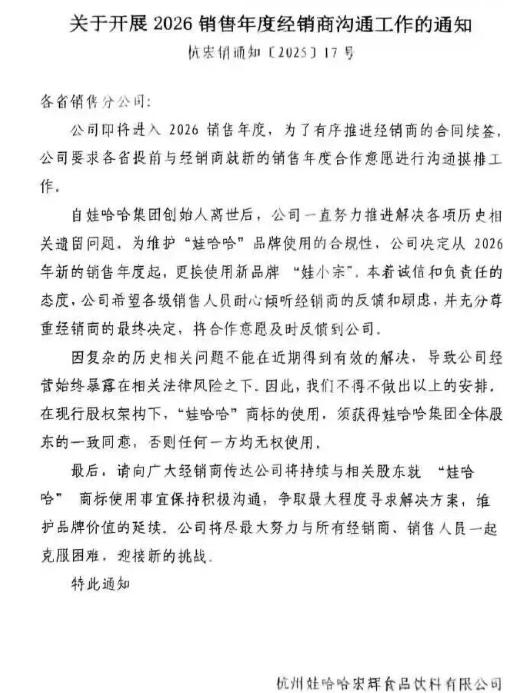
宗馥莉强推“娃小宗”,娃哈哈经销商直摇头
3 6 Ke· 2025-09-19 09:05
Core Viewpoint - The current chairman of Wahaha Group, Zong Fuli, plans to abandon the "Wahaha" brand established by her father and replace it with a new brand "Wawaizong" starting from the 2026 sales year due to ownership and trademark usage issues [1][4][6]. Group 1: Brand Transition - The decision to launch a new brand "Wawaizong" comes after the failure to transfer the "Wahaha" trademark to a company fully controlled by Zong Fuli, which would have allowed her to maintain control over the brand [6][7]. - The new brand "Wawaizong" has already seen the application for 45 trademarks covering various international categories, indicating a significant push towards establishing this new identity [9]. Group 2: Sales Challenges - Wahaha's sales have been declining, with reports indicating a drop in sales by 15% to 40% in various regions, attributed to market saturation and increased competition [12][13]. - The beverage industry is facing a downturn, with many retailers still selling stock from previous months, leading to concerns about future sales performance [11]. Group 3: Distributor Concerns - Distributors express skepticism about the new brand, fearing that consumer recognition and acceptance of "Wawaizong" will be challenging, especially in lower-tier markets where brand loyalty is strong [10][12]. - Many distributors are struggling with high inventory levels and low profit margins, with Wahaha's profit margins reported at only 10%, significantly below the industry average of 15% [22][24]. Group 4: Market Competition - The competitive landscape is intensifying, with brands like Nongfu Spring and others gaining market share through aggressive pricing and marketing strategies, further complicating Wahaha's position [19][28]. - The introduction of low-cost alternatives in the market has led to price wars, making it difficult for Wahaha to maintain its pricing structure and market presence [14][19]. Group 5: Internal Challenges - The company is facing internal challenges, including a complex product line that lacks focus, which hinders its ability to adapt to market changes effectively [36][37]. - The shift in strategy towards larger distributors has created instability in the distribution network, leading to fears among smaller distributors about their future viability [30][32].
饮料乳品板块9月19日涨0.14%,天润乳业领涨,主力资金净流出1.57亿元
Zheng Xing Xing Ye Ri Bao· 2025-09-19 08:47
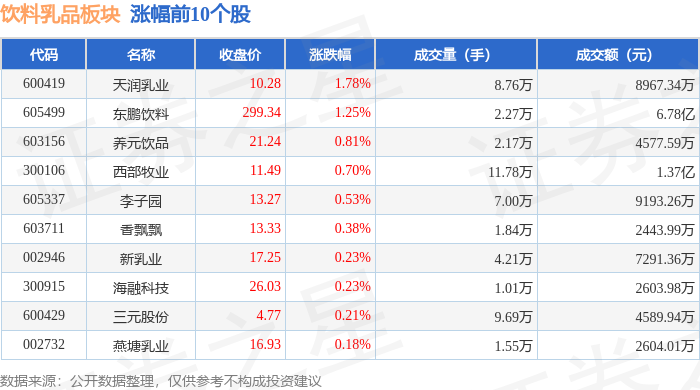
Market Overview - The beverage and dairy sector increased by 0.14% on September 19, with Tianrun Dairy leading the gains [1] - The Shanghai Composite Index closed at 3820.09, down 0.3%, while the Shenzhen Component Index closed at 13070.86, down 0.04% [1] Stock Performance - Tianrun Dairy (600419) closed at 10.28, up 1.78% with a trading volume of 87,600 shares and a transaction value of 89.67 million yuan [1] - Dongpeng Beverage (605499) closed at 299.34, up 1.25% with a trading volume of 22,700 shares and a transaction value of 678 million yuan [1] - Yangyuan Beverage (603156) closed at 21.24, up 0.81% with a trading volume of 21,700 shares and a transaction value of 45.78 million yuan [1] - Other notable stocks include Xibu Muye (300106) at 11.49 (+0.70%) and Liziyuan (605337) at 13.27 (+0.53%) [1] Capital Flow - The beverage and dairy sector experienced a net outflow of 157 million yuan from institutional investors, while retail investors saw a net inflow of 138 million yuan [2] - The overall capital flow indicates a mixed sentiment, with institutional investors withdrawing funds while retail investors are actively buying [2] Individual Stock Capital Flow - Dongpeng Beverage saw a net inflow of 72.40 million yuan from institutional investors, while it experienced a net outflow of 51.02 million yuan from speculative funds [3] - Xibu Muye had a net inflow of 20.37 million yuan from institutional investors, but a net outflow of 2.29 million yuan from retail investors [3] - Tianrun Dairy had a net inflow of 4.29 million yuan from institutional investors, with a net outflow of 5.49 million yuan from retail investors [3]



政策聚焦内需,茅台动销好转!消费ETF(159928)探底回升翻红,盘中再获5400万份净申购!港股通消费50ETF(159268)涨超1%!
Xin Lang Cai Jing· 2025-09-19 08:21
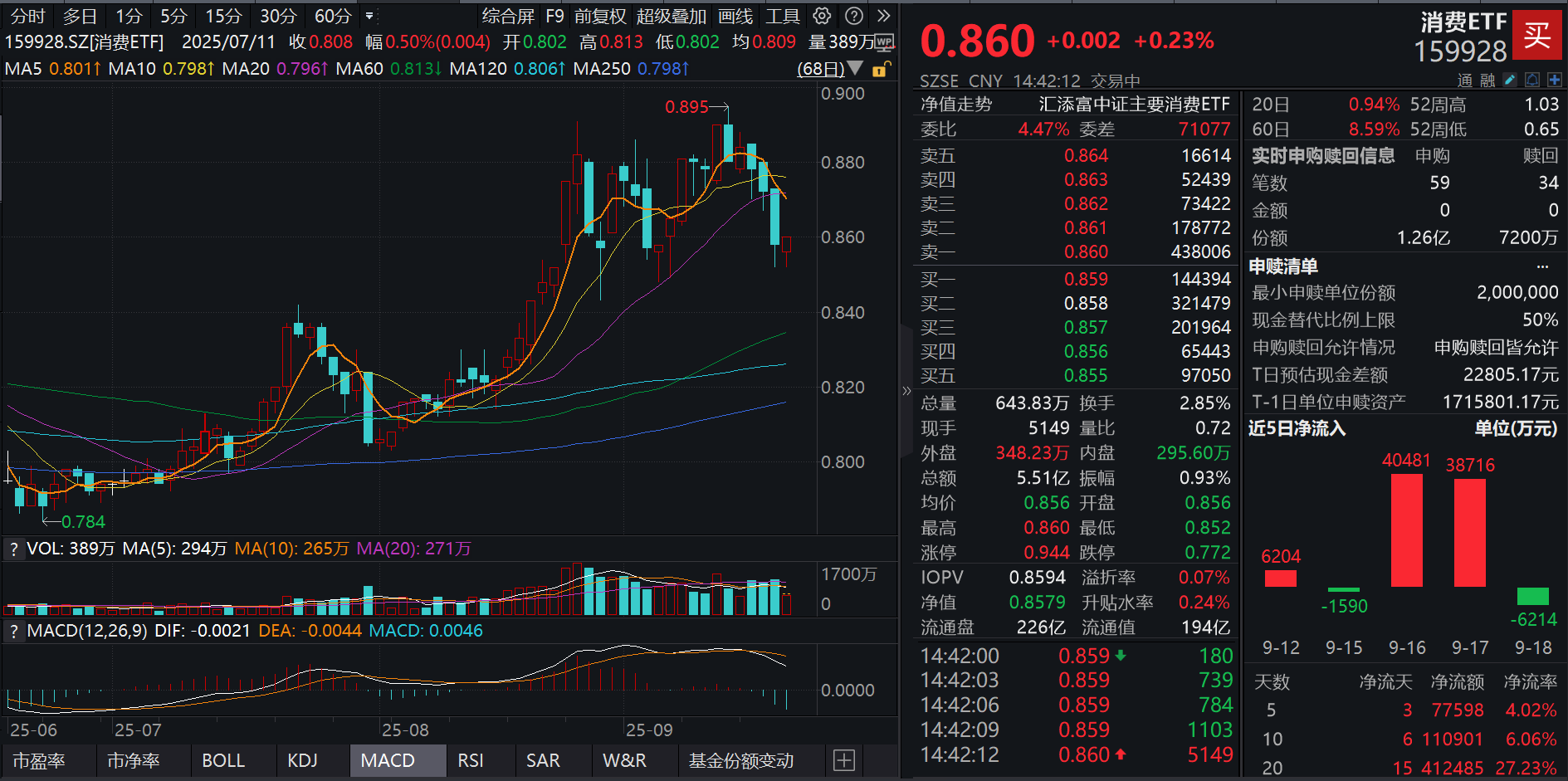
Group 1 - The consumer sector is showing signs of recovery, with the Consumption ETF (159928) gaining 0.23% and achieving a trading volume exceeding 560 million yuan, alongside a net subscription of 54 million units [1] - The Consumption ETF (159928) has reached a scale of over 19.7 billion yuan, leading its peers significantly [1] - The Hong Kong Stock Market's Consumption 50 ETF (159268) rose over 1%, with a trading volume exceeding 30 million yuan, and has seen net inflows for three out of the last five days, accumulating over 2.9 million yuan [3] Group 2 - High-level policies are focusing on boosting domestic demand, with measures implemented from 2023 to 2025 effectively stimulating consumption potential, leading to a steady increase in retail sales [5] - The pet food market is projected to reach 166.8 billion yuan in 2024, growing by 7.54% year-on-year, with cat food dominating the segment [5] - The beauty and skincare market is expected to surpass 430 billion yuan in retail sales by 2024, driven by consumer upgrades and a focus on product efficacy [5] Group 3 - The new-style tea beverage market in China is projected to exceed 400 billion yuan by 2028, with strong consumer demand driving the upstream industry [6] - The secondary dimension derivative market is experiencing rapid growth, expected to reach 168.9 billion yuan in 2024, with a significant portion of users from Generation Z [6] Group 4 - The liquor sector is entering a peak season, with improved sales performance reported by Moutai, and companies are innovating products and seeking channel reforms [7] - The dairy product sector is showing marginal improvements, while the beverage sector is performing well with new product launches [8] - The Consumption ETF (159928) has a significant weight in top stocks, with over 68% of its top ten holdings, including major liquor brands and dairy companies [8]
民生证券:大众品板块分化依旧 把握结构性景气
Zhi Tong Cai Jing· 2025-09-19 03:21
Group 1: Beer Sector - The beer sector shows ongoing industry differentiation, with a recommendation for Yanjing Beer and Zhujiang Beer due to their relatively strong fundamentals and performance potential [1][2] - Yanjing Beer benefits from steady reforms and improved operational efficiency, leading to a more pronounced profit alpha [2] - China Resources Beer is highlighted as a national leader with a favorable operating cycle, expected to continue outperforming the industry despite external pressures [2] Group 2: Seasoning and Food Supply - The seasoning and food supply sector is under pressure due to weakened downstream restaurant demand, with some companies performing better due to new products and channel expansions [4] - Cost reductions in key raw materials like soybeans and sugar have positively impacted profit margins for companies like Haitian and Angel Yeast [4] - The industry is expected to see growth if restaurant demand recovers, allowing leading companies to capture more market share [4] Group 3: Snack Foods - The snack food sector is experiencing increased internal differentiation, with companies that create hit products and leverage quality channels showing strong revenue performance [1][5] - Companies like Yanjing and Youyi Foods are capitalizing on structural category benefits and new channel opportunities, particularly in membership-based and bulk sales channels [5] - The sector is advised to focus on new product development and market share growth, with recommendations for companies like Angel Yeast and Baba Foods [4][5]
大众品板块2025年中报业绩综述:分化依旧,把握结构性景气
Minsheng Securities· 2025-09-18 13:45
Investment Rating - The report provides a positive investment rating for the low-alcohol and beverage sectors, recommending specific companies based on their performance and market positioning [2]. Core Insights - The report emphasizes the structural recovery in the consumer goods sector, highlighting the importance of channel dynamics and product innovation in driving growth [2][25]. - It identifies key players in the beer segment, such as Yanjing Beer and Zhujiang Beer, which are expected to outperform due to their strong regional presence and operational efficiency [2][11]. - The report also notes the challenges faced by the seasoning and food supply sectors, particularly due to weak downstream demand, but suggests potential for recovery as the restaurant industry stabilizes [2][26]. Summary by Sections Beer Sector - The beer sector experienced a revenue of 41.73 billion yuan in the first half of 2025, with a year-on-year growth of 2.8% [7]. - Major companies like Qingdao Beer and China Resources Beer showed mixed performance, with Qingdao Beer achieving a revenue increase of 1.9% [11][12]. - The report highlights the impact of channel structure on revenue performance, with companies like Yanjing and Zhujiang benefiting from a higher proportion of non-immediate sales channels [11][12]. Yellow Wine Sector - The yellow wine sector reported a revenue of 1.93 billion yuan in the first half of 2025, reflecting a year-on-year growth of 3.4% [26]. - Kuaijishan, a leading player, achieved a double-digit growth rate of 11% in the same period, driven by its high-end and youth-oriented strategies [26][27]. - The report indicates a trend of market share concentration among leading companies, with Kuaijishan and Guyue Longshan capturing a larger portion of the market [31]. Seasoning and Food Supply Sector - The seasoning and food supply sector faced revenue pressure due to weak restaurant demand, but companies that successfully launched new products or expanded channels showed resilience [2][26]. - The report suggests that a recovery in restaurant demand could lead to increased supply chain needs, benefiting leading companies in the sector [2][26]. Beverage Sector - The beverage sector is highlighted for its high growth potential, particularly for companies like Dongpeng Beverage, which is expanding its national presence [2]. - The report recommends focusing on companies that are effectively navigating the competitive landscape and capitalizing on emerging consumer trends [2][26].