
零跑汽车

Search documents
推进全球化布局 零跑汽车提前完成年度目标
Zhong Guo Qing Nian Bao· 2025-12-11 01:41
Core Insights - Leap Motor's founder and CEO Zhu Jiangming announced that by 2026, the company will have all four series (A, B, C, D) in place, along with four new vehicle launches [2] - The launch of the Lafa5 electric sports sedan at a price range of 92,800 to 116,800 yuan has attracted significant consumer attention, reflecting Leap Motor's strategic thinking in a competitive market [2][3] - Leap Motor achieved a net profit of 150 million yuan and revenue of 19.45 billion yuan in Q3, marking nearly a 100% year-on-year growth, and has already met its annual sales target of 500,000 units ahead of schedule [2][4] Product Strategy - The Lafa5 represents a new product strategy for Leap Motor, targeting young consumers seeking individuality, contrasting with previous practical models [3] - Leap Motor's self-reflective approach, learning from past experiences like the S01, has led to systematic adjustments in product definition, pricing strategy, and market promotion [3] - The company maintains a "fully self-researched" core technology route, with a current self-research ratio of 65% for key components, aiming to increase it to 80% or higher [3][4] Global Expansion - Leap Motor's overseas sales of 44,000 units have positioned it as a "export champion" among new Chinese car manufacturers, with plans for the Lafa5 to be launched globally, particularly in Europe, by Q2 2026 [4][5] - The global market strategy includes a "global platform + regional adaptation" model, which is expected to provide sustainable growth beyond mere exports [6] Future Goals - Leap Motor has set an ambitious target of achieving annual sales of 1 million units by 2026, doubling its current target of 500,000 units [5] - The company anticipates a steady increase in market share for electric vehicles by 5%-10% in the coming year, supported by a comprehensive product matrix covering price ranges from 60,000 to 300,000 yuan [5] - The emphasis on long-term value creation over short-term expansion reflects a broader trend in the Chinese electric vehicle industry [6]



智通港股沽空统计|12月11日
智通财经网· 2025-12-11 00:26
Group 1 - The top short-selling ratios are led by China Resources Beer (80291), AIA Insurance (81299), and Anta Sports (82020), all at 100.00% [1][2] - The highest short-selling amounts are recorded for Alibaba (09988) at 1.485 billion, Tencent Holdings (00700) at 1.163 billion, and China Construction Bank (00939) at 921 million [1][2] - The highest deviation values are for China Resources Beer (80291) at 37.08%, AIA Insurance (81299) at 34.84%, and Spring Health (01858) at 34.29% [1][2] Group 2 - The top ten short-selling ratios include JD Health (86618) at 100.00%, SenseTime (80020) at 89.60%, and Lenovo Group (80992) at 87.78% [2] - The top ten short-selling amounts also feature Xiaomi Group (01810) at 914 million and Pop Mart (09992) at 826 million [2] - The top ten short-selling deviation values include Baidu Group (89888) at 32.64% and Yum China (09987) at 29.58% [2]






多款明星车型卖不动了
Di Yi Cai Jing· 2025-12-10 14:46
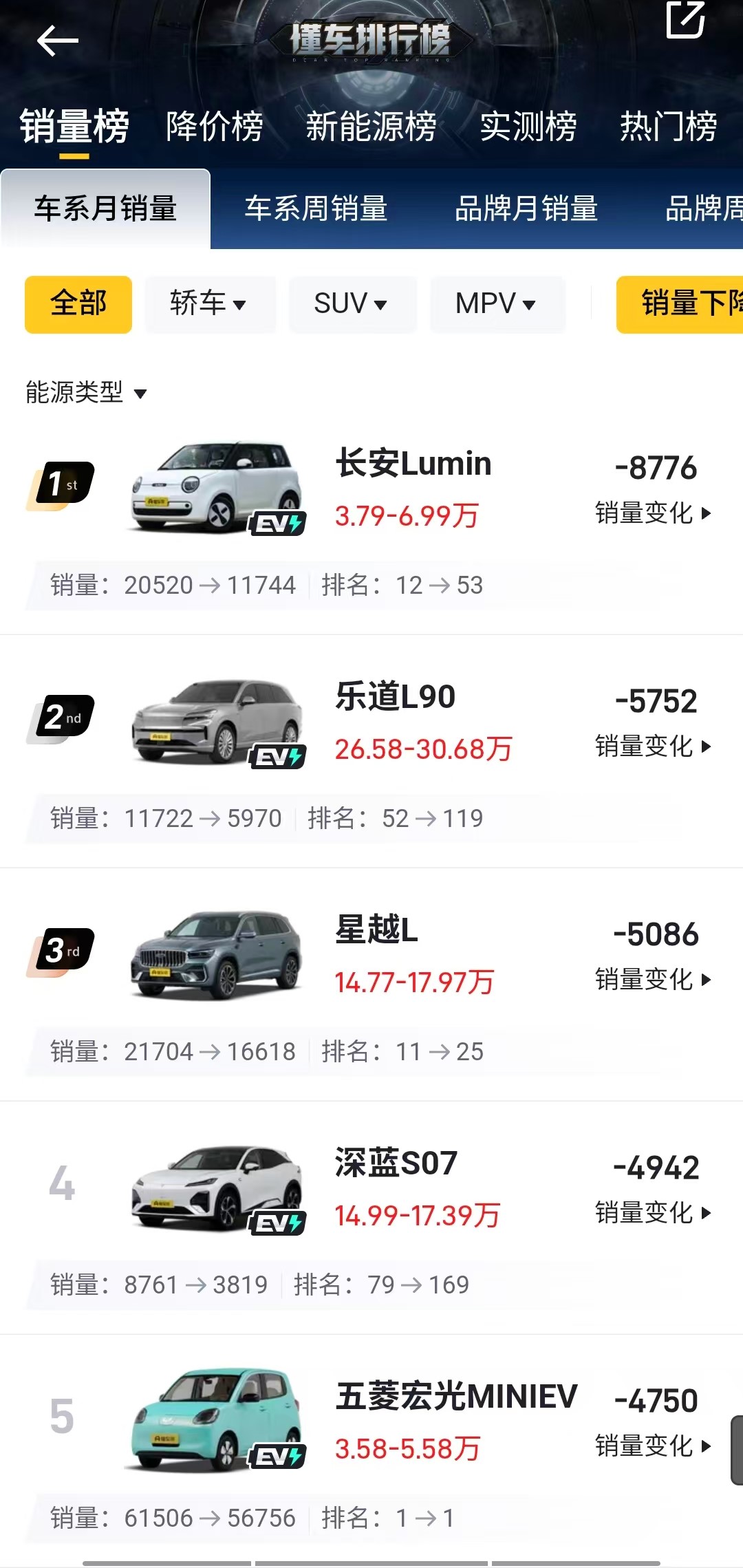
Core Insights - The automotive market in November experienced a significant downturn, with many popular models facing substantial sales declines [1][5][6] - A total of 139 models saw a decrease in sales, with 17 models dropping over 3000 units [1] - The overall retail sales of passenger vehicles in November reached 2.225 million units, marking an 8.1% year-on-year decline, which is a notable increase from the 0.5% decline in October [5] Sales Performance - Changan Lumin faced the largest sales drop, selling 11,744 units, down 8,776 units from the previous month, a decrease of 43.7%, dropping from 12th to 53rd in rankings [1] - Leado L90's sales fell below 10,000 units for the first time, with 5,970 units sold, a 49.1% drop, and its ranking fell to 119 [1][8] - Deep Blue S07's sales plummeted from 8,761 to 3,819 units, a 56.4% decline, dropping to 169th place [1][8] - Xiaomi SU7's sales decreased to 12,520 units, down 48.7% from its peak of 24,410 units in July, marking four consecutive months of decline [5] Competitive Landscape - New energy vehicle models like Leap Motor C11 and C16 also saw sales declines, but the new model Lafa5 achieved 7,397 units in its launch month [5] - NIO's ES8 saw an increase in deliveries to 10,689 units, up 3,986 units from the previous month [5] - The market is expected to face even more intense competition in 2026 as the industry undergoes a significant shakeout [6]
汽车行业跟踪报告:11月乘用车市场优惠力度持续减弱
GUOTAI HAITONG SECURITIES· 2025-12-10 13:20
股票研究 /[Table_Date] 2025.12.10 11 月乘用车市场优惠力度持续减弱 [Table_Industry] 汽车 ——汽车行业跟踪报告 | [姓名table_Authors] | 电话 | 邮箱 | 登记编号 | | --- | --- | --- | --- | | 刘一鸣(分析师) | 021-23154145 | liuyiming@gtht.com | S0880525040050 | | 张觉尹(分析师) | 021-23185705 | zhangjueyin@gtht.com | S0880525040057 | | 潘若婵(分析师) | 021-23154145 | panruochan@gtht.com | S0880525110006 | 本报告导读: 11 月市场优惠力度持续减弱,行业内部结构性分化加剧。我们维持行业"增持"评 级。 投资要点: [Table_Report] 相关报告 汽车《优必选与卓世科技达成战略合作,众擎发 布 T800》2025.12.08 汽车《线控转向相关国标发布,产业迎来重要助 推》2025.12.07 汽车《零跑 Lafa 5 上市,海 ...
盘点2025:造车新势力盈利能力大揭秘
Xin Lang Cai Jing· 2025-12-10 10:52
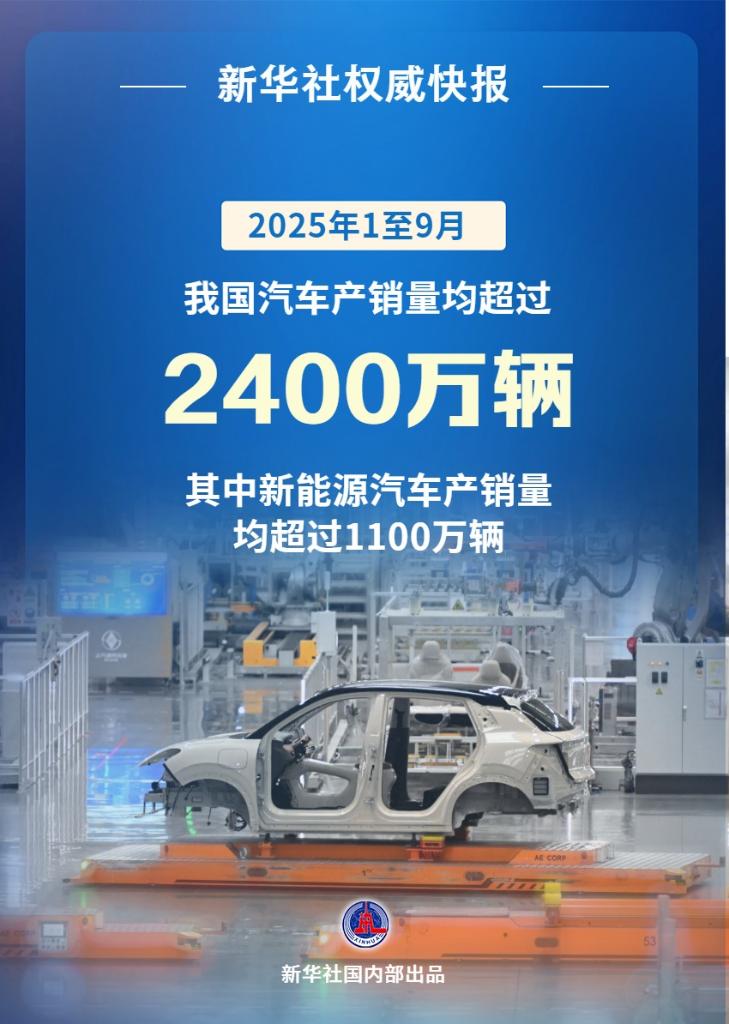
文|新能源观 2025年前9个月,我国新能源汽车产销量便双双突破千万辆,再次迎来了一个历史性的转折点。 图/2025年1-9月新能源车产销双超1100万辆 几乎是在同一个时间节点,昔日"卖一辆亏一辆"的新造车品牌们,或扭亏为盈或亏损大幅收窄,并向盈利发起猛攻。 近期,头部新造车品牌披露的三季报显示,除了率先实现盈利的理想汽车出现了短期承压、由盈转亏的情况,其他几位头部玩家的财报都相对亮眼。 其中,零跑汽车在2025年上半年成功扭亏为盈后,三季度持续盈利;小米汽车在三季度斩获了首季盈利;小鹏和蔚来虽然仍处于亏损当中,但亏损大幅收 窄,并多次明确2025年四季度为盈利冲刺节点。 从"烧钱换市场"到"价值创造"的跨越,新造车品牌们似乎正在告别持续亏损的阵痛期。而这背后,是技术自研与产品布局的双重突破。 1. 新造车头部企业摆脱"越卖越亏"魔咒? "一季度每卖一辆车亏损4.9万元,二季度每卖一辆车亏损6.39万元""平均每卖一辆车亏超8万元""每个季度亏损约50亿元"……昔日,"卖一辆亏一辆,卖得越 多亏得越多"被看成是新造车品牌们最大的标签之一。 然而,随着新能源汽车产销规模的不断突破,以及市场渗透率的进一步提升, ...


信邦智能(301112) - 2025年12月10日投资者关系活动记录表
2025-12-10 09:52
Group 1: Company Overview and Acquisition - The target company, Indichip Micro, specializes in automotive-grade mixed-signal chips, with cumulative shipments exceeding 350 million units since its establishment in 2017 [1] - The acquisition aims to enhance the company's position in the automotive chip sector, which is characterized by rapid growth and low domestic replacement rates [5] - The target company generated revenue of 584 million CNY in 2024, with automotive-grade chip revenue accounting for 551 million CNY, representing over 90% of total revenue [2] Group 2: Revenue Composition and Market Demand - The target company's revenue for the reporting period was 494.04 million CNY, 584.15 million CNY, and 385.31 million CNY, with automotive-grade chips being the primary revenue driver [2] - The increasing penetration of the target company's products in the market is expected to sustain revenue growth, driven by rising demand from electric vehicle manufacturers [2] Group 3: Client Base and Market Position - Indichip Micro's products are utilized in over a hundred vehicle models, serving major domestic brands like BYD, SAIC, and Geely, as well as international brands such as Volkswagen and Ford [3] - The company has established a competitive edge in domestic chip production, filling gaps left by foreign manufacturers in the automotive lighting control chip market [4] Group 4: Strategic Benefits of the Acquisition - The acquisition is anticipated to create synergies between the acquirer and the target, optimizing asset quality and enhancing operational resilience [5] - The target company has a strong customer base in the domestic automotive sector, which can help the acquirer expand its market presence and improve customer retention [5]
ATFX:港股缩量震荡寻方向,美联储决议成反弹契机?
Sou Hu Cai Jing· 2025-12-10 08:31
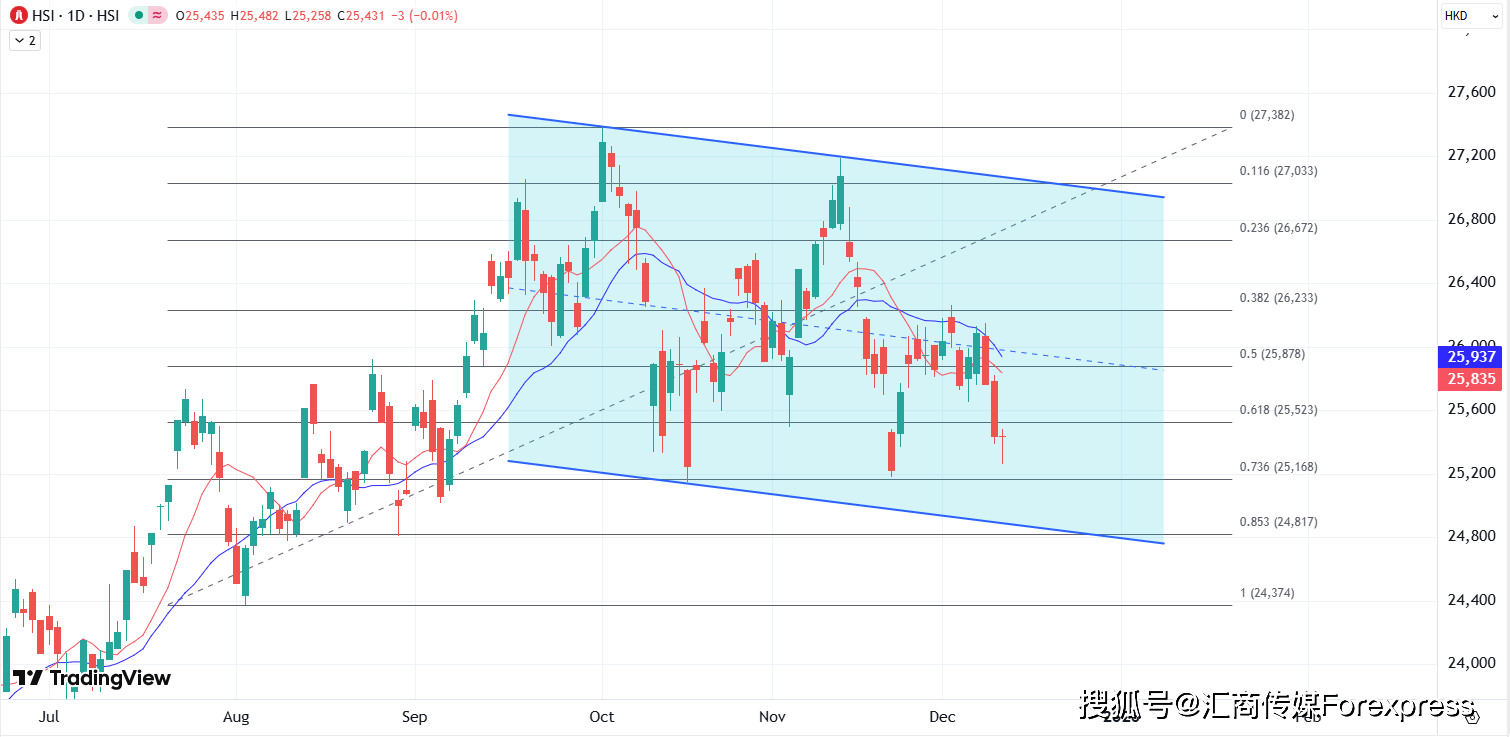
Group 1 - Hong Kong stocks experienced a decline, with the Hang Seng Index dropping 109 points or 0.43% to 25,325 points amid mixed performances from major tech stocks [1] - Alibaba (09988) aims to develop a super app through its newly established C-end business group, resulting in a 0.6% increase in its stock price [1] - Semiconductor stocks faced downward pressure, with SMIC (00981) down 1.7% and ASMPT (00522) down 3.2%, while the U.S. government allows NVIDIA to export H200 AI chips to China, but the Chinese government reportedly plans to restrict access to these chips [1] Group 2 - Automotive stocks showed weakness, with BYD (01211) down 1.1% and NIO (09866) down 2.8%, while Geely (00175) plans to secure a $420 million syndicated loan for the privatization of Zeekr, leading to a 0.9% increase in its stock price [2] - Shipping stocks saw significant declines, with the Baltic Dry Index (BDI) hitting a near two-week low, causing Orient Overseas International (00316) to drop 5.6% [2] - Pharmaceutical stocks were mixed, with China National Pharmaceutical Group (01177) and others declining by 2.5% to 3.3%, while Fosun Pharma (02196) rose by 3.8% [2] Group 3 - The Hong Kong market sentiment has turned cautious as southbound trading has been shrinking, with the upcoming Central Economic Work Conference expected to provide further guidance [3] - The Federal Reserve's interest rate decision is anticipated to impact Hong Kong stocks, with potential support for the market if a hawkish stance is not adopted [3]
“零跑现象”获央视点赞:中国车企出海2.0时代的破局者
Zhong Guo Qi Che Bao Wang· 2025-12-10 03:42
Core Insights - Leap Motor, defined as an "industry dark horse," has achieved significant milestones in the Chinese electric vehicle market, including being the top-selling new energy vehicle brand for nine consecutive months and doubling its sales year-on-year in Q3 [2][3] - The company's success is attributed to its comprehensive self-research strategy and innovative overseas expansion model, providing a new template for high-quality internationalization of Chinese car manufacturers [2][3] Group 1: Market Position and Strategy - The Chinese electric vehicle market is entering a "淘汰赛" (elimination round) phase, with leading brands engaging in price wars and new entrants facing funding and technology challenges [3] - Leap Motor's breakthrough is not merely due to sales growth but is a result of its long-term commitment to a comprehensive self-research strategy and a healthy business model [3][5] - Unlike many new entrants that focus on supply chain integration for quick monetization, Leap Motor's self-research approach creates a unique core barrier, covering essential hardware and software systems [5] Group 2: Financial Performance - In Q3, Leap Motor achieved a net profit of 150 million yuan and a gross margin of 14.5%, demonstrating that its growth is based on sound business logic rather than merely "burning cash" for volume [5] - The company has 33.92 billion yuan in available funds, indicating a robust financial position that supports its growth strategy [5] Group 3: Product and Technology Validation - The popularity of multiple models, including the C10, T03, and B10, serves as market validation of Leap Motor's technological capabilities, with the B10 recognized as a benchmark in the smart SUV segment [7] - Leap Motor has exceeded its annual target of 500,000 units and aims for one million units by 2026, showcasing its sustainable growth potential [7] Group 4: Overseas Expansion - Leap Motor's rapid overseas expansion is characterized by innovative cooperation models and high-quality channel layouts, differentiating it from traditional Chinese car manufacturers [8][10] - The company has established over 800 stores in 35 countries within just over a year, leveraging a strategic partnership with Stellantis to integrate resources across the supply chain [10] - Leap Motor's overseas outlets serve as comprehensive service centers, enhancing customer trust and market penetration, particularly in Europe [11] Group 5: Global Recognition and Market Entry - In November 2025, Leap Motor received 15,000 export orders, marking a significant milestone in the global recognition of Chinese automotive brands [14][16] - The B10 model has achieved Euro NCAP five-star certification, surpassing EU standards in key safety metrics, which has facilitated its entry into the competitive European market [16] - Leap Motor's user base in Europe consists primarily of mid-to-high-end consumers, indicating a shift in the brand's market perception and positioning [17] Group 6: Future Outlook - With plans for localized production in Malaysia and Europe by 2026, Leap Motor aims to reduce costs and respond quickly to regional market demands [13][22] - The company's experience highlights the importance of a technology-driven approach, user-centric focus, and innovative business models for Chinese car manufacturers to establish a foothold in the global market [22]

凯众股份(603037):收购拓盛提升盈利增长,聚氨酯开始机器人领域新应用
NORTHEAST SECURITIES· 2025-12-10 03:24
Investment Rating - The report initiates coverage with an "Accumulate" rating for the company [4][5] Core Views - The acquisition of Anhui Tuosheng will enhance profitability and expand the product delivery capabilities in the automotive NVH (Noise, Vibration, and Harshness) sector [2][3] - The company is a leader in the polyurethane buffer block market, holding a 36% market share, and aims to build a comprehensive product matrix by integrating rubber-based elastomers through this acquisition [2][3] - The company is also exploring new applications for polyurethane materials in the robotics field, which could open additional revenue streams [3] Financial Summary - The company reported revenues of 4.87 billion, 6.10 billion, and 5.49 billion for Q1-Q3 of 2023, 2024, and 2025 respectively, with net profits of 0.42 billion, 0.59 billion, and 0.47 billion, reflecting net profit margins of 8.6%, 9.7%, and 8.5% [2] - Projected revenues for 2025-2027 are estimated at 8.30 billion, 9.77 billion, and 11.49 billion, with corresponding net profits of 0.89 billion, 1.10 billion, and 1.40 billion [3] - The company’s PE ratios are projected to be 39.73, 32.07, and 25.26 for 2025, 2026, and 2027 respectively [3] Market Position - The company’s automotive damping components account for 65% of total revenue, primarily from polyurethane buffer blocks and top supports used in automotive suspension systems [2] - The company has established a supply chain presence with major domestic automakers including BYD, SAIC-GM, Geely, and others [2]

政策补贴推动乘用车销量结构化增长
Jin Rong Shi Bao· 2025-12-10 02:01
Group 1 - In November, the retail sales of passenger cars in China reached 2.225 million units, a year-on-year decrease of 8.1% and a month-on-month decrease of 1.1%. Cumulatively, retail sales for the year reached 21.483 million units, an increase of 6.1% year-on-year [1] - Passenger car exports in November were 601,000 units, marking a year-on-year increase of 52.4% and a month-on-month increase of 9.1%. For the first 11 months of the year, exports totaled 5.151 million units, up 17.2% year-on-year [1] Group 2 - In November, the penetration rate of new energy vehicles (NEVs) in the domestic passenger car retail market reached 59.3%, an increase of 7 percentage points year-on-year, setting a new historical high. This growth is attributed to policies such as trade-in subsidies and exemption from purchase tax for NEVs [2][3] - The sales of pure electric vehicles have outpaced those of plug-in hybrid and range-extended models, primarily due to the impact of "two new" policies promoting high-cost performance pure electric models. In November, sales of plug-in hybrids and range-extended models declined [2] Group 3 - In November, BYD led the passenger car retail market with sales of 307,000 units, followed by Geely with 268,000 units, and FAW-Volkswagen with 138,000 units. Other brands like Chery, Changan, and SAIC-GM-Wuling also exceeded 100,000 units in sales [2] - Domestic brands accounted for nearly 70% of the market share this year, with German brands experiencing the fastest decline. BYD, Geely, and Chery ranked the top three in incremental sales, while brands like Leap Motor and Xpeng saw significant growth [3] Group 4 - The automotive market is not experiencing the typical seasonal sales increase at year-end, primarily due to the reduction of replacement subsidies, leading many consumers to purchase vehicles earlier [4] - In the high-end market, domestic brands have the potential to capture a larger share. For the mass market, overseas sales appear to be a key channel for profit growth [4] Group 5 - Chinese automotive brands are expected to see significant growth in emerging markets, particularly in Southeast Asia and Latin America, with brands like BYD leading in sales in Indonesia [5] - Localization of production is becoming essential for Chinese automotive companies as they expand globally. Starting in 2025, domestic brands will accelerate overseas production capacity, transitioning from single product exports to localized production and global services [6]

