蔚来

Search documents
车企2025年产销量放榜 突破多个“里程碑”
Zheng Quan Shi Bao Wang· 2026-01-04 14:38
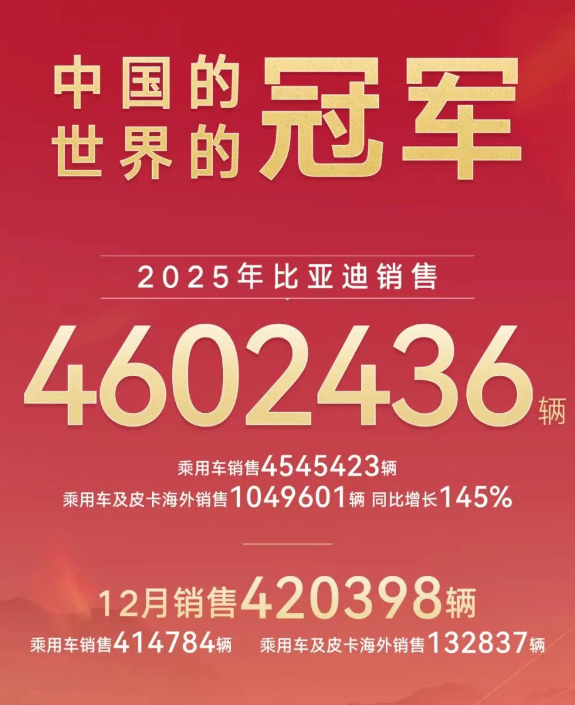
Core Insights - Major automotive companies in China, including BYD, Changan Automobile, and Geely, reported significant sales growth for 2025, with a notable increase in overseas sales and milestones achieved by new energy vehicle manufacturers [1][2][5][7]. BYD - BYD's total sales for 2025 reached 4.6024 million units, a year-on-year increase of 7.73%, with pure electric vehicle sales growing nearly 28% and commercial vehicle sales increasing by approximately 162% [2]. - BYD's overseas exports of new energy vehicles totaled 133,200 units in December 2025, with annual overseas sales surpassing 1 million units, reflecting a 145% year-on-year growth [4]. - The total installed capacity of BYD's power batteries and energy storage batteries was approximately 285.634 GWh, marking a nearly 47% increase from the previous year [4]. Changan Automobile - Changan's total sales for 2025 reached 2.913 million units, a year-on-year growth of 8.54%, with self-owned brand sales increasing by 10.86% and new energy vehicle sales growing by about 50% [5]. BAIC Blue Valley - BAIC Blue Valley achieved significant production and sales growth, with total production reaching 206,300 units, a year-on-year increase of 127.17%, and total sales of 209,600 units, up 84.06% [6]. Geely Automobile - Geely's total vehicle sales for 2025 were 3.0246 million units, a 39% increase compared to the previous year, exceeding its annual sales target [7]. - Geely set a sales target of 3.45 million units for 2026, representing a growth of approximately 14% from 2025, with a new energy vehicle sales target of 2.22 million units, up 32% [7]. NIO - NIO reported a delivery of 48,100 units in December 2025, a year-on-year increase of 54.6%, with total deliveries for the year reaching 326,000 units, up 46.9% [8]. Li Auto - Li Auto delivered 44,200 new vehicles in December 2025, with a historical cumulative delivery surpassing 1.5 million units, expanding its market presence in Central Asia and Africa [9]. XPeng - XPeng delivered 37,500 smart electric vehicles in December 2025, with total annual deliveries of 429,400 units, reflecting a year-on-year growth of 126% [10]. - The company expanded its overseas market presence with 45,000 units delivered abroad, a 96% increase, and established 1,100 new charging stations, bringing the total to 3,000 [10].




车企2025“年终考”成绩单出炉
Mei Ri Jing Ji Xin Wen· 2026-01-04 14:21
Core Insights - The 2025 Chinese automotive market showcased a "stronger getting stronger, increasing differentiation" trend amid deepening new energy transitions and intense industry competition [1] Group 1: Performance of Leading Companies - BYD achieved sales of 4.6024 million vehicles in 2025, with overseas sales surpassing 1 million for the first time, marking a 145% year-on-year increase in passenger and pickup truck sales [2] - BYD's pure electric vehicle sales reached 2.2567 million units, a nearly 28% increase, surpassing Tesla's 1.636 million units, making BYD the global leader in annual electric vehicle sales [2] - Geely also exceeded its annual sales target, achieving 3.0246 million units sold, a 39% year-on-year increase, with new energy vehicle sales reaching 1.6878 million units, up 90% [2] Group 2: Performance of Other Companies - Dongfeng Motor achieved its dual target of over 1 million new energy vehicles and 1.5 million total vehicle sales, with new energy vehicle sales reaching 1.04 million, a 21% increase [3] - Changan Automobile reported sales of 2.913 million vehicles, a growth of 8.5%, with new energy vehicle sales of 1.109 million, up 51% [5] - Chery Group sold 2.8064 million vehicles, a 7.8% increase, with new energy vehicle sales reaching 903,800 units, a 54.9% increase [5] Group 3: Underperformance of Certain Companies - China FAW achieved a total vehicle sales of 3.302 million, a 3.2% increase, but fell short of its target of 3.45 million [4] - Great Wall Motors reported sales of 1.3237 million vehicles, a 7.33% increase, but only achieved 33.09% of its 4 million target [5][6] - New energy vehicle sales for Great Wall reached 403,700 units, a 25.44% increase, but the overall performance was below expectations [5][6] Group 4: New Forces in the Market - Among new forces, Leap Motor, Xiaomi, and Xpeng all exceeded their annual sales targets, with Leap Motor achieving 596,600 units sold, marking a 119.3% target completion rate [7] - Xiaomi's vehicle deliveries surpassed 50,000 in December 2025, exceeding its annual target of 350,000 [7] - NIO and Li Auto, however, did not meet their targets, with NIO selling 326,000 units and Li Auto selling 406,300 units, both falling short of their respective goals [8][9]


周观点 | 2025销量圆满收官 2026关注新国补落地节奏【国联民生汽车 崔琰团队】
汽车琰究· 2026-01-04 14:18
Market Performance - The automotive sector outperformed the market this week, with a 1.9% increase, ranking 4th among Shenwan sub-industries, surpassing the CSI 300 by 1.8 percentage points [1] - Within the sub-sectors, automotive parts, commercial passenger vehicles, motorcycles and others, and commercial freight vehicles rose by 3.8%, 0.4%, 0.2%, and 0.1% respectively, while passenger vehicles and automotive services fell by 1.3% and 2.3% [1] Investment Recommendations - Recommended core stocks include Geely Automobile, Xpeng Motors, BYD, Berteli, Top Group, New Spring Co., Hu Guang Co., and Chunfeng Power [2][11] - For passenger vehicles, recommended stocks are Geely Automobile, Xpeng Motors, and BYD, with a focus on Jianghuai Automobile [5] - In the parts sector, recommendations include intelligent driving companies like Berteli, Horizon Robotics, and Kobot, as well as new force industry chains such as H chain (Xingyu Co., Hu Guang Co.) and T chain (Top Group, New Spring Co., Shuanghuan Transmission) [5][24] Robotics Sector - Huawei increased its investment in humanoid robots, with Dongguan Jimu Robotics Co., Ltd. raising its registered capital from 3.89 billion to 4.69 billion yuan, focusing on key technologies like machine vision and natural language processing [3][11] - The production progress and technological iteration of Tesla remain core themes, with domestic robot manufacturers like Yushut Technology expected to enter the IPO stage soon, potentially catalyzing the sector [3][11] Policy Impact on Demand - The new national subsidy policy for 2026 aims to stimulate domestic demand, transitioning from a fixed subsidy model to a flexible mechanism based on vehicle price [4][12] - The policy is expected to improve the structure of subsidized models, activating demand for mid-to-high-end vehicle replacements and reducing low-level price competition [4][18] Sales Performance - In December, BYD, Geely, and Changan ranked as the top three automakers by sales, with respective sales of 420,398, 255,000, and 236,817 units, showing a year-on-year change of -18.3%, +1.6%, and +12.7% [4][19] - New energy vehicle sales are projected to benefit from the new subsidy policy, with a focus on the sales targets set by Geely, Zero Run, and Xiaomi for 2026 [19][20] Motorcycle Market - The large-displacement motorcycle market is expanding rapidly, with sales of 250cc and above motorcycles reaching 61,000 units in November, a year-on-year increase of 11.3% [31] - Recommended companies in this sector include Chunfeng Power and Longxin General, which are leading in the large-displacement motorcycle market [31][33] Commercial Vehicle Sector - The heavy truck market saw a significant year-on-year increase of approximately 46% in November, driven by the old-for-new subsidy policy that supports the replacement of older diesel trucks [34][36] - Recommended companies in this sector include Weichai Power and China National Heavy Duty Truck Group [36] Tire Industry - The tire industry is experiencing a strong demand with high operating rates, particularly in the PCR segment, which stood at 72.05% [38] - Recommended companies include Sailun Tire and Senqilin, which are expected to benefit from the ongoing globalization and demand recovery [37][39]

结构性转变,有望推动中国股票继续上行
Zhong Guo Ji Jin Bao· 2026-01-04 14:17
Group 1 - The core viewpoint is that structural changes in the Chinese market are expected to drive continued upward momentum in Chinese stocks, particularly in technology sectors, with significant returns anticipated in 2026 [1][4]. - In 2025, the MSCI China Index saw a return rate exceeding 30%, outperforming the S&P 500's return of approximately 16.39% [1]. - Global institutions are increasingly launching China-focused ETFs, with a total of 53 ETFs listed in the U.S., amounting to approximately $31.47 billion in total assets [2]. Group 2 - The largest Chinese ETFs in the U.S. include KWEB, MCHI, FXI, CQQQ, and ASHR, with KWEB having the largest size at $8.02 billion [2]. - CQQQ was a standout performer in 2025, attracting over $2 billion in inflows, while KWEB and MCHI received inflows of approximately $1.973 billion and $871 million, respectively [2]. - The interest in non-U.S. ETFs, including those focused on China, is expected to continue growing in 2026, driven by attractive valuations compared to U.S. stocks [3]. Group 3 - UBS Wealth Management forecasts that advanced manufacturing and technology will be key growth drivers for the Chinese market in 2026, supported by increased government R&D investment [4]. - The Chinese government aims to boost R&D spending to at least 3.2% of GDP by 2030, with a compound annual growth rate of 7% [4]. - Abundant liquidity, with approximately 7 trillion RMB in household savings, is expected to flow into the stock market, particularly in sectors like cloud computing, e-commerce, and AI [5].

结构性转变,有望推动中国股票继续上行
中国基金报· 2026-01-04 14:09
Group 1 - The core viewpoint of the article is that structural changes in the Chinese market are expected to drive continued upward momentum in Chinese stocks, particularly in the technology sector, with significant inflows into ETFs tracking these stocks [2][9]. - In 2025, the MCHI index, which tracks the MSCI China Index, achieved a return rate exceeding 30%, while the S&P 500 index returned approximately 16.39% during the same period [2]. - The total scale of 53 Chinese ETFs listed in the US is approximately $31.47 billion (about 220 billion RMB), with the largest being KWEB at $8.02 billion and MCHI at $7.78 billion [4]. Group 2 - The CQQQ ETF saw over $2 billion in inflows in 2025, making it a significant winner among Chinese ETFs, while KWEB and MCHI also received substantial inflows of $1.973 billion and $871 million, respectively [4]. - The interest in non-US ETFs, including Chinese ETFs, is expected to continue growing in 2026, driven by attractive valuations compared to US stocks [7]. - UBS forecasts that advanced manufacturing and technology will be new growth engines for the Chinese economy, with R&D spending expected to grow at a compound annual growth rate of at least 7% by 2030 [9].

Weekend Round-Up: Tesla Loses EV Crown, BYD's Overseas Sales Surge And Stellantis-Backed Leapmotor Bags $530 Million Funding
Benzinga· 2026-01-04 14:01
Core Insights - Tesla has lost its position as the world's leading electric vehicle (EV) maker to BYD after experiencing a second consecutive year of declining sales [1][2] - BYD reported a significant increase in overseas deliveries despite a decline in domestic sales [1][3] Tesla's Performance - Tesla's fully electric vehicle deliveries fell by 9% in 2025, totaling 1.64 million units compared to 1.79 million in 2024 [2] - The decline is attributed to increased competition, particularly from Chinese manufacturers, and the expiration of U.S. federal EV tax credits [2] BYD's Sales Figures - BYD experienced an 18.34% year-over-year decline in December sales, with total sales of over 420,398 units [3] - However, the company saw a remarkable 133.01% year-over-year increase in overseas deliveries, selling over 133,172 units abroad [3] Rivian's Delivery Results - Rivian reported a 26.2% drop in fourth-quarter deliveries, with only 9,745 vehicles delivered compared to 13,201 in the previous quarter [4] - For the full year 2025, Rivian produced 42,284 vehicles and delivered 42,247, marking an approximately 18% year-over-year decrease from 51,579 deliveries in 2024 [4] Leapmotor's Funding - Leapmotor, backed by Stellantis, secured over $530 million in funding from the state-owned automaker FAW [5] - The CEO of Leapmotor, Zhu Jiangming, set an ambitious target of achieving 4 million annual sales by the next decade [5] Waymo's Expansion - Waymo, supported by Alphabet, has begun testing its Robotaxi service in London as part of its expansion plans into international markets [6] Nio's Record Deliveries - Nio reported a record 48,135 vehicle deliveries in December 2025, reflecting a 54.6% year-over-year increase [7] - The deliveries included 31,897 units from the NIO brand, 9,154 from the ONVO brand, and 7,084 from the FIREFLY brand [7]

汽车行业周报:2026年汽车以旧换新国补延续,比亚迪超越特斯拉成为纯电汽车全球销冠-20260104
KAIYUAN SECURITIES· 2026-01-04 13:43
Investment Rating - The industry investment rating is "Positive" (maintained) [1] Core Views - The automotive sector is expected to experience a bottom recovery due to the implementation of the vehicle trade-in policy in 2026, with BYD surpassing Tesla to become the global sales champion for pure electric vehicles [5][16] - The domestic automotive market saw significant sales growth in 2025, with BYD leading with 4.6 million units sold, a 8% increase year-on-year [5][16] - The report highlights the competitive landscape, with new energy vehicle sales driving market growth, particularly for companies like BYD and NIO [5][16] Industry News - In 2025, BYD sold 4,602,436 vehicles, maintaining its position as the top seller, while new entrants like Leap Motor and Xiaomi also showed strong sales growth [5][13] - Tesla's 2025 delivery data revealed nearly 1.64 million vehicles delivered, with a 8.6% decrease compared to the previous year [14][16] - NIO has expanded its battery swap network, aiming to build 1,000 new battery swap stations by 2026 [15] - The lithium battery industry is experiencing price increases, with demand for energy storage batteries remaining high [18] - The 2026 vehicle trade-in policy will adjust subsidies based on vehicle price, with a maximum subsidy of 20,000 yuan [19] Market Performance - The automotive sector outperformed the market with a 1.49% increase, ranking fifth among A-share industries [6][28] - The passenger vehicle index saw a decline of 1.20%, while the automotive parts index increased by 3.63% [6][28] - The report indicates a decrease in PE ratios for passenger and commercial vehicle sectors, while the automotive parts sector saw a 12% increase in PE ratios [10][12] Investment Recommendations - For passenger vehicles, the report recommends companies like JAC Motors and Seres, with beneficiaries including Geely [7] - In the automotive parts sector, companies such as Desay SV and Zhejiang Xiantong are recommended, with beneficiaries including Weichai Power and Huayu Automotive [7]
比亚迪首次全年反超特斯拉,全球纯电王座易主
3 6 Ke· 2026-01-04 12:54
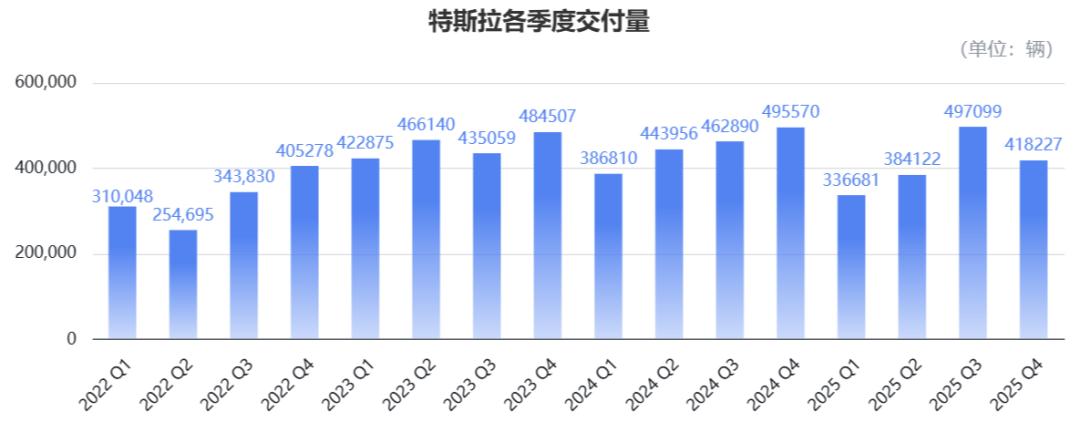
Core Insights - The global electric vehicle sales leader has shifted from Tesla to BYD, marking a significant change in the market dynamics [1][2][12] - Tesla's sales in 2025 declined, with a total of 1.655 million vehicles sold, a 9% year-over-year decrease, while BYD's sales reached 2.257 million, a 27.9% increase [7][12] Group 1: Tesla's Performance - In Q4 2025, Tesla delivered 418,227 vehicles, a 16% decline year-over-year, with Model 3/Y accounting for 406,585 units [2][5] - The decline in Tesla's sales was anticipated due to the expiration of U.S. tax incentives, leading to a surge in Q3 deliveries [5][10] - Tesla's total sales for 2025 were 1.655 million vehicles, down from 1.8086 million in 2023, marking a second consecutive year of decline [7][10] Group 2: BYD's Growth - BYD's total sales for 2025 reached 4.6 million vehicles, a 7.73% increase, with pure electric vehicle sales at 2.257 million, representing a 27.9% increase [12][24] - BYD's overseas sales surged by 145%, contributing to 22.8% of total sales [24] - This marks the first time BYD has topped the global sales chart for pure electric vehicles, surpassing Tesla's 1.636 million units [12][13] Group 3: Market Dynamics and Competitors - The competition in the electric vehicle market is intensifying, with Chinese automakers gaining significant market share [16][42] - Other notable performers include Xpeng, which saw a 125.9% increase in sales, and Li Auto, which faced an 18.8% decline [20][35] - The overall landscape indicates a shift towards a more diversified and competitive market, moving away from Tesla's previous dominance [42]

电控下半场:三年营收翻七倍的臻驱赴港IPO,但资本要的不止是规模增速
3 6 Ke· 2026-01-04 12:42
Core Viewpoint - The article discusses the competitive landscape of the electric vehicle (EV) industry, highlighting the transition from battery competition to electric control and intelligence, with a focus on the recent IPO application of Zhenjue Technology, a differentiated electric control system supplier leveraging a "Power Brick" architecture [1][2]. Group 1: Company Overview - Zhenjue Technology has submitted an IPO application to the Hong Kong Stock Exchange, aiming to capitalize on its rapid production capabilities and market position in the EV sector [1]. - The company has established a differentiated electric control system based on the "Power Brick" architecture, which integrates power modules, control logic, and thermal management to simplify assembly and enhance cross-platform reuse [2][3]. Group 2: Market Position and Product Development - Zhenjue Technology has secured contracts with 13 automakers and 50 vehicle models, indicating strong market acceptance of its products, which are used in popular models like the AITO M7 and Changan Deep Blue [3][4]. - The company has achieved significant production milestones, with its Chongqing factory producing over 100,000 units within five months of operation, demonstrating its manufacturing agility [1][6]. Group 3: Financial Performance - Zhenjue Technology's revenue surged from 160 million yuan in 2023 to 1.159 billion yuan in 2024, marking a growth of over six times, with further revenue of 1.217 billion yuan in the first nine months of 2025 [6]. - Despite revenue growth, the company continues to face losses, with figures of 237 million yuan, 335 million yuan, and 257 million yuan for the years 2023, 2024, and the first nine months of 2025, respectively [6][7]. Group 4: Strategic Initiatives - The company is expanding its business into international markets, with plans to deliver products to over 30 countries and aims for batch shipments to North America by Q3 2025 [8]. - Zhenjue Technology's strategy includes enhancing its global market presence and improving its profitability model through international sales, which typically offer higher margins [8][9]. Group 5: Competitive Landscape - The competitive environment is intensifying, with major players like BYD, Tesla, and others advancing their integrated solutions, posing challenges for Zhenjue Technology [4][9]. - Zhenjue Technology differentiates itself by focusing on system-level integration and standardization of its Power Brick architecture, positioning itself as a hybrid of an independent Tier-1 supplier and power semiconductor capabilities [10].
我们该怎样记住2025年的中国汽车?
Xin Lang Cai Jing· 2026-01-04 11:30
Core Insights - The Chinese automotive industry has undergone a significant transition in 2025, moving towards the popularization of electrification and the acceptance of safety and responsibility in intelligent driving, while the focus has shifted from expansion to efficiency, governance, and organizational capability [2][69]. Group 1: Industry Competition and Regulation - The Chinese automotive sector has seen a comprehensive intervention from the government to restore competitive order, addressing issues like price wars and production consistency [4][70]. - The intervention marks a shift from merely addressing price control to tackling the root cause of competition, which is the high degree of product and capability homogeneity among companies [6][73]. - The need for differentiation in competition is emphasized, suggesting that true market differentiation must be established to eliminate the cycle of homogeneous competition [9][75]. Group 2: State-Owned Enterprise Reform - The establishment of a new state-owned enterprise, Changan Automobile, marks a significant reform in the state-owned automotive sector, indicating a shift from scale and form to mechanisms and efficiency [10][14]. - The reform aims to enhance the capabilities of state-owned enterprises, focusing on creating irreplaceable advantages in key areas [12][14]. - The changes in state-owned enterprises reflect a broader trend towards efficiency and capability building in the face of new industry challenges [15][64]. Group 3: Intelligent Driving and Safety - The rapid adoption of intelligent driving technologies has led to a shift in focus from technical capabilities to safety and responsibility, with companies facing increased scrutiny over their marketing practices [16][18]. - A significant traffic accident in March 2025 highlighted the urgent need for clear definitions of responsibility and safety standards in intelligent driving [18][21]. - Companies like Geely are taking proactive steps to enhance safety standards, indicating a broader industry trend towards building safety as a core competency [21][23]. Group 4: Globalization and Market Dynamics - The Chinese automotive industry is increasingly viewed as a key player in global market dynamics, with companies recognizing the need for localized manufacturing and long-term partnerships abroad [44][46]. - The shift from merely exporting products to establishing a presence in foreign markets reflects a deeper understanding of the complexities of global trade [44][46]. - The evolving landscape of international relations, particularly between China and the West, is reshaping how Chinese automotive companies approach global expansion [43][48]. Group 5: Capital Market Engagement - The surge of Chinese automotive companies seeking IPOs in Hong Kong indicates a strategic reassessment of capital and risk in light of global market changes [56][58]. - The focus on stable cash flow and clear profit models is becoming essential as the industry transitions into a phase of stock competition and technological differentiation [56][58]. - The choice of Hong Kong for IPOs reflects a desire for regulatory stability and alignment with global standards, enhancing transparency and governance [58][61]. Group 6: Industry Consolidation and Efficiency - A trend of strategic consolidation is emerging, with companies prioritizing resource concentration and efficiency over brand proliferation [66][66]. - Major global automakers are also reducing operations and focusing on core competencies, indicating a broader industry recognition that scale alone may not ensure safety in a volatile market [66][66]. - The end of the expansion phase in the automotive industry signals the beginning of a more competitive environment that tests endurance, efficiency, and organizational capabilities [66][66].