美的集团

Search documents
益普索:中国品牌全球净信任度较2024年提升12个百分点
Xin Lang Cai Jing· 2025-12-24 06:39
Core Insights - The report by Ipsos indicates that the global net trust index for Chinese brands reached 32% in 2025, a significant increase of 12 percentage points compared to 2024, reflecting a continuous rise in trust levels [1] Group 1: Trust Levels - In 2025, the proportion of respondents in developed markets who expressed strong or moderate trust in Chinese brands rose to 36%, with particularly strong performance in the UK and US markets [1] - The consumer electronics sector sees Lenovo, Huawei, and Xiaomi maintaining the top three positions in the trust rankings [1] - In the smart home appliance sector, brands such as Hisense, Haier, TCL, and Midea have seen their trust indices and rankings rise in tandem [1] Group 2: AI Industry Insights - The AI sector is identified as a core area of competition between China and the US, with emerging markets like Malaysia (57%) and Qatar (51%) showing a higher willingness to purchase/use Chinese AI products compared to the US [1]
中国品牌跨越信任临界线:2025全球信任指数报告解析
Jing Ji Guan Cha Bao· 2025-12-24 06:23
Core Insights - The global trade landscape is undergoing a structural upheaval due to a new wave of tariffs, reshaping international perceptions of different countries [1] - Chinese brands are at a critical turning point in their globalization process, transitioning from mere product exports to deepening brand value and achieving global trust [1] - The "2025 China Brand Global Trust Index" report by Ipsos reveals new pathways and core opportunities for Chinese brands to build global trust [1] Global Trust Landscape - A significant transformation in the global brand trust landscape is occurring, with European and American brands declining while brands from China, Japan, and South Korea are rising [2] - 49% of global respondents believe China has a positive impact on world affairs, a 10 percentage point increase from 2024, marking the first time this figure surpasses that of the U.S. [2] - China's global net trust level for brands reached 32%, a substantial increase of 12 percentage points from 2024, while U.S. brand trust declined from 68% in 2021 to 61% in 2025 [2] Developed Markets as Key Battlegrounds - In developed markets, the net trust in Chinese brands has turned positive for the first time, with 36% of respondents expressing trust, a 6 percentage point increase from 2024 [3] - Trust levels in the UK rose from 29% in 2021 to 49% in 2025, while the U.S. reached 48%, also a 6 percentage point increase [3] - In emerging markets, the net trust in Chinese brands soared to 51%, a 13 percentage point increase from 2024, with Nigeria and Egypt leading globally [3] Benchmark Brands Leading Trust Upgrade - Chinese benchmark brands are showing strong global trust performance, particularly in the consumer electronics sector, with Lenovo, Huawei, and Xiaomi leading the rankings [4] - The purchase intent for Chinese consumer electronics brands reached 40%, surpassing that of U.S. (38%) and South Korea (34%) [4] - Smart home appliance brands like Hisense and Haier are also seeing trust growth, bolstered by technological innovation and global expansion [4] Automotive and E-commerce Industry Insights - The automotive sector is significantly influenced by the country of origin effect, with Chinese brands' purchase intent at 30%, trailing behind Japanese and German brands [5] - E-commerce platforms are experiencing a decline in overall trust index due to tariff fluctuations, but Temu's recognition surged, moving from 29th to 20th place [5] - The AI sector is emerging as a competitive core area, with countries like Malaysia and Qatar showing higher purchase intent for Chinese AI products than the U.S. [5] Trust Drivers and Market Strategies - Trust drivers for Chinese brands have diversified, with "providing high-quality products/services" remaining the top factor at 10.9% [6] - In developed markets, relationship-oriented factors are prioritized, while emerging markets focus more on product and environmental dimensions [6] - Social media advertising is the primary channel for brand marketing, with a global reach of 59%, particularly effective in emerging markets [7] Conclusion - As the global trust landscape is restructured, Chinese brands are positioned at a new historical starting point, transitioning from product output to brand credibility [8] - The future success of Chinese brands hinges on long-term strategies, high-quality products, ESG practices, and localized approaches to deepen global trust [8]
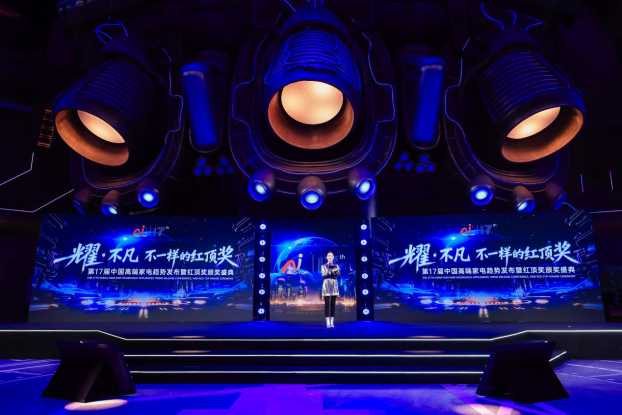
红顶奖“耀・不凡”盛典收官 定义2025高端家电新趋势
Zhong Guo Zhi Liang Xin Wen Wang· 2025-12-24 06:12
Core Insights - The 17th China High-End Home Appliance Trend Release and Red Top Award Ceremony emphasizes the theme "Shining Extraordinary," reflecting the commitment to promoting quality living and guiding consumer trends in the high-end home appliance sector [1] Group 1: Event Overview - The Red Top Award, a significant accolade in the high-end home appliance industry, aims to enhance quality living and consumer trends [1] - The event featured numerous well-known home appliance companies such as Haier, Midea, Bosch, and TCL, along with partners like JD Home Appliances and various media outlets [3] Group 2: Market Trends - A report by NIQ-GfK and JD Home Appliances indicates that Chinese consumer confidence remains resilient, with a clear preference for high-end, quality, and emotionally valuable products [4] - Online retail sales for products like coffee machines, robotic vacuums, and large-screen TVs saw double-digit growth from January to September this year, highlighting the booming high-end home appliance market [4] Group 3: Innovation Focus - The core theme of this year's Red Top Award is innovation, particularly in how artificial intelligence is reshaping the home appliance industry [7] - The event featured a unique interaction with the AI robot Zhiyuan Lingxi X2, showcasing the potential of "AI + consumption" and the redefinition of product forms and services [7][9] Group 4: Social Responsibility - The "Shining Extraordinary · For the Future" exhibition merges AI art with award-winning home appliances, emphasizing the intersection of technology and art [8] - The Red Top Award's commitment to social responsibility aims to ensure that the benefits of high-end home appliance development reach a broader audience [8] Group 5: Future Aspirations - The founder of the Red Top Award, Lü Shenghua, expressed the ambition to help Chinese home appliance brands expand into international markets, positioning the award as a catalyst for industry progress and future living concepts [11]

资金疯狂抢筹A500ETF!A500ETF南方(159352)红盘向上冲击四连涨,连续15日获资金净流入
Xin Lang Cai Jing· 2025-12-24 05:51
Group 1 - A500ETF Southern (159352) has shown a 0.33% increase, marking its fourth consecutive rise, with a trading volume of 68.48 billion yuan and a turnover rate of 16.37% [1] - The underlying index, the CSI A500 Index, rose by 0.24%, with notable gains from constituent stocks such as Xinwei Communication (up 18.25%) and Beijing Junzheng (up 10.73%) [1] - Over the past month, A500ETF has seen a net inflow of over 70 billion yuan, with total assets surpassing 270 billion yuan, indicating strong market interest [1] Group 2 - The CSI A500 Index tracks high-quality large and mid-cap A-share companies, focusing on emerging manufacturing and consumption upgrade sectors, and is designed to reflect the value of the Chinese market [2] - The index is the second-largest broad-based index for A-share ETFs, offering balanced industry and market capitalization distribution, which helps mitigate risks while reflecting the overall Chinese economy [2] - The index's core financial metrics are strong, with attractive valuations and historical performance demonstrating high resilience and elasticity, making it suitable for long-term investment [2] Group 3 - The CSI A500 Index is recognized as a "barometer of China's new productive forces," utilizing an innovative compilation logic that prioritizes industry leaders and excludes negative ESG factors [3] - The top ten weighted stocks in the index include major companies like CATL, Kweichow Moutai, and China Ping An, reflecting a balanced industry and market capitalization approach [3] - A500ETF Southern offers the lowest fee rates in the industry, providing investors with a high-precision, low-cost investment channel, complemented by high liquidity and convenient investment options [3]
青浦宣传周|美的王炜:青浦“国际化”助力美的集团实现“全球突破”
Zhong Guo Jin Rong Xin Xi Wang· 2025-12-24 05:24
Group 1 - The core viewpoint of the article highlights the advantages of Qingpu in the Yangtze River Delta, including its hub position, quality talent policies, and comfortable living environment, which can support Midea Group in achieving "global breakthroughs and technological leadership" [1] - Midea Group's Central Research Institute representative Wang Wei emphasizes that Qingpu is an innovative highland suitable for both living and working [1]

并行科技赵鸿冰:如何最大化发挥算力效益?丨GAIR 2025
雷峰网· 2025-12-24 04:56
Core Viewpoint - The article emphasizes the rapid growth and evolution of the computing power market, highlighting the importance of building a robust computing service system from the user's perspective and the need for efficient resource integration and scheduling through computing networks [3][4][18]. Group 1: Computing Power Market Overview - The computing power market has experienced explosive growth across multiple scenarios and business types, evolving from supercomputing to intelligent computing forms, and from computing power leasing to computing networks [3][4]. - The current computing power market is characterized by four core business types: computing power leasing, computing power services, computing power operations, and computing power networks [3][22]. Group 2: User-Centric Computing Services - The company has developed a "factory-network integration" model, combining heavy asset investments in computing clusters with light asset expansion to connect various computing centers across the country [4][27]. - The computing power network can schedule over 2 million CPU cores and more than 50,000 GPU cards, serving over 160,000 users, with commercial output exceeding 20 billion core hours and nearly 200 million card hours [4][27]. Group 3: Key Trends and Future Directions - The compound annual growth rate of computing power is projected to reach 52.3%, driven by significant capital investments in AI infrastructure, despite concerns about a potential "computing power bubble" [5][6]. - The demand for inference capabilities is expected to drive the next wave of growth in the computing power market, with major clients already entering the stage of implementing inference business [11][12]. Group 4: Technological Innovations and Competitive Edge - The company has established a mature standard system for integrating computing resources, allowing for rapid access and networked output of computing power [7][8]. - A performance prediction model has been developed, achieving prediction errors of less than 2% in small-scale scenarios and single-digit errors in medium to large-scale scenarios, supporting user resource selection decisions [35][36]. Group 5: Market Position and Client Base - The company serves a diverse client base, including top universities and research institutions, with significant partnerships established to provide computing support for AI research [43][45]. - The computing power index is likened to essential utilities like water and electricity, indicating its foundational role in the digital economy, with a 1% increase in computing power expected to boost GDP by hundreds of billions [45].

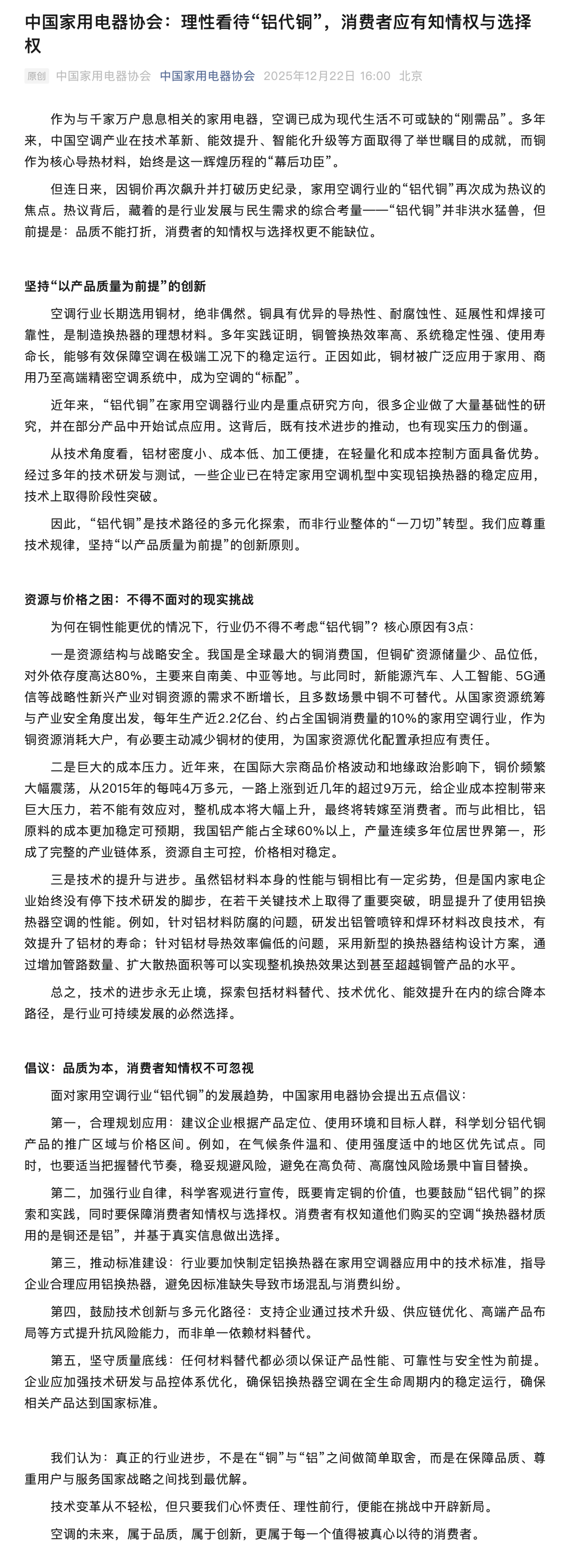
格力称暂无“铝代铜”计划,董明珠曾称“在没有100%的把握前,格力空调绝不使用;此前美的、小米等品牌推动“铝代铜”标准落地引热议
Hang Zhou Ri Bao· 2025-12-24 04:51
Core Viewpoint - The air conditioning industry is actively exploring the use of aluminum as a substitute for copper, but significant technical challenges remain, particularly regarding the performance and reliability of aluminum compared to copper [1][2][3]. Group 1: Company Insights - Gree Electric stated that copper constitutes about 20% of air conditioning costs, and despite aluminum being cheaper, it currently lacks the performance and reliability of copper, leading to no immediate plans for aluminum substitution [1][2]. - Gree's Chairman, Dong Mingzhu, emphasized that while aluminum can technically replace copper, the company will not adopt it until it meets the same technical standards as copper [1][2]. - The rising copper prices, which have exceeded $10,000 per ton, have prompted discussions about aluminum substitution as a cost-reduction strategy in the industry [1][3]. Group 2: Industry Developments - The Chinese home appliance industry is accelerating the development of standards for aluminum substitution, with various companies participating in the formulation of guidelines and standards [2][4]. - A group of leading air conditioning companies, including Haier and Midea, has committed to a self-regulatory agreement to promote responsible communication regarding aluminum heat exchangers [2][4]. - The China Household Electrical Appliances Association has proposed five initiatives to guide the responsible application of aluminum in air conditioning, emphasizing quality assurance and consumer rights [4][5]. Group 3: Technical Challenges - The primary challenges in substituting aluminum for copper include aluminum's inferior thermal conductivity, corrosion resistance, and long-term reliability, which necessitate further technological advancements [2][8]. - The complexity of aluminum welding processes poses additional challenges for manufacturers, requiring enhanced capabilities and skills [2][8]. - Despite the challenges, the industry is making progress in developing aluminum technologies, with some companies achieving breakthroughs in specific applications [7][9]. Group 4: Market Dynamics - China is the largest producer and consumer of air conditioning units, with about 80% of its copper supply imported, while it controls 60% of global aluminum production, making aluminum a more stable resource option [1][8]. - The significant cost pressures from fluctuating copper prices have led the industry to consider aluminum as a viable alternative to maintain competitive pricing [9][10]. - The ongoing technological advancements in aluminum materials aim to enhance their performance, making them a more feasible option for air conditioning applications in the future [9][10].

市场化下的新蓝海,集中汇流正在扛起户用光伏的大旗
Quan Jing Wang· 2025-12-24 04:40
Core Viewpoint - The implementation of the new market-oriented pricing for renewable energy projects marks a significant shift from a subsidy-driven growth model to a market-driven approach, posing challenges for the household photovoltaic (PV) sector [1] Group 1: Challenges Facing Household PV - The household PV sector is facing dual structural constraints under the new market-oriented trading environment, which limits its value realization [1] - The grid's capacity is reaching its limits, hindering large-scale development, as many rural distribution networks are overwhelmed by the surge in installed capacity, leading to significant project integration challenges [2] - The decentralized nature of household PV assets makes it difficult to meet market trading requirements, resulting in a revenue dilemma where generated electricity cannot be effectively sold [2] Group 2: Solutions and Innovations - The traditional decentralized development model is inadequate for the new phase, necessitating an innovative approach that balances scale efficiency and grid compatibility, leading to the emergence of the centralized aggregation model [3] - The centralized aggregation model allows for large-scale development of rooftop PV systems at the village level, effectively addressing integration issues and opening new market opportunities [3][4] - This model enhances the bargaining power and market responsiveness of household PV projects by developing them at a megawatt scale, aligning with the technical requirements of market-oriented trading [4] Group 3: Policy Support and Market Trends - National and local policies are strongly supporting the centralized aggregation model, encouraging the development of distributed PV systems through collective village-level integration [4][5] - The centralized aggregation model is seen as a necessary direction for industry development, driven by grid capacity constraints, market demands, and policy support [5] Group 4: Future Prospects - The centralized aggregation model is rapidly gaining traction nationwide, indicating its potential to become a leading force in the market-oriented household PV sector [8] - Companies like Zhengtai Aneng are strategically positioned to leverage this model, potentially expanding into the distributed commercial energy sector and transforming from a household PV leader to a comprehensive energy service provider [8]

连续16天净流入!A500ETF基金(512050)冲击4连涨,最新规模超300亿元
Xin Lang Cai Jing· 2025-12-24 03:26
A500ETF基金紧密跟踪中证A500指数,中证A500指数从各行业选取市值较大、流动性较好的500只证券 作为指数样本,以反映各行业最具代表性上市公司证券的整体表现。 数据显示,截至2025年11月28日,中证A500指数(000510)前十大权重股分别为宁德时代(300750)、贵州 茅台(600519)、中国平安(601318)、招商银行(600036)、紫金矿业(601899)、中际旭创(300308)、美的集 团(000333)、兴业银行(601166)、新易盛(300502)、长江电力(600900),前十大权重股合计占比20.04%。 A500ETF基金(512050),场外联接(华夏中证A500ETF联接A:022430;华夏中证A500ETF联接C: 022431;华夏中证A500ETF联接Y:022979),相关指数基金(华夏中证A500指数增强A:023619;华夏 中证A500指数增强C:023620), A500增强ETF基金(512370) 从资金净流入方面来看,A500ETF基金(512050)近16天获得连续资金净流入,最高单日获得28.78亿元净 流入,合计"吸金"137.8 ...
豆包手机声量登顶,豆包家电缘何锦衣夜行?
3 6 Ke· 2025-12-24 03:13
Core Insights - Doubao Mobile's "AI Custody" feature has become a phenomenon in the market, showcasing the practical application of AI terminals [1] - The device can simulate human-like finger movements to complete complex tasks across multiple applications, significantly enhancing user convenience [2] - Despite the popularity of Doubao Mobile, the AI home appliance sector remains relatively stagnant, raising questions about the disparity between mobile and home appliance AI adoption [3][4] Industry Analysis - The AI home appliance market is facing challenges due to hardware compatibility issues, as many appliances are not designed for advanced AI interactions [6] - The practical application of AI in home appliances is limited by the need for effective user demand matching and value communication [7] - The commercial monetization of AI home appliances is indirect, with current revenue models primarily focused on hardware sales rather than AI service monetization [11] Company Strategies - Major players like Midea and TCL are investing heavily in AI technology, with Midea integrating its "Meiyan" model into various appliances, while TCL focuses on enhancing user interaction through AI [12][13] - Emerging brands like Tineco are innovating in specific segments, such as cleaning appliances, by combining improved hardware design with proprietary AI models [14][16] - The industry is moving towards a more interconnected AI ecosystem, with companies exploring cross-platform and cross-device integration to enhance user experience [18][20] Cost and Market Dynamics - The introduction of AI technology in home appliances significantly increases hardware costs, which poses a barrier to widespread adoption [21][23] - Companies are exploring strategies to balance the high costs of AI integration with the need for practical, user-friendly applications [24] - The future of AI home appliances hinges on achieving cost-effective solutions, establishing industry standards, and effectively communicating the value of AI features to consumers [25]