宝马

Search documents
固态电池板块更新及推荐
2025-05-13 15:19
Summary of Solid-State Battery Sector Update and Recommendations Industry Overview - The solid-state battery sector is experiencing heightened interest due to technological innovations, particularly following the announcement of sulfide patents and industry conferences, which catalyze market movements and liquidity premiums [1][2][3] - The focus of solid-state battery technology is increasingly narrowing, with sulfide solid electrolytes viewed as the ultimate direction, complemented by halide doping [1][3][4] Key Developments in Technology - Solid-state battery applications are expanding from automotive power batteries to energy storage, consumer electronics, power tools, low-altitude aircraft, and robotics, indicating a rich demand side that supports growth [1][5] - Major automotive companies are making significant advancements in solid-state battery development, with Stellantis planning to test a 77 Ah solid-state cell by 2026, and Toyota targeting production of next-generation electric vehicles by 2025 [3][12] - Domestic automakers are also set to introduce semi-solid and solid-state batteries, with SAIC's Zhiji L7/LS7 models marking the beginning of large-scale shipments [3][13] Investment Focus Areas - Investment in the solid-state battery sector should concentrate on three main areas: materials (focusing on sulfide systems like Xiamen Tungsten and CATL), batteries (including major manufacturers and second-tier firms in consumer electronics), and equipment (focusing on dry process routes like Naconor and Mannesmann) [1][6][20] - High-nickel ternary cathode materials are expected to dominate in the medium term, while lithium-rich manganese-based materials are anticipated for the long term [4][7] Recent Trends and Future Outlook - The solid-state battery industry is projected to reach nearly 100 GWh in capacity planning, but the investment required for solid-state batteries is significantly higher than for liquid batteries, with costs estimated at over 500 million yuan per GWh [18] - The industry is expected to see a definitive growth year in 2025, although the trend of reducing equipment costs may take one to two years to materialize [18][19] Emerging Technologies and Products - Recent advancements in negative electrode materials have transitioned from traditional graphite to silicon-carbon and now to lithium metal, with CATL introducing self-generating lithium metal technology [8][16] - Solid-state battery technology is rapidly evolving, with brands like OnePlus and Vivo beginning to evaluate silver polymer or semi-solid battery products for performance [17] Noteworthy Companies and Recommendations - Companies such as New Energy, Better Battery, and Guoxuan have recently launched new products, with a consensus that sulfide is the ultimate form, while transitional routes will be more compatible with current lithium-ion systems [19] - Recommended companies to watch include those in the Qingneng, Weilan, and Tailan systems, as well as upstream material companies like Tian Nai Technology and Dao Shi Technology, and high-nickel ternary material companies like Xiamen Tungsten New Energy and Rongbai Technology [20][21]

自动驾驶将在今年大爆发!这四家美股公司必须关注!
美股研究社· 2025-05-13 10:58
Core Viewpoint - The article emphasizes that the autonomous driving market is on the verge of a significant breakthrough, with major companies like Tesla, Uber, and Waymo making substantial advancements in the commercialization of autonomous vehicles this year [3][4]. Group 1: Market Overview - The autonomous driving market is projected to grow from $1.7 trillion to $3.9 trillion over the next decade, with fully autonomous driving expected to increase from $60 billion in 2024 to $200 billion by 2033 [4]. - McKinsey predicts that autonomous driving could generate $400 billion in revenue by 2035 [4]. Group 2: Deployment Strategies - There are two primary strategies for deploying autonomous vehicles: gradual deployment (L2/L3 to L4) and direct deployment of fully autonomous systems (L4 Robotaxi) [5][13]. - Gradual deployment involves traditional automakers like Tesla and BMW, focusing on enhancing automation through user data and algorithm training [7][10]. - Direct deployment is led by tech companies like Waymo and Cruise, focusing on specific geofenced areas for autonomous operations [14][15]. Group 3: Key Players - Mobileye (MBLY) is highlighted as a core supplier for the second deployment strategy, providing essential components like chips and software for autonomous driving [21][24]. - MBLY holds a 50% market share in the Advanced Driver Assistance Systems (ADAS) market, with its EyeQ chip integrated into approximately one-third of new vehicles globally [26]. - Collaborations with major automakers like BMW and Volkswagen enhance MBLY's market presence and revenue potential [30][34]. Group 4: Uber and Lyft's Role - Uber is positioned as a leading player in the ride-hailing market, holding a 75% market share in the U.S., while Lyft holds 25% [48]. - Uber's profitability, with a net profit margin of 22.4%, contrasts with Lyft's lower profitability, indicating Uber's stronger market position [50][52]. - Collaborations with MBLY and other tech companies are crucial for both Uber and Lyft to integrate autonomous vehicles into their platforms [46][56]. Group 5: Pony.ai's Expansion - Pony.ai is identified as a Chinese autonomous driving software company, with significant growth potential in the robotaxi market, projected to expand from $54 million in 2023 to $12 billion by 2030 [58]. - The company has achieved all-weather Level 4 autonomous driving and is expanding its services in major Chinese cities [59][61]. - Partnerships with Uber and Toyota are expected to enhance Pony.ai's global reach and operational capabilities [63].




固态电池三大新变
高工锂电· 2025-05-13 10:31
Core Viewpoint - The article discusses the recent trends and developments in the solid-state battery industry, highlighting key innovations in electrolyte materials, an accelerated iteration of anode materials, and the deepening collaboration between process and equipment innovations [3][11][16]. Group 1: Electrolyte Material Innovation - The solid-state electrolyte membrane, regarded as the "fifth main material" of solid-state batteries, is undergoing significant technological adjustments, with a shift towards coating existing base membranes rather than relying solely on self-supporting membranes [4][5]. - Companies like Weilan New Energy and TaiLan are emphasizing the use of existing base membranes for solid-state electrolyte coating, indicating a more practical approach to production stability and application reliability [4][5]. - The cost of electrolyte membranes in Japan and South Korea is reportedly at least 30% lower than that in China, which may drive the adoption of base membrane routes in the industry [5]. Group 2: Anode Material Iteration - The focus on anode material iteration, particularly silicon-carbon anodes, is gaining momentum, with significant investments and production capacity expansions observed in the first five months of the year, exceeding 220,000 tons and over 20 billion yuan in related investments [7][8]. - Notable projects include a 100,000-ton silicon-carbon anode material project by Xinyuan Technology with a total investment of 12 billion yuan, marking a significant expansion in the sector [7]. - Companies like Sanyuan Technology and Multi-Flor have also initiated substantial projects in silicon-carbon anodes, indicating a robust growth trajectory in this area [8][9]. Group 3: Process and Equipment Innovation - The solid-state battery production equipment has seen remarkable advancements, particularly in dry electrode processes, which are becoming a focal point for the industry [11][12]. - Companies such as XianDao Intelligent and Mannesmann have made significant breakthroughs in dry process equipment, indicating a maturation of key manufacturing processes [12][13]. - The integration of equipment and the ability to deliver complete production lines are becoming critical indicators of company strength, with successful bids for large-scale projects highlighting this trend [14][15].

合资沉浮20年:昔日王者 重回一线
2 1 Shi Ji Jing Ji Bao Dao· 2025-05-12 14:08
Core Viewpoint - The article discusses the transformation of joint venture car manufacturers in China, highlighting their shift from dominance to a reactive stance against the rise of domestic brands, and their recent efforts to reclaim market leadership through new energy vehicles and local partnerships [1][12][22]. Group 1: Historical Context - Joint venture brands held a 66% market share in China's passenger car market in 2014, while new entrants like NIO and Xpeng were just emerging [1]. - By 2024, the market share of joint venture brands is projected to drop below 35%, contrasting with the rise of domestic brands like BYD and Xpeng, which have capitalized on electric and intelligent vehicle technologies [12][14]. Group 2: Recent Developments - In 2025, joint venture brands are actively seeking to regain influence by launching new energy sub-brands, such as SAIC-GM's high-end brand "Zhijing" and Dongfeng Honda's independent brand "Lingxi" [1]. - Collaborations with local companies are also emphasized, with models like Audi A5L and Dongfeng Nissan N7 integrating advanced driving systems developed with Huawei and Momenta [2][23]. Group 3: Market Dynamics - The Shanghai Auto Show has seen increased foot traffic for joint venture brands, indicating a renewed interest as they adapt to local market demands [2]. - Buick's appeal in the Middle East is noted, as the brand meets local consumer expectations for quality and comfort, leading to potential partnerships for new model introductions [5]. Group 4: Strategic Shifts - Joint venture manufacturers are shifting their development focus to be more localized, with decision-making authority being transferred to Chinese teams to better align with consumer needs [22][25]. - The article highlights the importance of safety and technology integration, with companies like SAIC-GM and Dongfeng Nissan emphasizing local development and collaboration with leading suppliers [24][26]. Group 5: Challenges Ahead - Despite the positive momentum, joint venture companies face challenges in sustaining R&D investments while balancing profitability, as seen with Volkswagen's projected 33.5% revenue decline in China for 2024 [25]. - The need for a cohesive strategy that integrates local market demands with global standards remains a critical challenge for these manufacturers [27].
中美破冰之际,港股或迎今年全球最大IPO
财富FORTUNE· 2025-05-12 13:03
Core Viewpoint - CATL's IPO in Hong Kong is set to be one of the largest in recent years, with an expected fundraising of $4 billion to $5 billion, coinciding with favorable developments in US-China trade relations that may enhance investor sentiment [1][2]. Group 1: IPO Details - CATL's Hong Kong IPO has attracted cornerstone investors with a total subscription of HKD 20.371 billion, accounting for 65.7% of the offering [2]. - The pricing strategy for the IPO is set at HKD 263 per share, which is only about 5% lower than its A-share price, indicating a strong value proposition aimed at long-term investors [2][3]. - The funds raised will primarily be allocated to the construction of CATL's factories in Hungary, which will enhance local supply chains and reduce logistics costs by 30% [3]. Group 2: Financial Health and Strategy - As of Q1 2025, CATL reported cash and cash equivalents exceeding CNY 321.3 billion, indicating that the IPO is not merely for capital replenishment but also for strategic partnerships with long-term investors [2][3]. - The IPO represents only 5% of CATL's total equity, with 90% of the raised funds directed towards the first and second phases of its Hungarian project [3]. Group 3: Market Position and Future Outlook - CATL's overseas revenue is projected to decline by 15% in 2024, but the company aims to mitigate risks associated with currency fluctuations and market competition through the IPO [3][4]. - The European market, where electric vehicle penetration is currently around 18%, presents significant growth opportunities for CATL, especially in the context of increasing demand for energy storage [4]. - CATL's collaboration with Ford to supply lithium iron phosphate batteries starting in 2026 is expected to bolster its position in the US market, despite previous challenges [5].

蔚来旗舰ET9四月交付量超越宝马7系、奥迪A8L
news flash· 2025-05-12 11:53
Core Insights - NIO ET9 achieved its first complete monthly sales surpassing traditional luxury brands BMW 7 Series and Audi A8L in April [1] - This marks the first time a Chinese brand's flagship executive model has outperformed traditional luxury executive models in sales [1] - NIO's stock surged nearly 8% in Hong Kong and over 7% in pre-market trading in the US due to multiple positive news [1]
星宇股份(601799):合作优质客户,业绩增长稳健
GOLDEN SUN SECURITIES· 2025-05-12 02:30
Investment Rating - The report maintains a "Buy" rating for the company [5] Core Views - The company achieved a revenue of 3.095 billion yuan in Q1 2025, representing a year-on-year growth of 28.3%, with a net profit of 322 million yuan, up 32.7% year-on-year [1] - The company benefits from the vehicle replacement policy, leading to sustained growth in automotive consumption, with a diverse customer base including major brands such as Volkswagen, Toyota, and Mercedes-Benz [1][2] - The company has optimized its customer structure and improved profitability through strong cost control, with a net profit margin increase from 10.06% in Q1 2024 to 10.41% in Q1 2025 [2] - The company is advancing its global strategy, focusing on R&D and partnerships with firms like Huawei, and has entered the supply chains of foreign luxury brands [3] Financial Performance - The company is projected to achieve revenues of 16.511 billion yuan, 20.460 billion yuan, and 25.398 billion yuan for the years 2025, 2026, and 2027, respectively, with year-on-year growth rates of 24.6%, 23.9%, and 24.1% [4] - The net profit is expected to reach 1.919 billion yuan, 2.486 billion yuan, and 3.125 billion yuan for the same years, with growth rates of 36.3%, 29.5%, and 25.7% [4] - The company's earnings per share (EPS) is projected to increase from 6.72 yuan in 2025 to 10.94 yuan in 2027 [4] Customer and Product Development - The company has undertaken 69 new model development projects in 2024, with 40 models entering mass production, including high-value projects like the smart headlights for Huawei's AITO M9 [2] - The M9 model is expected to deliver 150,000 units in 2024, contributing significantly to revenue growth [2] Global Expansion - The company is making strides in global markets, with the establishment of factories in Europe, Mexico, and the USA, marking a new phase in its globalization efforts [3]

全球车市转折大年,西方落幕中国登场
3 6 Ke· 2025-05-12 01:33
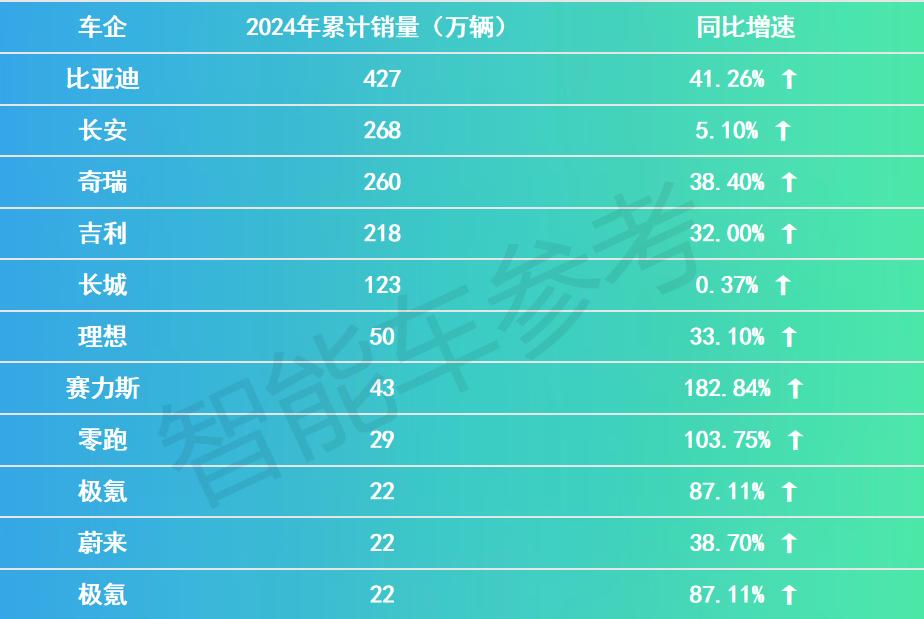
Core Viewpoint - The global automotive industry is experiencing a significant shift, with traditional automakers struggling to adapt to electrification and smart technology, while Chinese companies are rapidly gaining market share and showing strong growth in sales and performance [1][2]. Group 1: Sales Performance - Chinese automakers are witnessing substantial sales growth, with BYD projected to sell 4.27 million units in 2024, marking a 41.26% increase year-on-year [1]. - Other notable performers include Changan with 2.68 million units (5.10% increase), Chery with 2.60 million units (38.40% increase), and Geely with 2.18 million units (32.00% increase) [1][2]. Group 2: Financial Health and Debt Levels - The debt levels of major global automakers are generally high, with many exceeding 60% debt-to-asset ratios. For instance, Ford's debt ratio is 84.27%, and Chery's is 88.64% [4][5]. - Chinese companies like BYD and Geely have lower debt pressures compared to their overseas counterparts, with BYD's total liabilities at 75% of its revenue and Geely's at 88% [8][10]. Group 3: Debt Structure - The structure of debt is crucial, with Chinese automakers relying less on interest-bearing debt. For example, BYD's interest-bearing debt constitutes only 4.9% of its total liabilities [9][10]. - In contrast, foreign giants like Volkswagen and Ford have over 60% of their debt as interest-bearing, indicating higher financial pressure [11]. Group 4: Accounts Payable and Operational Efficiency - The accounts payable to revenue ratio is an important indicator of financial health. BYD has the lowest ratio at 31%, while NIO has the highest at 52% [12][14]. - The average accounts payable turnover days for domestic automakers range from 125 to 205 days, with BYD leading at 127 days, indicating efficient payment practices [13][14]. Group 5: Strategic Implications of Debt - High debt levels in the automotive industry can signify substantial investments in growth and innovation. Companies like BYD and Changan demonstrate that manageable debt can support expansion and technological advancement [16][17]. - The ability to carry significant debt is increasingly seen as a competitive advantage in the rapidly evolving automotive landscape [18].

硅谷观察:销量一片惨淡,特斯拉股价为什么还能走高?
Xin Lang Ke Ji· 2025-05-11 23:10
Group 1 - Tesla's stock price has risen despite a continuous decline in global sales, with a recent closing price of $298.26, marking a 4.7% increase [2] - The stock has increased for three consecutive weeks, with a total rise of 18%, 1%, and 3.85%, leading to a market capitalization exceeding $960 billion [2] - Tesla's price-to-earnings ratio is approaching 170, indicating a significant disconnect between stock performance and sales figures [2][18] Group 2 - In Europe, Tesla's sales have plummeted by 36% year-on-year in Q1, totaling 53,200 units, while the overall electric vehicle market in Europe grew by 24% [3] - Competitors like Volkswagen and BMW are gaining market share, with Volkswagen selling 65,700 units and BMW approaching Tesla's sales with 46,600 units [5][8] - In April, Tesla's sales in the UK dropped by 62%, contrasting with an 8% increase in overall electric vehicle sales in the country [5] Group 3 - Tesla's market share in Germany has fallen from 10% to 4%, with the Model Y dropping from the top-selling electric vehicle to fifth place [8] - Analysts suggest that the decline in sales is not merely due to product updates but is rooted in deeper structural issues related to Elon Musk's controversial public persona [9] - Musk's political interventions and support for controversial figures have led to a backlash in Europe, further harming Tesla's brand image [11] Group 4 - In contrast to Tesla's struggles, BYD has seen significant growth, with a 755% increase in sales in Germany and a 311% increase in the UK [12] - Tesla's global deliveries fell by 1% last year and by 13% in Q1, while BYD's sales reached 1.765 million units, surpassing Tesla's figures [13] - Tesla's inventory pressures are evident, with a complete shutdown of production lines for a week, indicating challenges in managing stock levels [16] Group 5 - Despite negative sales data, Tesla's stock price rose due to perceived positive signals from U.S.-China trade negotiations [18] - Analysts are focusing on Tesla's advancements in autonomous driving and the upcoming launch of a low-cost vehicle, which could drive future sales [20][21] - The anticipated low-cost model, potentially priced around $30,000, is expected to attract consumers and help revitalize sales [21]

央行:汽车金融公司存款准备金率降至0%!工信部出手整顿隐藏式门把手!宝马一季度财报公布,净利润大幅度下滑!丨一周大事件
电动车公社· 2025-05-11 15:55
New Car Launches - BYD Sea Lion 07DM-i launched with a price range of 169,800 to 205,800 yuan, featuring a 1.5T engine and a 26.6kWh battery pack with a pure electric range of 150/135 km [3][9] - Li Auto L series smart refresh version launched, maintaining original prices with upgraded configurations; prices range from 241,800 to 439,800 yuan [10][19] - Geely Galaxy Star 8 launched with a limited-time price of 115,800 to 155,800 yuan, featuring a family-style design and advanced driver assistance systems [20][30] - Jiayuan AIR launched with two versions priced at 147,800 to 159,800 yuan, targeting family users with high configurations [31][37] - New Audi A6 plug-in hybrid version revealed, featuring a 2.0T engine and a 25.9kWh battery pack with a WLTC pure electric range of 111 km [39][42] - Beijing Hyundai ELEXIO global debut, based on the E-GMP platform with a CLTC range exceeding 700 km [45][46] - New Volvo XC70 unveiled, set to launch in September, based on the new SMA hybrid architecture [49][51] Company Dynamics - SAIC Group achieved a record high of 128,000 new energy vehicle sales in April [55][58] - Changan Automobile reported 71,349 new energy vehicle sales in April, indicating steady growth [59][61] - Extreme Stone Automobile delivered 1,128 units in April, surpassing a cumulative delivery of 10,000 units [62][63] - BMW's Q1 financial report showed a significant decline in net profit by 26.4% to 2.173 billion euros, with a revenue drop of 7.8% [82][84] Industry News - The Ministry of Industry and Information Technology proposed a mandatory national standard for automotive door handle safety to address potential risks [85][89] - The People's Bank of China announced a reduction in the reserve requirement ratio for automotive finance companies to 0%, aimed at stimulating consumption in the automotive sector [91][92]