
天弘基金

Search documents
爆款单品时代来临 ETF品种多点开花
Zhong Guo Zheng Quan Bao· 2025-07-03 20:26
Core Insights - The domestic ETF market experienced significant growth in the first half of 2025, with total ETF assets surpassing 4 trillion yuan, increasing from 3.73 trillion yuan at the beginning of the year to 4.31 trillion yuan by mid-year [1][2] - Several new and existing ETFs gained substantial inflows, with notable contributions from major fund companies such as Huaxia Fund, E Fund, and Fuguo Fund, which added 928.32 billion yuan, 648.66 billion yuan, and 513.71 billion yuan respectively [1][2] - The focus of ETF fund managers is shifting from brand promotion to achieving scale, driven by new policies and regulatory guidance [7][8] ETF Market Growth - The total scale of domestic ETFs reached over 4 trillion yuan for the first time, with an increase of over 580 billion yuan in the first half of 2025 [1] - Eight public fund institutions added between 20 billion yuan and 50 billion yuan in ETF management scale, while ten institutions added between 5 billion yuan and 20 billion yuan [2] - The market saw multiple standout products across various sectors, indicating a broad-based growth in ETF inflows [2] Performance of Existing Products - Several existing ETFs revitalized their performance, with the Huaxia Gold ETF and Fuguo China-Hong Kong Internet ETF seeing net inflows of 311.47 billion yuan and 257.27 billion yuan respectively [3] - Other ETFs, such as the Industrial Bank China-Hong Kong Technology ETF and Huaxia China-Robotics ETF, also experienced significant scale increases, each exceeding 100 billion yuan [3] New Product Launches - The first batch of benchmark market-making credit bond ETFs gained attention, with several funds exceeding 20 billion yuan in scale by mid-year [4] - Existing products like the Hai Futong China Short-term Bond ETF also saw substantial growth, with nearly 20 billion yuan added in the first half of the year [4] Strategic Focus of Fund Managers - Fund managers are advised to focus on innovative potential products and maintain a robust marketing strategy to capture market share [8] - The competitive landscape is expected to continue, with leading products maintaining an advantage due to their established resources and market presence [7][8]

2025上半年ETF榜出炉:港股医药飙涨58%,光伏ETF集体重挫超11%
Hua Xia Shi Bao· 2025-07-03 14:20
Core Viewpoint - The ETF performance in the first half of 2025 shows a stark contrast, with the Hong Kong innovative drug ETFs surging over 58%, while the photovoltaic industry ETFs faced a decline of over 11% [2][3]. Group 1: Performance of Innovative Drug ETFs - The top-performing ETFs are dominated by the pharmaceutical sector, particularly focusing on Hong Kong innovative drugs and biotechnology, indicating strong investor interest in the innovative drug field [3]. - The leading ETF, Huatai-PB Hong Kong Innovative Drug ETF, achieved a remarkable increase of 58.77%, with a scale of 7.802 billion [4]. - Other notable ETFs include Yinhua and Wanji's Hong Kong Innovative Drug ETFs, both exceeding 57% growth, showcasing significant capital involvement in the sector [4][5]. Group 2: Performance of Photovoltaic and Traditional Energy ETFs - In stark contrast, the coal and photovoltaic industry ETFs experienced significant declines, with the top loser, Guotai Zhongzheng Coal ETF, dropping by 12.28% [6][7]. - The photovoltaic ETFs collectively faced severe downturns, with all listed ETFs in this category recording declines exceeding 11%, reflecting the industry's adjustment pressures [7][8]. Group 3: Underlying Market Dynamics - The extreme market divergence reflects a sensitive response to changes in industry trends, driven by supportive policies for innovative drugs and the challenges faced by traditional energy and photovoltaic sectors [9]. - Recent policies from various government departments have provided robust support for the innovative drug industry, enhancing its development prospects [9][10]. - Conversely, the photovoltaic sector is grappling with overcapacity and financial losses, with expectations for a prolonged adjustment period before recovery [10]. Group 4: Future Outlook - The innovative drug market in China is projected to have significant growth potential, driven by low per capita medical spending and an aging population [11]. - The Hong Kong innovative drug sector is expected to continue its rapid development, supported by policy initiatives and advancements in research and commercialization [11][12]. - Long-term perspectives suggest that innovative drugs represent a "long slope, thick snow" sector, emphasizing the importance of distinguishing between thematic speculation and value growth [12].


债券型ETF新动向不断!首批科创债ETF快速“通关”,存量规模已破3800亿
Bei Jing Shang Bao· 2025-07-03 14:20
Core Viewpoint - The approval of the first batch of 10 Science and Technology Innovation Bond ETFs marks a significant development in the bond ETF market, which has seen rapid growth in 2023, surpassing 380 billion yuan in total scale, with over 60% of net inflows in the ETF market attributed to bond ETFs [1][6][9]. Group 1: Approval and Launch of Science and Technology Innovation Bond ETFs - The first batch of 10 Science and Technology Innovation Bond ETFs has been officially approved, with a swift approval process of only half a month from the submission of materials [1][3]. - The fund managers of these ETFs have announced that the issuance will start on July 7, with a maximum fundraising scale of 3 billion yuan for each product [4]. - The ETFs will track various indices, including the China Securities AAA Technology Innovation Company Bond Index and the Shanghai Stock Exchange AAA Technology Innovation Company Bond Index [3][4]. Group 2: Growth of Bond ETFs - The total scale of bond ETFs has rapidly exceeded 380 billion yuan, with a significant year-on-year growth of 146.03% as of the end of the first quarter of 2023 [6][9]. - As of July 2, the bond ETF market consists of 29 products, and if the new Science and Technology Innovation Bond ETFs are successfully launched, the total will increase to 39 [6]. - The average annual return of bond ETFs has been stable, with 15 out of 29 products achieving returns exceeding 1% this year [9]. Group 3: Market Dynamics and Investor Sentiment - The growth of bond ETFs is driven by several factors, including their trading advantages, increased demand for safe-haven assets, and policy support [8]. - The bond ETF market has become a new focus for investors, with net inflows accounting for over 60% of total ETF net inflows this year [9]. - The Science and Technology Innovation Bond ETFs are expected to provide investors with convenient tools for allocating high-quality technology innovation company bonds [5][10].
天弘基金郭相博:CXO中报确定性强,重视回调后的创新药
Sou Hu Cai Jing· 2025-07-03 09:43
Core Viewpoint - The innovation drug sector is experiencing a resurgence, driven by supportive policies and a favorable investment environment, marking a significant shift from "squeezing out excess" to "promoting innovation" in the pharmaceutical industry [2][3]. Group 1: Market Performance - In the first half of 2025, the pharmaceutical sector showed strong performance, with the CITIC Pharmaceutical Index rising by 8.11%, outperforming major indices like the Shanghai Composite Index (+5.98%) and the ChiNext Index (+4.25%) [3]. - The A-share innovation drug index increased by 21.84%, while the Hong Kong Hang Seng Innovation Drug Index surged by 60.27% during the same period [4]. Group 2: Policy Support and Industry Trends - The recent policy document titled "Several Measures to Support the High-Quality Development of Innovative Drugs" outlines 16 measures to support the entire chain of innovative drug development, indicating a systemic shift in policy support [2][7]. - The domestic pharmaceutical industry has undergone a transformation since the "4+7" procurement policy was implemented in 2018, leading to a fruitful period for innovative drugs in 2025 as the results of this transformation begin to materialize [7]. Group 3: Future Outlook - The innovation drug sector is expected to remain a key investment focus in the third quarter, with core innovative drug assets requiring attention despite potential short-term fluctuations [8]. - The CDMO (Contract Development and Manufacturing Organization) sector is anticipated to see a revenue recovery trend continuing into the second quarter of 2025, as the industry has established an order inflection point [9]. - The CRO (Contract Research Organization) and front-end innovative drug sectors are set to benefit from overseas licensing deals, which will bring incremental revenue expectations from upfront payments [10].

开源证券IPO梦碎:屡遭监管“点名”,债券业务被暂停冲击业绩
Mei Ri Jing Ji Xin Wen· 2025-07-03 08:14
Core Viewpoint - The IPO application of Kaiyuan Securities has been suspended due to the withdrawal of the sponsor, marking a significant setback for the company after three years of efforts to go public [1][4][5]. Group 1: Company Background - Kaiyuan Securities is headquartered in Xi'an, Shaanxi, and its main business includes securities brokerage, investment consulting, financial advisory, underwriting and sponsorship, proprietary trading, fund sales, asset management, margin financing, and selling financial products [1]. - The company is controlled by Shaanxi Coal and Chemical Industry Group, which holds 58.80% of the shares, and the actual control is held by the Shaanxi Provincial State-owned Assets Supervision and Administration Commission [2]. Group 2: IPO Journey - The IPO journey began in July 2022 when Kaiyuan Securities submitted its application to the China Securities Regulatory Commission (CSRC) for listing on the Shenzhen Stock Exchange [2]. - The company planned to issue up to 1.153 billion shares, aiming to raise 4 billion yuan for business upgrades, including enhancing brokerage services, investment banking capabilities, and digital service capabilities [2][3]. Group 3: Regulatory Challenges - The CSRC imposed a six-month suspension on the company's bond underwriting qualifications due to compliance issues, which significantly impacted its investment banking revenue [6][7]. - The company faced multiple regulatory penalties and compliance concerns, including misleading statements in fundraising documents and inadequate due diligence in bond underwriting [9][10]. Group 4: Financial Performance - In 2024, the company's investment banking revenue dropped to 464 million yuan, a decrease of 45.89% year-on-year, with the contribution to total revenue falling from 41.07% in 2019 to 16.23% [7]. - The overall revenue for 2024 was 2.859 billion yuan, a decline of 6.61% year-on-year, while the net profit attributable to shareholders increased by 12.25% to 687 million yuan [14]. Group 5: Market Position and Future Outlook - Despite the challenges, Kaiyuan Securities has established a strong position in the New Third Board market, supervising 723 companies, which accounts for 11.77% of the total listed companies [2][13]. - The company is expected to focus on enhancing its services for supervised enterprises and may consider restarting its IPO application after the suspension period ends [15].
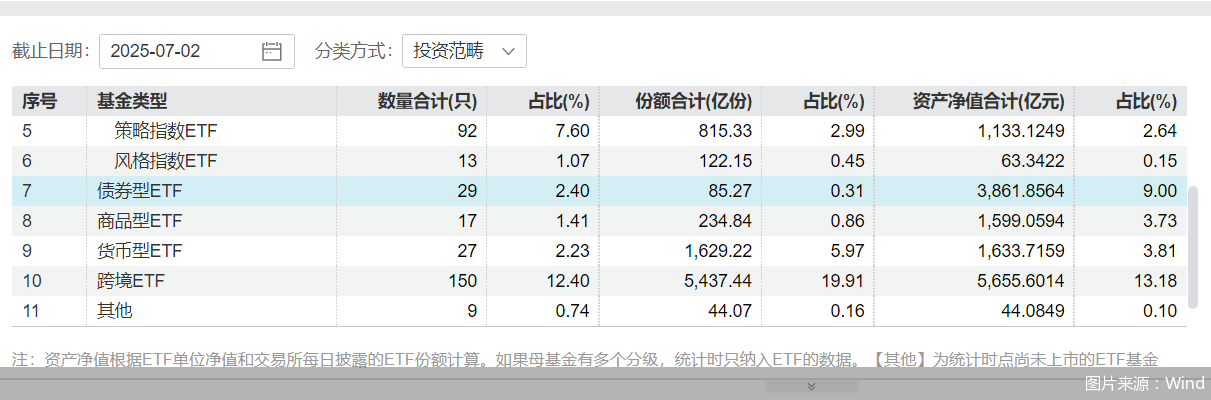
资金疯狂涌入债券型ETF,规模超百亿的债券ETF达15只
Ge Long Hui· 2025-07-03 06:24
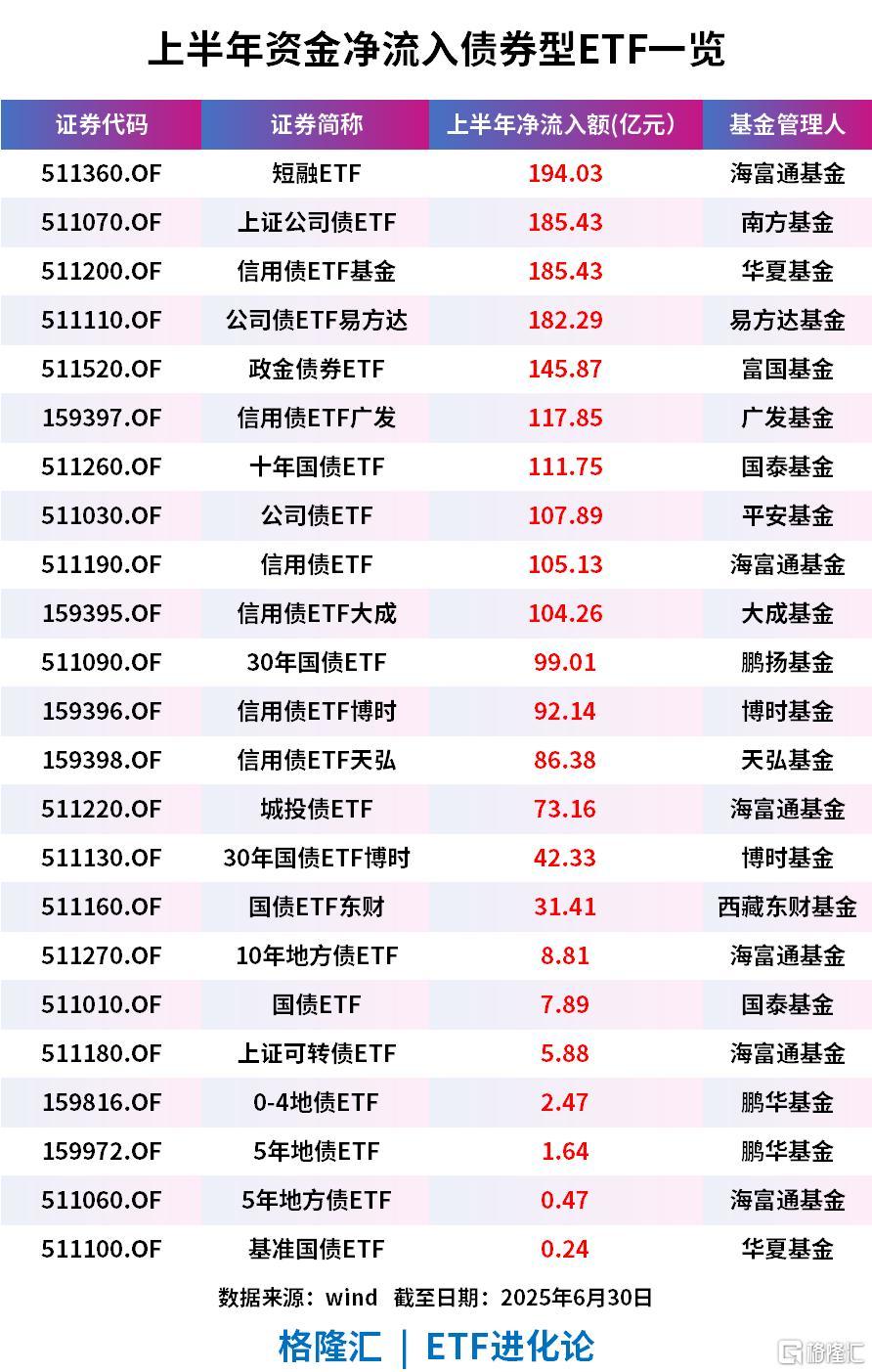
Group 1 - The total scale of ETFs surpassed 4 trillion yuan, reaching 4.31 trillion yuan, representing a growth of 15.57% compared to the end of last year [1] - The largest growth in the first half of the year was seen in bond ETFs, which grew by 120.71% to 383.976 billion yuan [1] - A total of 29 bond ETFs reached a combined scale of 383.976 billion yuan, setting a new historical record [1] Group 2 - Bond ETFs had the highest net inflow in the first half of the year, totaling 175.784 billion yuan [1] - Notable bond ETFs with net inflows exceeding 10 billion yuan include Hai Futong Short-term Bond ETF, Southern Shanghai Stock Company Bond ETF, and others [1] - The top bond ETF by scale is the Government Financial Bond ETF, which reached 52 billion yuan [5][7] Group 3 - There are 15 bond ETFs with a scale exceeding 10 billion yuan, including various types such as policy financial bonds and corporate bonds [5] - The rapid growth of bond ETFs is attributed to factors such as increased market liquidity, lower costs, improved regulatory frameworks, and a shift in investor risk preferences [10] - The credit bond market is experiencing fluctuations in yield, with low-grade credit spreads compressing the most [11] Group 4 - The outlook for the second half of the year suggests that credit bond yields are likely to remain volatile, with potential for credit spreads to widen due to supply-demand mismatches [12][13] - Investment strategies should focus on short to medium-term high-grade credit bonds and consider opportunities in local government bonds [12]
ETF资金榜 | 公司债ETF易方达(511110)资金加速流入,科创板块受关注-20250702
Sou Hu Cai Jing· 2025-07-03 02:37
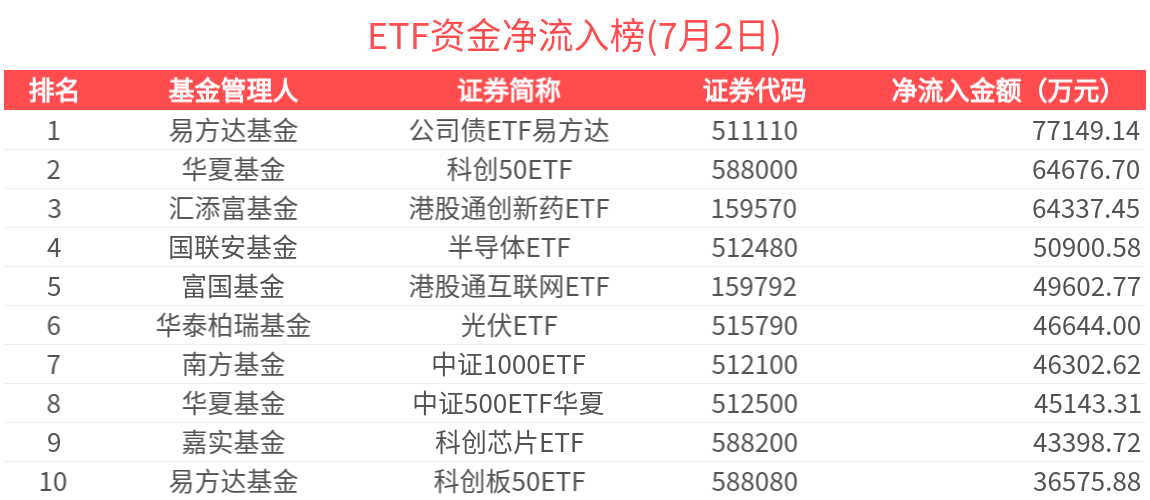
Summary of ETF Fund Flows Core Insights - On July 2, 2025, a total of 300 ETF funds experienced net inflows, while 354 funds saw net outflows, indicating a mixed sentiment in the market [1] - Notable inflows were observed in specific ETFs, particularly the Company Bond ETF by E Fund, which led with a net inflow of 771.4 million yuan [3] - Conversely, significant outflows were recorded in several ETFs, with the A500 ETF by Harvest leading the outflows at 891 million yuan [5] Inflow Analysis - The top five ETFs with the highest net inflows included: 1. Company Bond ETF by E Fund (771.4 million yuan) 2. Sci-Tech Innovation 50 ETF by Huaxia (646.7 million yuan) 3. Hong Kong Stock Connect Innovative Drug ETF by Huitianfu (643.3 million yuan) 4. Semiconductor ETF by Guolianan (509 million yuan) 5. Hong Kong Stock Connect Internet ETF by Fuguo (496 million yuan) [3][5] - A total of 103 ETFs have seen continuous net inflows, with the Company Bond ETF by E Fund leading for 20 consecutive days, accumulating a total inflow of 10.176 billion yuan [7] Outflow Analysis - The top five ETFs with the highest net outflows included: 1. A500 ETF by Harvest (891 million yuan) 2. Shanghai Stock 50 ETF by Huaxia (651.6 million yuan) 3. CSI 300 ETF by Huatai (607.2 million yuan) 4. CSI A500 ETF by Southern (470.4 million yuan) 5. A500 ETF by Huatai (411.7 million yuan) [5][9] - A total of 229 ETFs have experienced continuous net outflows, with the 300 ETF Enhanced leading for 18 consecutive days, resulting in a total outflow of 355.7 million yuan [9] Recent Trends - Over the past five days, 89 ETFs have recorded net inflows exceeding 100 million yuan, with the A500 ETF by Huatai leading at 4.846 billion yuan [10] - Conversely, 95 ETFs have seen net outflows exceeding 100 million yuan, with the CSI 300 ETF leading at 7.354 billion yuan [10]
★首批创新浮动管理费率基金上报
Zheng Quan Shi Bao· 2025-07-03 01:56
Core Viewpoint - The first batch of innovative floating fee rate products based on performance benchmarks has been reported, with 26 fund managers participating, indicating a shift towards performance-based fee structures in the industry [1][2]. Group 1: Product Overview - A total of 26 fund managers have submitted products, including 21 leading managers in active equity fund management, 4 small to medium-sized managers, and 1 foreign-owned manager [1]. - The participating fund managers include well-known firms such as E Fund, Fuguo Fund, and GF Fund, among others [1]. - The new floating fee rate model charges management fees based on each investor's holding period and annualized return, with specific fee structures for different holding durations [1]. Group 2: Investor-Centric Design - The product design emphasizes investor interests, allowing fee adjustments based on performance relative to benchmarks, with asymmetric adjustments favoring fee reductions for underperforming funds [2]. - The products aim to encourage long-term investment from investors, focusing on enhancing the long-term investment experience rather than merely increasing fundraising scale [2]. Group 3: Regulatory Framework - The "Action Plan" mandates that leading institutions should issue at least 60% of these new funds compared to their active equity fund issuance within a year [3]. - The implementation of these floating fee rate products will not affect the normal operation of existing products, ensuring a smooth transition [3]. - Fund managers are preparing for the rollout by focusing on product design, legal documentation, and communication with sales channels [3].
★首批创新浮动费率基金本周开抢 众多产品细节曝光
Zheng Quan Shi Bao· 2025-07-03 01:56
Core Viewpoint - The first batch of innovative floating rate funds has been approved and will start issuing on May 27, marking a significant shift in the fund management fee structure aimed at better aligning with investor interests [1][2]. Fund Structure and Fee Details - The innovative floating rate funds will operate on an open-ended basis, with management fees determined by the holding period and annualized return during that period [2]. - For holdings of less than one year, a management fee of 1.20% will be charged; for one year or more, fees will vary based on performance, with a maximum of 1.50% for returns exceeding 6% and a minimum of 0.60% for returns below -3% [2]. - The fee structure emphasizes asymmetric design, with a greater potential reduction in fees for poor performance compared to increases for good performance, prioritizing investor protection [2]. Industry Response and Manager Selection - Multiple fund companies have expressed that the floating management fee reform is a strong approach to optimize active equity funds and shift the industry’s operational model [1][3]. - A range of experienced and high-performing fund managers have been appointed to lead these new products, indicating a commitment to quality management [3][4]. Fundraising Goals and Strategies - Fundraising targets vary, with the highest set at 8 billion for one fund and many aiming for 3 billion to 5 billion, reflecting a cautious approach to initial fundraising [6]. - Companies are focusing on long-term investor experience rather than immediate fundraising success, with some planning to bind their interests with investors through self-purchase or initiator funds [6][7]. Future Outlook - The floating rate product is seen as a significant practice in public fund reform, with expectations for more products to be filed and potentially normalized in issuance [6]. - Companies are enhancing their core investment research capabilities and focusing on actual investor returns to foster long-term value creation [7].
最赚钱ETF榜单出炉,4.3万亿市场呈现三大变化
2 1 Shi Ji Jing Ji Bao Dao· 2025-07-02 13:05
Core Viewpoint - The domestic ETF market has reached a new high with a total scale of 4.31 trillion yuan as of June 30, 2023, reflecting a 15.55% increase from the end of last year, driven by over 300 billion yuan in inflows and structural market trends [1][5]. Group 1: Market Trends - The ETF market has seen significant growth since 2025, with over 300 billion yuan in new funds entering the market [1]. - As of June 30, 2023, the total scale of ETFs listed in China reached 4.31 trillion yuan, up from 3.73 trillion yuan at the end of last year, marking a 15.55% growth [1][5]. - Several ETFs have demonstrated strong performance, with multiple Hong Kong stock innovative drug ETFs and others achieving over 50% returns [1][11]. Group 2: Changes in Fund Flows - Three major changes in fund flows have been identified in the ETF market for the first half of the year: 1. The top ten ETFs by net inflow are no longer exclusively broad-based ETFs [2][4]. 2. Bond ETFs have contributed significantly to the market's growth [5][6]. 3. Industry-specific ETFs have gained popularity, particularly dividend-themed ETFs [7][10]. Group 3: Performance of Specific ETFs - The top ten ETFs by net inflow include various products, with the top performers being the HuShen 300 ETF and several bond ETFs, collectively attracting significant capital [3][9]. - Despite some core broad-based ETFs experiencing net outflows since May, they still ranked high in net inflows for the first half of the year, with several exceeding 100 billion yuan [8][9]. - The performance of ETFs tracking innovative drug and technology indices has been particularly strong, with many achieving returns exceeding 50% [11][13]. Group 4: Investor Behavior and Market Sentiment - The divergence between fund flows and returns can be attributed to investor behavior, where institutional investors may redeem funds upon reaching target returns, leading to net outflows despite high returns [15]. - Market sentiment also plays a role, as investors may preemptively invest in broad-based ETFs based on economic recovery expectations, while taking profits from high-performing ETFs [15]. Group 5: Future Outlook - Analysts suggest that the market may continue to experience high volatility, with a focus on sectors such as defense and technology for potential growth opportunities [16][17]. - The ongoing low interest rate environment and policies favoring dividends are expected to support high-yield assets, while the economic recovery may enhance market risk appetite [17].