
陕西煤业

Search documents
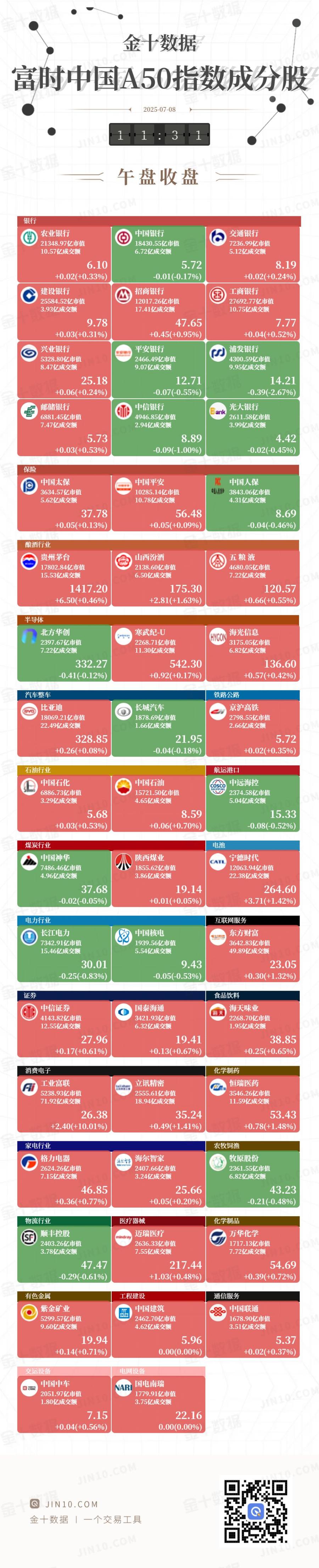
金十图示:2025年07月08日(周二)富时中国A50指数成分股午盘收盘行情一览:酿酒、石油板块全线走高,银行、汽车板块涨跌不一
news flash· 2025-07-08 03:35
Industry Performance - The FTSE China A50 Index components showed a mixed performance with the liquor and oil sectors rising, while the banking and automotive sectors experienced varied movements [1][6]. - The liquor industry saw significant market capitalizations with Kweichow Moutai at 1,780.28 billion, Wuliangye at 213.86 billion, and Shanxi Xinghuacun Fen Wine at 468.01 billion [3]. - The oil sector also performed well, with China Petroleum at 1,572.15 billion and China National Offshore Oil at 237.46 billion [3]. Company Highlights - China Pacific Insurance reported a market capitalization of 1,200 billion with a trading volume of 5.62 million [3]. - North Huachuang in the semiconductor sector had a market cap of 239.77 billion, while Cambrian Technology reached 226.87 billion [3]. - Gree Electric Appliances and Haier Smart Home in the home appliance sector had market caps of 262.43 billion and 236.16 billion respectively [4]. Trading Volumes - The trading volume for Kweichow Moutai was 15.53 million, while Wuliangye had 6.50 million [3]. - In the semiconductor sector, North Huachuang had a trading volume of 7.22 million, and Cambrian Technology had 11.30 million [3]. - The trading volume for Gree Electric Appliances was 7.15 million, and Haier Smart Home was 3.24 million [4].







宝泰隆: 中审亚太关于宝泰隆新材料股份有限公司2024年年度报告的信息披露监管问询函的回复
Zheng Quan Zhi Xing· 2025-07-07 10:12
Core Viewpoint - The inquiry letter from the Shanghai Stock Exchange regarding Baotailong New Materials Co., Ltd. focuses on the company's financial disclosures, particularly concerning supplier relationships and prepayments, highlighting significant changes in supplier dynamics and the implications for liquidity risk [1][2]. Supplier and Prepayment Analysis - Over the past three years, the top five suppliers accounted for 32.95%, 32.89%, and 40.87% of the total annual procurement, indicating a notable fluctuation in supplier relationships [1]. - The prepayment balances for the company were reported as 0.25 billion, 0.49 billion, and 0.40 billion for the respective years, with a significant portion attributed to Huayu Company, which has a 45% stake in a subsidiary of Baotailong [1][2]. - Huayu Company has been a consistent top supplier from 2021 to 2023, with procurement amounts of 1.85 billion, 1.67 billion, and 1.64 billion, respectively [2]. Transaction and Fund Flow Disclosure - The company is required to disclose detailed information about its top suppliers, including their names, establishment dates, main businesses, actual controllers, procurement content, and any related party transactions [2][3]. - The inquiry also seeks clarification on the rationale for Huayu Company being both a customer and supplier, and whether the prepayments align with the procurement scale and liquidity risk [2][7]. Long-term Asset Expenditure - The company reported a net cash outflow of 4.01 billion from investment activities, with 3.99 billion allocated to the acquisition of long-term assets, which exceeds the net cash flow from operating activities of 3.13 billion [8][10]. - The company is expected to provide details on significant long-term asset expenditures, including transaction parties, amounts, payment methods, and project progress to ensure compliance and transparency [8][9]. Audit and Compliance - The annual audit firm has conducted procedures to verify the authenticity and legality of accounts payable and to ensure there are no duplicate payments or improper fund flows to related parties [8]. - The audit findings indicate that the company's disclosures regarding fund flows and supplier relationships are consistent with the information obtained during the audit process [8].

固定收益、基金评价联合深度报告:科创债ETF启航
CMS· 2025-07-07 10:03
1. Report Industry Investment Rating No relevant content provided. 2. Core Views of the Report - In 2025, the continuous policy support has driven the expansion of the science - innovation bond market, and the science - innovation bond ETF has been quickly launched. The first batch of 10 science - innovation bond ETFs are scheduled to be issued on July 7, 2025 [1][2][11][13]. - The first - batch science - innovation bond ETFs track three major indices: the AAA Science - Innovation Bond Index, the Shanghai AAA Science - Innovation Bond Index, and the Shenzhen AAA Science - Innovation Bond Index. These indices have different characteristics in terms of return - risk, remaining maturity, weighted duration, bond rating, issuer industry, remaining face value, and collateral ratio [3]. - The expansion of science - innovation bond ETFs brings investment opportunities. Institutions have started to increase their allocation of science - innovation bond index constituent bonds. Three types of potentially beneficial targets can be pre - arranged: targets that are both science - innovation bond index constituent bonds and exchange benchmark market - making varieties, science - innovation bond targets with remaining excess spread protection, and targets with a remaining maturity of 3 - 4 years [5]. 3. Summary According to the Directory 3.1 Science - Innovation Bond ETF Launch Background - In 2025, policies on science - innovation bonds were continuously strengthened. In March, the central bank governor proposed to build a "science and technology board" in the bond market. In May, relevant policies were introduced to support the issuance of science - innovation bonds, including expanding the issuer scope, encouraging the creation of science - innovation bond ETFs, and improving the risk - sharing mechanism [12][13]. - Since the new policy was issued, the issuance scale of science - innovation bonds has exceeded 620 billion yuan, and the outstanding scale has reached 2.5 trillion yuan, providing sufficient underlying assets for science - innovation bond ETFs [2]. - The issuers of new science - innovation bonds are mainly central and local state - owned enterprises, with a relatively high proportion of financial enterprises. In terms of industry, they are mainly concentrated in the banking and building decoration industries [17]. 3.2 Science - Innovation Bond ETF Issuance Overview and Index Comparison 3.2.1 First - Batch Science - Innovation Bond ETFs and Index Products - As of July 6, 2025, 10 fund companies plan to issue science - innovation bond ETFs on July 7, 2025. Six companies' ETFs track the AAA Science - Innovation Bond Index, three track the Shanghai AAA Science - Innovation Bond Index, and only Invesco Great Wall's ETF tracks the Shenzhen AAA Science - Innovation Bond Index [22]. - Thirteen fund companies have reported science - innovation bond index funds (non - ETFs), all of which are benchmarked against the Shanghai AAA Science - Innovation Bond Index [24]. 3.2.2 Science - Innovation Bond Index System - Currently, the China Securities Index Company and the Shenzhen Stock Exchange have issued science - innovation bond indices. The China Securities Index Company has issued two series: the CSI Science - Innovation Bond Index series and the Shanghai Science - Innovation Bond Index series. The Shenzhen Stock Exchange has issued the Shenzhen Science - Innovation Bond Index [26]. 3.2.3 Main Index Comparison - In terms of index compilation methods, there are differences in the base period, sample space, sampling method, and weighting method among the three indices [30]. - In terms of cumulative returns from December 30, 2022, to July 3, 2025, the AAA Science - Innovation Bond Index and the Shanghai AAA Science - Innovation Bond Index had relatively high and similar returns, while the Shenzhen AAA Science - Innovation Bond Index had relatively lower returns [31]. - In different stages, the Shanghai AAA Science - Innovation Bond Index had better return performance, and the Shenzhen AAA Science - Innovation Bond Index had the lowest annualized volatility, the lowest maximum drawdown, and the highest return - risk ratio in the whole period [34]. - The remaining maturity distributions of the three indices are concentrated in 1 - 5 years, with a small amount of weight in 0 - 1 year and 7 - 10 years. The Shenzhen AAA Science - Innovation Bond Index has a relatively shorter remaining maturity [35]. - The Shanghai AAA Science - Innovation Bond Index has the highest weighted duration, and the Shenzhen AAA Science - Innovation Bond Index has the lowest, which may be part of the reason for the return differences among the indices [36]. - The AAA Science - Innovation Bond Index and the Shanghai AAA Science - Innovation Bond Index have a higher proportion of high - rated constituent bonds than the Shenzhen AAA Science - Innovation Bond Index [39]. - The constituents of the AAA Science - Innovation Bond Index and the Shanghai AAA Science - Innovation Bond Index are mainly distributed in the construction industry, while those of the Shenzhen AAA Science - Innovation Bond Index are mainly in the comprehensive and manufacturing industries [43]. - The issuers of the three indices' constituent bonds are mainly central and local state - owned enterprises. The Shenzhen AAA Science - Innovation Bond Index allocates nearly 5% of public enterprise bonds [46]. - The remaining face values of the three indices' constituent bonds are concentrated between 500 million yuan and 2 billion yuan, and the distribution of the Shenzhen AAA Science - Innovation Bond Index is more dispersed [48]. - The collateral ratios of the three indices' constituent bonds are generally distributed between 80% and 100%, and the Shenzhen AAA Science - Innovation Bond Index has a more concentrated weight in the 70% - 90% range [48]. 3.3 Investment Opportunities in Bonds Brought by Science - Innovation Bond ETFs - Since mid - June, the excess spread of science - innovation bond index constituent bonds has significantly compressed, and there has been a valuation deviation between constituent bonds and non - constituent bonds of the same issuer. The turnover rate of science - innovation bond index constituent bonds has significantly increased, indicating that institutions have started to increase their allocation [5][51][56][57]. - Considering the future expansion of science - innovation bond ETFs, three types of potentially beneficial targets can be pre - arranged: targets that are both science - innovation bond index constituent bonds and exchange benchmark market - making varieties, science - innovation bond targets with remaining positive excess spread, and targets with a remaining maturity of 3 - 4 years [5][61][62].
山西证券研究早观点-20250707
Shanxi Securities· 2025-07-07 07:23
Group 1: Coal Industry Overview - The coal industry is expected to maintain a balanced supply and demand in 2024, with domestic production initially declining before increasing, and imports exceeding expectations throughout the year [4] - National coal production is projected to reach 4.759 billion tons in 2024, a year-on-year increase of 2.16%, with an additional 101 million tons compared to the previous year [4] - The major coal-producing regions, including Shanxi, Shaanxi, and Inner Mongolia, are expected to contribute 3.89 billion tons, accounting for 81.7% of total production, with significant capacity increases in Xinjiang [4] Group 2: Financial Performance of Coal Companies - In 2024, sample coal companies are expected to see a decline in net profit due to falling coal prices and rigid costs, despite an increase in production [4][5] - The average coal sales price for 25 sample coal companies is projected to be 622 RMB/ton, a decrease of 7.54% year-on-year, while the average net profit per ton is expected to drop by 21.48% to 92.49 RMB/ton [4] - The total dividend amount declared by these companies is estimated at 87.9 billion RMB, a decrease of 14.99% year-on-year, with the dividend payout ratio increasing to approximately 60.82% of net profit [4] Group 3: Investment Strategy in Coal Sector - The market anticipates lower performance in the coal sector, but leading companies are expected to outperform expectations through cost reduction and efficiency improvements [5] - The investment strategy suggests focusing on undervalued companies with strong performance support, such as Xinjie Energy and Huahua Energy, while also considering companies with significant non-coal business [5] - The report highlights the attractiveness of high-dividend stocks and stable high-dividend varieties, recommending companies like China Shenhua and Shaanxi Coal Industry for their strong financial returns [5] Group 4: Telecommunications Industry Insights - Huawei's recent release of the Cloudmatrix384 technology significantly enhances inference efficiency through a soft-hard collaborative approach [6] - The CM384 architecture utilizes a fully interconnected UB bus to minimize communication latency, allowing for efficient workload management across 384 NPUs and 192 CPUs [6][7] - The report indicates a positive outlook for the computing power sector in Q2, driven by significant AI deployment projects across Europe and the easing of market sentiment [7] Group 5: Company-Specific Analysis - Daqo New Energy - Daqo New Energy is experiencing short-term pressure on performance but maintains a strong cash position with 4.32 billion RMB in liquid assets [8][12] - The company has proactively reduced production to manage inventory, with a projected production of 11-14 thousand tons of polysilicon in 2025 [12] - The stock buyback and share cancellation plan reflects the company's confidence in future growth and aims to enhance financial metrics such as earnings per share [16]

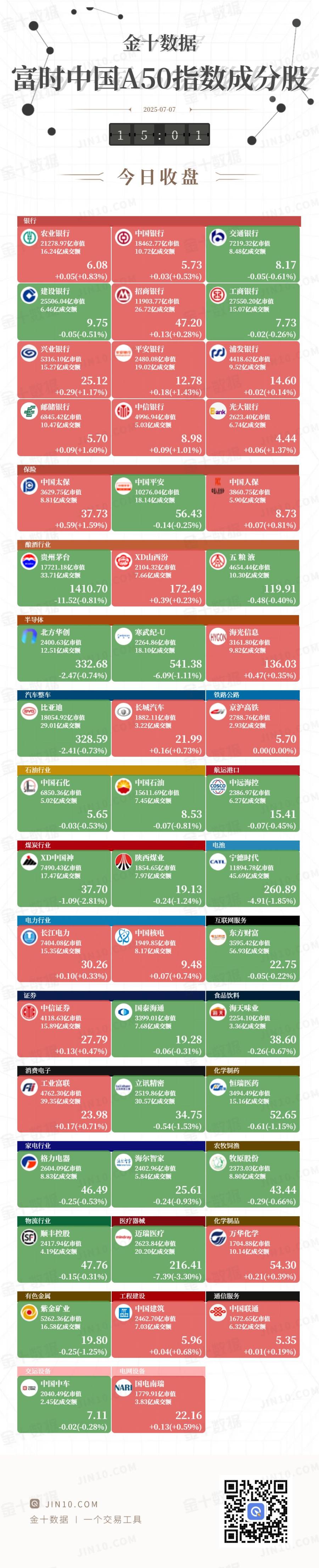
金十图示:2025年07月07日(周一)富时中国A50指数成分股今日收盘行情一览:银行股多数飘红,酿酒、保险、半导体板块走势分化
news flash· 2025-07-07 07:06
金十图示:2025年07月07日(周一)富时中国A50指数成分股今日收盘行情一览:银行股多数飘红,酿酒、保险、半导体板块走 势分化 +0.09(+1.60%) +0.09(+1.01%) +0.06(+1.37%) 保险 中国太保 中国平安 0.000 中国人保 08 3860.75亿市值 3629.75亿市值 10276.04亿市值 8.81亿成交额 18.14亿成交额 5.90亿成交额 37.73 8.73 56.43 +0.59(+1.59%) -0.14(-0.25%) +0.07(+0.81%) 酸酒行业 贵州茅台 XD山西分 五粮液 17721.18亿市值 2104.32亿市值 4654.44亿市值 33.71亿成交额 10.30亿成交额 7.66亿成交额 119.91 1410.70 172.49 -11.52(-0.81%) +0.39(+0.23%) -0.48(-0.40%) 半导体 北方华创 寒武纪-U 海光信息 HYGON 2400.63亿市值 2264.86亿市值 3161.80亿市值 12.51亿成交额 18.10亿成交额 9.82亿成交额 332.68 541.38 136.03 ...

欢迎订阅 | 势银《中国氢能及燃料电池产业月度分析报告》
势银能链· 2025-07-07 03:20
Core Viewpoint - The article emphasizes the rapid growth and development of the hydrogen energy industry, particularly in the areas of hydrogen production, storage, transportation, and fuel cells, highlighting significant project advancements and market dynamics in the first quarter of 2025 [4][9][11]. Group 1: Hydrogen Production Dynamics - The article discusses the dynamics of various hydrogen production technologies, including ALK, PEM, and AEM electrolysis methods, indicating a notable increase in project progress and bidding activities [6][11]. - In the first quarter of 2025, the scale of publicly awarded electrolysis projects increased significantly, with a growth of over 58 times compared to the same period in the previous year [9][10]. Group 2: Green Hydrogen Projects and Downstream Consumption - There are currently 788 green hydrogen projects in China, with 78 new projects added in the first quarter of 2025 [9]. - The article provides a detailed breakdown of new projects and updates, indicating a robust pipeline for green hydrogen initiatives [9]. Group 3: Hydrogen Storage, Transportation, and Refueling Stations - The article highlights the ongoing developments in hydrogen storage and transportation, as well as the establishment of refueling stations, which are critical for the hydrogen supply chain [6]. Group 4: Fuel Cell Industry Dynamics - The fuel cell market saw a total installed capacity of 47.6 MW in the first quarter of 2025, with Oriental Hydrogen leading the market with a share of 30.5% [13][17]. - The top five companies in the fuel cell sector have a high market concentration of 74.0%, indicating a competitive landscape [17].

周期论剑: 中报预判及大宗品下半年的推荐
2025-07-07 00:51
Summary of Conference Call Records Industry or Company Involved - The records primarily discuss the overall market outlook, particularly focusing on the stock market, energy sector, and various industries including steel, chemicals, and real estate. Core Points and Arguments 1. **Market Outlook**: The market is expected to reach 3,700 points in September and October, with July and August being the last opportunity for fund managers to increase their positions this year [1][2] 2. **Geopolitical and Economic Policy Impact**: Recent geopolitical tensions have eased, and the necessity for large-scale economic measures has decreased, impacting market expectations [3] 3. **Mid-Year Reporting Season**: The mid-year reporting season will significantly influence the market, especially with a high number of IPOs and increased selling pressure [5] 4. **Economic Policy Shift**: The Central Financial Committee's focus on reducing "involution" indicates a shift in economic policy towards improving living standards and addressing the issue of revenue without profit [6][7] 5. **Investment Strategy**: Investors are advised to switch between high and low sectors, focusing on electronics, non-ferrous metals, agriculture, and technology growth sectors [9] 6. **Non-Ferrous Metals Sector**: The non-ferrous metals sector is expected to benefit from policies aimed at reducing excessive capacity, particularly in copper and aluminum [10] 7. **OPEC+ Production Increase**: OPEC+ has decided to increase production by 550,000 barrels per day, which aligns with expectations but exceeds market predictions [12] 8. **Impact of the U.S. DAHLMA Act**: The DAHLMA Act is expected to lower costs for oil and gas companies, potentially leading to a short-term rebound in oil prices [13][14] 9. **Chemical Industry Outlook**: The basic chemical industry is anticipated to gradually recover by 2025, with recommendations for specific sectors such as explosives and price-increasing products [15] 10. **Steel Industry Recovery**: The steel sector is projected to enter a bottoming-up cycle over the next two to three years, driven by profit recovery and stable demand [20][22] 11. **Real Estate Market Dynamics**: The real estate sector is experiencing a reduction in land purchases, with major cities seeing significant increases in land sale revenues [25] 12. **Building Materials Sector Changes**: The building materials sector is undergoing significant changes, with expectations of improved profitability in cement and glass industries [27][29] Other Important but Possibly Overlooked Content 1. **Investment Recommendations**: Specific companies in various sectors are highlighted for their strong performance and potential, including Baosteel, China Northern Rare Earth Group, and others in the steel and non-ferrous metals sectors [24][10] 2. **Energy Sector Trends**: The energy sector is expected to see a shift in dynamics due to geopolitical factors and seasonal demand fluctuations, impacting pricing strategies [30][35] 3. **Market Sentiment**: The overall sentiment in the market is cautiously optimistic, with expectations of a balanced approach to investment amid fluctuating economic indicators [9][38] 4. **Long-term Projections**: The long-term outlook for various sectors, including energy and chemicals, suggests a gradual recovery and potential for growth, despite short-term volatility [16][38]
煤炭拐点清晰,反内卷下的供给变化和新能源新政的对火电影响详解
2025-07-07 00:51
Summary of Conference Call Records Industry Overview - The conference call primarily discusses the **coal industry** in China, focusing on supply-demand dynamics, pricing trends, and the impact of government policies on coal and energy production [1][2][3][4][5][6][7][8][9]. Key Points and Arguments 1. **Coal Consumption and Demand Forecast**: - Daily coal consumption is expected to exceed **2.3 million tons** this year, with peak demand in July and August likely to surpass expectations due to rising temperatures [1][3]. 2. **Coal Price Trends**: - Coal prices have declined to **640-650 CNY/ton**, influenced by increased imports and domestic supply from Inner Mongolia and Xinjiang, alongside low electricity demand during a warm winter [1][4][7]. - The price is projected to rebound to **670-680 CNY/ton** as temperatures rise, with a stable bottom expected between **610-650 CNY/ton** [1][8]. 3. **Future of Thermal Power and New Energy Installations**: - New energy installations are expected to peak in **2024** at approximately **350 GW**, but policy changes and subsidy withdrawals may suppress future growth [5]. - The most significant pressure on thermal power is anticipated in **2025**, with a gradual easing of pressure expected by **2026** and potential growth in **2027** [5]. 4. **Impact of Leadership Changes in Xinjiang**: - Recent leadership changes in Xinjiang may affect coal production capacity expansion, potentially leading to a reduction in new coal capacity in the medium to long term [6]. 5. **Supply and Import Dynamics**: - Domestic coal supply is stabilizing but slightly declining, with imports expected to total **450-460 million tons** for the year, reflecting a year-on-year decrease of **8-9 million tons** [7]. 6. **Market Supply-Demand Situation**: - The coal market is characterized by stable supply and rising demand, with a price bottom forming in early **2025** [8]. 7. **Government Policies on Market Competition**: - The Central Financial Committee's recent discussions emphasize the need to combat low-price competition and promote orderly market conditions, marking a shift towards market-driven adjustments rather than strict regulatory measures [2][9]. 8. **Lessons from the Cement Industry**: - The cement industry has successfully implemented collaborative production strategies to enhance profitability, which could serve as a model for other cyclical industries facing similar challenges [10][11]. Additional Important Insights - The coal industry is experiencing a **prisoner's dilemma** scenario, where companies continue production despite losses to maintain market share, complicating efforts to reduce supply and stabilize prices [12][13][14]. - The unique characteristics of the cement industry, such as lower transportation costs and easier production adjustments, contrast sharply with the complexities faced by the coal and other heavy industries [15]. - The steel market is currently viewed as the most favorable among commodity sectors, while the coking coal market faces significant challenges, with over **90%** of companies reporting losses in the second quarter [16][17]. Investment Recommendations - Short-term investment strategies should focus on leading companies in the coal sector, such as **Shaanxi Coal and Chemical Industry**, **China Shenhua Energy**, **China Coal Energy**, and **Jin控煤业**, as they align with current market trends and investment logic [18].
煤价磨底,供需重构 | 投研报告
Zhong Guo Neng Yuan Wang· 2025-07-07 00:46
Supply Side - The domestic raw coal production target for 2025 is approximately 4.8 billion tons, with slight increases expected in major production areas and continued growth in Xinjiang coal output, although the growth rate may decline due to fluctuating coal prices [1][2] - In April 2025, coal production contracted by over 50 million tons month-on-month due to low coal prices, while a slight recovery was observed in May in preparation for summer energy supply [1][2] - As of May 2025, 53.61% of coal companies are operating at a loss, indicating a persistent low price environment and potential production cuts among small and medium-sized coal enterprises [2] Import Side - The expected coal import volume for 2025 is 51 million tons, which, while lower than in 2024, remains at a high level, contributing to downward pressure on prices due to sufficient domestic supply [2] - Cumulative coal imports as of May 2025 reached 18.9 million tons, a year-on-year decrease of 7.95%, marking three consecutive months of decline [2] Demand Side - In the first five months of 2025, cumulative thermal power generation was 2,444.8 billion kWh, accounting for 65.60% of total generation, with a year-on-year decline of 2.88% due to competition from renewable energy sources [3] - Chemical coal demand has significantly increased, with high operating rates for methanol and urea, and construction material coal demand is expected to remain stable as the real estate sector stabilizes [3] - The supply of coking coal is expected to be ample, which may suppress coking coal prices, especially with seasonal declines in steel demand anticipated in July and August [3] Investment Recommendations - The coal sector is viewed as a high dividend target with long-term investment value, especially in the context of ongoing uncertainties in international relations and trade conflicts [4] - Companies recommended for attention include high-dividend, stable profit leaders like China Shenhua (601088.SH) and China Coal Energy (601898.SH), as well as companies that can mitigate price volatility like Xinjie Energy (601918.SH) [5]
国海证券晨会纪要-20250707
Guohai Securities· 2025-07-07 00:02
Group 1: Heavy Truck Industry - In June 2025, heavy truck sales in China saw a significant year-on-year increase, with wholesale and terminal sales growing approximately 29% and 36% respectively [4][5] - The overall beta of heavy trucks has strengthened due to strong internal demand, with a cumulative wholesale and terminal sales growth of about 6% and 16% respectively in the first half of 2025 [4] - The "old-for-new" policy is expected to accelerate demand, with the wholesale sales of heavy trucks in Q3 2025 likely to continue to rise, potentially leading to a non-seasonal peak [5][6] Group 2: Investment Strategy and Recommendations - The heavy truck industry is rated as "recommended," with key companies such as China National Heavy Duty Truck Group and Foton Motor expected to benefit from high operational leverage and new growth opportunities [6] - The report emphasizes the importance of capturing upward turning points in the market, particularly in the context of domestic demand recovery and high export penetration rates [6] Group 3: Toy Manufacturing Industry - Derlin International, a leading global toy manufacturer, is set to launch a new factory in Indonesia mid-2025, which will enhance its production capacity and meet growing customer demands [10][12] - The company reported a revenue of HKD 5.45 billion in 2024, with a net profit of HKD 740 million, indicating a slight revenue increase but a decline in net profit [10][11] - The North American market remains the largest for Derlin International, accounting for 42.26% of total sales in 2024, while the company is actively diversifying its customer base to mitigate risks associated with high customer concentration [11][12] Group 4: Pharmaceutical Industry - The report provides insights into Japan's healthcare modernization, highlighting the balance between quality, efficiency, and cost, which can serve as a reference for China's healthcare reforms [14][15] - Japan's healthcare system has achieved high life expectancy and low infant mortality rates while maintaining manageable healthcare costs, with a significant proportion of elderly citizens [14][15][16] Group 5: Gold Market Analysis - The report outlines the core logic behind gold price fluctuations, emphasizing its role as a non-renewable resource and its dual function as a consumption good and investment asset [19][20] - Investment demand for gold is projected to remain strong, with central bank purchases and jewelry demand being significant contributors to overall demand [20][21] - The report discusses the impact of actual interest rates on gold prices, noting that rising rates typically exert downward pressure on gold prices, while lower rates enhance its attractiveness [22][23] Group 6: Robotics Industry - The establishment of a 10 billion RMB humanoid robot industry investment fund in Hubei province aims to support key enterprises and technologies in the humanoid robotics sector [35][40] - Companies like Stepper have launched advanced torque motors and hollow actuators, indicating ongoing innovation and product development in the robotics field [36][40] - The report highlights the rapid growth and commercialization of humanoid robots, suggesting a significant investment opportunity in this emerging market [40][41]