
伊利股份

Search documents
食品饮料行业周报:行业继续筑底,关注高股息品种-20251012
Shenwan Hongyuan Securities· 2025-10-12 11:13
Investment Rating - The report maintains a "Positive" investment rating for the food and beverage industry, with a focus on structural opportunities within the sector [2][3]. Core Insights - The industry is in a bottoming phase, particularly for the liquor segment, which requires patience as it undergoes inventory destocking and price stabilization. The report emphasizes the importance of identifying structural opportunities in food companies [3][7]. - Key recommendations include high-dividend stocks such as Guizhou Moutai, Shanxi Fenjiu, and Luzhou Laojiao in the liquor sector, and Yili, Qingdao Beer, and Uni-President in the consumer goods sector [3][7][9]. - The report anticipates a 20-30% year-on-year decline in overall liquor demand during the 2025 Mid-Autumn Festival and National Day, with inventory levels expected to increase by 10-20% [8][9]. Summary by Sections 1. Weekly Insights on Food and Beverage - The food and beverage sector experienced a slight decline of 0.15% last week, with liquor down 1.17%, underperforming the Shanghai Composite Index by 0.52 percentage points [6][32]. - The report highlights the performance of various sub-sectors, noting that beverage and dairy products outperformed the benchmark index [32]. 2. Market Performance of Food and Beverage Sectors - The report indicates that the beverage and dairy sector outperformed the benchmark index by 3.16 percentage points, while the liquor sector underperformed by 0.75 percentage points [32][38]. 3. Liquor Sector Analysis - Current prices for Moutai are 1765 RMB for loose bottles and 1795 RMB for boxed sets, both down 35 RMB from the previous period. The report expects continued pressure on liquor companies' financials through Q3 2025 [8][14]. - The report notes that the liquor industry is entering a destocking phase, with a significant time required for inventory digestion and price stabilization [8][9]. 4. Consumer Goods Sector Analysis - The report maintains a positive outlook on the dairy sector, citing cost reductions and supply-demand improvements as key trends. Recommendations include Yili and New Dairy [9][30]. - The snack and beverage segments are highlighted for their structural growth opportunities, with specific recommendations for companies like Uni-President and Wei Long [9][30].





食品饮料周观点:秋糖在即,关注品类、渠道等边际反馈-20251012
GOLDEN SUN SECURITIES· 2025-10-12 09:43
Investment Rating - The report maintains an "Increase" rating for the food and beverage industry [5] Core Views - The upcoming autumn sugar festival is expected to provide insights into brand strategies, product matrices, and channel transformations in the liquor sector, particularly focusing on new channel developments [2] - The report highlights that the white liquor sector is currently at a double bottom in terms of fundamentals and expectations, with further sales improvements anticipated during the Mid-Autumn Festival and National Day [2] - The beverage sector is seeing significant competition and innovation, with companies like East Peak Beverage accelerating their listing process on the Hong Kong Stock Exchange [3] Summary by Sections White Liquor - The autumn sugar festival will focus on terminal sales dynamics, inventory pricing, channel changes, and category expansion [2] - The report anticipates that Q3 financial results will show continued pressure release, with expectations for gradual improvement in sales and channel performance [2] Beer and Beverages - The report notes organizational changes at Lanzhou Yellow River, which has established a beverage division to seek higher growth [3] - The beer sector is entering a low season, and the report suggests focusing on stable growth leaders and key products [3] - East Peak Beverage's renewed application for a public listing indicates a fast-tracking of its dual listing strategy [3] Food Sector - The Mid-Autumn Festival and National Day have been identified as critical periods for consumer spending, with online sales leading the growth [4] - The report mentions that the sales of mooncakes reached 13.98 million boxes, a year-on-year increase of 1.75% [4] - Wanchen Group has received clearance from the State Administration for Market Regulation regarding its anti-monopoly review, allowing it to recover minority shareholder rights [4]
大众品25Q3业绩前瞻:把握新品新渠道中的结构性成长机会
ZHESHANG SECURITIES· 2025-10-12 09:21
Investment Rating - The industry investment rating is "Positive" (maintained) [2] Core Insights - The report highlights structural growth opportunities in new products and channels within the consumer goods sector, particularly in the context of the 25Q3 performance forecast [2] - The performance of various sub-sectors is expected to vary, with specific companies showing significant growth potential due to category advantages and new channel expansions [10][12][14][15][16][19][21][22] Sub-sector Summaries 1.1 Snack Foods - The performance in 25Q3 is expected to be differentiated, with companies like Wanchen Group projected to achieve a revenue growth of 39% and a net profit growth of 382% [2][25] - Emphasis is placed on companies that can leverage category trends and new channel opportunities for sustained growth [10][11] 1.2 Soft Drinks - The energy drink segment is showing improved market conditions, with companies like Dongpeng Beverage expected to see a revenue growth of 31% and a net profit growth of 33% [2][25] - The report suggests focusing on companies with strong brand power and channel capabilities for long-term growth [12][13] 1.3 Dairy Products - The dairy sector is anticipated to experience flat demand in 25Q3, with companies like Yili expected to see only a 2% revenue growth [2][25] - The report indicates that profitability may improve once raw milk prices stabilize [14] 1.4 Tea Drinks - The market is characterized by a leading player, Mixue Group, which is expected to expand its competitive edge through enhanced product offerings [2][15] - The mid-price segment is highlighted as a key growth area, with recommendations for companies like Guming [15] 1.5 Health Supplements - The report notes a trend towards increased concentration in the B-end market, with companies like Xianle Health projected to achieve a revenue growth of 15% [2][25] - The C-end market is advised to focus on high-growth single products [16][17] 1.6 Ready-to-Drink Alcohol - The performance in 25Q3 is expected to be strong, with companies like Bairun expected to see an 8% revenue growth [2][25] - New product launches are anticipated to drive sales growth [18] 1.7 Beer - The impact of the "drinking ban" is expected to be limited, with Qingdao Beer projected to achieve a 2% revenue growth and an 8% net profit growth [2][25] - The report suggests that the beer sector will see stable growth driven by structural upgrades and cost improvements [19][20] 1.8 Condiments - Leading companies like Haitian Flavoring are expected to maintain stable performance, with a revenue growth of 7% [2][25] - The report emphasizes the importance of robust market strategies during periods of flat demand [21] 1.9 Frozen Foods - The sector is facing weak demand, with companies like Anjixin expected to see a 6% revenue growth [2][25] - The report advises monitoring the recovery of the restaurant supply chain for potential investment opportunities [22][23] 1.10 Marinated Products - The focus is on improving store operations as the sector continues to recover from previous challenges [24] Key Company Tracking - The report provides a detailed forecast for various companies across different segments, highlighting expected revenue and net profit growth rates for 25Q3 [25]





信用债周度观察(20250928-20251011):信用债发行量季节性下降,各行业信用利差涨跌互现-20251012
EBSCN· 2025-10-12 08:09
Report Industry Investment Rating - No industry investment rating is provided in the report. Core Viewpoints - The issuance volume of credit bonds decreased seasonally, and the credit spreads of various industries showed mixed trends [1][25]. Summary According to Relevant Catalogs 1. Primary Market 1.1 Issuance Statistics - From September 28 to October 11, 2025, a total of 119 credit bonds were issued, with a total issuance scale of 141.362 billion yuan, a month - on - month decrease of 75.82% [1][11]. - Among them, 39 industrial bonds were issued, with a scale of 64.185 billion yuan, a month - on - month decrease of 75.75%, accounting for 45.40% of the total credit bond issuance scale; 70 urban investment bonds were issued, with a scale of 43.777 billion yuan, a month - on - month decrease of 72.63%, accounting for 30.97%; 10 financial bonds were issued, with a scale of 33.4 billion yuan, a month - on - month decrease of 79.11%, accounting for 23.63% [1][11]. - The average issuance term of credit bonds was 2.44 years, with industrial bonds at 1.63 years, urban investment bonds at 2.80 years, and financial bonds at 3.16 years [2][14]. - The average issuance coupon rate of credit bonds was 2.34%, with industrial bonds at 2.12%, urban investment bonds at 2.45%, and financial bonds at 2.35% [2][18]. 1.2 Cancellation of Issuance Statistics - Three credit bonds were cancelled for issuance during the period [23]. 2. Secondary Market 2.1 Credit Spread Tracking - By industry, among Shenwan primary industries, the largest upward adjustment of AAA - rated industry credit spreads was in the building decoration industry, up 2.6BP, and the largest downward adjustment was in the media industry, down 4BP; for AA + - rated industry credit spreads, the largest upward adjustment was in the chemical industry, up 6.6BP, and the largest downward adjustment was in the non - ferrous metals industry, down 8.6BP; for AA - rated industry credit spreads, the largest upward adjustment was in the non - bank finance industry, up 6.7BP, and the largest downward adjustment was in the machinery and equipment industry, down 5BP [3][25]. - Coal credit spreads generally increased, while steel credit spreads generally decreased. The AAA and AA + - rated coal credit spreads increased by 0.3BP and 0.5BP respectively, and the AAA and AA + - rated steel credit spreads decreased by 1.1BP and 2.7BP respectively [25]. - The credit spreads of urban investment bonds of each rating showed mixed trends, while non - urban investment credit spreads generally increased. The credit spreads of the three - level urban investment bonds decreased by 0.2BP, increased by 0.6BP, and increased by 1.7BP respectively; the credit spreads of the three - level non - urban investment bonds increased by 0.1BP, increased by 2.3BP, and increased by 1.3BP respectively [25]. - The credit spreads of state - owned enterprises showed mixed trends, while those of private enterprises generally increased. The credit spreads of the three - level central state - owned enterprises decreased by 0.7BP, decreased by 0.3BP, and decreased by 1.1BP respectively; the credit spreads of the three - level local state - owned enterprises increased by 0.6BP, increased by 1.8BP, and increased by 2BP respectively; the AAA and AA + - rated private enterprise credit spreads increased by 10.9BP and 0.8BP respectively [25][26]. - Regionally, the credit spreads of urban investment bonds showed mixed trends. The regions with the highest AAA - rated credit spreads were Liaoning, Shaanxi, and Jilin, with spreads of 101, 94, and 91BPs respectively; for AA + - rated, they were Qinghai, Shaanxi, and Gansu, with spreads of 144, 131, and 125BPs respectively; for AA - rated, they were Shaanxi, Sichuan, and Guangxi, with spreads of 154, 154, and 153BPs respectively. In terms of month - on - month changes, the largest upward adjustment of AAA - rated credit spreads was in Henan, up 7.2BP, and the largest downward adjustment was in Shaanxi, down 4.7BP; for AA + - rated, the largest upward adjustment was in Hunan, up 8BP, and the largest downward adjustment was in Yunnan, down 4.9BP; for AA - rated, the largest upward adjustment was in Guangxi, up 26.8BP, and the largest downward adjustment was in Yunnan, down 5BP [25][27]. 2.2 Trading Volume Statistics - The total trading volume of credit bonds was 855.283 billion yuan, a month - on - month decrease of 47.12%. The top three in terms of trading volume were commercial bank bonds, corporate bonds, and medium - term notes. Specifically, the trading volume of commercial bank bonds was 254.914 billion yuan, a month - on - month decrease of 47.74%, accounting for 29.80% of the total credit bond trading scale; the trading volume of corporate bonds was 237.461 billion yuan, a month - on - month decrease of 52.14%, accounting for 27.76%; the trading volume of medium - term notes was 17.722 billion yuan, a month - on - month decrease of 45.30%, accounting for 20.72% [4][28]. 2.3 Actively Traded Bonds This Period - The report selects the top 20 urban investment bonds, industrial bonds, and financial bonds in terms of trading volume for investors' reference [30].
关联交易“去优留劣”?多家“空壳”经销商存疑,菊乐股份8年上市路终落定?
Zhong Guo Ji Jin Bao· 2025-10-11 15:50
Core Viewpoint - Jule Co., Ltd. is transitioning to the Beijing Stock Exchange after multiple failed IPO attempts on the Shenzhen Stock Exchange, amid significant leadership changes following the death of its chairman, Tong Enwen [1][2] Group 1: Company Leadership and Ownership - Following the death of chairman Tong Enwen, his daughter, Tong Zhu, inherited 73.35% of the company's shares, becoming the actual controller of Jule Co., Ltd. [1] - Gao Zhaohui, Tong Zhu's spouse, is now the chairman and general manager of the company [1] Group 2: Financial Performance and IPO Plans - Jule Co., Ltd. plans to raise 5.52 billion yuan through its IPO, a reduction of 8.11 billion yuan from previous plans [10] - The company has shown revenue growth of 5.1% and net profit growth of 18.4% for 2024, despite a general industry downturn [7][10] Group 3: Related Party Transactions - Concerns have been raised regarding potential irregularities in related party transactions, including higher sales prices to affiliated companies compared to third-party sales [3][4] - The company has been criticized for "going for the inferior" in transactions, acquiring less profitable subsidiaries while paying additional amounts [4][5] Group 4: Market Position and Competition - Jule Co., Ltd. relies heavily on the Sichuan market, with nearly 76% of its revenue coming from the region, which may limit growth potential [11] - The company faces intense competition from both regional and national dairy giants, with a market share of only 0.31% in the dairy industry from 2020 to 2022 [12] Group 5: Production Capacity and Utilization - The company's production capacity utilization has fluctuated, with rates of 85.29%, 78.44%, and 84.49% from 2022 to 2024 [10] - The industry is experiencing overcapacity, with a decline in national milk production expected in 2024, which may impact Jule Co., Ltd.'s growth [11][12]
关联交易“去优留劣”?多家“空壳”经销商存疑,菊乐股份8年上市路终落定?
中国基金报· 2025-10-11 15:47
Core Viewpoint - The article discusses the challenges faced by Jule Co., Ltd. in its IPO journey, highlighting concerns over related party transactions and the company's financial health amidst industry competition and potential overcapacity [2][7]. Group 1: Company Overview - Jule Co., Ltd. has transitioned to the Beijing Stock Exchange after multiple failed attempts to list on the Shenzhen Stock Exchange over seven years [2]. - The company is known for its popular products "Suanle Milk" and "Chewable Yogurt," which have a strong market presence in Sichuan [2]. Group 2: Leadership Changes - The company's actual controller and chairman, Tong Enwen, passed away on September 6, 2025, leading to his daughter, Tong Zhu, inheriting 73.35% of the shares and becoming the new actual controller [2][3]. - Tong Zhu's spouse, Gao Zhaohui, is now the chairman and general manager of Jule Co., Ltd. [3]. Group 3: Related Party Transactions - Concerns have been raised regarding potential irregularities in related party transactions, particularly the "go for the inferior, leave the superior" practice, where the company may be favoring less profitable subsidiaries [5][6]. - Jule Co., Ltd. has been involved in transactions with its major supplier, Gansu Qianjin Modern Agriculture Development Group, which is also a related party, raising questions about the legitimacy of these dealings [5][6]. Group 4: Financial Performance - Despite a general downturn in the industry, Jule Co., Ltd. reported a revenue growth of 5.1% and a net profit increase of 18.4% for 2024, contrasting with the declining performance of its peers [10]. - The company’s revenue from related parties has been significant, with procurement from related parties accounting for 10% to 16% of total purchases from 2019 to 2021 [6][10]. Group 5: Distribution Channels - Jule Co., Ltd. relies heavily on distributors, with distributor revenue accounting for 75.7% to 70% of total revenue from 2022 to 2024, and distributor gross margins exceeding direct sales [9][10]. - The company has faced scrutiny over the sustainability of its revenue growth, particularly given the unusual performance of certain small distributors that contributed significantly to revenue but had limited operational history [10][11]. Group 6: Capacity Utilization and Market Challenges - The company has experienced fluctuating capacity utilization rates, with figures of 85.29%, 78.44%, and 84.49% from 2022 to 2024, indicating potential inefficiencies [13]. - Jule Co., Ltd. faces significant competition from both regional and national dairy giants, with a heavy reliance on its flagship product "Suanle Milk," which may limit growth prospects [14][15].


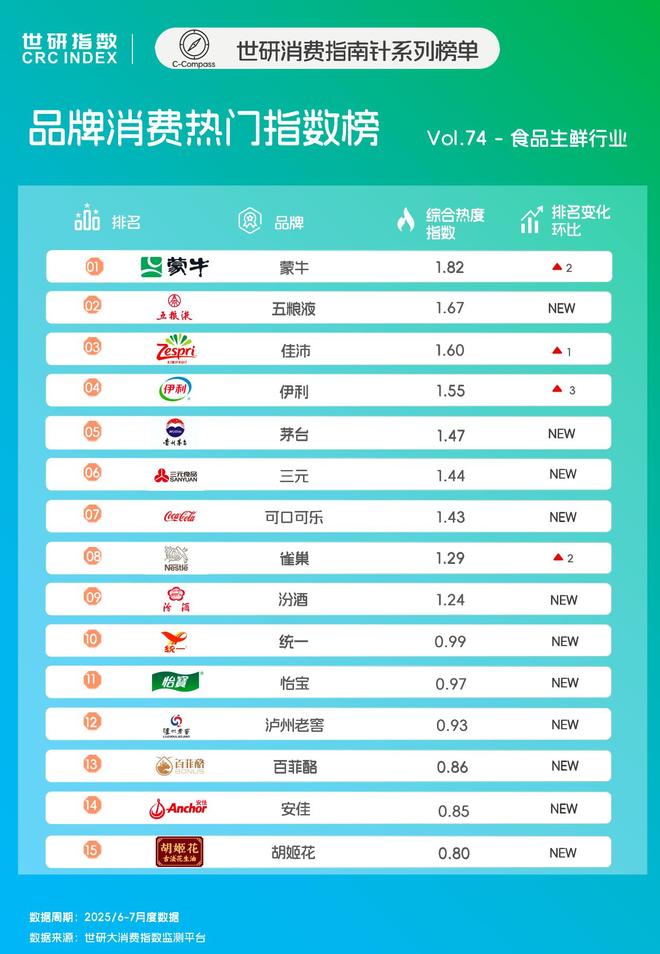
乳品聚焦夏季营养补给,特色食材价值重构|世研消费指数品牌榜Vol.74
3 6 Ke· 2025-10-11 11:04
Group 1 - The core viewpoint of the articles highlights the innovation in the dairy industry, focusing on health technology and targeted nutritional solutions to meet summer dietary needs [2] - Major dairy brands such as Mengniu, Yili, and San Yuan are leveraging biotechnological breakthroughs to address specific consumer pain points, such as children's immunity and digestive sensitivity [2] - The report indicates a shift from homogeneous nutritional offerings to precise health management, driven by technological advancements and unique processing methods [2] Group 2 - The scarcity attributes of specialty ingredients are reshaping their value, with brands like Zespri and Hu Jihua enhancing product appeal through health claims and cultural connections [3] - Zespri is positioning its products as "healthy luxury symbols" by utilizing unique varieties and premium packaging, while Hu Jihua emphasizes traditional craftsmanship to differentiate its peanut oil [3] - Brands like Coca-Cola and Yibao are effectively tapping into basic consumer needs, transforming their products into emotional and experiential offerings [3] Group 3 - The report outlines a comprehensive index evaluation system developed by Shiyan Index, which includes various consumption trend reports across multiple industries [4] - The index aims to objectively present trends in consumer behavior, assisting brands and industries in tracking market dynamics and enhancing competitive strength [4]

研判2025!中国婴幼儿配方羊奶粉行业进入壁垒、市场政策、产业链、销售规模、竞争格局及发展趋势分析:市场竞争从“增量抢滩”转向“存量博弈”[图]
Chan Ye Xin Xi Wang· 2025-10-11 01:26
Core Insights - The increasing awareness and acceptance of goat milk powder among consumers, particularly young families, is driving rapid market growth due to its nutritional benefits and better absorption characteristics [1][7] - In 2024, the retail volume of infant formula goat milk powder in China is projected to reach 50,000 tons, a year-on-year increase of 5.93%, accounting for 71.43% of the total goat milk powder retail volume [1][7] - The retail value of infant formula goat milk powder is expected to reach 18.8 billion yuan, with a year-on-year growth of 8.67%, representing 75.20% of the total retail value of goat milk powder [1][7] Industry Overview - Goat milk powder is made from goat and sheep milk, which has fat globule sizes similar to human milk and a protein structure that closely resembles it, making it suitable for infants with sensitive stomachs or allergies to cow's milk [2][3] - The infant formula goat milk powder market is categorized into three stages based on the age of infants: Stage 1 (0-6 months), Stage 2 (6-12 months), and Stage 3 (12-36 months) [3] Market Policies - Recent policies in China, such as the "14th Five-Year Plan for Dairy Industry Competitiveness Enhancement" and various guidelines for rural revitalization and high-quality development, provide a favorable environment for the growth of the infant formula goat milk powder industry [4] Industry Chain - The upstream of the infant formula goat milk powder industry includes milk source (goat and sheep farming), auxiliary materials, production equipment, and packaging materials, with high-quality milk sources being crucial for product quality [5][6] - Major goat milk farming regions in China include Shaanxi, Shandong, and Henan, with some companies establishing their own farms to ensure quality and safety [5] Competitive Landscape - The domestic brands dominate the infant formula goat milk powder market, accounting for over 90% of registered products, with a high market concentration where the top five companies hold a 60.8% market share [6][8] - Companies like Ausnutria and Yipin Nutrition are key players, with Ausnutria being the first infant formula company listed in Hong Kong and having a significant global presence [8][10] Development Trends - The importance of milk sources will continue to rise, with fresh milk becoming the mainstream raw material, and companies adopting short-chain processing techniques to retain natural nutrients [10] - Innovations in formulations will focus on enhancing nutritional elements such as DHA, ARA, and probiotics, while also addressing the needs of infants with allergies through low-allergen and easily digestible products [10][11]

败诉!蒙牛被判不正当竞争,赔偿伊利500万
Guo Ji Jin Rong Bao· 2025-10-10 15:52
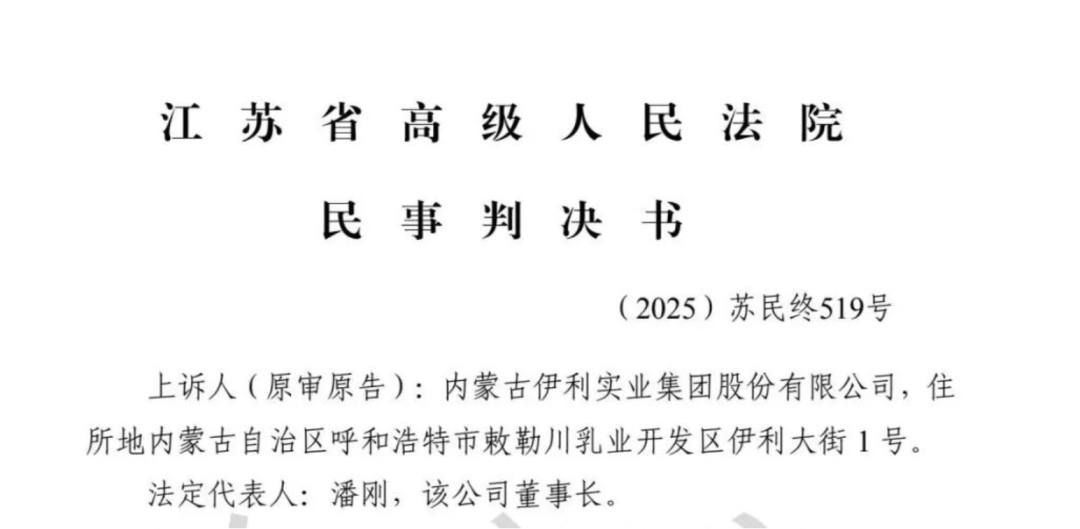
Core Viewpoint - The recent court ruling in favor of Yili against Mengniu highlights ongoing competition and branding issues in the dairy industry, particularly regarding packaging similarities that can confuse consumers [1][8]. Legal Dispute Summary - The Jiangsu Provincial High Court ruled that Mengniu's "Selected Pasture" milk packaging closely resembles Yili's "Jindian" packaging, constituting unfair competition. Mengniu is required to cease the infringing behavior and pay Yili 5 million yuan in damages [1][8]. - Yili requested Mengniu to publish a statement in major newspapers to mitigate the negative impact of the infringement [1]. Packaging Similarity Analysis - The packaging of Yili's "Jindian" and Mengniu's "Selected Pasture" is described as "highly similar," particularly in color scheme and layout, which could lead to consumer confusion [3][4]. - A survey indicated that 82.6% of respondents found the packaging similar, and 83.9% believed there was a connection between the two products [4]. Court Findings - The court determined that the similarity in packaging focuses on the main identifying features and overall visual effect rather than a detailed comparison of each side [6]. - The high recognition of Yili's packaging, combined with the similarities and the potential for consumer confusion, led to the conclusion that Mengniu's actions constituted unfair competition [7][8]. Historical Context of Disputes - This is not the first dispute between Yili and Mengniu over packaging. Previous cases include a 2015 ruling where Mengniu was found to have engaged in unfair competition regarding the "Future Star" yogurt [10][12]. - In 2023, Yili also sued Mengniu's subsidiary for similar reasons, resulting in Mengniu changing its packaging and paying compensation [14]. Market Position and Financial Performance - Yili's revenue for the first half of the year was 61.933 billion yuan, a 3.37% increase, while Mengniu's revenue was 41.567 billion yuan, a 6.95% decline, indicating a widening gap between the two companies [15]. - Yili's diverse business structure, including significant revenue from milk powder and ice cream, contrasts with Mengniu's reliance on liquid milk, which has seen a decline in sales [17][18].
食品饮料行业深度报告:食品饮料:存量时代的品牌突围路径
Capital Securities· 2025-10-10 13:12
Investment Rating - The report rates the food and beverage industry as "Positive" [1] Core Insights - The food and beverage sector is entering a "stock era" where consumption per capita has peaked, leading to dual pressure on volume and price. This shift necessitates a change in investment logic, with leading companies focusing on shareholder returns and high dividend yields to provide a safety margin [5][18] - Brands are adapting to the trend of consumption substitution by enhancing product cost-effectiveness or quality-price ratios, which may lead to a restructuring of the industry landscape [5] - There are localized opportunities benefiting from consumption upgrades, particularly in categories like juice and liquid milk, where consumers are willing to pay more for improved quality [5] - The emergence of niche products catering to specific consumer groups, particularly among Generation Z, is noted, with these products often having emotional attributes and social relevance [5] - Changes in traffic and channel dynamics present new opportunities for smaller and new brands, with the growth of discount supermarkets and high-end membership stores expected to drive industry growth [5] - Domestic food and beverage brands are increasingly looking to expand overseas, particularly in Southeast Asia, where the market for snacks is projected to exceed $20 billion in 2024, presenting significant growth potential [5] Summary by Sections 1. Characteristics of the Stock Era - The overall consumption market has shown moderate recovery, with retail sales in China reaching 32.39 trillion yuan from January to August 2025, a year-on-year increase of 4.6% [14] - The food and beverage industry shows internal differentiation, with some sub-sectors like fresh meat and edible oils experiencing growth, while others like liquor and beer face declines [15] 2. Brand Breakthrough Paths in Food and Beverage - The report emphasizes the importance of enhancing product value propositions to maintain competitive advantages amid rising consumption substitution trends [5] - It highlights the significance of localized consumption upgrades in specific product categories, which can drive higher consumer spending [5] 3. Sub-industry Analysis - The report provides detailed insights into various sub-industries, including liquor, beer, dairy products, condiments, snacks, and soft drinks, analyzing their performance and market dynamics [7] 4. Investment Recommendations - The report suggests that leading companies in the food and beverage sector are increasingly focusing on shareholder returns, with a notable rise in dividend rates, particularly in the liquor industry [33]