
东鹏饮料

Search documents
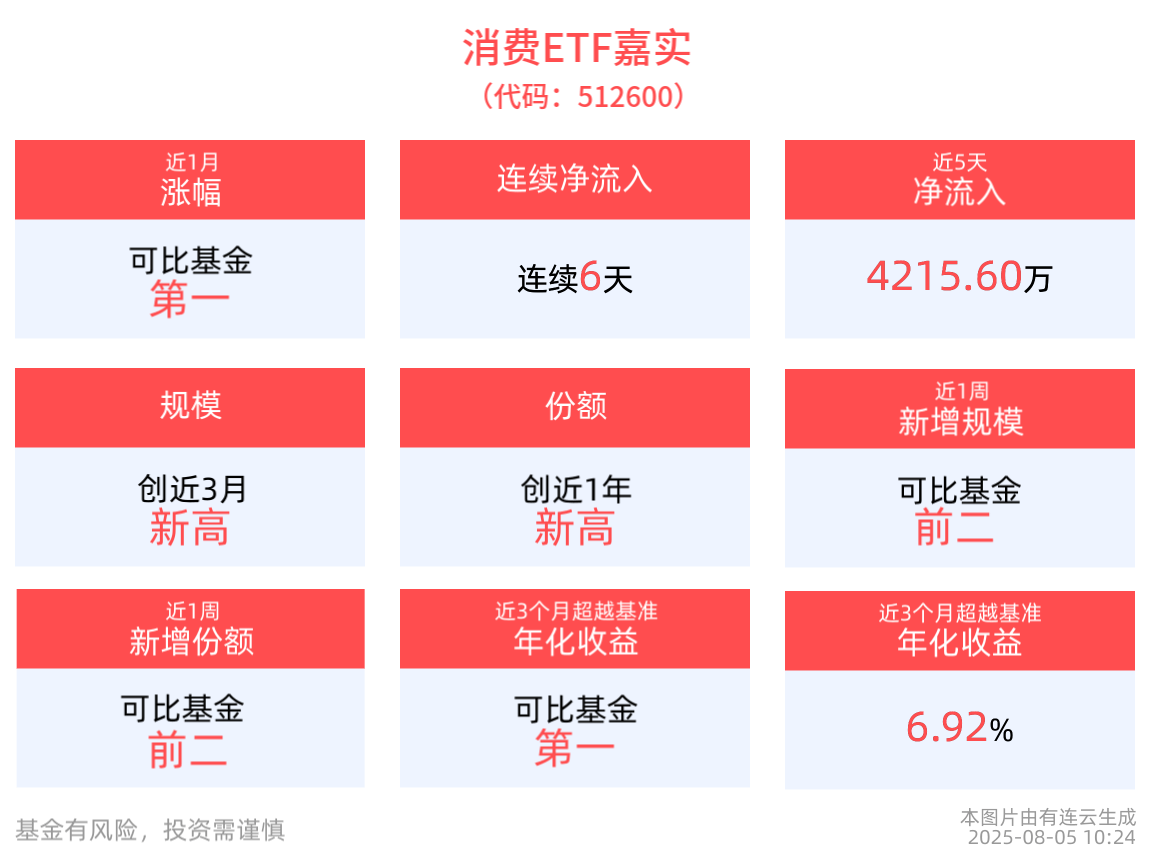
近6天获得连续资金净流入,消费ETF嘉实(512600)最新规模创近3月新高!
Sou Hu Cai Jing· 2025-08-05 02:51
Group 1 - The core viewpoint of the news highlights the performance and liquidity of the Consumption ETF managed by Jiashi, which has seen significant inflows and growth in both scale and shares [2][3] - As of August 4, the Consumption ETF Jiashi achieved a scale of 549 million yuan, marking a three-month high, and its shares reached 799 million, the highest in nearly a year [2] - The ETF has experienced continuous net inflows over the past six days, with a peak single-day net inflow of 13.37 million yuan, totaling 54.89 million yuan [2] Group 2 - The net asset value of the Consumption ETF Jiashi has increased by 4.55% over the past six months, ranking in the top two among comparable funds [2] - The ETF's highest monthly return since inception was 24.50%, with the longest streak of consecutive monthly gains being seven months and an overall increase of 66.83% [2] - The current price-to-earnings ratio (PE-TTM) of the index tracked by the ETF is 18.83, which is in the 9.13% percentile over the past year, indicating a historically low valuation [2] Group 3 - The news also mentions that the government has allocated 690 billion yuan for consumer goods replacement programs, with plans to distribute another 690 billion yuan in October, contributing to a total of 3 trillion yuan for the year [3] - The liquor industry is reportedly bottoming out, with leading companies adjusting their channel structures to enhance market capabilities, which may lead to growth opportunities if consumer demand improves [3] - The Consumption ETF Jiashi tracks the major consumption index, which includes leading A-share companies across various sectors, with liquor being the largest segment at 45% weight [3]

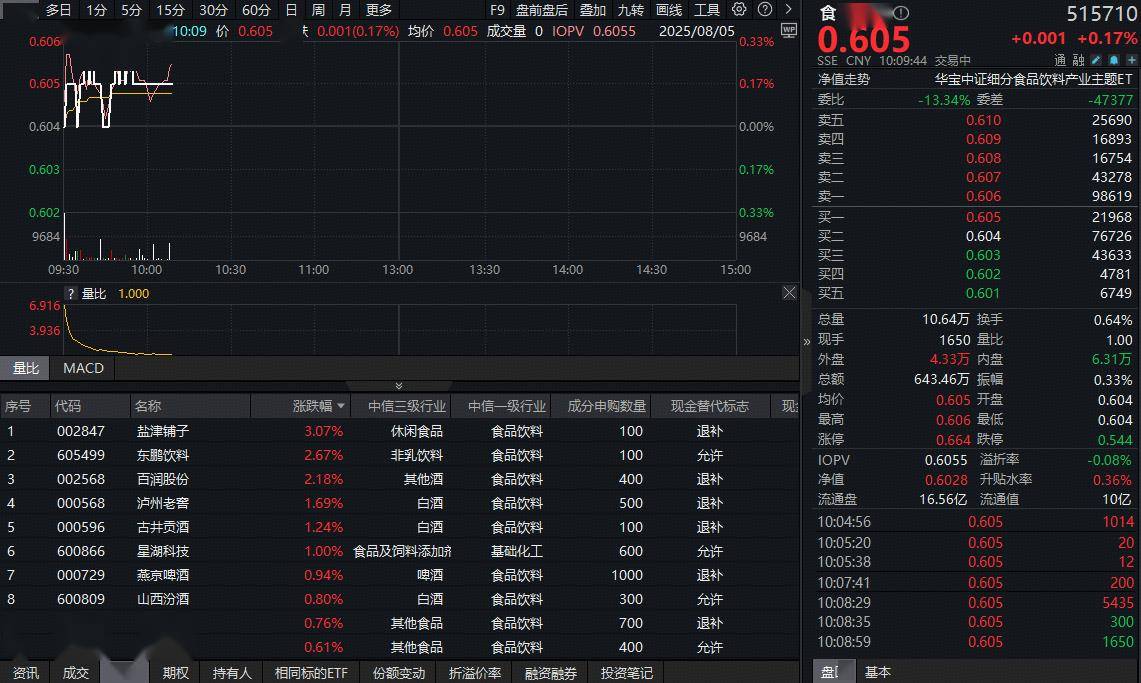
ETF盘中资讯|茅台回购已超53亿元!吃喝板块震荡走高,食品ETF(515710)红盘上扬!
Sou Hu Cai Jing· 2025-08-05 02:34
值得注意的是,吃喝板块当前估值仍处低位。数据显示,截至昨日(8月4日)收盘,食品ETF(515710)标的指数细分食品指数市盈率为19.87倍,位于近 10年来3.52%分位点的低位,中长期配置性价比凸显。 深港证券指出,当前白酒板块处于寻底过程中,短期内行业对白酒市场秩序和批价管控压力上市,二季度业绩预期或将难以明显转好,年内报表压力或逐季 度得到释放。在近期市场整体波动回升情况下,低估值的顺周期板块有望逐步受到市场重视,建议关注后续新增政策对消费板块的催化。 吃喝板块今日(8月5日)震荡走高,反映吃喝板块整体走势的食品ETF(515710)持续红盘震荡,截至发稿,场内价格涨0.17%。 成份股方面,大众品及白酒龙头均有亮眼表现。截至发稿,盐津铺子大涨超3%,东鹏饮料、百润股份涨超2%,泸州老窖、古井贡酒等多股涨超1%。 | | 案日 14 | રસ્ત | 15分 30分 ୧୦સ | 日 周 月 | 日本 | | F9 盘前盘后 叠加 九转 | | 画线 丁目 | 60 2 | | 9 | 515 | | --- | --- | --- | --- | --- | --- | --- | --- | -- ...

茅台回购已超53亿元!吃喝板块震荡走高,食品ETF(515710)红盘上扬!
Xin Lang Ji Jin· 2025-08-05 02:23
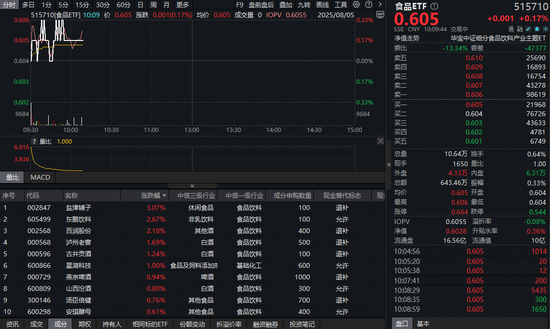
吃喝板块今日(8月5日)震荡走高,反映吃喝板块整体走势的食品ETF(515710)持续红盘震荡,截至 发稿,场内价格涨0.17%。 深港证券指出,当前白酒板块处于寻底过程中,短期内行业对白酒市场秩序和批价管控压力上市,二季 度业绩预期或将难以明显转好,年内报表压力或逐季度得到释放。在近期市场整体波动回升情况下,低 估值的顺周期板块有望逐步受到市场重视,建议关注后续新增政策对消费板块的催化。 方正证券表示,今年以来居民消费逐步释放,但市场回升仍需观望。当前食品饮料估值已处相对低位, 高层会议着力强调扩大内需,以民生为抓手,或将催化板块向好,看好底部布局机会。 一键配置吃喝板块核心资产,重点关注食品ETF(515710)。根据中证指数公司统计,食品ETF (515710)跟踪中证细分食品饮料产业主题指数,约6成仓位布局高端、次高端白酒龙头股,近4成仓位 兼顾饮料乳品、调味、啤酒等细分板块龙头股,前十权重股包括"茅五泸汾洋"、伊利股份、海天味业 等。场外投资者亦可通过食品ETF联接基金(A类012548/C类012549)对吃喝板块核心资产进行布局。 图片、数据来源:沪深交易所等,截至2025.8.5。 成份股方面 ...
中原证券晨会聚焦-20250805
Zhongyuan Securities· 2025-08-05 00:58
Core Insights - The report highlights the significant growth in the new energy vehicle (NEV) market, with a penetration rate of 44.3% in the first half of the year, marking a historical high for the same period [5][8] - The Shanghai government has implemented measures to support enterprises in enhancing basic research, aiming to boost high-quality development [5][8] - Beijing has introduced a mechanism to promote investment growth in future industries through 16 measures, tailored to local conditions [5][8] Domestic Market Performance - The Shanghai Composite Index closed at 3,583.31, with a slight increase of 0.66%, while the Shenzhen Component Index rose by 0.46% to 11,041.56 [3] - The average price-to-earnings ratios for the Shanghai Composite and ChiNext indices are 14.60 and 40.70, respectively, indicating a suitable environment for medium to long-term investments [8][15] Industry Analysis - The report indicates a recovery in the engineering machinery and industrial robotics sectors, with the AIDC industry showing high prosperity [34] - The food and beverage sector has seen a slight increase, particularly in the white wine and cooked food segments, despite overall underperformance in the first half of the year [18][19] - The photovoltaic industry has rebounded significantly, with a 9.73% increase in the index, driven by policies aimed at curbing low-price competition [22][24] New Energy Vehicle Industry - The global sales of electric vehicles are projected to exceed 20 million units by 2025, with China's market leading in both total volume and growth rate [26][27] - The report emphasizes the comprehensive development of the NEV industry chain in Henan Province, which includes upstream raw materials, midstream components, and downstream vehicle manufacturing [25][27] New Energy Storage Industry - The new energy storage sector is experiencing rapid growth, with a significant increase in installed capacity expected to reach over 30 million kilowatts by 2025 [28][32] - The report outlines the importance of lithium-ion batteries in the storage market, highlighting the competitive landscape and the need for technological advancements [29][33] Capital Market Insights - The report notes that the capital market is expected to maintain a stable upward trend, supported by favorable policies and liquidity conditions [8][15] - The focus on technology growth and cyclical manufacturing sectors is recommended for future investments, particularly in software development, photovoltaic equipment, and pharmaceuticals [15][18]

券商8月金股,来了
Shang Hai Zheng Quan Bao· 2025-08-04 14:11
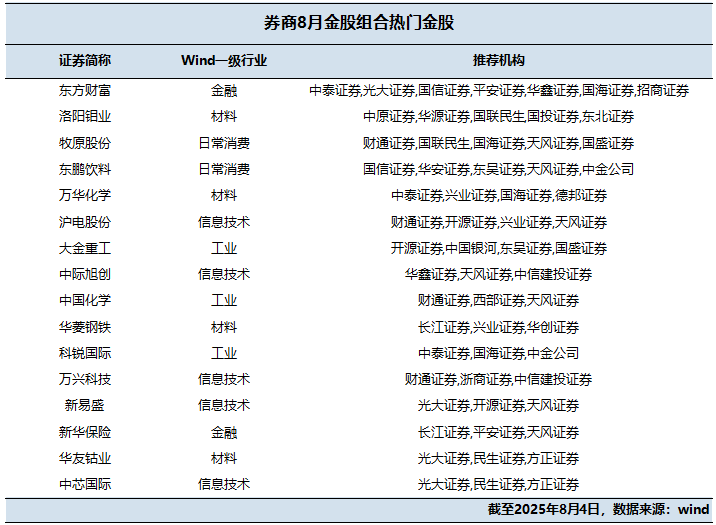
Core Insights - The article highlights the increasing attention on Dongfang Caifu, which has become the most popular stock among brokerages in August, indicating a positive outlook for the A-share market overall [1][2] Group 1: Stock Recommendations - Dongfang Caifu received recommendations from seven institutions, including Guosen Securities and招商证券, due to expected growth in brokerage, credit, and distribution business performance amid rising market activity [2] - Other stocks like Luoyang Molybdenum, Muyuan Foods, and Dongpeng Beverage also gained attention, each receiving recommendations from five brokerages, with Luoyang Molybdenum benefiting from a favorable interest rate cycle and strong fundamentals [2] - The focus of brokerages in August is primarily on sectors such as information technology, materials, industrials, consumer discretionary, and healthcare [2][3] Group 2: Performance of Recommended Stocks - The performance of the recommended stocks shows that all 35 brokerage gold stock combinations recorded positive returns year-to-date, with Dongxing Securities leading at a 44.33% increase [4] - Other top performers include Huaxin Securities and Kaiyuan Securities, with year-to-date increases of 38.03% and 31.26%, respectively [4] Group 3: Market Outlook - Brokerages maintain a positive outlook for the A-share market in August, emphasizing technology innovation as the main investment theme, and suggesting a shift from dividend stocks to growth stocks [5] - The market is expected to experience fluctuations in early August, with a potential return to an upward trend later in the month, supported by improved free cash flow expectations from half-year reports [5] - Emerging technology assets and high-end equipment manufacturing are identified as key investment areas, with a growing emphasis on the value of stable high-dividend assets amid declining interest rates [5]

食品饮料行业7月月报:热点行情回落,白酒抬头-20250804
Zhongyuan Securities· 2025-08-04 13:59
Investment Rating - The industry investment rating is "stronger than the market," indicating an expected increase of over 10% in the industry index relative to the CSI 300 over the next six months [59]. Core Insights - The food and beverage sector experienced a slight increase of 0.89% in July 2025, with notable performances from liquor and cooked food, while overall trading volume remained low at 32.698 billion shares [1][7]. - From January to July 2025, the food and beverage sector recorded a cumulative decline of 3.50%, underperforming the market index, with the sector ranking second to last among 31 primary industries [5][12]. - The valuation of the food and beverage sector is at a ten-year low, with a current valuation of 13.93 times earnings, while liquor is even lower at 11.98 times [5][14]. - In July 2025, 52.34% of individual stocks in the sector saw price increases, indicating a significant improvement in stock performance compared to the previous month [21][24]. - Investment opportunities are recommended in the liquor, soft drink, health products, baking, and snack sectors for August 2025, with a specific stock portfolio suggested [54][56]. Summary by Sections 1. Market Performance - The food and beverage sector saw a slight increase of 0.89% in July 2025, with significant gains in cooked food, health products, liquor, and meat products, while other sub-sectors declined [1][7]. - The total trading volume for the sector in July was 32.698 billion shares, reflecting a month-on-month increase of 1.509 billion shares but a decrease of 19.525 billion shares from the peak in April [1][7]. 2. Valuation - As of July 31, 2025, the food and beverage sector's valuation stands at 13.93 times earnings, which is low compared to historical data, with liquor at 11.98 times [5][14]. 3. Individual Stock Performance - In July 2025, 52.34% of stocks in the food and beverage sector increased in value, with health products and dairy products showing strong performance [21][24]. - Specific stocks such as liquor brands and baked goods showed signs of recovery, with notable increases in their stock prices [21][24]. 4. Investment Trends - The food and beverage manufacturing sector has seen a continuous increase in fixed asset investment, with a year-on-year growth of 22.9% in 2024 and 16.0% in 2025 [28]. - The report highlights the potential for growth in emerging markets within the food and beverage sector, such as pre-prepared meals and baked goods, reflecting a shift in consumer preferences towards higher-quality and more diverse food options [53][54].
食品饮料行业周报:育儿补贴落地,长期有望撬动整体消费-20250804
Guohai Securities· 2025-08-04 13:33
Investment Rating - The report maintains a "Recommended" rating for the food and beverage industry [1][4]. Core Insights - The implementation of the national childcare subsidy is expected to stimulate overall consumption in the long term, particularly benefiting the infant food sector [8]. - Recent policy signals from the Political Bureau meeting indicate a commitment to proactive fiscal and monetary policies aimed at boosting domestic demand and consumption [5]. - The food and beverage sector has underperformed compared to the broader market, with a decline of 1.45% over the past two weeks, while the Shanghai Composite Index rose by 0.72% [3][17]. Summary by Sections Industry Performance - Over the past year, the food and beverage sector has shown a 5.7% increase, but it has lagged behind the Shanghai Composite Index in the short term [3][17]. - The health products segment experienced the smallest decline of 0.01%, while processed foods and meat products fell by 0.16% and 0.30%, respectively [17]. Key Companies and Recommendations - Recommended stocks in the liquor segment include Kweichow Moutai, Wuliangye, Luzhou Laojiao, Shanxi Fenjiu, and others [28]. - In the consumer goods segment, recommended stocks include BaiRun Co., WeiLong, Salted Fish, Nongfu Spring, and others [28]. Market Trends - The report highlights a significant drop in the number of banquet reservations for graduation ceremonies, indicating a shift in consumer behavior due to recent restrictions [5]. - New product launches by companies like Qiaqia are accelerating, with a focus on innovative and differentiated products to capture market share [9]. Financial Performance - Dongpeng Beverage reported a revenue of 10.737 billion yuan for H1 2025, a year-on-year increase of 36.4%, with a net profit of 2.375 billion yuan, up 37.2% [10]. - The report notes that the beverage market is facing pressure from price wars, particularly in the bottled water segment, impacting profitability [11]. Valuation Metrics - As of August 1, 2025, the dynamic price-to-earnings ratio for the food and beverage sector stands at 20.23x, indicating a relatively low valuation compared to historical averages [23].





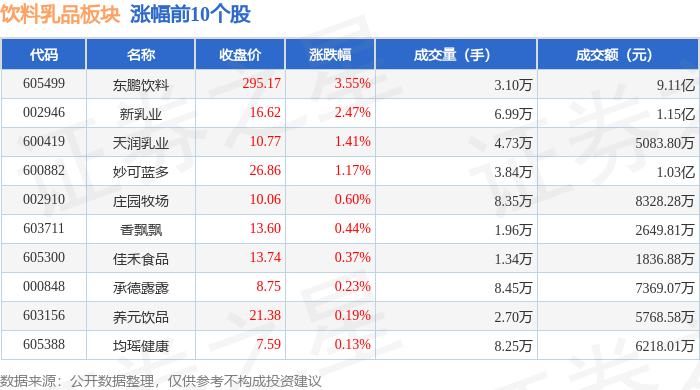
饮料乳品板块8月4日涨0.95%,东鹏饮料领涨,主力资金净流出3990.86万元
Zheng Xing Xing Ye Ri Bao· 2025-08-04 08:29
证券之星消息,8月4日饮料乳品板块较上一交易日上涨0.95%,东鹏饮料领涨。当日上证指数报收于 3583.31,上涨0.66%。深证成指报收于11041.56,上涨0.46%。饮料乳品板块个股涨跌见下表: | 代码 | 名称 | 收盘价 | 涨跌幅 | 成交量(手) | 成交额(元) | | --- | --- | --- | --- | --- | --- | | 6655509 | 东鹏饮料 | 295.17 | 3.55% | 3.10万 | 9.11亿 | | 002946 | 新乳业 | 16.62 | 2.47% | 6.99万 | 1.15亿 | | 600419 | 天润乳业 | 10.77 | 1.41% | 4.73万 | 5083.80万 | | 600882 | 妙可蓝多 | 26.86 | 1.17% | - 3.84万 | 1.03亿 | | 002910 | 庄园牧场 | 10.06 | 0.60% | 8.35万 | 8328.28万 | | 603711 | 香飘飘 | 13.60 | 0.44% | 1.96万 | 2649.81万 | | 605300 | 佳木食品 | ...




食品饮料行业周报(25年第31周):行业进入中报业绩期,关注板块结构性机会-20250804
Guoxin Securities· 2025-08-04 07:44
Investment Rating - The investment rating for the food and beverage industry is "Outperform the Market" [4][5][76]. Core Views - The industry is entering the mid-year performance reporting period, with a focus on structural opportunities within the sector [10]. - In the liquor segment, there is a slight decline in high-end liquor prices during the off-season, and attention is drawn to mid-year performance [10][11]. - The beer and beverage sectors are entering a peak season, with stable performance from leading companies in basic condiments [13][18]. - The report emphasizes the importance of consumer engagement and market health for liquor companies, with a shift towards internationalization and youth-oriented strategies [12][10]. Summary by Sections Liquor - The liquor sector saw a 2.4% decline this week, with high-end liquor prices slightly dropping [12][11]. - Key companies are focusing on cultural engagement and market health, with initiatives like the opening of cultural experience centers by Kweichow Moutai [10]. - Recommended stocks include Kweichow Moutai, Shanxi Fenjiu, and Wuliangye, which have demonstrated strong risk resilience [12][10]. Consumer Goods - The beer sector is experiencing a slight decrease in fund holdings, with Yanjing Beer seeing an increase in its fund holding ratio [13]. - The snack sector has seen a significant increase in fund holdings, particularly in companies like Yanjing and Wancheng Group [14]. - The condiment sector is expected to perform steadily, with a focus on mid-year performance windows [15]. Frozen Foods - Companies are actively developing new products during the off-season, with a long-term benefit from industrialization [16]. - Recommended companies include Anjijia and Qianwei Central Kitchen, which are focusing on stable operations and product innovation [16]. Dairy Products - The dairy sector is expected to see a gradual recovery in demand, with supply adjustments leading to improved conditions in 2025 [17]. - The report suggests positioning in leading dairy companies that have a safety margin in valuations [17]. Beverages - The beverage sector is entering a peak season, with significant performance differentiation among leading companies [18]. - Recommended stocks include Nongfu Spring and Dongpeng Beverage, which are accelerating national expansion and platform development [18].


量化大势研判:预期成长优势差继续扩大
Minsheng Securities· 2025-08-04 06:40
Quantitative Models and Construction Methods 1. Model Name: Quantitative Market Trend Judgment Framework - **Model Construction Idea**: The framework identifies the dominant market style by comparing the intrinsic attributes of assets, which are tied to their industry lifecycle stages. It prioritizes assets based on the sequence of growth rate (g) > return on equity (ROE) > dividend yield (D) to determine the most advantageous assets and focuses on the most promising sectors[5][6][9] - **Model Construction Process**: 1. Define five style stages for equity assets: external growth, quality growth, quality dividend, value dividend, and distressed value[5] 2. Compare assets globally to identify advantageous ones based on their intrinsic characteristics[5] 3. Use the priority sequence g > ROE > D to evaluate whether good assets exist and whether they are overvalued[5][6] 4. Focus on sectors with the most advantageous characteristics in the current market[5][6] - **Model Evaluation**: The framework has demonstrated strong explanatory power for A-share market style rotations since 2009, achieving an annualized return of 26.70%[16] 2. Model Name: Asset Comparison Strategy - **Model Construction Idea**: This model categorizes assets into primary and secondary groups. Primary assets include actual growth, expected growth, and profitability assets. Secondary assets are prioritized based on crowding levels and fundamental factors[9] - **Model Construction Process**: 1. Classify assets into primary (expected growth, actual growth, profitability) and secondary (quality dividend, value dividend, distressed value) categories[9] 2. Allocate market funds to primary assets when any of them show an advantage; otherwise, shift to secondary assets[9] 3. Rank secondary assets by crowding levels and fundamental factors, with the order: quality dividend > value dividend > distressed value[9] --- Model Backtesting Results 1. Quantitative Market Trend Judgment Framework - Annualized return: 26.70% since 2009[16] - Historical performance: Positive excess returns in most years, with limited effectiveness in 2011, 2012, 2014, and 2016[16][19] - Excess returns by year: - 2009: 51% - 2010: 14% - 2013: 36% - 2017: 27% - 2020: 44% - 2022: 62%[19] --- Quantitative Factors and Construction Methods 1. Factor Name: Expected Growth (gf) - **Factor Construction Idea**: Measures the expected growth rate based on analysts' forecasts, regardless of the industry lifecycle stage[6] - **Factor Construction Process**: 1. Use analysts' forecasted growth rates as the primary input[6] 2. Calculate the spread (Δgf) between top and bottom groups to assess the trend of expected growth[21] - **Factor Evaluation**: The factor has shown consistent expansion, with top groups driving the increase, indicating analysts' optimism about high-growth sectors[21] 2. Factor Name: Actual Growth (g) - **Factor Construction Idea**: Focuses on performance momentum (Δg) during transition and growth phases[6] - **Factor Construction Process**: 1. Calculate the spread (Δg) between top and bottom groups based on actual growth rates[25] 2. Monitor the trend of Δg to identify growth opportunities in the market[25] - **Factor Evaluation**: The factor has shown gradual expansion, with opportunities in sectors maintaining strong momentum despite a slowdown in top-tier growth[25] 3. Factor Name: Profitability (ROE) - **Factor Construction Idea**: Evaluates valuation levels using the PB-ROE framework, focusing on mature industries[6] - **Factor Construction Process**: 1. Calculate the PB-ROE residuals for each industry[40] 2. Rank industries based on residuals to identify undervalued high-ROE sectors[40] - **Factor Evaluation**: The factor's advantage has declined, and its crowding level remains low, suggesting limited opportunities in the current market[28] 4. Factor Name: Quality Dividend (DP+ROE) - **Factor Construction Idea**: Combines dividend yield (DP) and ROE to identify high-quality dividend-paying industries[6] - **Factor Construction Process**: 1. Calculate DP and ROE scores for each industry[43] 2. Combine the scores to rank industries and select the top-performing ones[43] - **Factor Evaluation**: The factor has shown significant excess returns in specific years, such as 2016, 2017, and 2023[43] 5. Factor Name: Value Dividend (DP+BP) - **Factor Construction Idea**: Combines dividend yield (DP) and book-to-price ratio (BP) to identify undervalued dividend-paying industries[6] - **Factor Construction Process**: 1. Calculate DP and BP scores for each industry[47] 2. Combine the scores to rank industries and select the top-performing ones[47] - **Factor Evaluation**: The factor has demonstrated strong excess returns in years like 2009, 2017, and 2021-2023[47] 6. Factor Name: Distressed Value (PB+SIZE) - **Factor Construction Idea**: Identifies industries with low price-to-book ratios (PB) and small market capitalization (SIZE), focusing on stagnation and recession phases[6] - **Factor Construction Process**: 1. Calculate PB and SIZE scores for each industry[51] 2. Combine the scores to rank industries and select the lowest-scoring ones[51] - **Factor Evaluation**: The factor has shown significant excess returns during periods like 2015-2016 and 2021-2023[51] --- Factor Backtesting Results 1. Expected Growth (gf) - Δgf continues to expand, driven by top-tier groups, indicating analysts' optimism about high-growth sectors[21] 2. Actual Growth (g) - Δg shows gradual expansion, with opportunities in sectors maintaining strong momentum despite a slowdown in top-tier growth[25] 3. Profitability (ROE) - ROE advantage continues to decline, with low crowding levels and limited opportunities in the current market[28] 4. Quality Dividend (DP+ROE) - Significant excess returns in 2016, 2017, and 2023[43] 5. Value Dividend (DP+BP) - Strong excess returns in 2009, 2017, and 2021-2023[47] 6. Distressed Value (PB+SIZE) - Significant excess returns during 2015-2016 and 2021-2023[51]