
谷歌

Search documents
深夜重磅!美联储降息25个基点,解读来了
2 1 Shi Ji Jing Ji Bao Dao· 2025-10-29 22:50
Group 1 - The Federal Reserve announced a 25 basis point cut in the federal funds rate target range to 3.75% to 4.00%, marking the fifth rate cut since September 2024 [1] - Fed Chairman Jerome Powell indicated that the decision for a rate cut in December is uncertain, with current expectations for a rate cut probability at 65%, down from 90% prior to the meeting [6] - Powell mentioned that a government shutdown could impact economic activity and the upcoming December meeting [6] Group 2 - The Fed's FOMC statement revealed that the asset purchase program will end on December 1, with Powell noting that market pressures necessitate immediate adjustments to the balance sheet operations [7] - Following Powell's comments, U.S. stock markets experienced a downturn, with only the Nasdaq showing a slight increase [8] - Notable performances in the tech sector included Nvidia rising approximately 3% to a market cap of $5 trillion, while Apple surpassed a $4 trillion market cap for the first time [10] Group 3 - The two-year U.S. Treasury yield surged to 3.59%, and the dollar index saw a short-term increase, while the onshore RMB depreciated against the dollar [11] - Bitcoin experienced a decline, with approximately 129,165 traders liquidated in the last 24 hours, totaling around $558 million in liquidations [12][13] - Analysts suggest that the recent rate cuts may enhance the attractiveness of emerging markets, potentially leading to improved global financial conditions and lower global financing costs [14]

深夜重磅!美联储降息25个基点,美股跳水,黄金跌破3930美元,加密货币近13万人爆仓,解读来了
2 1 Shi Ji Jing Ji Bao Dao· 2025-10-29 22:16
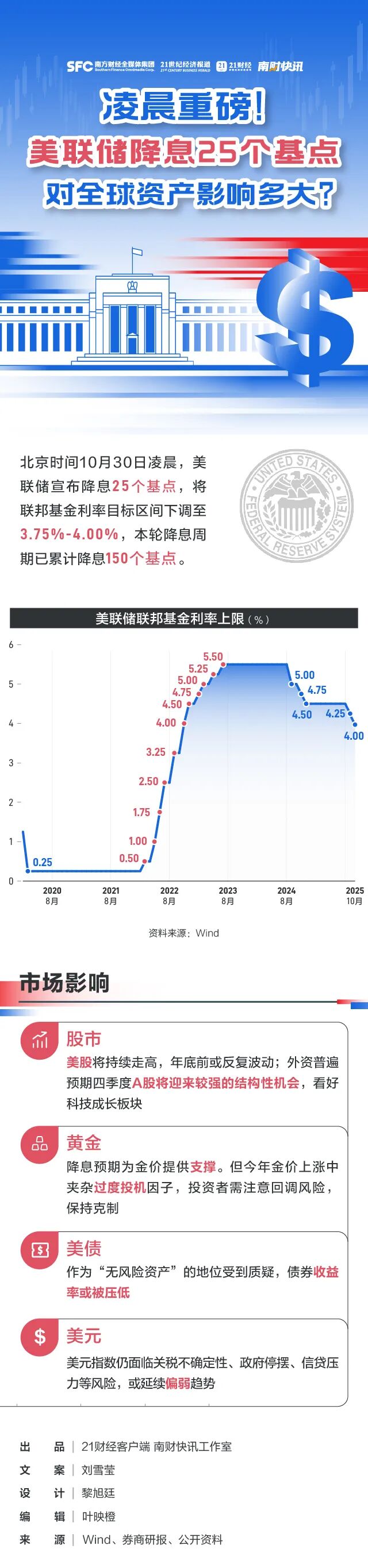
Core Viewpoint - The Federal Reserve announced a 25 basis point reduction in the federal funds rate target range to 3.75% to 4.00%, marking the fifth rate cut since September 2024 and a cumulative reduction of 150 basis points in this cycle [1][3]. Market Impact - U.S. stock markets are expected to continue rising, with potential volatility before the end of the year; foreign investors anticipate strong structural opportunities in the A-share market, particularly favoring the technology growth sector [6]. - The expectation of rate cuts supports gold prices, although excessive speculation has been noted, suggesting investors should be cautious of potential pullbacks [7]. - The status of U.S. Treasuries as a "risk-free asset" is under scrutiny, with bond yields likely to be suppressed [7]. - The U.S. dollar index faces risks from uncertainties regarding tariffs, government shutdowns, and credit pressures, likely leading to a continued weak trend [7]. Federal Reserve Outlook - Fed Chairman Jerome Powell indicated that the December rate decision is uncertain, with a 65% probability of a rate cut, down from 90% prior to the meeting [9]. - Powell noted that the government shutdown could impact economic activity and the upcoming rate decision, emphasizing the need for caution in the absence of data [9]. Stock Market Performance - Major tech stocks showed strong performance, with NVIDIA rising approximately 3% and surpassing a market cap of $5 trillion; Apple also closed above $4 trillion for the first time [12]. - Meta Platforms saw a significant drop of over 8% in after-hours trading due to disappointing earnings [12]. Bond and Currency Movements - The two-year U.S. Treasury yield surged to 3.59%, while the dollar index rose briefly, and the onshore RMB depreciated against the dollar [13]. - Spot gold prices fell below $1,930 per ounce [13]. Emerging Markets - The current rate cut is viewed as a preventive measure, with expectations for a dual bull market in stocks and bonds if economic data supports a soft landing; however, persistent inflation or a sharp decline in the job market could increase asset volatility [17]. - The decline in U.S. Treasury yields is expected to improve global financial market conditions, driving down global financing costs and enhancing the attractiveness of emerging market assets [18].
深夜重磅!美联储降息25个基点,美股跳水,黄金跌破3930美元,加密货币近13万人爆仓,解读来了
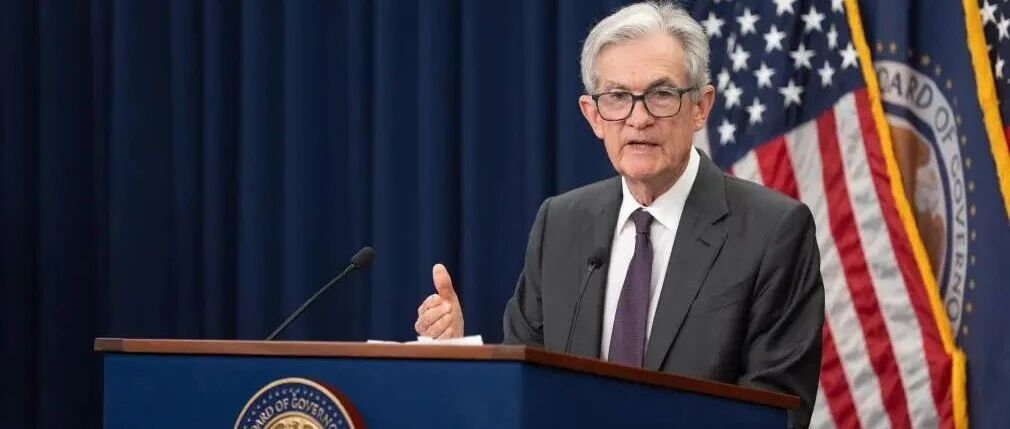
21世纪经济报道· 2025-10-29 22:06
Core Viewpoint - The Federal Reserve has lowered the federal funds rate target range by 25 basis points to 3.75% to 4.00%, marking the fifth rate cut since September 2024 and a cumulative reduction of 150 basis points in this cycle [1][3]. Market Impact - The U.S. stock market is expected to continue rising, with potential fluctuations before the end of the year; foreign capital is generally optimistic [6]. - Following comments from Fed Chair Jerome Powell regarding uncertainty around December's rate actions, U.S. stocks experienced a drop, although tech stocks like NVIDIA and Apple showed strong performance [12]. - The yield on two-year U.S. Treasury bonds surged to 3.59%, while the dollar index rose slightly, and the onshore RMB depreciated against the dollar [13]. Economic Outlook - Powell indicated that the December rate cut is not guaranteed, and uncertainties such as a government shutdown could impact economic activity [10][11]. - The probability of a rate cut in December has decreased to 65%, down from 90% prior to the meeting [11]. - The Fed plans to end its balance sheet reduction on December 1, with indications that it may be time to halt quantitative tightening [11]. Emerging Markets - The attractiveness of emerging markets is expected to increase as U.S. Treasury yields decline, which may lower global financing costs and support better performance in global stock markets [19].
五万亿市值的英伟达,托起了谁的脊梁?
Hu Xiu· 2025-10-29 15:43
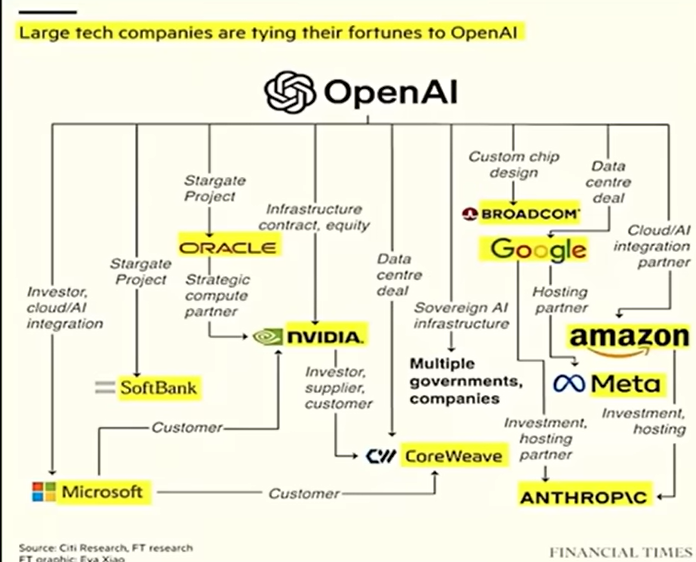
Core Viewpoint - Nvidia has become the first company in history to surpass a market capitalization of $5 trillion, driven by strong demand for AI technology and significant investments in AI infrastructure [1][2]. Group 1: Nvidia's Market Position and AI Demand - Nvidia's CEO Jensen Huang highlighted that the Blackwell and Rubin architecture chips could generate over $500 billion in revenue from 20 million GPUs by 2026, which is five times the revenue expected from the Hopper architecture chips between 2023 and 2025 [2]. - Huang also dismissed concerns regarding an AI bubble, despite rising skepticism in the market as Nvidia's valuation soared [3][4]. Group 2: Capital Circulation and Investment Dynamics - Nvidia's $100 billion investment in OpenAI has raised concerns about an AI bubble, as OpenAI committed to a $10 billion GPU order in return, creating a circular flow of capital between Nvidia and OpenAI [5][7]. - This capital cycle involves Nvidia investing in OpenAI, which in turn purchases cloud services from Oracle worth $300 billion, leading to further chip orders from Nvidia [7][8]. Group 3: Financial Health of Major Tech Companies - The free cash flow of the "Big Seven" tech companies has decreased by 62.45% from the end of 2024 to mid-2025, indicating a shift towards leveraging external financing for AI investments [12][14]. - Companies like Meta are increasingly resorting to debt financing, with Meta raising $27 billion through private debt issuance to build data centers, reflecting a trend of high-risk financing strategies [14]. Group 4: AI's Role in U.S. Economic Strategy - The U.S. government views AI as a core component of national strategic competition, leading to increased investments and policies aimed at maintaining dominance in AI technology [15][37]. - The "Stargate Project" aims to establish a global AI data center network with a $500 billion investment, indicating the scale of financial commitment required to support AI initiatives [40][42]. Group 5: Market Dynamics and Valuation Concerns - The S&P 500 has risen by 17.16% this year, driven by optimism around corporate earnings and AI investments, but this growth is largely attributed to valuation increases rather than fundamental earnings growth [22][31]. - The concentration of market capitalization among the top 10 stocks in the S&P 500, which are heavily AI-related, has reached 41.43%, raising concerns about potential overvaluation similar to the dot-com bubble [28][30].

亚马逊(AMZN.US)110亿美元AI数据中心启用!专供合作伙伴Anthropic训练大模型
智通财经网· 2025-10-29 13:59
Core Insights - Amazon has officially launched its $11 billion Rainier data center project in Indiana, aimed at training and running models for the generative AI leader Anthropic [1] - The project was initially announced in December 2024 and will house approximately 1 million of Amazon's custom Trainium2 chips [1] - Anthropic's recent funding round in September 2024 valued the company at $183 billion [1] Group 1 - The Rainier project spans 1,200 acres and is described as one of AWS's most ambitious infrastructure projects to date [1] - The data center will not only support Anthropic's existing models but also the upcoming versions of its generative AI chatbot, Claude [1] - AWS engineer Ron Diamant stated that the project will lead the next generation of AI models [1] Group 2 - Anthropic recently announced an expansion of its partnership with Google, utilizing Google's tensor processing units, with the deal valued in the "hundreds of billions" [2] - This expanded collaboration is expected to bring over 1 gigawatt of computing power online by 2026 [2] - Despite the partnership with Google, Anthropic remains committed to working with Amazon as its primary training partner and cloud service provider [2]

\十五五\规划将量子科技列为未来产业核心赛道,关注北交所量子科技产业链企业:北交所科技成长产业跟踪第四十八期(20251026)
Hua Yuan Zheng Quan· 2025-10-29 05:21
Group 1 - The "14th Five-Year Plan" includes quantum technology as a core future industry, with a focus on quantum computing, communication, and measurement [7][8][10] - By 2025, China's quantum technology market is expected to exceed 20 billion yuan, with a compound annual growth rate of 35%-40% [2][33][35] - The global quantum computing market was valued at 1.1 billion USD in 2022 and is projected to grow to approximately 7.6 billion USD by 2027 [14][16] Group 2 - The median price-to-earnings (P/E) ratio for the information technology sector on the Beijing Stock Exchange increased by 5.26% to 62.4X [43][54] - The median market capitalization for electronic device companies on the Beijing Stock Exchange rose from 2.28 billion yuan to 2.43 billion yuan [45][48] - The median P/E ratio for mechanical equipment companies on the Beijing Stock Exchange increased from 52.5X to 54.4X, with total market capitalization rising from 117.67 billion yuan to 123.18 billion yuan [50][52]
刚刚直线涨停!重磅利好来袭!A股量子科技概念股集体走强
Zheng Quan Shi Bao Wang· 2025-10-29 03:38
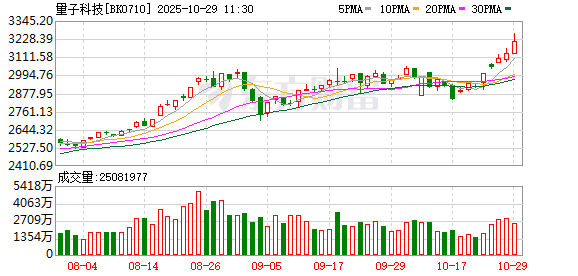
Core Insights - The quantum technology sector in A-shares experienced a significant surge, with stocks like Shenzhou Information and Tianrongxin hitting the daily limit, while Keda Guokuan and Guodun Quantum rose over 10% [2][4] - NVIDIA launched NVQLink, connecting quantum computing companies and research labs with GPU computing, marking a pivotal moment for the industry [2][6] - The Chinese government has included quantum technology as a key growth area in its 15th Five-Year Plan, indicating strong policy support for the sector [7] Market Performance - On October 29, A-share quantum technology stocks saw widespread gains, with notable increases including Shenzhou Information at 9.99% and Tianrongxin at 10.02% [4][5] - The overall quantum technology index rose by 2.75% [5] Technological Developments - NVIDIA's NVQLink is designed to integrate GPU computing with quantum processors, aiming to enhance the performance of quantum supercomputers [6] - NVIDIA's CEO announced plans to expand quantum bits from hundreds to potentially tens of thousands in the future [6] Policy Support - The Central Committee of the Communist Party of China emphasized the importance of quantum technology in its economic development strategy, aiming to foster new growth points [7] - The quantum technology market in China is projected to reach $9.758 billion by 2029, with a compound annual growth rate of 37.45% from 2024 to 2029 [7] Industry Applications - Key applications of quantum technology include quantum computing, quantum communication, and quantum precision measurement [8] - The commercial viability of quantum computing is expected to accelerate, with significant advancements anticipated in the next 5 to 10 years [8][9] Future Outlook - Quantum computers are expected to work alongside classical computers to form new supercomputing architectures, focusing on areas such as quantum simulation, optimization, AI enhancement, and algorithmic advantages [9]



海外大厂百亿美元算力合作,光模块需求上修!云计算ETF汇添富(159273)探底回升!机构:政策引领,重点布局算力与存储赛道
Sou Hu Cai Jing· 2025-10-29 03:28
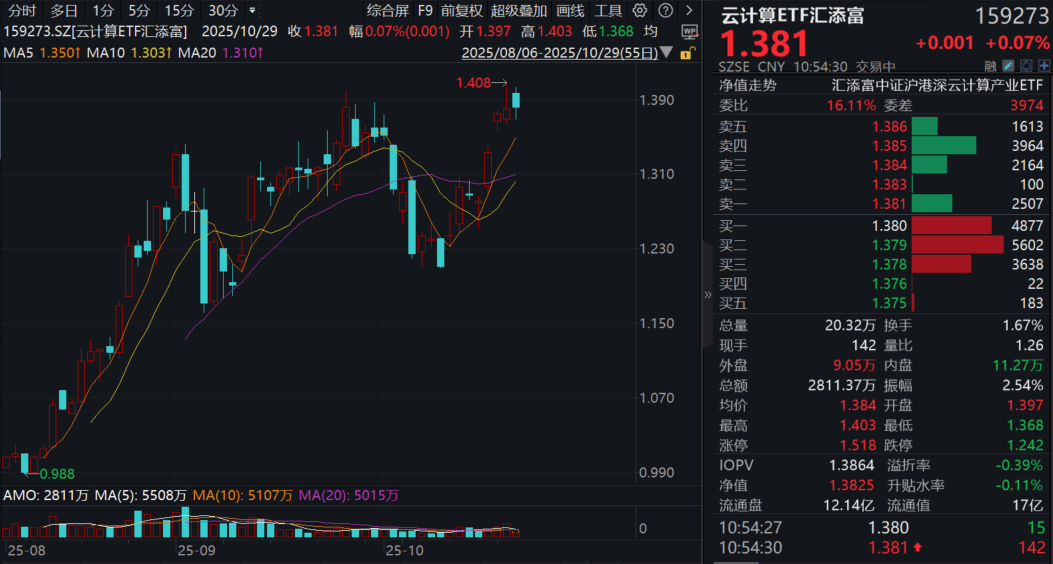
Group 1 - The cloud computing ETF Huatai (159273) showed a rebound after a volatile trading session, with a trading volume exceeding 30 million yuan, and its latest scale reached nearly 1.7 billion yuan, leading its peers [1] - As of October 28, the ETF's net value was 1.3825, with a slight increase of 0.07% on October 29, and the trading data indicated a total volume of 203,200 shares with a turnover rate of 1.67% [1] - Major component stocks of the ETF, such as Inspur Information and Kingdee International, experienced gains, with Inspur Information rising over 2% [1][2] Group 2 - Anthropic confirmed a partnership with Google Cloud worth several billion dollars, involving the provision of up to 1 million TPU AI chips and 1GW of power capacity, marking Anthropic's largest TPU procurement agreement to date [3] - The global AI computing power arms race is intensifying, with companies like OpenAI also forming significant partnerships with Nvidia and AMD for large-scale computing systems [3] - The demand for AI tokens has surged, leading to optimistic market expectations for AI computing investments and commercialization prospects [3][4] Group 3 - The demand for optical modules is projected to increase significantly, with estimates for 2025-2027 showing a demand of 50 million, 75 million, and 100 million units respectively [4] - Recent adjustments in procurement plans for 1.6T optical modules have raised the total industry demand from 10 million to 20 million units, driven by the rapid growth in bandwidth requirements for AI training and inference networks [5] - The semiconductor industry in China is focusing on self-sufficiency, with a strong push for domestic equipment and materials to meet the increasing demand for AI computing power [6]
英伟达GTC大会:黄仁勋驳斥“AI泡沫”质疑,称“钱途”不可限量!
Jin Shi Shu Ju· 2025-10-29 03:08
Core Insights - Nvidia's CEO Jensen Huang announced new partnerships and dismissed concerns about an "AI bubble," stating that the company's latest chips could generate up to $500 billion in revenue [2] - The GTC conference in Washington showcased Nvidia's expanding collaboration network, including partnerships with Uber, Palantir, and CrowdStrike, and highlighted the launch of a new system connecting quantum computers with AI chips [2][3] - Nvidia's flagship AI accelerators, "Blackwell" and its updated model "Rubin," are expected to drive unprecedented sales growth by 2026 [2][3] Partnerships and Collaborations - Nvidia plans to invest €1 billion (approximately $1.2 billion) in a data center in Germany in collaboration with Deutsche Telekom and has recently signed an investment agreement with Nokia [2] - The company is also working with Lucid to develop an autonomous driving platform and with CrowdStrike to create an AI cybersecurity system [5] - A partnership with Eli Lilly aims to build a powerful supercomputer for the pharmaceutical industry, utilizing over 1,000 Nvidia Blackwell AI accelerator chips [4] Market Position and Competition - Nvidia's latest generation of chips is expected to ship 20 million units, a significant increase compared to the 4 million units sold of the previous "Hopper" chip [3] - Despite Nvidia's dominance in the AI accelerator market, competition is intensifying with AMD and Broadcom entering the field, and companies like Qualcomm announcing plans to enter the AI accelerator market [4][6] - Nvidia's stock rose 5% following the conference, closing at a record $201.03, while AMD's stock has more than doubled this year, indicating investor optimism about AMD as a competitor [3][6] Economic Impact and Future Outlook - Huang emphasized that AI is reshaping the global economy and that current investments in computing infrastructure are justified [6] - The company is seeking assistance from the White House and Congress to restore AI chip exports to China, which have resulted in significant revenue losses [6] - Nvidia's efforts to position itself as a key supplier for sovereign AI systems globally reflect its ambition to expand its influence beyond the U.S. market [6]
全线大涨!美国突传大消息!
天天基金网· 2025-10-29 01:13
Core Viewpoint - The article discusses significant developments in the nuclear power sector in the United States, driven by the increasing electricity demand from artificial intelligence (AI) and the strategic partnerships formed between the government and private companies to enhance nuclear energy production [3][5][10]. Group 1: Government Actions and Agreements - The U.S. government has signed an $80 billion agreement with Westinghouse Electric Company to build nuclear reactors to meet the growing electricity demand from AI [5][10]. - This partnership involves Brookfield Asset Management and Canadian uranium producer Cameco Corp, which recently acquired Westinghouse for approximately $7.9 billion [5][6]. - The plan aims to solidify the U.S. position as a nuclear power leader and increase the global export of Westinghouse nuclear technology [7][8]. Group 2: Job Creation and Economic Impact - Each AP1000 nuclear power plant with two units is expected to create or maintain 45,000 manufacturing and engineering jobs across 43 states, with over 100,000 construction jobs nationwide [6][8]. - The initiative is part of a broader strategy to revitalize the nuclear energy sector, which includes regulatory reforms and increased investment in nuclear technology [8]. Group 3: Corporate Involvement and Projects - Major tech companies like Google and Microsoft are entering agreements to restart closed nuclear power plants to meet their energy needs for AI data centers [10][11]. - Google has signed a 25-year power purchase agreement with NextEra to restart the Duane Arnold Energy Center in Iowa, with a projected cost exceeding $1.6 billion and expected to begin operations in 2029 [10][11]. - Microsoft has also reached a similar agreement to restart the Three Mile Island nuclear plant in Pennsylvania, highlighting a trend of tech companies opting to revive existing facilities rather than building new ones [11]. Group 4: Safety Concerns and Criticism - Critics caution that efforts to restart decommissioned nuclear plants must adhere to strict regulatory standards, emphasizing the need for careful consideration of safety, especially for aging reactors [12]. - Concerns have been raised regarding the Duane Arnold plant, which suffered significant damage during a storm and shares design similarities with the Fukushima reactor that experienced a meltdown in 2011 [12].
