
邮储银行

Search documents
银行资负跟踪20251207:Q4银行浮盈兑现估算和EVE指标影响看法
CMS· 2025-12-07 05:03
Investment Rating - The report maintains a "Recommended" investment rating for the banking industry [2] Core Insights - The banking sector is experiencing a significant adjustment in long-term bonds, with a projected interest rate increase of 25-42 basis points, aligning with the "asset shortage" logic [14][15] - There is an ongoing demand for banks to realize floating profits from bond markets, particularly as the high base from the previous year's Q4 is expected to exert greater pressure on profit realization this year [14][15] - The report outlines three scenarios for revenue growth in 2025, indicating that banks may need to sell bonds worth approximately 0.20 trillion to 1.14 trillion yuan depending on the revenue growth target [15][19] Summary by Sections Section 1: Floating Profit Realization and EVE Indicator Impact - The report discusses the ongoing pressure for banks to realize floating profits in December, with expectations of significant bond sales to support stable performance [14][15] - It highlights the need for banks to manage duration risk effectively, as the current structure of liabilities is shortening, which may impact stability [16][17] Section 2: Loan and Bond Yield Comparison - The report provides insights into the yield comparison between loans and bonds, indicating a need for banks to adjust their strategies in response to changing market conditions [8] Section 3: Deposit Rate Tracking - The report tracks changes in deposit rates, noting adjustments made by specific banks to their deposit rates, which may influence overall funding costs [6] Section 4: Bill Discounting Volume and Price Tracking - The report analyzes the trends in bill discounting, indicating a significant drop in short-term bill rates while highlighting seasonal patterns in the market [24][25] Section 5: Central Bank Dynamics and Market Rate Tracking - The report details the central bank's operations, including reverse repos and liquidity management, which are crucial for maintaining market stability [25][26] Section 6: Government Debt Financing and Fiscal Strength Tracking - The report discusses the government's debt financing activities and their implications for fiscal policy, emphasizing the need for careful monitoring of future fiscal measures [26] Section 7: Interbank Certificate of Deposit Tracking - The report notes a positive net financing position for interbank certificates of deposit, indicating a shift in funding strategies among banks [28]
信用卡市场持续收缩,三年累计减少1亿张
Di Yi Cai Jing· 2025-12-07 04:11
Core Insights - The credit card market in China is experiencing a significant contraction, with a total issuance of 707 million cards as of Q3 2025, down from 715 million in Q2 2025 and a peak of 807 million in Q3 2022, marking a decline of approximately 100 million cards over three years [2][3] - The non-performing loan (NPL) rate for credit cards has risen to 2.40% as of mid-2025, indicating increasing pressure on asset quality within the banking sector [5][6] Credit Card Issuance Trends - The total number of credit cards has been on a downward trend for 12 consecutive quarters, with a notable reduction of 800 million cards in Q3 2025 compared to the previous quarter [2] - Major banks have reported a significant decrease in credit card loan balances, with a reduction of nearly 600 billion yuan in the first half of 2025 compared to the end of 2024 [3] - Credit card transaction volumes have also declined, with an overall decrease of approximately 8% year-on-year, particularly affecting banks like China Merchants Bank and Bank of Communications [3] Factors Influencing Market Contraction - The contraction in the credit card market is attributed to multiple factors, including regulatory policies that encourage banks to move away from aggressive card issuance and the rise of mobile payments and internet credit tools that are replacing traditional credit card usage [4] - Banks are shifting their focus from merely expanding card issuance to more refined management and risk control strategies [4] Asset Quality Concerns - The total amount of overdue credit card loans has increased from 842.85 billion yuan in Q2 2022 to 1,239.64 billion yuan by the end of 2024, indicating a growing concern over asset quality [5] - The average NPL rate for credit card overdrafts among 12 domestic banks has risen from 2.33% at the end of 2024 to 2.40% by mid-2025, with specific banks like ICBC and CCB reporting even higher rates [5] Risk Management and Asset Disposal - In response to rising NPLs, banks are accelerating the disposal of non-performing assets, with over 260 billion yuan in personal loan asset packages being transferred in November alone [6] - Notable cases include large asset packages from banks like Minsheng Bank and SPDB, indicating a proactive approach to managing credit risk [6] Operational Adjustments in Banking - Banks are implementing cost-cutting measures, including the closure of credit card centers and integrating credit card operations into broader retail banking strategies [7] - The future of credit card services is expected to focus on providing safer and more value-added financial services rather than merely promoting overspending [7] - The competitive landscape is likely to favor larger banks with strong risk management capabilities, while smaller banks will need to find ways to attract and retain customers without compromising on risk [7]



年内445家A股公司已披露定增预案
Zheng Quan Ri Bao· 2025-12-05 16:35
Group 1 - A total of 13 companies in the A-share market announced private placement plans on December 5, with one company disclosing a new plan, ten plans approved by shareholders, one approved by the exchange, and one by the CSRC [1] - Chongqing Meilixin Technology Co., Ltd. plans to raise no more than 1.2 billion yuan, with 500 million yuan allocated for a semiconductor equipment precision component project, 500 million yuan for a communication and automotive parts project, and 200 million yuan for working capital [1] - Shanghai ShenKai Petroleum Chemical Equipment Co., Ltd. received approval from the CSRC for a private placement, planning to issue 26.1283 million shares at 8.42 yuan per share, raising a total of 220 million yuan for a high-end marine engineering equipment manufacturing base project and other purposes [1] Group 2 - As of December 5, 445 listed companies disclosed private placement plans in 2023, a year-on-year increase of 110.90%, indicating a significant enhancement in market financing willingness [2] - A total of 151 companies completed private placements, raising a total of 853.055 billion yuan, with major banks like China Bank, Postal Savings Bank, and others raising over 100 billion yuan each, collectively amounting to 520 billion yuan [2] - Financing activities are increasingly concentrated in high-tech and strategic emerging industries, such as semiconductors, new energy, high-end manufacturing, and biomedicine, with industry leaders leveraging their advantages to initiate large-scale fundraising [2] Group 3 - The rapid growth in the number of private placement plans is attributed to multiple factors, including policy support, ample funds, corporate transformation, and industrial upgrades, indicating that private placements are becoming a significant refinancing method for listed companies [3] - The effectiveness of raised funds in translating into tangible performance growth and sustainable competitive advantages remains crucial for companies [3] - The role of private placements in the A-share market is expected to deepen, supporting companies' cross-cycle growth as the capital market and the real economy become more interconnected [3]
最新:部分银行上调存款利率
Xin Lang Cai Jing· 2025-12-05 12:48
Core Insights - Several banks have recently lowered RMB deposit rates, with major state-owned banks removing five-year large-denomination certificates of deposit (CDs) from their offerings [1][2] - The remaining three-year deposit products have seen rates drop to between 1.5% and 1.75%, with limited availability [1][2] - Some banks have begun to raise deposit rates as a strategy to attract deposits [3][4] Summary by Category Deposit Rate Changes - Major state-owned banks have collectively removed five-year large-denomination CDs, leaving only three-year products with rates between 1.5% and 1.75% [1][2] - Smaller banks are also adjusting or canceling three-year and five-year ordinary fixed deposit products [1][2] Recent Rate Increases - Some banks, such as Hangzhou Bank, have recently increased rates on certain deposit products, with new funds for three-year deposits starting at 1.9% for amounts of 200,000 yuan and 1.8% for non-new funds [3] - Other banks, including Ningbo Bank and Shengjing Bank, have also raised rates on select deposit products [4] Industry Perspective - Industry insiders suggest that the recent increases in deposit rates by some banks are a temporary measure aimed at attracting deposits [2][4]


险资入市再松绑 增量长期资金有望“跑步入场”
Xin Jing Bao· 2025-12-05 12:44
Core Viewpoint - The recent adjustment by the National Financial Regulatory Administration to lower risk factors for certain insurance company investments is aimed at encouraging insurance capital to enter the stock market and support strategic industries in China [1][4]. Group 1: Risk Factor Adjustments - The risk factor for insurance companies holding stocks in the CSI 300 Index and the China Securities Low Volatility 100 Index for over three years has been reduced from 0.3 to 0.27 [2][4]. - For stocks listed on the Sci-Tech Innovation Board held for over two years, the risk factor has been lowered from 0.4 to 0.36 [2][4]. - Lowering the risk factor allows insurance companies to free up capital, enhancing their investment capacity in the stock market [2][3]. Group 2: Encouragement of Long-term Investment - The adjustments encourage insurance companies to hold stocks for longer periods, which supports corporate development and aligns with national strategies [3][4]. - The focus on specific indices and stocks, such as blue-chip and technology stocks, indicates a strategic direction to bolster investments in key economic sectors [4][5]. Group 3: Increased Market Participation - As of the end of Q3 this year, insurance companies have accelerated their stock market participation, with investments in stocks and securities reaching 5.59 trillion yuan, accounting for 14.92% of their total investment [5]. - Insurance capital has been increasing its holdings in major stocks, with significant acquisitions noted in several banks and companies [5]. - The ongoing reduction in risk factors is expected to further enhance insurance capital's engagement in the stock market, driving improvements in investment efficiency and market stability [5].
重磅!险资入市再松绑,增量长期资金有望“跑步入场”
Bei Ke Cai Jing· 2025-12-05 12:33
Core Viewpoint - The National Financial Regulatory Administration has adjusted the risk factors for certain insurance company investments, aiming to encourage insurance capital to enter the stock market and support strategic industries in the country [1][3][11]. Risk Factor Adjustments - The risk factor for stocks held by insurance companies for over three years in the CSI 300 Index and the CSI Low Volatility 100 Index has been reduced from 0.3 to 0.27 [5][11]. - The risk factor for ordinary shares listed on the Sci-Tech Innovation Board held for over two years has been lowered from 0.4 to 0.36 [6][11]. Impact on Capital Allocation - Lowering the risk factors will free up capital for insurance companies, allowing them to invest more in the stock market. For example, a company with a total capital of 1 billion yuan would see a reduction in capital usage from 300 million yuan to 270 million yuan for a 100 million yuan investment in the CSI 300 stocks [7][8]. - The saved capital can be reinvested into stocks or other assets, thereby expanding the investment capacity of insurance capital [8]. Encouragement of Long-term Investment - The adjustments encourage insurance companies to hold stocks for longer periods, which supports the development of enterprises and aligns with national strategies [10][12]. - The focus on specific indices and stocks indicates a targeted approach to encourage investment in blue-chip and technology stocks, which are crucial for economic growth [11][12]. Recent Trends in Insurance Capital - As of the end of Q3 this year, the total investment by life and property insurance companies in stocks and securities investment funds reached 5.59 trillion yuan, accounting for 14.92% of their total investment balance, marking a new high since 2022 [13]. - Insurance capital has been increasing its holdings in major stocks, with significant increases observed in the first three quarters of the year [13][15]. Future Outlook - With the reduction in risk factors, insurance capital is expected to further increase its stock market investments, which may lead to enhanced resource allocation towards equity investment and research capabilities within insurance companies [16].
邮储银行青岛分行:坚守金融温度 以“心”服务伴民生
Zhong Guo Jin Rong Xin Xi Wang· 2025-12-05 11:11
Group 1 - The core viewpoint of the articles emphasizes the commitment of Postal Savings Bank's Qingdao branch to enhance financial services through digitalization while maintaining a human touch to meet public needs [1][2] - The bank has launched 7,968 "Postal Love Wallets" this year, providing small denomination cash totaling 17.54 million yuan, integrating convenience into citizens' daily lives [1] - The bank has conducted 8 "Cash Mobile Caravan" activities in rural areas, completing the exchange of 151,000 pieces of small change, demonstrating the practical value of financial services reaching underserved communities [1] Group 2 - The bank focuses on elderly care through the "Warm Sun Golden Rays" initiative, establishing 3 nationally certified "Elderly-Friendly Service Five-Star" outlets equipped with necessary facilities for senior citizens [2] - The bank offers basic services such as resting areas, drinking water, and blood pressure measurement for the elderly, along with educational sessions on anti-counterfeiting and financial knowledge [2] - The bank plans to continue extending its services from urban to rural areas and from offline to online, fulfilling its responsibility as a state-owned bank to meet the needs of the public [2]
“十五五”深度研究系列报告(七):如何建立“金融强国”?
ZHESHANG SECURITIES· 2025-12-05 07:26
Group 1: Central Bank Objectives - The "14th Five-Year Plan" emphasizes the need to "improve the modern central banking system," with a notable shift to explicitly include "economic growth" as a primary goal alongside currency stability and financial stability[1] - The dual-pillar framework will provide tools and institutional support for both currency stability and financial stability, marking a significant evolution in the central bank's objectives[3] - The adjustment in primary objectives reflects a structural recalibration, aligning legal requirements with modern central banking discourse, enhancing consistency between law and practice[19] Group 2: Macro-Prudential Management - The macro-prudential framework is expected to evolve along three main lines: objectives, tools, and mechanisms, focusing on systemic stability rather than individual risk management[3] - The macro-prudential toolbox will be systematized, with increased attention to stock, bond, and foreign exchange markets, enhancing the central bank's ability to manage systemic risks[3] - The central bank's focus will shift from temporary crisis management to regular expectation management and emergency arrangements, improving its crisis response capabilities[26] Group 3: Interest Rate Marketization - China's interest rate marketization has progressed through three stages: price liberalization, establishment of a rate transmission system, and refined price control[31] - The future evolution of the interest rate corridor is expected to tilt operational target rates from DR007 towards DR001, enhancing liquidity management and tool innovation[38] - The central bank is likely to explore conditional liquidity tools for non-bank institutions to provide support during extreme market fluctuations, preventing irrational spikes in short-term rates[5] Group 4: Capital Market Development - The "Five Major Articles" will shift focus towards three main lines: from tool coverage to institutional construction, from credit-led to a balanced approach between equity and debt financing, and from central bank-led initiatives to collaborative efforts across multiple policies[8] - The emphasis on direct financing through equity and bond markets aims to enhance the capital market's functionality, aligning it with the needs of the real economy[9] - The development of a direct financing system centered on technology enterprises will focus on deepening equity financing and thickening bond markets[9]
央行“收短放长”再加码,万亿流动性注入稳市场
Huan Qiu Wang· 2025-12-05 06:32
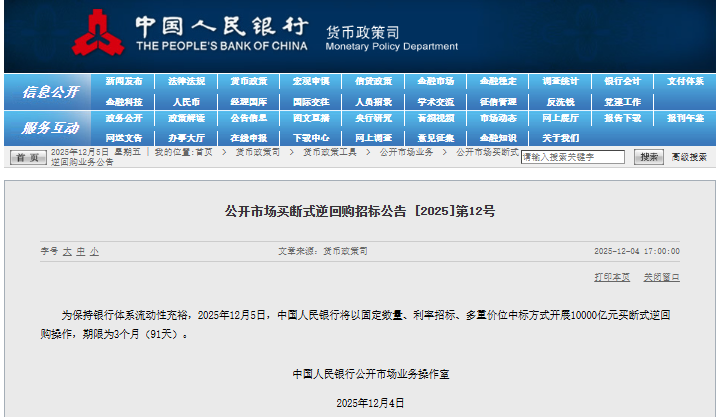
Core Viewpoint - The People's Bank of China (PBOC) conducted a 1 trillion yuan (approximately 140 billion USD) three-month reverse repo operation on December 5 to maintain reasonable liquidity in the banking system at year-end, effectively rolling over the same amount of maturing funds [1]. Group 1: Market Liquidity - The operation reflects a stable demand for liquidity in the banking system at the beginning of the month, with institutions preferring to retain flexibility in managing liabilities until clearer funding needs arise mid-month and month-end [6]. - The market generally anticipates the PBOC's overall support for medium to long-term liquidity in December, with an additional 400 billion yuan (approximately 56 billion USD) six-month reverse repo maturing, and a likelihood of another six-month operation being conducted [6]. - This operation is part of a strategy to address potential liquidity tightening pressures, as the government bond issuance is expected to be high, alongside a significant amount of interbank certificates maturing [6]. Group 2: Monetary Policy Strategy - The operation continues the PBOC's "short-term withdrawal, long-term injection" strategy, having net injected 650 billion yuan (approximately 91 billion USD) of medium to long-term liquidity while withdrawing 556.2 billion yuan (approximately 78 billion USD) of short-term funds through seven-day reverse repos [7]. - This strategy aims to meet the market's demand for stable medium to long-term funds while preventing fund idling and improving fund utilization efficiency, which is crucial for maintaining year-end liquidity and stabilizing market expectations [7]. - Future policy outlook suggests that the PBOC may implement a new round of reserve requirement ratio (RRR) cuts before year-end, potentially leading to a decrease in the scale of net medium-term liquidity injections [7].

房地产底线逻辑研究系列报告一:银行直供房热度背后的真相
Bank of China Securities· 2025-12-05 04:38
Investment Rating - The report rates the real estate industry as "Outperform" [1] Core Insights - The report highlights the increasing attention on bank-supplied housing, primarily due to the ongoing downturn in the real estate market, which has led to declining prices and heightened market concerns [12][28] - It emphasizes that the increase in bank-supplied housing is a response to rising non-performing asset pressures and is part of banks' routine asset disposal operations aimed at liquidity recovery [12][28] - The report suggests that the impact of bank-supplied housing on the overall real estate market is limited, with a small market share and low transaction volumes [28] Summary by Sections 1. What is Bank-Supplied Housing? - Bank-supplied housing refers to properties acquired by banks through the disposal of non-performing loans, which are then sold or rented out directly by the banks [11][12] - The main sources of these properties include loans defaulted by individuals or companies, leading to the banks taking ownership [11][12] 2. Recent Trends in Bank-Supplied Housing - The number of bank-supplied housing listings has increased, with 16,000 units listed in 2024, a 73% year-on-year increase, and 14,000 units in the first ten months of 2025, showing a 4% increase from 2024 [22][27] - However, the total volume remains significantly lower than that of auctioned properties, with bank-supplied housing listings being less than one-eighteenth of auctioned properties [22][28] 3. Distribution and Characteristics of Bank-Supplied Housing - The majority of bank-supplied housing is concentrated in lower-tier cities, with first-tier cities accounting for only 0.6% of listings [30][31] - The properties are predominantly unfinished (59%) or simply decorated (38%), with only 3% being fully furnished [40][48] - A significant portion (86%) of the listings is priced below 1 million yuan, reflecting the current market conditions [47][49] 4. Transaction Dynamics - The transaction rate for bank-supplied housing is low, with only 7% of the 14,000 units listed in the first ten months of 2025 being sold, compared to 20% for auctioned properties [28] - Most transactions occur at or near the starting price, indicating a market heavily influenced by price sensitivity [28] 5. Investment Recommendations - The report suggests focusing on three main lines of investment: 1. Companies with stable fundamentals and high market shares in core cities, such as Binjiang Group and China Merchants Shekou [28] 2. Smaller firms that have shown significant breakthroughs in sales and land acquisition since 2024, like Poly Real Estate Group [28] 3. Commercial real estate companies exploring new consumption scenarios and operational models, such as China Resources and Swire Properties [28]