易方达基金

Search documents
最高涨近130%!超1800只基金受益
券商中国· 2025-11-24 15:21
Core Viewpoint - The A-share market has shown significant gains since the "9.24" rally, with 34 core indices achieving an average increase of over 50%, and four indices exceeding 100% growth as of November 21 [1][4]. Index Performance - The top-performing indices since the "9.24" rally include: - 北证50: 129.66% - 科创200: 109.57% - 创业板50: 105.20% - 科创创业20: 104.91% - 科创50: 99.96% - 科创100: 95.53% - 创业板指: 90.79% [2][3][4]. Fund Growth - Over 1,800 index funds have been established, with more than 35% of current funds launched since the second half of 2024 [1][8]. - The stock ETF market has seen significant growth, with nearly 60% of the total issuance in the last five years [1][8]. Fund Distribution - Among the 34 core indices, 32 have attracted public fund investments, with the 沪深300 index having the highest number of funds at 319 [5][6]. - The 中证A500 index has seen 279 funds since its launch in September 2024, while some older indices like 中小100 have fewer than 10 funds [5][6]. Performance Disparity - The performance of index funds varies significantly, with the 中证A500 index having around 80 fund companies involved, while some indices have very few funds despite being established for a long time [6][7]. - The largest沪深300 ETF has exceeded 4,000 billion in size, while many others remain below 100 billion [6][7]. Industry Evolution - The index fund industry has shifted from focusing on individual products to building comprehensive capabilities, with a growing emphasis on cost efficiency and tracking accuracy [8][9]. - The total ETF market has surpassed 5.6 trillion, with significant contributions from major fund management companies [8][9].


股票股指期权:震荡降波,可考虑卖出虚值看涨期权
Guo Tai Jun An Qi Huo· 2025-11-24 14:39
Report Industry Investment Rating No relevant content provided. Core Viewpoint The market shows a trend of oscillating volatility decline, and it is advisable to consider selling out-of-the-money call options [1]. Summary by Related Catalogs 1. Market Data Statistics - **Underlying Market Statistics**: The closing prices of the Shanghai Stock Exchange 50 Index, CSI 300 Index, and some ETFs have changed, with trading volume showing varying degrees of decline. For example, the Shanghai Stock Exchange 50 Index closed at 2950.56, down 5.29 points, and its trading volume decreased by 9.59 billion hands [1]. - **Options Market Statistics**: The trading volume and open interest of various options have also changed. For instance, the trading volume of Shanghai Stock Exchange 50 Index Options decreased by 11,704, and the open interest increased by 2,676 [1]. 2. Options Volatility Statistics - **Near - Month Options**: The implied volatility (ATM - IV) of most options has declined. For example, the ATM - IV of Shanghai Stock Exchange 50 Index Options decreased by 1.28% [4]. - **Next - Month Options**: The ATM - IV of most options has also decreased. For example, the ATM - IV of Shanghai Stock Exchange 50 Index Options decreased by 0.29% [4]. 3. Specific Option Analysis - **Shanghai Stock Exchange 50 Index Options**: Analyzed through full - contract PCR, main - contract skewness, volatility cone, and volatility term structure charts [7][8]. - **CSI 300 Index Options**: Similar analysis methods are used, including full - contract PCR, main - contract skewness, volatility cone, and volatility term structure charts [11][12]. - **CSI 1000 Index Options**: Analyzed with relevant charts such as full - contract PCR, main - contract skewness, volatility cone, and volatility term structure [15][16]. - **ETF Options**: Options of various ETFs, such as Shanghai Stock Exchange 50ETF, Huatai - Ba瑞 300ETF, etc., are analyzed using similar methods [23][27].
ETF周报(20251117-20251121)-20251124
Mai Gao Zheng Quan· 2025-11-24 14:19
Report Industry Investment Rating No information provided in the content. Core Viewpoints of the Report The report provides a comprehensive analysis of the ETF market from November 17 to November 21, 2025, including the secondary market overview, ETF product profiles (market performance, fund flows, trading volume, margin trading, and new issuance/listing), and new product approvals [1][22]. Summary by Relevant Catalogs 1. Secondary Market Overview - **Index Performance**: During the sample period, the South China Commodity Index, S&P 500, and SGE Gold 9999 had the top weekly returns, at -1.81%, -1.95%, and -3.17% respectively. The Nikkei 225 had the highest PE valuation quantile at 79.92%, while the S&P 500 had the lowest at 42.80% [1][10]. - **Industry Performance**: Among the Shenwan primary industries, banks, media, and food and beverage had the top returns, at -0.89%, -1.25%, and -1.44% respectively. Power equipment, comprehensive, and basic chemicals had the lowest returns, at -10.54%, -9.18%, and -7.47% respectively. The industries with the highest valuation quantiles were petroleum and petrochemicals, coal, and commercial and retail trade, at 95.88%, 94.24%, and 94.24% respectively [1][17]. 2. ETF Product Profiles 2.1 ETF Market Performance - **By Product Type**: Money market ETFs had the best average performance, with a weighted average return of 0.01%, while QDII ETFs had the worst, at -5.31%. - **By Listing Plate**: ETFs related to US stocks and MSCI China A-share concepts had better performance, with weighted average returns of -3.38% and -3.65% respectively. ETFs related to the CSI 2000 and ChiNext had worse performance, at -6.85% and -6.06% respectively. - **By Industry Sector**: Consumer sector ETFs had the best average performance, with a weighted average return of -2.61%, while biopharmaceutical sector ETFs had the worst, at -6.23%. - **By Theme**: Bank and dividend ETFs had better performance, with weighted average returns of -1.09% and -2.70% respectively. New energy and low-carbon environmental protection ETFs had the worst performance, at -10.17% and -8.50% respectively [22][25]. 2.2 ETF Fund Flows - **By ETF Category**: Broad-based ETFs had the largest net inflow of funds, at 33.641 billion yuan, while style ETFs had the smallest, at 3.537 billion yuan. - **By Listing Plate**: Hong Kong stock ETFs had the largest net inflow of funds, at 15.621 billion yuan, while MSCI China A-share concept ETFs had the smallest, at -181 million yuan. - **By Industry Sector**: Technology sector ETFs had the largest net inflow of funds, at 6.328 billion yuan, while consumer sector ETFs had the smallest, at -772 million yuan. - **By Theme**: Artificial intelligence and non-bank ETFs had the largest net inflows of funds, at 2.2 billion yuan and 2.177 billion yuan respectively. Bank and consumer electronics ETFs had the smallest, at -1.642 billion yuan and -64 million yuan respectively [2][29][31]. 2.3 ETF Trading Volume - **By ETF Category**: Style ETFs had the largest increase in the average daily trading volume change rate, at 19.05%, while money market ETFs had the largest decrease, at -13.04%. - **By Listing Plate**: The CSI 500 ETF had the largest increase in the average daily trading volume change rate, at 42.27%, while the ChiNext Innovation 50 had the largest decrease, at -17.98%. - **By Industry Sector**: The cyclical sector had the smallest decrease in the average daily trading volume change rate, at -4.23%, while the consumer sector had the largest decrease, at -18.82%. - **By Theme**: Non-bank and chip semiconductor ETFs had the largest average daily trading volumes in the past 5 days, at 16.317 billion yuan and 8.392 billion yuan respectively. Dividend and military industry ETFs had the largest increases in the average daily trading volume change rate, at 13.92% and 8.73% respectively. Consumer electronics and low-carbon environmental protection ETFs had the largest decreases, at -37.60% and -32.34% respectively [35][38][41][43]. 2.4 ETF Margin Trading During the sample period, the net margin purchase of all equity ETFs was 6.019 billion yuan, and the net short sale was -820 million yuan. The Huaxia Shanghai Stock Exchange Science and Technology Innovation Board 50 ETF had the largest net margin purchase, and the Harvest Shanghai Stock Exchange Science and Technology Innovation Board Chip ETF had the largest net short sale [2][49]. 2.5 ETF New Issuance and Listing During the sample period, 8 funds were established and 4 funds were listed. A total of 54 new fund products were reported this week, including 11 science and technology innovation theme ETFs. On November 21, the CSRC approved 16 hard technology products, including the first batch of 7 science and technology innovation and entrepreneurship artificial intelligence ETFs, 3 science and technology innovation board chip ETFs, 4 science and technology innovation board chip design theme ETFs, and 2 technology theme active equity funds [3][51][54].
银行理财资产配置专题分析:25Q3 理财的基金投资有何变化?
Hua Yuan Zheng Quan· 2025-11-24 14:07
Report Industry Investment Rating There is no information provided in the text about the report's industry investment rating, so this section is skipped. Core Viewpoints of the Report - In 25Q3, the scale of wealth management increased steadily, with a super - seasonal rise of 1.5 trillion yuan. The break - even rate of wealth management first rose and then fell rapidly in October. The industry has entered the era of wealth management companies, and regulatory requirements are approaching those of public funds [2][6][13]. - In 25Q3, bank wealth management reduced its allocation to public funds. It significantly increased the allocation of cash and bank deposits, while reducing the allocation of equity assets and public funds, and the bond allocation ratio decreased [29]. - In 25Q3, wealth management reduced its allocation to bond - type funds. It mainly reduced the allocation of bond - type funds and increased the allocation of international/QDII funds, stock - type funds, and alternative investment funds [47][49]. Summary by Relevant Catalogs 1. 25Q3 Wealth Management Scale Steadily Grows - **Entering the Era of Wealth Management Companies**: Since 2018, a series of regulatory policies have been introduced, narrowing the gap between bank wealth management regulatory requirements and public funds. As of October 2025, 32 wealth management companies have been approved to be established and all are in operation. In H1 2025, the net profit of most wealth management companies increased year - on - year, with an overall growth of 1.7% [6][9][10]. - **25Q3 Scale Growth**: As of September 2025, the wealth management scale was 32.13 trillion yuan, with a super - seasonal increase of 1.5 trillion yuan in 25Q3. In October, the scale increased by 1.5 trillion yuan, higher than the seasonal increment. Most wealth management companies' scales increased in 25Q3, with different growth rates among different types of companies. Fixed - income products' Q3 scale increased compared to Q2, while equity products' Q3 scale decreased [13][14][16][18]. - **Break - even Rate and Performance Benchmark**: The break - even rate of wealth management rose from late July and then decreased rapidly in October. As of November 9, 2025, it was about 0.39%. The average performance comparison benchmark of newly issued RMB fixed - income wealth management products has been declining, and it is expected to slowly fall to around 2.0% [22][25]. 2. Bank Wealth Management Reduced Allocation to Public Funds in 25Q3 - **25Q3 Public Fund Investment Proportion Declined**: In 25Q3, wealth management significantly increased the allocation of cash and bank deposits, while reducing the allocation of equity assets and public funds. The proportion of public funds decreased by 0.3 pct compared to 25H1. The investment behavior of wealth management companies in public funds was differentiated in 25Q3 [29][30]. - **Asset Allocation Changes in H1 2025**: Large - bank wealth management companies generally increased the allocation of public funds, with the overall scale rising to 0.4 trillion yuan and the proportion rising to 3.8%. Joint - stock bank wealth management companies also generally increased the allocation of public funds and slightly increased the allocation of deposit - type assets. Most urban and rural commercial bank wealth management companies increased the allocation of deposit - type and public fund - type assets and reduced the allocation of bond - type assets in H1 2025. The indirect investment proportion has increased in recent years [34][38][43]. 3. 25Q3 Wealth Management Reduced Allocation to Bond - Type Funds - **Overall Public Fund Allocation**: In 25Q3, the allocation of public funds by wealth management decreased slightly. As of September 2025, the scale of public funds allocated by wealth management was about 1.3 trillion yuan, with a proportion of 3.9%, a decrease of 0.3 pct compared to 25Q2 [47]. - **Allocation of Different Types of Public Funds**: Bond - type funds are still the main type of public funds allocated by bank wealth management. In 25Q3, wealth management increased the allocation of international/QDII funds, stock - type funds, and alternative investment funds, while reducing the allocation of bond - type funds. Among bond - type funds, it increased the allocation of secondary bond funds, medium - and long - term pure bond funds, and convertible bond funds, and reduced the allocation of short - term pure bond funds. Among stock and hybrid funds, it increased the allocation of passive index - type stock funds [49][56][65].
告别“脸盲症”!ETF开启更名潮,基金管理人简称成标配
Nan Fang Du Shi Bao· 2025-11-24 13:16
Core Viewpoint - The recent regulatory changes by the Shanghai and Shenzhen Stock Exchanges aim to standardize the naming conventions for ETFs, addressing the issue of similar fund names that confuse investors in a rapidly growing market [2][3]. Group 1: Regulatory Changes - The revised fund business guidelines require ETF names to follow a structure of "core elements of the investment target + ETF" and include the fund manager's abbreviation [3]. - Existing ETFs with non-compliant names must complete the renaming process by March 31, 2026, to ensure smooth business operations [3]. Group 2: Market Context - As of November 24, the total number of ETFs in the market reached 1,367, with a total market size of 5.6 trillion yuan [3][4]. - The proliferation of similar ETF names has created significant challenges for investors, particularly with products tracking the same index, such as the 40 ETFs tracking the CSI A500 index [3][4]. Group 3: Impact on Investors - The new regulations are expected to reduce the confusion for investors, who previously had to compare multiple ETFs with similar names, thus lowering the investment threshold [5]. - Investors are advised to consider factors beyond the fund manager's name, such as fund size, liquidity, tracking error, and management fees, to make informed decisions [5].

操作:注意!信号有变!散户一定要做好两手准备!看好了
Ge Long Hui· 2025-11-24 12:55
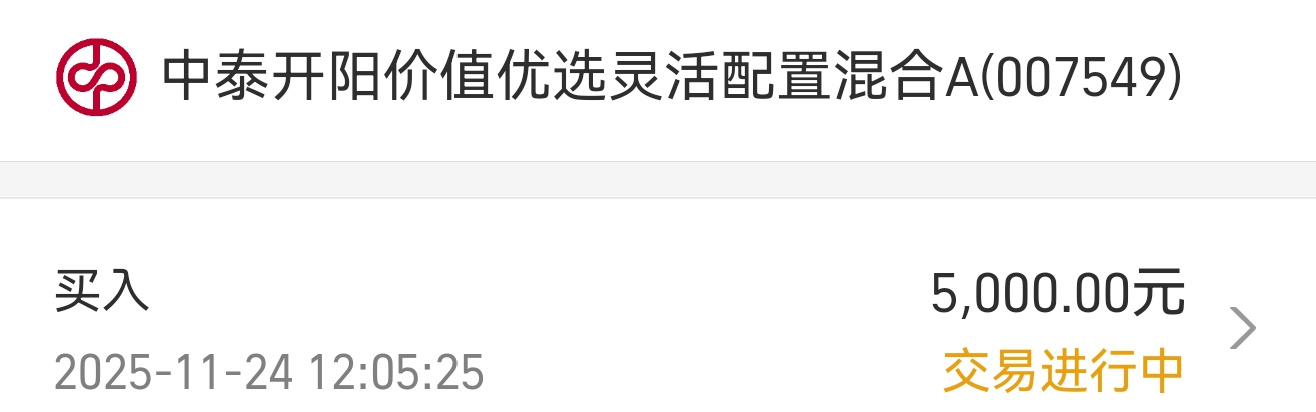
Market Overview - The market is experiencing fluctuations, with the main index showing signs of retreat after an upward movement, indicating a potential adjustment period ahead [1] - The current market environment is characterized by increased volatility, leading to a more conservative investment approach [2] Investment Strategy - The company has reduced its investment position from 700,000 to over 400,000, reflecting a cautious stance amid market uncertainties [1] - A focus on dollar-cost averaging and maintaining liquidity to respond to market changes is emphasized [1] Fund Investments - The company has increased its investment in the Morgan Huikai Growth Mixed Fund by 10,000, citing the fund manager's strong track record with an annualized return of 11.57% over nine years [2] - An additional investment of 5,000 has been made in the Zhongtai Kaiyang Value-Selected Flexible Allocation Mixed Fund, which has a balanced portfolio across various sectors, reducing volatility [2] - A 5,000 investment in the E-Fund CSI Military Industry Index (LOF) is noted, with expectations of growth due to stable defense spending and industry upgrades [3] Sector Analysis - The military industry is highlighted for its strong policy support and stable demand, with a focus on technological advancements and high barriers to entry [3] - The chip industry is currently facing a pullback, with the company opting to observe before making further investments [4] - The bond market is showing mixed signals, with the company maintaining its current holdings [7] - The renewable energy sector is in a consolidation phase, with plans to wait for a clearer trend before investing [7] - The Hong Kong stock market has shown some rebound but remains unstable, prompting a wait-and-see approach [7]
债券ETF跟踪:信用债类ETF大幅净流入
ZHONGTAI SECURITIES· 2025-11-24 12:27
Report Summary 1. Report Industry Investment Rating No information about the industry investment rating is provided in the report. 2. Core Viewpoints - Bond - type ETFs had significant net inflows in the past week, with credit - type ETFs leading the way, and large cumulative net inflows throughout the year [3]. - The net values of various bond ETF products recovered significantly in the past week, with some products performing well and others showing different trends [4]. - Credit - bond ETFs and science - innovation bond ETFs had certain increases in unit net value, and their discount rates were at specific levels [5]. 3. Summary by Relevant Catalogs 3.1 Funds Flow - As of November 21, 2025, bond - type ETFs had a total net inflow of 12.729 billion yuan in the past week. Interest - rate, credit, and convertible - bond ETFs had net inflows of 3.538 billion yuan, 6.636 billion yuan, and 2.555 billion yuan respectively. Among credit - type ETFs, short - term financing, corporate bonds, and urban investment bonds had net inflows of 2.598 billion yuan, 1.269 billion yuan, and 1.212 billion yuan respectively, while market - making credit bonds had a net outflow of 252 million yuan, and science - innovation bonds had a net inflow of 1.809 billion yuan. - As of November 21, 2025, the cumulative net inflows of interest - rate, credit, and convertible - bond ETFs for the year were 74.2 billion yuan, 445.363 billion yuan, and 25.137 billion yuan respectively, with a total of 544.7 billion yuan [3]. 3.2 Net Value Performance - Throughout the week, the net values of various bond ETF products recovered significantly. As of November 21, 2025, the 5 - year local - bond ETF and 10 - year local - bond ETF performed well, rising 0.15% and 0.14% respectively. The government - financial bond ETF and 0 - 4 local - bond ETF both rose 6BP. Treasury - bond ETFs and state - development - bond ETFs performed steadily. Convertible - bond ETFs and Shanghai - Stock - Exchange convertible - bond ETFs fell 1.72% and 1.37% respectively last week [4]. 3.3 Performance of Credit - Bond ETFs and Science - Innovation Bond ETFs - As of November 21, 2025, the median unit net values of credit - bond ETFs and science - innovation bond ETFs were 1.0126 and 1.0008 respectively, rising 0.01% and 0.02% throughout the week. Among credit - bond ETFs, Dacheng Credit - Bond ETF performed well, rising 0.04%. Among science - innovation bond ETFs, Fuguo, Boshi, and JingShun Science - Innovation Bond ETFs performed relatively well. As of November 21, 2025, the median discount rate of credit - bond ETFs was 25BP, and that of science - innovation bond ETFs was 22BP [5]. 3.4 Credit - Type ETF Duration Tracking - As of November 21, 2025, the holding durations of short - term financing ETFs, corporate - bond ETFs, and urban - investment - bond ETFs were 0.40 years, 1.84 years, and 2.21 years respectively. Among market - making credit - bond ETFs, the median holding durations of products tracking the Shanghai - market - making corporate - bond and Shenzhen - market - making corporate - bond indexes were 3.789 years and 2.87 years respectively. Among science - innovation bond ETFs, the median holding durations of products tracking the AAA science - innovation bond, Shanghai - AAA science - innovation bond, and Shenzhen - AAA science - innovation bond indexes were 3.47 years, 3.56 years, and 3.24 years respectively [8]. 3.5 Report Abstract - Last week, the ChinaBond New Composite Index rose 0.03% throughout the week. Short - term pure - bond and medium - long - term pure - bond funds rose 0.02% and 0.02% respectively. The ChinaBond AAA Science - Innovation Bond Index and the Shanghai Stock Exchange Benchmark Market - Making Corporate - Bond Index rose 0.03% and 0.03% respectively [7].
A股震荡“翻倍基”仅剩两成,ETF狂揽千亿逆势加仓
Di Yi Cai Jing· 2025-11-24 12:16
Core Insights - The A-share market has experienced significant volatility, with the Shanghai Composite Index dropping below key support levels, leading to a decline of nearly 5% in just over a week [1][4] - Active equity funds have faced substantial performance declines, with nearly 90% reporting negative returns in the fourth quarter, and over 30% experiencing declines exceeding 10% [2][3] - In contrast, the ETF market has seen a surge in inflows, with over 102.8 billion yuan entering stock ETFs in the fourth quarter, reversing a trend of outflows from the previous quarter [3] Group 1: Market Performance - The Shanghai Composite Index fell to 3836.77 points, with a cumulative decline of 4.78% over the last seven trading days [4] - Active equity funds have seen a dramatic reduction in performance, with only 23% of previously high-performing funds remaining in positive territory [2] - The decline in active funds is attributed to a significant market correction, particularly affecting sectors like AI and pharmaceuticals that had previously attracted substantial investment [2][3] Group 2: ETF Market Dynamics - The ETF market has attracted significant capital, with 102.8 billion yuan net inflow in the fourth quarter, marking a stark contrast to the nearly 50 billion yuan outflow in the previous quarter [3] - Notable inflows have been observed in broad-based ETFs, with specific products like the Southern CSI 500 ETF and the E Fund ChiNext ETF seeing net inflows exceeding 40 billion yuan [3] - Defensive investment strategies have gained traction, with funds focused on low volatility and free cash flow attracting significant capital, indicating a preference for stable assets in a turbulent market [3] Group 3: Future Market Outlook - Analysts suggest that the current market volatility may present long-term investment opportunities in sectors with strong fundamentals, despite short-term challenges [5][6] - The ongoing adjustments in market sentiment are expected to continue, with a focus on sectors such as technology, consumption, and high-end manufacturing as potential growth areas [6] - The overall outlook remains cautiously optimistic, with expectations of a gradual upward trend in the A-share market, supported by structural improvements in the domestic economy and favorable monetary conditions [6]
资金“抄底”了,大举净流入
Zhong Guo Zheng Quan Bao· 2025-11-24 12:12
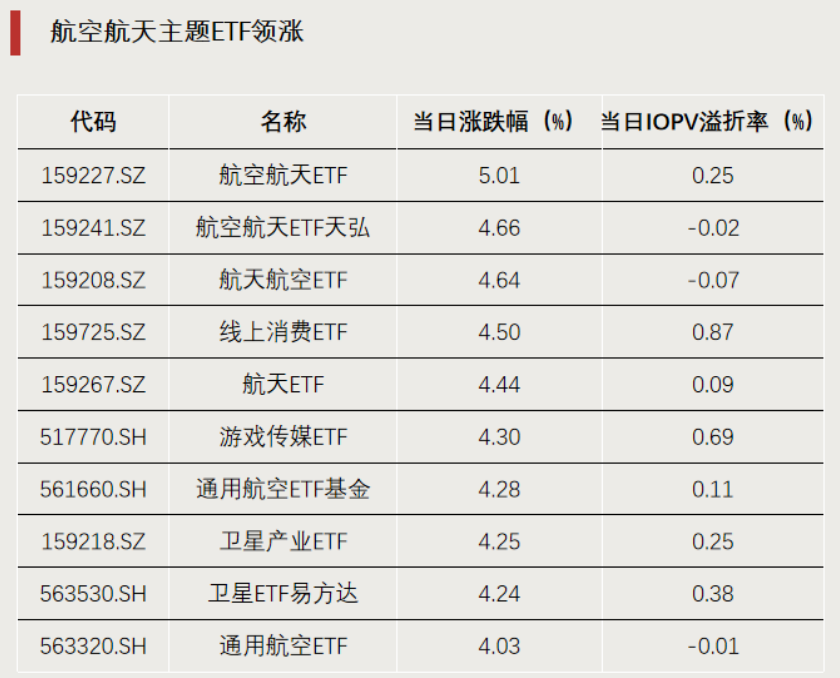
Group 1: ETF Performance - Aerospace and satellite-themed ETFs showed strong gains, with multiple products rising over 4% on November 24 [4] - The Satellite ETF (563230) surged by 3.79%, with its share increasing nearly 50% since the end of September, making it the top performer among similar ETFs [4] - The technology-focused Nasdaq ETF (159509) experienced a significant premium of 19.23% after resuming trading following a one-hour suspension [3][10] Group 2: Market Trends - The market saw a significant adjustment last week, but there was a "bottom-fishing" trend with substantial net inflows into several broad-based ETFs [2][7] - The lithium carbonate futures contract hit a limit down, negatively impacting market expectations for related companies, leading to a decline in rare metals and energy-related ETFs [5] - Despite recent adjustments, the long-term development logic of the new energy sector remains solid, supported by policy, market demand, and performance recovery [5] Group 3: Fund Flows - Notable net inflows were recorded for several broad-based ETFs, including the CSI 500 ETF, which saw a net inflow of 57.78 billion [9] - The Hang Seng Technology and CSI 50 ETFs also ranked high in net inflows for November, indicating investor interest in these sectors [9] - Active trading was observed in various currency and bond ETFs, with the Silver Day ETF (511880) achieving a transaction volume exceeding 20 billion [7][8]
【公募基金】美联储降息预期摇摆,国内债市窄幅震荡——泛固收类公募基金指数跟踪周报(2025.11.17-2025.11.21)
华宝财富魔方· 2025-11-24 10:52
Market Overview - The bond market maintained a volatile trend last week, with the 1-year government bond yield decreasing by 0.96 basis points to 1.40%, while the 10-year yield slightly increased to 1.82%, and the 30-year yield rose by 0.95 basis points to 2.16% [2][4] - The overall bond market continued its oscillation, with short-term bonds performing better than long-term ones, and the expected "see-saw effect" between stocks and bonds did not materialize due to the weak stock market [4] - Short-term and medium-term momentum in the bond market is insufficient, and disturbances are expected to rise due to government debt payments and the maturity of a large number of open market operations [4] Public Fund Market Dynamics - E Fund's Ruiyi Ying'an FOF raised over 5.8 billion, marking the largest fundraising for a new fund in the fourth quarter, and is part of the招商银行 "TREE Long-term Profit Plan" [6] - The focus of these funds is primarily on low to medium-risk multi-asset products, indicating a trend towards conservative investment strategies in the public fund market [6] Fund Index Performance Tracking - The Money Enhanced Index rose by 0.02% last week, with a cumulative return of 4.32% since inception [3] - The Short-term Bond Fund Preferred Index also increased by 0.02%, with a cumulative return of 4.50% since inception [3] - The Medium to Long-term Bond Fund Preferred Index rose by 0.03%, achieving a cumulative return of 6.85% since inception [3] - Conversely, the Low Volatility Fixed Income + Fund Preferred Index fell by 0.53%, with a cumulative return of 4.23% since inception [3] - The High Volatility Fixed Income + Fund Preferred Index decreased by 1.13%, with a cumulative return of 6.89% since inception [3] - The REITs Fund Preferred Index dropped by 1.17%, but has a cumulative return of 32.24% since inception [3]