
古茗

Search documents
餐饮业持续回暖:2025年收入近5.8万亿 茶饮上市与“餐饮+”成亮点
Di Yi Cai Jing· 2026-01-24 05:36
Core Insights - The Chinese catering industry showed signs of recovery in 2025, with total revenue reaching 57,982 billion yuan, a year-on-year increase of 3.2% [1] - The industry experienced a significant rebound from a decline in 2022, where revenue was 43,941 billion yuan, down 6.3% [1] - The growth trend in 2025 reflects a stabilization in the market, with new business models and product categories emerging, particularly in health-oriented and seasonal offerings [1][2] Group 1: Industry Performance - In 2023, the catering revenue was 52,890 billion yuan, marking a 20.4% increase, followed by 55,718 billion yuan in 2024, which was a 5.3% growth [1] - The overall growth rate in 2025 showed a pattern of high growth followed by stabilization, with pressures on larger enterprises due to competitive factors [1] - The catering market is characterized by dynamic adjustments and optimization of internal structures, with some months showing growth rates below the industry average [1] Group 2: Market Trends and Innovations - The year 2025 saw a surge in listings within the catering sector, with many companies opting for Hong Kong stock exchange listings, including brands like Gu Ming and Mi Xue [2] - Companies are actively innovating and expanding into "catering+" scenarios, integrating with cultural tourism, digitalization, and local live streaming to enhance consumer experiences [2] - Future trends in the catering industry include a focus on small, specialized, and aesthetically pleasing establishments, with an emphasis on fresh, traceable ingredients and increased automation in kitchens [2]
餐饮业持续回暖:2025年收入近5.8万亿,茶饮上市与“餐饮+”成亮点
Di Yi Cai Jing· 2026-01-24 05:25
Core Insights - The Chinese catering market in 2025 is characterized by "stable growth, structural optimization, and frequent highlights" amidst fluctuations [1][2] Group 1: Market Performance - In 2025, the national catering revenue reached 57,982 billion yuan, a year-on-year increase of 3.2%, accounting for 11.6% of total retail sales of consumer goods, up 0.2 percentage points from the previous year [2] - The catering revenue in 2022 was 43,941 billion yuan, showing a decline of 6.3%. In 2023, the revenue rebounded to 52,890 billion yuan, marking a 20.4% increase. In 2024, it further increased to 55,718 billion yuan, with a growth rate of 5.3% [2] - The overall growth rate of the catering market in 2025 showed a trend of high growth followed by stabilization, with the growth rate gradually leveling off in the second half of the year [2] Group 2: Industry Trends - New business formats and product categories are actively emerging in 2025, with clear trends towards health and seasonality. Beverage sectors like tea and coffee are accelerating innovation and capital investment, expanding towards health and integration [2] - Catering enterprises are launching seasonal themed products such as "summer cool" and "autumn and winter warm food," with hot pot and barbecue categories continuing to gain popularity, reflecting a keen grasp of market trends [2] - The year 2025 marks a concentrated period for listings in the Chinese catering industry, with many companies opting for listings on the Hong Kong stock exchange [3] - Companies are proactively innovating and expanding "catering+" multi-scenario approaches, enhancing product development, holiday marketing, and cultural integration [3] - Future trends in the catering industry include the survival of small, specialized, and aesthetically pleasing shops, with an emphasis on fresh, traceable ingredients and fewer processing steps [3]
古茗(01364.HK):25年表现预计好于预期 长期空间广阔
Ge Long Hui· 2026-01-23 23:42
Core Viewpoint - The company is expected to achieve a significant increase in revenue and adjusted core net profit in 2025, driven by store openings and improved gross margins, outperforming market expectations [1][2] Group 1: Financial Projections - The company forecasts a 46% increase in revenue and a 64% increase in adjusted core net profit to 2.52 billion yuan in 2025, with a 50% revenue growth and a 78% profit increase in the second half of 2025 [1] - The adjusted net profit for 2025 has been revised upward by 9% to 2.5 billion yuan, and for 2026 by 19% to 3.2 billion yuan, with a new profit forecast for 2027 set at 3.9 billion yuan [2] Group 2: Operational Highlights - The company anticipates strong same-store sales growth in the second half of 2025, supported by delivery platform subsidies and new product offerings, with a stable profit margin for franchisees [1] - The company plans to accelerate store openings, expecting a net increase of nearly 3,500 stores in 2025, bringing the total to over 13,000 [1] - In 2026, the company will focus on dine-in services and brand upgrades, with an expected same-store revenue growth of 0-5% [2] Group 3: Market Position and Strategy - The company aims to enhance its brand recognition and value through the upgrade of its store image and effective product launches, maintaining a strong competitive edge despite market challenges [2] - The company has demonstrated resilience in performance, attributed to strong execution by its team and franchisees, indicating a broad long-term growth potential [2]
2026年,头部茶咖品牌还要继续比拼开店?
3 6 Ke· 2026-01-23 10:06
Core Insights - The tea and coffee industry is experiencing rapid expansion, with multiple brands achieving significant milestones in store openings, indicating a competitive landscape focused on growth and market penetration [1][2][4][6]. Group 1: Company Expansion - Gu Ming has successfully opened 3,000 new stores in 2025, bringing its total to 13,000 stores nationwide, with a focus on expanding beyond its traditional strongholds in Jiangsu, Zhejiang, and Shanghai [1]. - Other brands like Hu Shang A Yi and Luckin Coffee have also joined the "10,000 store club," with Hu Shang A Yi reaching over 10,000 stores and planning to add 2,000-3,000 more in 2026 [2][4]. - Luckin Coffee expanded from approximately 4,500 stores to 10,000 in just over 10 months, showcasing a rapid growth strategy [4]. Group 2: Market Trends - The tea and coffee sector saw a total of over 990,000 operating stores by the end of 2025, reflecting a year-on-year growth of 6.58% [6]. - The competitive landscape is characterized by brands innovating in store locations, with many moving away from traditional high-traffic areas to more unconventional sites like transportation hubs and scenic spots [8][11]. - The trend of "store-in-store" models is gaining traction, allowing brands to expand with lower capital investment by embedding their offerings within existing retail spaces [9][12]. Group 3: Product Innovation - Brands are diversifying their product offerings, with companies like Heytea introducing baked goods alongside their tea products, while Nayuki focuses on light meals [12]. - Tea Yan Yue Se has launched a new retail model that combines beverage sales with snack offerings, creating a unique shopping experience [12]. - The emphasis on product innovation and customer experience is becoming crucial for brands to differentiate themselves in a crowded market [13].


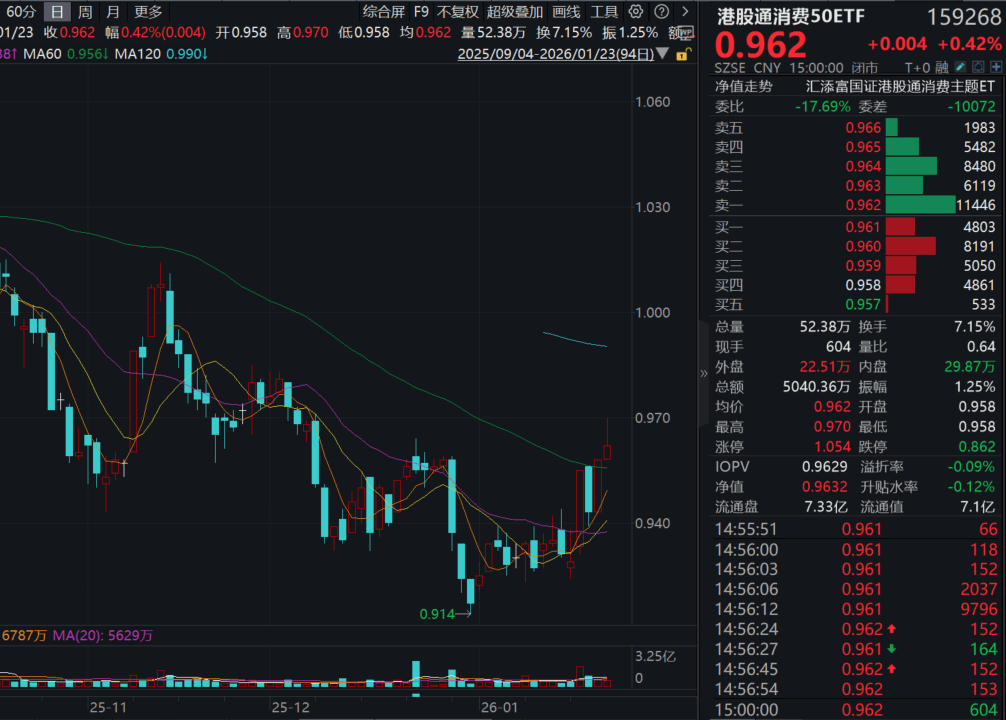
泡泡玛特、老铺黄金双双大涨6%!港股通消费50ETF(159268)再度收红!消费ETF(159928)近5日有3日获资金青睐!
Sou Hu Cai Jing· 2026-01-23 09:17
Group 1 - The core viewpoint of the articles highlights the strong performance of the Hong Kong stock market, particularly in the consumer sector, with significant gains in various consumer-related ETFs and stocks [1][3] - Pop Mart announced a share buyback of 2.51 billion HKD for 1.4 million shares, marking its first buyback action of 2024 [3] - The Consumer ETF (159928) has seen a net inflow of over 370 million HKD in the past five days, indicating strong investor interest [3] Group 2 - Huazhang Securities emphasizes the importance of the food and beverage sector, identifying it as a value opportunity due to high dividend yields and the potential for cyclical recovery [5] - The report suggests two main investment opportunities: efficient enterprises that excel in cost management and undervalued companies that can gain market share during downturns [5] - The white liquor sector is expected to undergo inventory clearance and recovery, with a focus on leading brands that have strong competitive advantages [6] Group 3 - The launch of Alibaba's Qianwen App marks a significant advancement in AI-driven consumer services, integrating various functions for seamless user experiences in shopping and travel [7] - The app's capabilities include a complete transaction loop in instant retail, travel planning, and shopping assistance, indicating a shift in consumer decision-making processes [7] - Tianfeng Securities predicts that AI technology will transform consumer engagement and growth mechanisms across various sectors, including e-commerce and online travel [7] Group 4 - The Consumer ETF (159928) is characterized by its resilience across economic cycles, with over 68.55% of its top ten holdings in essential consumer goods [8] - The top holdings include major liquor brands and agricultural companies, reflecting a diversified investment strategy within the consumer sector [9] - The ETF is positioned as an efficient investment vehicle for accessing the Hong Kong consumer market, particularly appealing to younger consumers [9]

中金:2025年餐饮品牌分化持续 看好现制饮品头部品牌
智通财经网· 2026-01-23 05:52
古茗计划延展咖啡和早餐时段、举行堂食营销活动和升级六代店型以提振同店和提升堂食销售占比,该 行预计26年同店收入有望同比持平。该行预计古茗25年门店净增近3500家,26年净新增门店数有望维持 25年水平。此外建议关注茶百道和沪上阿姨等品牌边际改善持续性:茶百道25年来产品上新机制调整取 得一定成效,计划26年向下拓宽产品价格带并持续优化运营;沪上阿姨指引26年新开2000-3000家。 智通财经APP获悉,中金发布研报称,2025年餐饮品牌分化持续,4Q25外卖退坡下现制饮品好于预 期,部分正餐边际改善。该行看好现制饮品头部品牌维持好于行业的同店和开店表现,关注部分品牌调 改效果和新品牌潜力。维持已覆盖标的投资评级、盈利预测和估值不变。 中金主要观点如下: 分化持续,4Q25外卖退坡下现制饮品表现好于预期,部分正餐迎来边际改善 该行估计4Q25沪上/古茗/茶百道/瑞幸/奈雪同店收入分别同比增长超20%/接近20%/双位数/10%/3%;锅圈 同店同比增速高单位数;海底捞受益于基数回落及调整举措,翻台同比持平;达势股份一线城市同店同比 正增长;太二受益于新店型调改,11月底开始同店转正、12月同店同增高单位数 ...
中金:维持古茗跑赢行业评级 上调目标价至36港元
Zhi Tong Cai Jing· 2026-01-23 01:48
Core Viewpoint - The company has raised its adjusted net profit forecasts for 2025 and 2026 by 9% and 19% respectively, reaching 2.52 billion and 3.2 billion yuan, and introduced a profit forecast of 3.9 billion yuan for 2027, reflecting better-than-expected store opening pace and gross margin improvements [1][2]. Group 1 - The company is expected to achieve a 64% year-on-year growth in core profit for 2025, with a projected revenue increase of 46% [2]. - The adjusted core net profit for 2025 is forecasted to reach 2.52 billion yuan, with a significant increase in the second half of 2025, driven by store openings and improved gross margins [2][3]. - The company anticipates a net increase of nearly 3,500 stores in 2025, surpassing a total of 13,000 stores, with strong same-store performance and expansion in key markets [3]. Group 2 - In 2026, the company will focus on dine-in services and brand upgrades, with expectations for same-store revenue growth of 0-5% despite the reduction in delivery subsidies [4]. - The company plans to enhance its brand recognition and value through the upgrade of its store image and the introduction of new products, aiming to solidify its competitive advantage [4]. - The company’s team and franchisees have demonstrated strong execution capabilities, indicating resilience in performance despite external challenges [4].
中金:维持古茗(01364)跑赢行业评级 上调目标价至36港元
智通财经网· 2026-01-23 01:43
Core Viewpoint - CICC has raised the adjusted net profit forecasts for Gu Ming (01364) for 2025 and 2026 by 9% and 19% to 2.5 billion and 3.2 billion HKD respectively, and introduced a profit forecast of 3.9 billion HKD for 2027, reflecting better-than-expected store opening pace and gross margin improvements [1] Group 1 - The company is expected to achieve a 64% year-on-year growth in core profit for 2025, with a projected revenue increase of 46% and adjusted core net profit reaching 2.52 billion HKD, outperforming market expectations due to better-than-expected store openings and gross margin improvements [2] - In the second half of 2025, same-store sales are anticipated to maintain strong growth, supported by delivery platform subsidies and new product offerings, with a projected net increase of nearly 3,500 stores, bringing the total to over 13,000 [3] Group 2 - In 2026, the company will focus on dine-in services and brand upgrades, with same-store revenue expected to grow by 0-5%, as the impact of delivery subsidies diminishes and the company enhances its brand recognition [4] - The company plans to upgrade its store image and maintain a rapid store opening pace, further consolidating its leading advantage in the market [4]
2026年,消费没有新故事?
虎嗅APP· 2026-01-22 23:59
Core Insights - The consumption market is undergoing a silent value reconstruction, characterized by both extreme "consumption downgrade" and sporadic "hotspot-style frenzy" [3][4] - Consumers are increasingly focused on practical value and emotional satisfaction, leading to a polarization in consumer personas [3][4] - The market is shifting towards a model where brands must provide genuine value rather than empty narratives, reflecting a collective negotiation between consumers and brands [4] Group 1: Market Trends - The year 2025 saw a significant increase in the popularity of second-hand platforms and discount supermarkets, indicating a shift towards practical consumption [3] - Despite some brands facing challenges, others like Mijia Ice City and Pop Mart have thrived, showcasing resilience in the market [4][5] - The trend of "not raising prices while upgrading consumption" is emerging as a key strategy for brands to navigate the current market environment [12] Group 2: Consumer Behavior - Consumers are now more discerning, focusing on the emotional value of products rather than just price, leading to a demand for higher quality and better experiences [40][41] - The rise of "K-shaped differentiation" in consumption indicates that while some sectors struggle, others are innovating and capturing market share [22] - The importance of emotional value in non-essential purchases, such as toys, is becoming more pronounced, as consumers seek joy and connection through their purchases [48][50] Group 3: Company Strategies - Companies are increasingly adopting a "four-dimensional warrior" approach, focusing on product upgrades, price optimization, user experience, and emotional connection with consumers [12][14] - The emphasis on localizing operations and decision-making is crucial for foreign brands to succeed in the Chinese market, as seen with companies like Bimbo [58][59] - Brands are encouraged to focus on core competencies and avoid unnecessary cost-cutting that could compromise product quality [42][44] Group 4: Future Outlook - The next few years are expected to see a continued emphasis on understanding and meeting diverse consumer needs, with a focus on value-driven products [60][61] - The market is likely to witness the emergence of new brands that prioritize consumer insights and long-term value creation [52][53] - The evolving landscape suggests that brands must adapt to changing consumer preferences and leverage emotional connections to thrive in a competitive environment [49][50]

茶饮品牌扎堆“卖饭”
Mei Ri Shang Bao· 2026-01-22 22:37
Core Insights - The tea beverage brand Mubaishouzuo Tea House has opened its first mall store in Hangzhou, introducing a new menu option that includes local snacks, indicating a trend among tea brands to diversify into food offerings for new growth opportunities [1][2] - The new store format of Mubaishouzuo represents a comprehensive upgrade in space, product, and consumer experience, featuring an expanded menu with main dishes and snacks [1] - Other brands, such as Mixue Ice City and Nayuki, are also venturing into food offerings, signaling a broader industry trend towards integrating food with beverage sales [2] Industry Trends - The integration of food offerings by tea brands aims to enhance customer spending and promote bundled purchases, as the supply chain becomes more mature and cross-industry barriers lower [2] - Successful integration of food and beverage requires alignment in brand tone, flavor, pricing, and product design to ensure a cohesive consumer experience [2] - The introduction of food items like Mubaishouzuo's Taro Rice and Nayuki's energy bowls reflects a strategic move to capture different meal occasions, such as breakfast and lunch, targeting specific consumer segments [1][2]