法国巴黎银行

Search documents
2025银行股业绩梳理
2 1 Shi Ji Jing Ji Bao Dao· 2025-12-31 23:42
Core Viewpoint - The A-share banking sector experienced a year of volatility in 2025, with an overall increase of 7%, which is significantly lower than the 34.39% gain in 2024, yet many individual bank stocks reached historical highs [1][3]. Group 1: Market Performance - By the end of 2025, 35 out of 42 bank stocks in the sector recorded gains, with 20 banks hitting historical highs and 21 banks increasing by over 10%, while 6 banks saw gains exceeding 20% [1][6]. - Agricultural Bank of China saw a remarkable stock price increase of over 52% during the year, briefly surpassing Industrial and Commercial Bank of China (ICBC) in market capitalization [1][3]. - ICBC maintained its position as the "king of stocks" with a market capitalization of 2.63 trillion yuan and a stock price increase of 21.54% [1][3]. Group 2: IPO Market - The A-share IPO market for banks remained stagnant in 2025, with no new listings, as several banks, including Guangzhou Bank, withdrew their applications [2][11]. - The only banks still in the IPO queue are Dongguan Bank, Huzhou Bank, Hubei Bank, Jiangsu Kunshan Rural Commercial Bank, and Guangdong Nanhai Rural Commercial Bank [11]. Group 3: Investment Trends - Long-term funds, particularly insurance capital, have been actively purchasing bank stocks, with insurance companies holding 382.5 million shares valued at 37.976 billion yuan by the end of Q3 2025 [8]. - The "stock accumulation for dividends" strategy has gained popularity among investors, with 28 out of 42 listed banks offering dividend yields above 4% [7][8]. Group 4: Capital Support - In 2025, state-owned banks received significant capital injections, with a total of approximately 520 billion yuan raised through targeted placements to enhance their capital structure [10]. - Meanwhile, smaller banks attracted investments from foreign and local state-owned enterprises, although the IPO process remains challenging for most [10][11].


油价录得2020年以来最大年度跌幅
Xin Lang Cai Jing· 2025-12-31 20:29
Core Viewpoint - International oil prices have declined slightly, leading to an annual drop of over 18% for 2025, despite geopolitical tensions, higher tariffs, OPEC+ production increases, and sanctions on Russia, Iran, and Venezuela. The market is increasingly anticipating a supply surplus [1][5]. Oil Price Movements - The price of West Texas Intermediate (WTI) crude oil for February delivery fell by $0.53, or 0.91%, closing at $57.42 per barrel [1]. - Brent crude oil contracts decreased by $0.48, or 0.78%, settling at $60.85 per barrel, marking an over 18% decline, the worst annual percentage drop since 2020, and the longest consecutive annual decline on record [2][5]. Inventory Data - According to the U.S. Energy Information Administration (EIA), U.S. crude oil inventories decreased by 1.9 million barrels to 422.9 million barrels, exceeding analyst expectations of a 867,000-barrel decline [3][7]. - Gasoline inventories rose by 5.8 million barrels to 234.3 million barrels, significantly higher than the expected increase of 190,000 barrels [7]. OPEC+ Production and Market Outlook - OPEC+ has accelerated production increases, releasing approximately 2.9 million barrels per day since April, and has paused further production increases for the first quarter of 2026 [4][8]. - Analysts predict that supply will exceed demand next year, with surplus estimates ranging from 3.84 million barrels per day by the International Energy Agency (IEA) to 2 million barrels per day by Goldman Sachs [9]. Geopolitical Factors - Despite indications of a supply surplus, geopolitical risks are expected to support oil prices. Analysts caution against underestimating the impact of geopolitical factors on market dynamics [5][9].
从减税到关税企稳:2026年美国经济有望迎来稳健增长
Xin Lang Cai Jing· 2025-12-31 13:49
Economic Overview - The U.S. economy faced initial predictions of recession or "stagflation" following Trump's global tariff plan, with a GDP contraction of 0.6% in Q1, but rebounded with a growth rate of 3.8% in Q2 and 4.3% from July to September [1][5] - If the Atlanta Fed's GDPNow model's prediction of 3% growth for Q4 holds true, the annual growth rate could reach 2.8%, surpassing the consensus forecast of 2.1% [1][5] Inflation and Consumer Prices - Inflation has stabilized, with a decrease to 2.7% in November, despite ongoing consumer dissatisfaction with high prices [1][5] - Consumer prices increased by approximately 2% during Trump's first year, compared to a 6% increase during Biden's first year [6] Trade Deficit and Tariff Impact - The trade deficit unexpectedly narrowed to $52.8 billion in September, the lowest level since June 2020, attributed to a significant increase in exports and a slight rise in imports [7][8] - Trump attributes these improvements to the administration's trade measures, claiming a 60% reduction in the trade deficit and significant GDP growth [8] Employment Trends - The unemployment rate rose to 4.6% in November, the highest since September 2021, raising concerns about potential negative impacts on employment due to economic uncertainty [8] Future Economic Outlook - Economists express cautious optimism for 2026, with Goldman Sachs predicting a growth rate of 2.6% and BNP Paribas forecasting a consensus of 1.9% [9] - Factors supporting this outlook include fiscal stimulus from the "Inflation Reduction Act," ongoing AI capital expenditures, and a reduction in the trade deficit [9][10] Monetary Policy and Interest Rates - The Federal Reserve is expected to implement at least one more rate cut in 2026, following three cuts in 2025, which may positively influence the economy [10] - The focus is on the Fed's ability to manage interest rate signals amid inflation concerns, with potential impacts from the anticipated replacement of the current chair [10] Economic Contributions and Risks - Continued advancements in AI, a bullish stock market forecast, and strong household balance sheets may contribute positively to GDP [10] - Despite the optimistic outlook, there are warnings of potential risks that could arise in the economic landscape [11]
白银从“非对称暴利”走进“高波动决胜局” 2026年将在泡沫争议中冲刺100美元?
Zhi Tong Cai Jing· 2025-12-31 01:12
Core Viewpoint - Silver prices have experienced significant volatility, with a recent peak above $84 followed by a sharp decline, raising concerns about a potential bubble in the market. However, analysts from Societe Generale caution against solely relying on quantitative models that suggest bubble behavior, emphasizing the need for a nuanced interpretation of price movements [1][2]. Group 1: Market Analysis - The recent surge in silver prices is attributed to a combination of macroeconomic factors, including expectations of lower interest rates from the Federal Reserve, structural supply constraints, and increased industrial demand driven by trends in electrification and renewable energy [3][4]. - The LPPLS model used by Societe Generale indicates that the current market state of silver may resemble a bubble, but analysts argue that this model should be viewed as a diagnostic tool rather than a definitive predictor of market behavior [2][3]. Group 2: Industrial Demand - The World Silver Association highlights that industrial demand for silver is being driven by significant growth in sectors such as AI data centers, electric vehicles, and renewable energy, with projected compound annual growth rates of 17% for the photovoltaic industry and 13% for the electric vehicle sector [4][5]. - The association forecasts that the demand for silver in industrial applications will continue to rise, particularly as global data center IT power capacity is expected to increase dramatically by 2025, necessitating more silver for essential components [5]. Group 3: Future Projections - Analysts predict that silver could reach $100 per ounce by 2026, supported by ongoing market dynamics and investment trends, although this target is viewed as an extreme bullish scenario [6][7]. - The dual role of silver as both an industrial metal and a store of value is attracting significant investment, with experts suggesting that the long-term bullish factors for silver remain strong [6][7].
Can Stablecoins Become Ubiquitous in 2026?
PYMNTS.com· 2025-12-30 16:35
Core Insights - Stablecoins have made significant progress in 2025, transitioning from being primarily held as reserves to being actively used for transactions, with a market capitalization exceeding $300 billion [3][5] - Major banks, card networks, and FinTechs have launched and integrated stablecoin payment and settlement products, driven by clearer regulatory frameworks [1][6] Market Trends - Stablecoin transaction volumes reached $27 trillion annually, although they still represent less than 1% of global daily money transfers [4] - The circulation of stablecoins doubled over the previous 18 months, indicating a shift towards more mainstream use cases [4] Regulatory Developments - The GENIUS Act established a federal framework for payment stablecoins in the U.S., clarifying reserve requirements and issuer oversight [6] - This regulatory clarity has encouraged major financial institutions to engage with stablecoins, leading to various partnerships and initiatives [5][6] Industry Initiatives - Visa and Bridge launched a card-issuing product allowing stablecoin use at any merchant accepting Visa, while Visa also expanded its stablecoin settlement capabilities [7][8] - Mastercard joined Paxos' Global Dollar Network to enable multiple stablecoins across its network [9] Corporate Engagement - Companies like SoFi, Coinbase, and PayPal have introduced stablecoin products aimed at various sectors, including enterprise solutions and AI-native businesses [10] - Major banks, including JPMorgan Chase and Bank of America, are exploring the launch of a jointly operated stablecoin [11][12] Use Cases - Stablecoins have found a mature use case in cross-border B2B payments and corporate treasury operations, allowing businesses to settle invoices and manage payroll more efficiently [15][17] - Dollar-denominated stablecoins are increasingly used in emerging markets as a hedge against currency volatility [17] Challenges - Despite advancements, consumer adoption of stablecoins remains uneven, particularly in developed markets where existing systems are effective [18] - Issues such as interoperability, transparency, and reliance on a small number of issuers pose ongoing challenges for the stablecoin industry [19]


日元年末逼近155关口 2026年或向160挺近
Jin Tou Wang· 2025-12-30 02:28
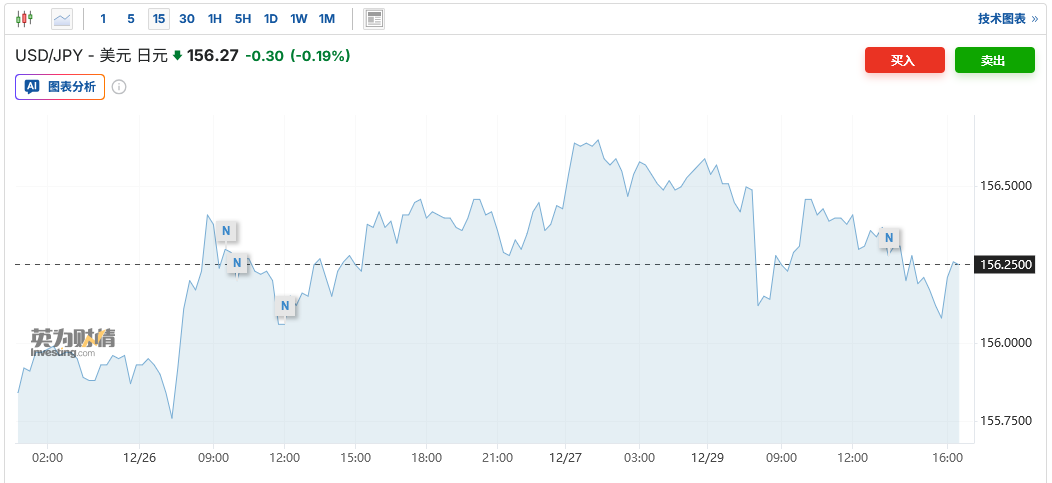
Core Viewpoint - The USD/JPY exchange rate remains strong, trading around 154.85 as of December 30, 2025, with expectations for it to break the 160 mark in 2026 despite a nearly 10% decline in the USD index throughout the year [1][2]. Group 1: Currency Policy Divergence - The strength of the USD/JPY is primarily due to the structural divergence in monetary policies between the US and Japan, with the Federal Reserve expected to slow its rate cuts in 2026 after a cumulative reduction of 75 basis points to 3.50%-3.75% in 2025 [2]. - The Bank of Japan raised rates to 0.75% in December but is proceeding cautiously, with market expectations for the next rate hike not fully priced in until September 2026, maintaining a negative real interest rate that diminishes the yen's attractiveness [2]. Group 2: Additional Factors Influencing the Yen - Increased carry trade activity is evident, with leveraged funds showing the highest short position against the yen since July 2024, as investors borrow low-yielding yen to invest in higher-yielding currencies [2]. - There is ongoing capital outflow pressure from Japan, with retail investors significantly buying overseas stocks and corporate mergers and acquisitions reaching multi-year highs [2]. - Persistent inflation in the US may limit the Fed's ability to cut rates further, while increasing pressure on Japanese government bonds could weaken the yen's safe-haven appeal [2]. Group 3: Market Intervention and Future Outlook - The yen is approaching the 160 level, which could trigger official intervention, as Japanese officials express concerns over speculative volatility in the exchange rate [3]. - Analysts believe that mere intervention may not reverse the yen's long-term weakness, emphasizing the need for a comprehensive fiscal strategy from the Japanese government [3]. - Most international investment banks maintain a bullish outlook on USD/JPY for 2026, with forecasts ranging from 160 to 165, driven by the slow pace of rate hikes from the Bank of Japan, ongoing capital outflows, and a deceleration in Fed rate cuts [3].
年终盘点之汇市:美元“单极”退潮,多极货币秩序浮现
智通财经网· 2025-12-29 15:17
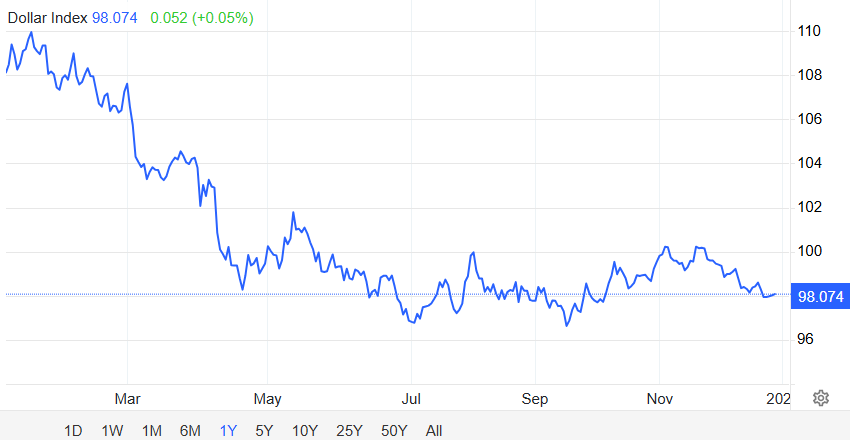
Group 1 - The US dollar index has been on a downward trend since the beginning of the year, reflecting changes in global investor attitudes towards dollar assets and the impact of US monetary policy [1][5][7] - The International Monetary Fund (IMF) reports that the dollar's share in global reserves has declined, dropping from 57.79% to 56.32% by the second quarter of 2025, marking a 30-year low [1][2] - The European Central Bank (ECB) and other global central banks are shifting towards independent monetary policies, leading to a diversified international monetary system [2][35] Group 2 - The euro has rebounded strongly, increasing by 13.5% over the year, driven by the weakening dollar and capital inflows [12][13] - The British pound has shown a "low open, high rise" trend, reaching a peak of 1.3743 against the dollar in July, supported by a stable UK economy and hawkish Bank of England policies [16][17] - The Japanese yen has experienced significant volatility, with a slight increase of 0.5% year-to-date, but facing depreciation pressures due to domestic political changes and fiscal risks [20][22][24] Group 3 - Resource currencies like the Australian dollar and Brazilian real have benefited from the weaker dollar, as it makes commodities cheaper for other currencies, boosting demand and export revenues [29][30] - The MSCI Emerging Markets Currency Index has risen over 6%, marking its best annual performance since 2017, with the Brazilian real gaining over 10% [31] - The weakening dollar has provided a significant boost to emerging market equities, while US stocks have remained strong, driven by AI themes despite concerns over US policies [33][34] Group 4 - The Federal Reserve has implemented three rate cuts in 2025, totaling 75 basis points, as it seeks to balance inflation control with employment stability [35][36] - The Bank of Japan has raised rates twice in 2025, marking a cautious approach amidst ongoing economic challenges, while the ECB has paused its rate cuts after a series of reductions earlier in the year [38][42] - The divergence in monetary policy paths among major central banks is expected to continue, with the Fed likely to cut rates once more in 2026, while the ECB may consider rate hikes depending on economic conditions [45][49]
三星生命保险、保诚等有意入股印度寿险公司IndiaFirst Life Insurance
Xin Lang Cai Jing· 2025-12-29 14:18
据报道,三星生命保险、法国巴黎银行和保诚有意入股印度寿险公司IndiaFirst Life Insurance。 ...
交易员权衡日央行加息时机及政府干预风险 日元小幅回升
智通财经网· 2025-12-29 08:58
Core Viewpoint - The Japanese yen has recovered some losses as the market weighs the timing of further interest rate hikes by the Bank of Japan and the potential for intervention by Japanese authorities during the year-end trading lull [1] Group 1: Bank of Japan's Policy and Market Reactions - The Bank of Japan raised its policy interest rate by 25 basis points to 0.75% in December, the highest level since 1995, indicating a potential for further tightening if inflation expectations are met [3] - Despite the rate hike, the yen weakened as the market was disappointed by the lack of clear guidance on future monetary tightening from the Bank of Japan [3] - Japanese Finance Minister Satsuki Katayama warned against speculative movements in the yen, stating that authorities have the "absolute freedom" to take bold actions if currency trends do not align with fundamentals [3] Group 2: Market Sentiment and Predictions - There is a growing bearish sentiment towards the yen, particularly after the Bank of Japan's December rate hike failed to provide sustained support, reinforcing the view of the yen's structural weakness [3] - Strategists from institutions like JPMorgan and BNP Paribas predict that the yen could depreciate to 160 yen per dollar or weaker by the end of 2026, driven by significant US-Japan interest rate differentials and ongoing capital outflows [4] - The chief strategist at JPMorgan highlighted the yen's weak fundamentals, suggesting little change in the situation for the coming year, with predictions of the yen reaching 164 yen per dollar by the end of 2026 [4] Group 3: Capital Outflows and Economic Factors - Japanese retail investors have shown a strong preference for overseas assets, with net purchases through investment trusts hovering around 9.4 trillion yen (approximately 60 billion USD), indicating a trend that may continue to suppress the yen [5] - Corporate capital outflows are also a significant factor, with stable foreign direct investment from Japan, largely unaffected by cyclical factors or interest rate changes, contributing to the yen's weakness [5] - Analysts expect the yen's weak position to persist, with predictions of the dollar-yen exchange rate reaching 165 by the end of 2026, as the Federal Reserve's interest rate cycle appears to be nearing completion [5] Group 4: Long-term Outlook - Some observers remain optimistic about the yen's long-term strength, with Goldman Sachs forecasting that the yen could eventually strengthen to 100 yen per dollar over the next decade, despite acknowledging short-term challenges [6]
“银色狂想曲”进入高波动章节? 白银火速跳水 创84美元历史最高位后急跌超3%
Zhi Tong Cai Jing· 2025-12-29 01:13
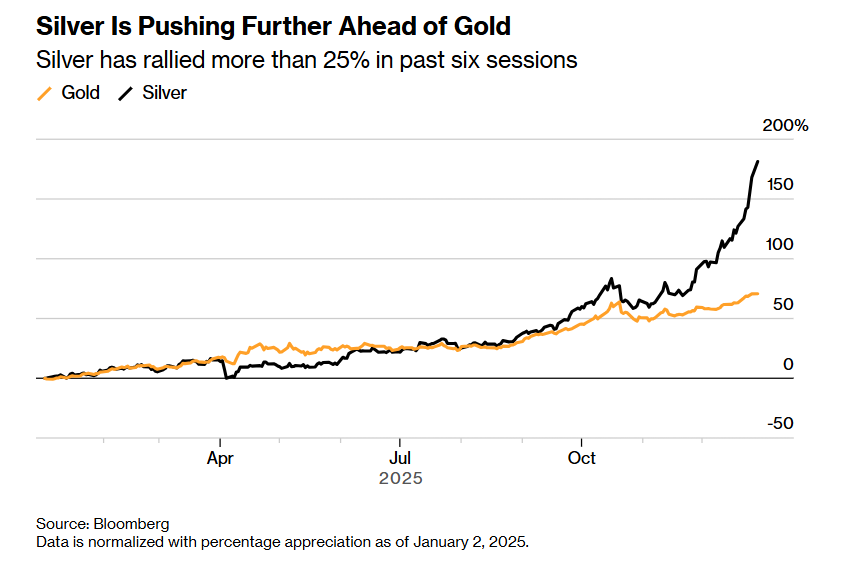
Core Viewpoint - Silver prices have surged to record highs, surpassing $80 per ounce for the first time, driven by speculative trading and supply shortages, with a notable increase of 165% year-to-date [1][4]. Group 1: Price Movements and Market Dynamics - Silver reached an all-time high of $84 per ounce before experiencing a sharp decline, highlighting the volatility driven by profit-taking among speculative investors [1]. - The recent six-day rally in silver prices has resulted in a cumulative increase of approximately 25%, marking the largest six-day gain since 1950 [1]. - The price of silver has been influenced by significant inflows of speculative funds and a supply mismatch in global commodity markets [1]. Group 2: Supply and Demand Factors - The silver market has been in a structural deficit for five consecutive years, with physical inventories rapidly depleting, leading to a supply squeeze [7]. - In 2025, global silver demand is projected to reach 1.24 billion ounces, while supply is expected to be only 1.01 billion ounces, resulting in a supply gap of 100 to 250 million ounces [7]. - The primary reason for the supply constraints is the rigid nature of global mining supply, as silver is often a byproduct of copper and zinc mining, and new mines take over a decade to develop [7]. Group 3: Investment Sentiment and Future Projections - Analysts suggest that the current surge in silver prices is driven by macroeconomic factors, including expectations of further interest rate cuts by the Federal Reserve, tight supply conditions, and strong industrial demand narratives [8]. - The World Silver Association highlights that the growth in demand for silver is supported by trends in AI data centers, electrification, and the transition to electric vehicles, with significant growth rates projected for these sectors [8][9]. - Some analysts predict that silver could reach $100 per ounce, driven by ongoing industrial demand and investment flows, with expectations of continued price increases until at least 2026 [10].