
Suzano

Search documents
中金 | 纸浆系列专题(三):一体化重构价值锚点
中金点睛· 2026-01-08 23:59
Core Viewpoint - The company continues to be optimistic about the performance of "forestry-pulp-paper integration" leaders by 2026, emphasizing that integration is key to achieving cost hedging and resource revaluation amid resource constraints and cost fluctuations. Focus should be on "value integrators" with high fiber self-sufficiency and resource barriers [2]. Industry Overview - After the paper industry bull market in 2021, profit distribution has tilted towards the pulp end, with a "long tail effect" in paper capacity clearance. The industry chain currently shows characteristics of "high concentration at the resource end and dispersed competition at the processing end," with pulp being a scarce resource commanding strong pricing power. The midstream paper sector is squeezed by high pulp prices and weak demand, leading to a continuous narrowing of profit margins [5][7]. - The strategic paradigm has shifted from capacity expansion to industry chain integration. Chinese paper companies have entered a mature phase of stock competition, where growth driven solely by capital expenditure is unsustainable. The core strategy has shifted to using self-owned fiber to hedge against volatile pulp prices, transforming leading companies from "global resource movers" to "value integrators" [5][8]. Market Dynamics - A short-term supply gap for wood chips is expected in 2026, with a potential recovery in pulp price levels. The domestic market has seen large-scale production of self-made pulp, but the construction cycle for quality wood chip resources lags behind equipment production. This is anticipated to push up cost levels as demand marginally improves [6]. - The competition landscape is characterized by heavy asset attributes and slow clearance. The investment per ton of paper exceeds 5,000 yuan, while pulp investment is over 2,000 yuan, leading to a long payback period. High depreciation necessitates maintaining high capacity utilization for cash flow, but the supply exceeds demand, and the core contradiction lies in the slow clearance efficiency at the bottom of the cycle [7]. Strategic Evolution - The industry has transitioned from a demand-driven phase to a mature phase of stock competition. Due to a lack of quality forest resources for pulp production, paper companies are in a "strong manufacturing, weak resource" decoupling state, making them vulnerable to global pulp price and exchange rate fluctuations. The strategic focus of leading companies has shifted to "forestry-pulp-paper integration," allowing them to convert unstable processing profits into certain resource premiums [8][9]. Global Comparison - Compared to emerging markets like Brazil, which are still in a dual growth phase of resources and consumption, the valuation logic of Chinese paper companies is undergoing reconstruction. Future focus will shift from capacity growth to the self-sufficiency rate of the entire industry chain. Leading companies are moving away from being "global resource movers" and are enhancing their cost control capabilities, which is crucial for maintaining stable ROE and achieving valuation recovery [9].




华尔街见闻早餐FM-Radio | 2026年1月8日
Sou Hu Cai Jing· 2026-01-07 23:36
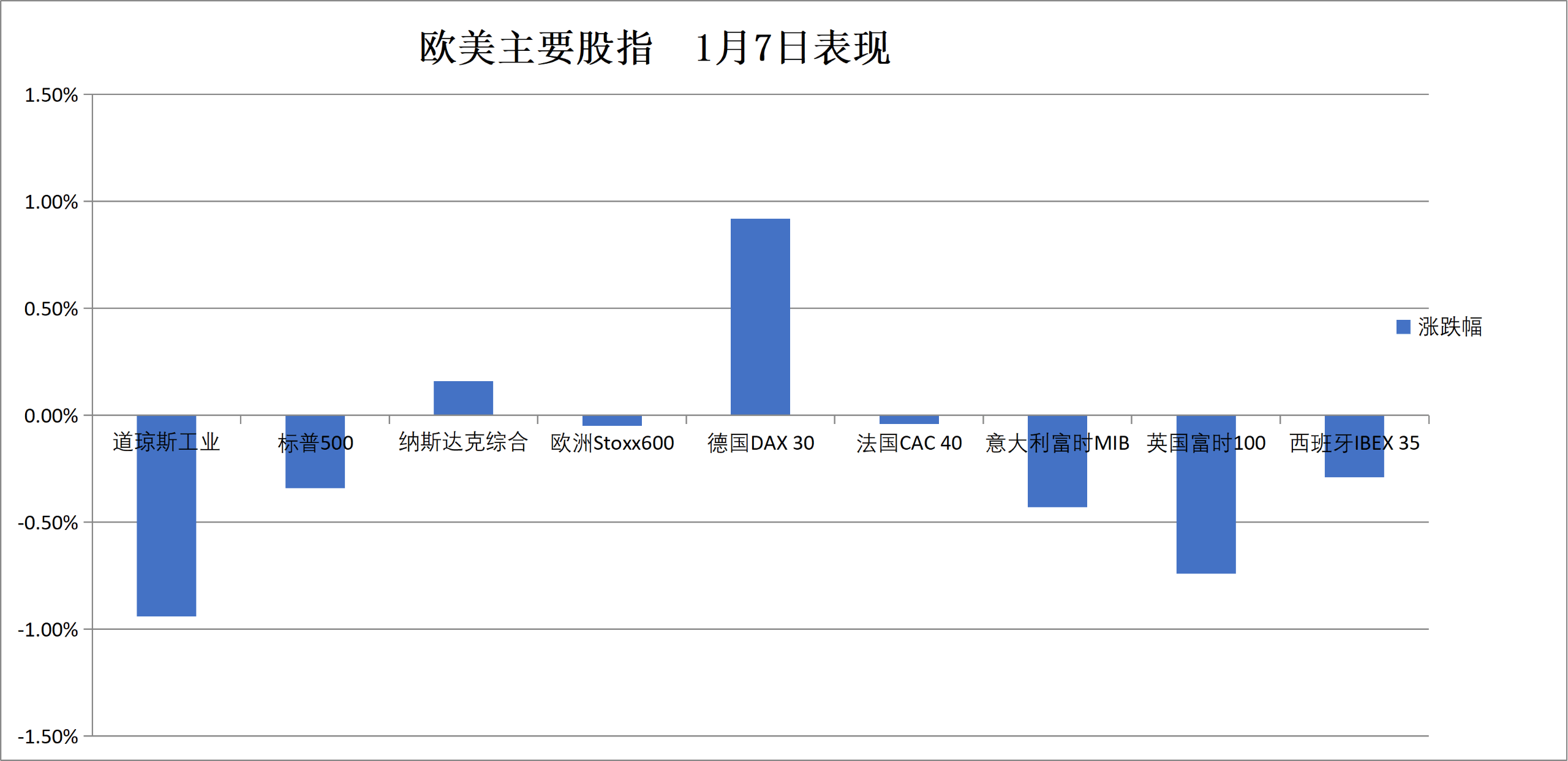
Market Overview - The US economic data presents mixed signals, with geopolitical risks affecting the stock market, leading to declines in the S&P 500 and Dow Jones, while the Nasdaq has seen three consecutive days of gains [1] - Google's parent company saw a 2.5% increase in stock price, surpassing Apple's market value for the first time since 2019, while Apple experienced a six-day decline [1] - The chip index halted a three-day rise, but Nvidia rebounded by 1% [1] - Valero Energy shares rose over 3% following Trump's announcement regarding the transfer of Venezuelan oil to the US [1] - Defense contractors fell after Trump stated he would not allow dividends and buybacks, with Northrop Grumman down 5.5% and Lockheed Martin nearly 5% [1] - Blackstone shares dropped 5.6% after Trump proposed banning institutional investors from purchasing single-family homes [1] Economic Indicators - The US ADP employment report showed a modest increase of 41,000 jobs in December, below expectations, while the JOLTS job openings fell to a one-year low [6][19] - The ISM services PMI rose to 54.4, the highest in over a year, indicating robust demand and a recovery in hiring [19] - The offshore RMB fell over 100 points, nearing the 7.0 mark, hitting a new low for the year [1] Commodities - Precious metals experienced a significant drop, with silver and platinum leading the decline, silver futures down over 6% and platinum nearly 8% [1][17] - Industrial metals also fell, with copper down over 2% and nickel down over 3% [1] - Oil prices dropped to a three-week low, with WTI crude futures down 2% [1][13] AI and Technology - The Chinese government aims to accelerate the upgrade of smart terminals, with a goal for key AI technologies to achieve reliable supply by 2027 [4][33] - The AI sector is seeing significant investment, with companies like Zhiyuan AI and MiniMax planning IPOs in Hong Kong, raising substantial capital [21][9] - The introduction of Gemini AI-powered smart TVs by Google marks a significant step in the consumer electronics sector [22] International Relations - The US is set to "resell" Venezuelan oil and has demanded Venezuela cut economic ties with China and Russia, which has drawn criticism from China [5][20] - The geopolitical landscape is tense, with the US military's recent actions against Russian-flagged oil tankers raising concerns about potential military escalation [20][26]
纸浆数据日报-20260107
Guo Mao Qi Huo· 2026-01-07 03:05
Report Summary 1. Report Industry Investment Rating - Not provided in the given content 2. Core View of the Report - Pulp is currently pulled by the trading logic of "strong supply" and "weak demand", lacking a clear short - term direction. The 05 contract is expected to fluctuate in the range of 5400 - 5700 yuan/ton [6] 3. Summary by Relevant Catalogs Pulp Price Data - **Futures Prices**: On January 6, 2026, SP2601 was 5528 yuan/ton with a daily increase of 1.02% and a weekly decrease of 0.65%; SP2609 was 5648 yuan/ton with a daily increase of 1.55% and a weekly decrease of 0.25%; SP2605 was 5612 yuan/ton with a daily increase of 1.48% and a weekly decrease of 0.32% [6] - **Spot Prices**: Coniferous pulp Silver Star was 5600 yuan/ton, Russian Needle was 5400 yuan/ton with no daily or weekly change; Broadleaf pulp Golden was 4720 yuan/ton with a daily increase of 0.43% and a weekly increase of 1.07% [6] - **Foreign Quotes and Import Costs**: For example, Chilean Silver Star's foreign quote increased by 2.94% month - on - month, and its import cost increased by 2.91% month - on - month; Brazilian Goldfish's import cost increased by 3.66% month - on - month [6] Pulp Fundamental Data - **Supply - Side**: In November 2025, the import volume of coniferous pulp was 72.5 tons with a month - on - month increase of 4.92%, and that of broadleaf pulp was 176.5 tons with a month - on - month increase of 33.92%. Suzano announced a full - scale price increase for global broadleaf pulp in January 2026 [6] - **Demand - Side**: Pulp demand has been stable recently. The price of tissue paper has risen slightly, and the prices of other paper products are stable. The production of major wood - pulp paper products is stable [6] - **Inventory - Side**: As of January 4, 2026, the inventory of mainstream pulp ports in China was 199.7 tons, a cumulative increase of 9.1 tons from the previous period, a month - on - month increase of 4.8%. The inventory has shifted to a cumulative trend, ending five consecutive weeks of destocking [6]
纸浆数据日报-20260106
Guo Mao Qi Huo· 2026-01-06 02:43
Group 1: Report Industry Investment Rating - No information provided Group 2: Core View of the Report - Pulp is currently pulled by the trading logic of "strong supply" and "weak demand", lacking a clear short - term direction. The 05 contract is expected to fluctuate in the range of 5400 - 5700 yuan/ton [6] Group 3: Summary by Relevant Content Pulp Price Data - **Futures Prices**: On January 5, 2026, SP2601 futures price was 5472 yuan/ton, up 0.22% day - on - day and down 1.08% week - on - week; SP2609 was 5562 yuan/ton, down 0.14% day - on - day and down 1.56% week - on - week; SP2605 was 5530 yuan/ton, down 0.04% day - on - day and down 1.32% week - on - week [6] - **Spot Prices**: Coniferous pulp Silver Star was 5600 yuan/ton, unchanged day - on - day and week - on - week; Russian Coniferous pulp was 5400 yuan/ton, unchanged; Broadleaf pulp Goldfish was 4700 yuan/ton, up 0.64% day - on - day and week - on - week [6] - **Foreign Quotes**: Chilean Silver Star's foreign quote was 700 dollars/ton, up 2.94% month - on - month; Brazilian Goldfish was 560 dollars/ton, up 3.70% month - on - month; Chilean Venus was 620 dollars/ton, unchanged [6] - **Import Costs**: Chilean Silver Star's import cost was 5721 yuan/ton, up 2.91% month - on - month; Brazilian Goldfish was 4587 yuan/ton, up 3.66% month - on - month; Chilean Venus was 5073 yuan/ton, unchanged [6] Pulp Fundamental Data - **Import Volume**: In November 2025, coniferous pulp import volume was 72.5 tons, up 4.92% month - on - month compared to October; broadleaf pulp import volume was 176.5 tons, up 33.92% month - on - month [6] - **Shipment Volume**: The pulp shipment volume to China in November 2025 was 178 thousand tons, up 3.00% month - on - month [6] - **Domestic Production**: The broadleaf pulp production of 25 countries showed fluctuations from November 2025 to December 2025; the chemi - mechanical pulp production was relatively stable [6] - **Inventory Data**: Pulp port inventory and futures delivery warehouse inventory also fluctuated during the period from November 2025 to December 2025. As of January 4, 2026, the inventory of China's mainstream pulp ports was 199.7 tons, up 9.1 tons from the previous period, a 4.8% increase [6] - **Finished Paper Production**: The production of various finished papers such as offset paper, coated paper, tissue paper, and white cardboard also fluctuated during the same period [6] Supply, Demand and Inventory Analysis - **Supply**: Suzano announced a full - scale price increase for global broadleaf pulp in January 2026. Goldfish broadleaf pulp increased by 20 dollars in Asia and 120 dollars in Europe and North America [6] - **Demand**: The pulp demand has been stable recently. The price of tissue paper has risen slightly, while the prices of other paper products are stable, and the production of major wood - pulp papers is stable [6] - **Inventory**: As of January 4, 2026, the inventory of China's mainstream pulp ports has shifted to a cumulative inventory trend, ending the continuous five - week destocking phenomenon [6]
纸浆数据日报-20260105
Guo Mao Qi Huo· 2026-01-05 03:30
Group 1: Report Industry Investment Rating - No information provided Group 2: Report's Core View - Pulp has intense competition between the "strong supply" and "weak demand" narratives recently, and is highly volatile due to market macro funds. It is recommended to wait and see [6] Group 3: Summary by Related Catalogs Pulp Price Data - Futures prices of SP2601, SP2609, and SP2605 on December 31, 2025, were 5460 yuan/ton, 5570 yuan/ton, and 5532 yuan/ton respectively, with daily decreases of 0.66%, 0.61%, and 0.65%, and weekly decreases of 1.66%, 1.59%, and 1.57% [6] - Spot prices of coniferous pulp Silver Star, Russian Needle, and broadleaf pulp Golden were 5600 yuan/ton, 5400 yuan/ton, and 4700 yuan/ton respectively on December 31, 2025, with the Golden having a daily and weekly increase of 0.64% [6] - Foreign offers of Chilean Silver Star, Brazilian Goldfish, and Chilean Venus were 700 dollars/ton, 560 dollars/ton, and 620 dollars/ton respectively, with monthly increases of 2.94%, 3.70%, and 0.00% [6] - Import costs of Chilean Silver Star, Brazilian Goldfish, and Chilean Venus were 5721 yuan/ton, 4587 yuan/ton, and 5073 yuan/ton respectively, with monthly increases of 2.91%, 3.66%, and 0.00% [6] Pulp Fundamental Data - In November 2025, imports of coniferous pulp were 72.5 tons, a 4.92% increase from October; imports of broadleaf pulp were 176.5 tons, a 33.92% increase from October [6] - The pulp shipment volume to China in November 2025 was 178 thousand tons, a 3.00% increase [6] - National production of broadleaf pulp and chemimechanical pulp in different weeks from November 13 to December 25, 2025, showed certain fluctuations [6] - As of December 25, 2025, pulp port inventory was 190.6 tons, a decrease of 8.7 tons from the previous period, a 4.4% decrease; futures delivery warehouse inventory was 10.1 tons [6] - Production of finished paper such as offset paper, coated paper, tissue paper, and white cardboard in different weeks from November 13 to December 25, 2025, also showed certain fluctuations [6] Supply, Demand, and Inventory - Suzano announced a full - scale price increase for global broadleaf pulp in January 2026, with a 20 - dollar increase in Asia and a 120 - dollar increase in Europe and North America for Golden broadleaf pulp [6] - The demand side remains weak. Among mainstream wood - pulp papers, the price of cultural paper continues to decline, while tissue paper and white cardboard have a slight increase [6] - As of December 25, 2025, the sample inventory of China's main pulp ports was 190.6 tons, showing a de - stocking trend for five consecutive weeks [6]
全球纸浆与造纸_纸业观察_亚洲漂白桉木浆(BEKP)再涨 20 美元 吨-Global Pulp & Paper _ P&P Digester_ Another US$20_t BEKP price hike in Asia
2025-12-29 15:51
Summary of Key Points from the Conference Call Industry Overview - The report focuses on the **Global Pulp & Paper** industry, specifically highlighting price movements and market dynamics related to **Bleached Eucalyptus Kraft Pulp (BEKP)** and **Bleached Softwood Kraft Pulp (BSKP)** prices in Asia, Europe, and North America [2][3]. Price Movements - **Suzano** has announced a price increase of **US$20/t** for BEKP in Asia and **US$120/t** in Europe and North America for January, following a previous increase of **US$20/t** on December 15 [2]. - Current imported prices for BEKP have risen to the **US$550-570/t** range [2]. - Daily resale prices for BEKP have remained stable at approximately **US$560/t** [3]. Factors Influencing Price Increases - Several factors are contributing to the upward trend in pulp prices: - **Woodchip prices** have increased by **US$30-40/t** since July [2]. - A clearer supply outlook for 2026 is anticipated due to changes in production capacities [2]. - Maintenance downtimes in Q4/Q1 are expected to remove approximately **450kt** of pulp from the market [2]. - Price hikes in paper products, particularly in China, are also influencing pulp prices [2]. Market Challenges - The near-term outlook for price increases appears more challenging due to: - Resistance from buyers, as domestic woodchip prices have recently declined [3]. - Thin margins for paper mills, despite attempts to raise prices [3]. - An increase in BHK production in China as mills revert from softwood [3]. Investment Recommendations - The report recommends a **Buy** rating for the following companies: - **Suzano** with a price target of **R$64** [4]. - **UPM** with a price target of **€27.10** [4]. - **International Paper (IP)** with a price target of **$53** [4]. Key Data Points - **China Daily Resale Prices**: BEKP at **US$561/t** (+US$1/t week-over-week); BSKP Futures at **US$683/t** (+US$6/t week-over-week) [5]. - **China Woodchip Prices**: Imported hardwood chips at **US$179/t** (-4% month-over-month); domestic hardwood chips at **US$148/t** (-2% week-over-week) [5]. - **China Pulp Stockpiles**: Total at **2,361kt**, a decrease of **33kt** week-over-week [5]. - **China Pulp Prices**: BHK at **US$535/t** (+US$7/t month-over-month); BSK at **US$661/t** (+US$5/t month-over-month) [5]. Risks and Considerations - The pulp and paper sectors in Latin America are subject to high volatility and various risk factors, including commodity price fluctuations, regulatory changes, production disruptions, and labor issues [12]. - UPM's operational leverage to currency rates and prices is mitigated by its global reach and product diversification [13]. - IP's volumes are influenced by macroeconomic factors, and any decline in economic activity could negatively impact demand [14]. This summary encapsulates the critical insights and data from the conference call, providing a comprehensive overview of the current state and outlook of the Global Pulp & Paper industry.

2026年造纸行业投资策略:林浆纸一体化推进,中长期格局优化
Shenwan Hongyuan Securities· 2025-12-29 05:43
Group 1 - The core view of the report emphasizes the integration of wood pulp and paper production, leading to an optimized long-term industry structure and upward profitability [3][5] - The report highlights the significant differences in supply and demand dynamics across various segments of the specialty paper market, suggesting a selective approach to identifying strong performers in favorable supply-demand conditions [4] - The wood pulp market is characterized by a cost structure that supports price stability, with needle pulp costs remaining high and supply-demand tightness providing a floor for prices; the report anticipates a gradual stabilization and slight improvement in pulp prices in 2026 [5][9][11] Group 2 - The report indicates that the paper industry has been in a prolonged bottoming phase, with signs of gradual improvement in supply-demand dynamics, particularly in the boxboard and corrugated paper segments [5][6] - Cultural paper demand is under pressure due to declining birth rates, with short-term stability in demand for double-glue paper but long-term challenges anticipated [22][25] - The white card paper segment is expected to benefit from trends such as replacing plastic with paper, with strong long-term growth potential despite short-term economic pressures [44][46] Group 3 - The report outlines that the supply structure for cultural paper is becoming more concentrated, with significant new capacity expected to come online in 2026, which may exert pressure on the market [29][40] - The profitability of the industry is expected to stabilize, with a focus on companies that lead in integrated operations and cost advantages, such as Sun Paper and Nine Dragons Paper [5][6] - The report suggests that the overall paper price stability is stronger than that of bulk paper, with capital expenditures slowing down and export demand contributing to incremental growth [5][6]


南华纸浆产业周报:期价再创新高,震荡走势预计延续-20251229
Nan Hua Qi Huo· 2025-12-29 00:52
Report Industry Investment Rating - Not provided in the document Core Views of the Report - This week's pulp futures prices reached a new high since April, with the main contract rising to 5710 yuan/ton on the 23rd, showing a wide - range volatile trend as expected. The main influencing factors include foreign market price support, the macro - sentiment impact of the RMB breaking 7, and capital fluctuations. [2] - It is expected that the pulp futures prices will continue to fluctuate in a wide range next week, with a possibility of a high - level decline. [3] - In the short - term, the futures prices are affected by the capital side, and the fundamentals are slightly stronger than before, with some support at the bottom. In the long - term, the impact of near - term warehouse receipts has been mostly priced in, while the supply of long - term warehouse receipts is uncertain, which brings some positive factors. The macro - sentiment may weaken due to the possible halt of the Fed's interest - rate cut process, but there may be positive policy factors in the domestic market. [4][5] Summary by Directory Chapter 1: Core Contradictions and Strategy Recommendations 1.1 Core Contradictions - The core factors this week are foreign market price support, the macro - sentiment impact of the RMB breaking 7, and capital fluctuations. The futures prices reached a new high, with the main contract rising to 5710 yuan/ton. Suzano's price increase in the Asian market in January and the RMB breaking 7 provided cost support and positive sentiment, respectively. Capital fluctuations led to wide - range volatility. [2] - From the fundamental perspective, China's pulp port inventory decreased by 8.7 tons this week, which is a significant de - stocking and is one of the reasons for the high - level volatility of futures prices. [2] - In terms of terminal demand, the operating rates of downstream paper types showed mixed changes, and the demand was relatively weaker than last week. The import price of softwood pulp increased by 0.02%, with a further narrowing of the increase, which still has a supporting effect but is difficult to drive the futures prices up further. [2] 1.2 Trading - Type Strategy Recommendations - Not detailed in the document 1.3 Industry Customer Operation Recommendations - For inventory management of enterprises with high inventories of pulp and offset printing paper, it is recommended to short pulp/offset printing paper futures to lock in profits and sell call options to collect premiums and reduce costs. The recommended hedging ratio is 25%, and the recommended entry intervals are 5500 - 5600 for pulp and 4350 - 4400 for offset printing paper. [9] - For procurement management of papermaking enterprises with low inventories, it is recommended to buy pulp/offset printing paper futures to lock in procurement costs in advance and sell put options to collect premiums and reduce procurement costs. The recommended hedging ratio is 25%, and the recommended entry intervals are 5000 - 5100 for pulp and 4000 - 4100 for offset printing paper. [9] Chapter 2: This Week's Important Information 2.1 This Week's Important Information - **Likely Positive Information**: The RMB breaking 7, Suzano's price increase of 20 dollars in the Asian market in January, and the further decline of port inventory [14] - **Likely Negative Information**: The relatively high valuation of futures prices and the shutdown plan of leading paper enterprises in the first quarter of 2026 [13] - **Spot Transaction Information**: The pulp price shows a range - bound trend, with the main contract range of [5550, 5650]. It is recommended to focus on short - term operations in the futures market, with a small amount of high - short strategies, and to wait and see for options. Temporarily wait and see for basis and arbitrage strategies. [13] Chapter 3: Market Interpretation 3.1 Price - Volume and Capital Interpretation - The SP2605 contract continued to fluctuate in a wide range this week. The RSI indicator once reached the over - bought range and then declined. Currently, the technical indicators are slightly bearish. [20] 3.2 Base and Spread Structure - Not detailed in the document Chapter 4: Supply, Demand, and Inventory 4.1 Supply - On December 26th, the inventory was 190.6 tons (- 8.7), which is a significant de - stocking and has a positive effect. The warehouse receipts have reached an absolute low compared to the same period. The price difference between softwood and hardwood pulp has gradually converged to a normal level, which is positive. [32] - In November, the domestic monthly import volume of softwood pulp was 81.99 tons, an increase from October. The global pulp shipment volume to China increased by 3.85% month - on - month in November, which will put pressure on future de - stocking. [32] 4.2 Demand - The downstream finished paper inventories of enterprises continue to accumulate, and the profit margins have declined this week, which restricts the raw material replenishment actions of downstream enterprises. [32] - The operating rates and production of various types of finished paper show different trends, and the export and consumption also have their own characteristics, which are presented in the corresponding seasonal charts. [68][73][76][82]
方正证券:人民币汇率走强 造纸板块有望受益
智通财经网· 2025-12-26 06:53
Group 1 - The core viewpoint of the report from Founder Securities indicates that rising raw material prices and a strong currency are likely to improve profitability in the paper industry, particularly benefiting integrated pulp and paper companies with high self-sourcing ratios [1] - As of December 25, 2025, the Shenwan Paper Industry Index rose by 3.68%, ranking third among Shenwan's secondary industry indices for the day [1] - The appreciation of the Renminbi is expected to benefit pulp and paper companies on the cost side, as the industry relies on approximately 60% imported pulp, leading to optimized procurement costs due to the recent currency strengthening [1] Group 2 - Overseas pulp manufacturers have continued to raise prices, with Brazil's Suzano announcing a price increase of $20 per ton for the Asian market, marking the fourth price hike in 2025 [2] - Chile's Arauco also announced a $20 per ton increase for both softwood and hardwood pulp, providing cost support for domestic paper price increases [2] Group 3 - Domestic paper companies are issuing price increase notices in response to rising raw material costs, with companies like Sun Paper, Asia Pacific Forest Products, APP (China), and Bohui Paper raising prices by 200 yuan per ton starting January 1, 2026 [3]


从产能周期看浆纸产业链的结构性变化与趋势
Guo Tai Jun An Qi Huo· 2025-12-23 13:52
1. Report Industry Investment Rating - Not provided in the document 2. Core View of the Report - The pulp and paper industry is undergoing significant structural changes, with broadleaf pulp gradually seizing market share from softwood pulp, and the industry is facing challenges such as overcapacity and compressed downstream profits [50][52][59] 3. Summary According to Related Catalogs 3.1 Pulp Mill Capacity: Is It in the Clearance Stage? - **Market Structure of Commodity Pulp**: Global commodity pulp capacity is dominated by broadleaf pulp, accounting for about 50%, followed by softwood pulp at about 20%. Suzano, APP, and UPM are major players [5] - **Pulp Production Cost Curve**: The average cash cost of BHKP is 289 dollars/ton for 70% of the capacity, and the CIF China break - even point (excluding logistics) is 580 - 600 dollars/ton for 70% - 75% of the capacity. For BSKP, the average cash cost is 500 dollars/ton for 41% of the capacity, and the CIF China break - even point (excluding logistics) is 445 - 465 dollars/ton for 85% - 90% of the capacity [8] - **Company Performance Analysis** - **SUZANO**: In 25Q1 - Q3, revenue was 37 billion reais, a year - on - year increase of 11%. Operating cost was 24.8 billion reais, a year - on - year increase of 33%. Operating profit was 7.5 billion reais, a year - on - year decrease of 1%. Net profit rebounded significantly mainly due to less derivative losses last year. Pulp revenue accounts for about 80% of the company's revenue [10][13] - **ARAUCO**: Q3 revenue was 1.5 billion dollars, a quarter - on - quarter decrease of 1%. Gross profit was 350 million dollars, with a gross profit margin of 23%. The company has been unprofitable since 2025, and Q3 net profit after non - recurring items was underwater. Pulp business EBITDA Margin is about 26.5% [22] - **Metsa Group**: Sales revenue increased, but profit reached a new low. In Q3, the operating profit margin was - 12%. Pulp sales continued to rise [26] - **Mercer**: In 25Q3, revenue was 458 million dollars, flat quarter - on - quarter. Gross profit was negative for two consecutive quarters. Net profit after non - recurring items was - 81 million dollars, the lowest since 2023. There was no substantial production cut [29][31][33] - **UPM**: Revenue continued to decline, with about 2.3 billion euros in 25Q3. Q3 gross profit margin was only 0.3%. Net profit was 18 million euros, with a net profit margin of 0.8%. ROCE in Q3 was 2.4%, the lowest in nearly two years [37][39][42] - **Solvency Analysis**: Most pulp mill asset - liability ratios are below 60%. As of Q3 2025, Mercer's asset - liability ratio was about 68.1%, and Suzano's was 60.7%. Most pulp mills' EBIT interest coverage ratios are above 1, but Arauco's was 0.36 and Mercer's was - 2.37 as of Q3 [45] 3.2 What Structural Changes Are Taking Place Currently? - **Difference between Softwood and Broadleaf Pulp Prices**: The price difference between softwood and broadleaf pulp has been widening. Broadleaf pulp capacity growth is faster than that of softwood pulp, and broadleaf pulp is gradually seizing market share from softwood pulp. The global consumption of commodity pulp is 67.7 million tons, of which about 64.6% is broadleaf pulp [50][52][53] - **Consumption Situation in Europe**: European softwood pulp monthly consumption is stable at 20 - 25 tons, far from recovering to the pre - energy - crisis level. European broadleaf pulp monthly consumption is above 50 tons and has returned to normal [55] - **Apparent Consumption and Paper Formula Adjustment**: Softwood pulp monthly apparent consumption is maintained at 60 - 80 tons, while broadleaf pulp monthly apparent consumption has increased from about 140 tons to 180 tons. The proportion of toilet paper and white cardboard has increased to about 35%, and the proportion of cultural paper has decreased. The pulp formula of toilet paper and double - glue paper has been deeply adjusted [58] - **Profit and Capacity Expansion of Finished Paper**: Downstream profits are continuously compressed, and the apparent profit per ton of many finished papers has turned negative. From 2025 to 2026, a large amount of new paper - making capacity is planned to be put into production, mainly in toilet paper, cultural paper, and white cardboard [59] - **Industrial Chain Inventory**: As of November, European softwood pulp inventory was 27 days, and broadleaf pulp inventory was 26 days. Pulp mill softwood pulp inventory days reached 48 days, a historical high for the same period, and broadleaf pulp inventory days were 45 days, flat month - on - month. Domestic pulp inventory has started to decline, with a structural surplus of softwood pulp [62] - **Stable Growth of Broadleaf Pulp Consumption**: The natural demand for BHKP may increase to 459,000 tons, with a CAGR of + 2.1%. Emerging markets contribute the main increment, and toilet paper and specialty paper are the main drivers [64] 3.3 Future Development Trends of the Pulp and Paper Industry Chain - **Industry Status**: The cumulative revenue of the paper - making industry was 1.16 trillion yuan, a year - on - year decrease of 2.4%. The profit was 31.22 billion yuan, a year - on - year decrease of 11.7%. The industry loss area exceeded 30%, and the cumulative loss of loss - making enterprises reached 16.7 billion yuan, a year - on - year increase of 10%, the highest in the same period in history. The SW paper - making industry index had a revenue of 125.7 billion yuan in 2025Q1 - Q3, a year - on - year decrease of 12%, and a net profit attributable to the parent company of - 1.8 billion yuan, a year - on - year decrease of 138%. The asset - liability ratio of listed paper enterprises exceeded 60%, and the current ratio and quick ratio fell below 1 [68][71] - **Integration of Forest, Pulp, and Paper**: Leading paper enterprises are implementing pulp - paper integration strategies, and some enterprises have a high degree of forest - pulp - paper integration. Domestic wood pulp consumption has increased from 9.5 million tons in 2015 to 26 million tons in 2024, and imported wood pulp has increased from 17.57 million tons to 25.95 million tons. The proportion of domestic wood pulp has increased from less than one - third to 50% [76] - **Integration Project Commissioning**: From 2025 to 2029, about 4.6 million tons of self - used BHKP capacity will be put into production in China. It is expected that the output of major wood - pulp - based finished papers will increase by 2.58 million tons in 2029, and self - used pulp will crowd out 2.66 million tons of commercial pulp demand for these paper types [80] - **Supply - Demand Changes of Commercial Pulp**: BHKP commercial pulp capacity will increase from 46.5 million tons to 50.5 million tons from 2024 to 2029E. Although demand continues to grow, capacity utilization will decline due to new capacity. The commissioning of integrated capacity is expected to reduce the demand for broadleaf commercial pulp by 4.4 million tons from 2024 to 2029 [83]