
中国宏桥

Search documents
智通ADR统计 | 1月21日
智通财经网· 2026-01-20 22:29
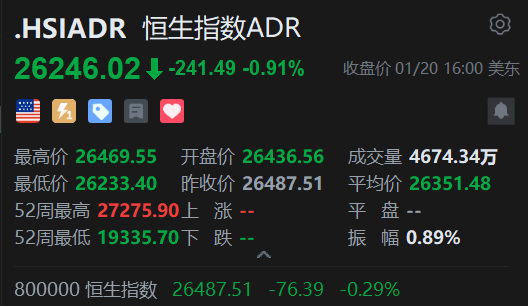
Market Overview - The Hang Seng Index closed at 26,246.02, down by 241.49 points or 0.91% [1] - The index reached a high of 26,469.55 and a low of 26,233.40 during the trading session [1] - The average price for the day was 26,351.48, with a trading volume of 46.7434 million [1] Major Blue-Chip Stocks Performance - HSBC Holdings closed at HKD 128.682, up by 0.22% compared to the Hong Kong close [2] - Tencent Holdings closed at HKD 593.183, down by 1.30% compared to the Hong Kong close [2] - Alibaba Group (W) closed at HKD 159.700, down by 0.44% [3] - Xiaomi Group (W) closed at HKD 35.480, down by 2.74% [3] - Meituan (W) closed at HKD 97.350, down by 1.17% [3] Stock Price Changes - Tencent Holdings saw a decrease of HKD 9.000, or 1.48% [3] - HSBC Holdings increased by HKD 1.400, or 1.10% [3] - China Ping An rose by HKD 0.600, or 0.88% [3] - BYD Company experienced a decline of HKD 3.700, or 3.67% [3] - Kuaishou Technology (W) fell by HKD 0.700, or 0.91% [3]






大行评级|小摩:预计今年以旧换新政策继续利好金属商品市场,建议买入紫金矿业
Ge Long Hui· 2026-01-20 08:00
Group 1 - The main trend in the commodity market for 2025 will continue into 2026, with global demand-driven metals (such as gold, copper, and lithium) expected to outperform domestic demand-driven sectors (such as coal and steel) [1] - Supply disruptions and accelerated industry consolidation are anticipated to persist throughout the year [1] - The old-for-new subsidy policy is expected to continue until 2026, with incentives becoming more targeted and efficiency-focused, providing substantial support for overall commodity demand [1] Group 2 - The preferred order for the basic materials sector in 2026 is gold and copper, followed by aluminum, lithium, coal, and steel [1] - The materials sector is expected to continue outperforming the MSCI China Index in 2026, with recommendations for investors to buy Zijin Mining and to accumulate China Aluminum and China Hongqiao on dips [1] - Luoyang Molybdenum may experience a temporary pause due to the issuance of convertible bonds [1]

港股再融资迎“开门红” 募资超270亿港元
2 1 Shi Ji Jing Ji Bao Dao· 2026-01-20 05:23
Core Insights - The Hong Kong capital market has seen a significant increase in refinancing activities at the beginning of 2026, with over HKD 27 billion raised by listed companies through various methods, marking a more than 20-fold increase compared to HKD 1.1 billion in the same period of 2025 [1][2]. Group 1: Market Activity - As of January 18, 2026, Hong Kong listed companies have raised a total of HKD 27 billion through placements, rights issues, and other means, indicating a strong market confidence and financing demand [2][3]. - The robust start to refinancing in 2026 builds on a historical high in 2025, where the total refinancing scale reached HKD 325.32 billion, surpassing the IPO fundraising scale for the first time [2][3]. - Major companies like BYD, Xiaomi, and Geely have completed significant fundraising rounds in 2025, contributing to a trend of continuous capital replenishment [2][3]. Group 2: Structural Characteristics - The refinancing activities in early 2026 show a diverse industry distribution, including sectors such as oil and petrochemicals, construction, software services, and healthcare [4]. - Notably, five companies raised over HKD 1 billion each, with the majority of funds being allocated to support international expansion, enhance R&D capabilities, and optimize financial structures [4][5]. - Placement remains the dominant method for refinancing, with over 75% of the 36 cases in 2026 utilizing this approach, highlighting its efficiency and flexibility [4][5]. Group 3: Emerging Trends - A notable trend in 2026 is the strategic mutual holdings between companies through cost issuance, exemplified by the collaboration between SF Express and Jitu Express [5]. - The refinancing landscape is characterized by a higher proportion of traditional and consumer industries compared to emerging sectors, reflecting the complementary nature of Hong Kong and A-share markets [5][6]. - Future trends indicate that refinancing will maintain high levels but with a more stable growth rate, driven by ongoing demand in capital-intensive industries and an increasing focus on optimizing capital structures and enhancing R&D capabilities [6][7].
港股异动丨有色金属股齐跌 美银指金属需求的增长已不再具有周期性特征
Ge Long Hui· 2026-01-20 02:31
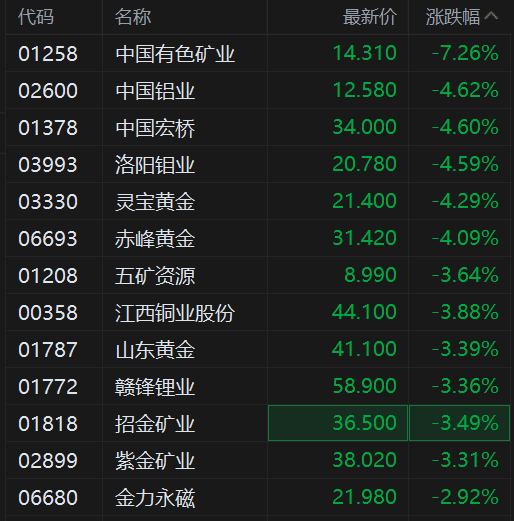
Group 1 - The core viewpoint of the news highlights a collective decline in Hong Kong's non-ferrous metal stocks, with significant drops observed in companies such as China Nonferrous Mining, China Aluminum, and China Hongqiao, among others [1] - The report mentions a strategy proposed by Bank of America, suggesting investment in non-AI tech stocks that benefit from the AI boom, focusing on sectors like electrification, infrastructure, and metals [1] - Bank of America identifies metals such as copper, silver, lithium, aluminum, and nickel as key beneficiaries of the growing demand driven by the restructuring of energy infrastructure across economies [1] Group 2 - Specific stock performance data shows China Nonferrous Mining down 7.26%, China Aluminum down 4.62%, and China Hongqiao down 4.60%, among others, indicating a broader trend of declines in the sector [2] - Other notable declines include Luoyang Molybdenum down 4.59%, Lingbao Gold down 4.29%, and Chifeng Jilong Gold down 4.09%, reflecting a significant downturn in the non-ferrous metal market [2] - The overall trend indicates that multiple companies in the non-ferrous metal sector, including Jiangxi Copper and Zijin Mining, experienced declines of over 3%, suggesting a challenging market environment [2]

铝的新时代-电解铝重估风鹏正举
2026-01-20 01:50
Summary of Key Points from the Conference Call Industry Overview - The conference call focuses on the aluminum industry, particularly the electrolytic aluminum market, highlighting the factors driving price increases and supply-demand dynamics [1][2][3]. Core Insights and Arguments - **Price Drivers**: The rise in non-ferrous metal prices is driven by multiple factors, including decreased supply elasticity, global power shortages, and emerging demands from AI data centers, which are reshaping base prices. Geopolitical risks are also prompting a reassessment of value, particularly for aluminum, which is significantly influenced by global green transitions and the AI revolution [1][3]. - **Supply-Demand Gap**: The electrolytic aluminum market is experiencing an expanding supply-demand gap, supported by proactive fiscal and monetary policies, suggesting that aluminum prices may reach new highs. Current cost levels remain low, enhancing profit margins, with average valuations for electrolytic aluminum companies around 10 times expected earnings for 2026, indicating good upside potential [1][5]. - **Global Supply Growth**: Global electrolytic aluminum supply growth is slowing, with Chinese production capacity reaching its peak and European and American regions facing energy constraints and investment cycle limitations. Projections indicate a global industrial growth rate of approximately 1.4% from 2025 to 2030, with China's average growth rate expected to be only 0.3% [1][8]. - **Challenges in Europe and America**: The growth of electrolytic aluminum capacity in Europe and America is hindered by insufficient power supply and difficulties in securing power contracts. The transition to carbon neutrality is limiting investments in high-energy-consuming industries, while rising electricity demand and aging power grids increase the risk of power outages [11][12]. - **Emerging Supply Regions**: Indonesia is identified as a key emerging supply region, but its development is constrained by Chinese policies limiting new coal-fired power plants abroad, leading to slow project progress. Significant expansion will require new power plants, which involve funding, cost, and timing challenges [14][15]. Additional Important Insights - **Investment Selection Criteria**: Investment strategies should focus on companies that benefit from rising aluminum prices, have high market capitalization and elasticity, possess overseas expansion capabilities, and show strong growth potential. Companies like South America International, Zhongxing Industry, and Hongqiao are highlighted as potential investment targets [6][27]. - **Aluminum Demand Trends**: Traditional and emerging demands are expected to jointly drive aluminum market growth over the next five years. Traditional demand is projected to grow at 0.2%, while emerging demand is expected to grow at 12%, indicating a significant shift in market dynamics [16]. - **Aluminum Substituting Copper**: The trend of aluminum replacing copper is gaining traction, particularly in the context of carbon neutrality. The demand for aluminum in sectors like new energy vehicles and home appliances is increasing, although high-end applications may take longer to transition due to performance requirements [17][18]. - **Cost Influences**: The cost of alumina is expected to fluctuate based on supply-demand dynamics and policy changes in key producing countries like Guinea, which significantly impacts the pricing of electrolytic aluminum [20][21]. - **Valuation Impact**: Current aluminum prices suggest that company valuations are below 10 times earnings. If prices rise to 30,000 yuan per ton, average valuations could compress to below 6 times, indicating a potential recovery space of over 70% [25]. This summary encapsulates the critical insights and trends discussed in the conference call, providing a comprehensive overview of the electrolytic aluminum market and its future outlook.
港股再融资迎“开门红”
Xin Lang Cai Jing· 2026-01-19 23:21
2026年伊始,香港资本市场再融资活动火热开场。 公开数据显示,2025年,比亚迪435亿港元的增发成为近十年港股最大再融资项目,小米、华虹半导 体、中国宏桥、吉利汽车等一批上市公司也完成了百亿级募资。众多公司在2025年通过多次再融资,形 成了"持续补血"的格局。 港股再融资市场的活跃,得益于其制度灵活与市场回暖。 格上基金研究员托合江认为,近年来,港股再融资大发展背后的核心驱动力有二:一是2025年恒生指数 全年上涨27.77%,带来市场情绪与估值修复,为港股再融资创造了有利窗口;二是港股市场本身具备 无锁定期、快速审批、多币种发行、灵活定价等优势。 业内人士进一步阐释,香港市场的再融资制度极为高效。上市公司董事会依据股东一般性授权即可进行 配售(通常不超过已发行股份的20%),无需事前监管审批,且融资次数无限制。这种"按需融资"的机 制设计,使得企业能够迅速捕捉市场机遇,高效满足业务发展的资金需求。 止于至善投资总经理何理指出,港股再融资的多少与市场表现息息相关,融资金额大发展的背后,离不 开港股市场2024年三季度以来估值修复且成交活跃带来的市场环境,同时受到境内监管将融资资源向战 略性新兴产业倾斜的 ...

从友谊港到友谊立交桥——探访中企建设的毛里塔尼亚民生工程
Shang Wu Bu Wang Zhan· 2026-01-19 15:42
从努瓦克肖特驱车向西南方向行驶,不到半小时就来到大西洋岸边的传统地标:中毛友谊港。港区 入口处,镌刻着阿拉伯语、法语和英语的"友谊港"字样,在阳光下显得庄重而温暖。这座始建于1979 年、1986年竣工运营的港口,曾是继坦赞铁路之后中国援非的第二大工程,被誉为"南南合作"的典范。 1.jpg 上世纪70年代,新独立的毛里塔尼亚渴望在首都建设一座深水港以联通世界,却因自然条件恶劣而 屡屡碰壁。1979年,在中国援建下,友谊港正式动工,由中国路桥公司的前身——"交通部援外办"组织 实施。工程历时7年,至1986年,这座拥有3个万吨级泊位、设计年吞吐量90万吨的港口竣工,一举承担 起全国90%以上的货物进出口,被当地人誉为"国家经济独立的象征"。 然而,故事并未止步于此。随着国民经济的发展,至2012年,港口实际吞吐量已达350万吨,远超 原有容量。面对新的发展需求,中毛合作再次发力。2009年,友谊港扩建工程启动。5年之后,新增的2 个20000吨级多用途泊位和1个5000吨级油泊位投入使用,其中4号泊位年设计集装箱吞吐量达7.2万TEU (国际标准箱),杂货15.1万吨;5号泊位年设计吞吐量达43.9万吨。 2 ...

港股再融资开门红,募资超270亿港元
21世纪经济报道· 2026-01-19 15:34
Core Viewpoint - The Hong Kong capital market has seen a significant increase in refinancing activities at the beginning of 2026, with over HKD 27 billion raised, marking a more than 20-fold increase compared to the same period in 2025, setting a vibrant tone for the year ahead [1][3]. Group 1: Active Refinancing at the Start of 2026 - As of January 18, 2026, Hong Kong-listed companies have raised over HKD 27 billion through various methods such as placements and rights issues, compared to HKD 1.1 billion in the same period of 2025 [1][3]. - The robust refinancing activity is built on the historical high of HKD 325.32 billion in 2025, which surpassed the IPO fundraising scale for the first time [3]. - Major companies like BYD and Xiaomi have completed significant fundraising projects, contributing to a trend of continuous capital replenishment [3]. Group 2: Structural Characteristics of Refinancing - The refinancing activities in early 2026 are characterized by a diverse industry distribution, including sectors like oil and gas, construction, software services, and healthcare [7]. - Notable companies such as SF Express and Jitu Express have raised over HKD 1 billion, indicating a clear differentiation in fundraising scales [7]. - The use of raised funds is closely aligned with core business strategies, including international expansion, technology R&D, and financial structure optimization [7]. Group 3: Advantages of Hong Kong's Refinancing Market - The efficiency of Hong Kong's refinancing system allows companies to quickly seize market opportunities without prior regulatory approval for placements [4]. - The flexible and diverse financing tools available in the Hong Kong market cater to various corporate needs, enhancing the ability to raise funds [5]. - The market's recovery and valuation improvements since Q3 2024 have created a favorable environment for refinancing activities [5]. Group 4: Emerging Trends in Refinancing - The refinancing landscape is evolving, with a notable increase in strategic mutual holdings among companies, exemplified by the collaboration between SF Express and Jitu Express [8]. - The current refinancing structure shows a higher proportion of traditional and consumer industries compared to emerging sectors, highlighting the complementary nature of Hong Kong and A-share markets [8]. - Future trends indicate that refinancing will remain high but with a more stable growth rate, and the focus will shift towards optimizing capital structures and enhancing R&D capabilities [10].




港股再融资迎“开门红”,募资超270亿港元
2 1 Shi Ji Jing Ji Bao Dao· 2026-01-19 12:37
Core Viewpoint - The Hong Kong capital market has seen a significant increase in refinancing activities at the beginning of 2026, with over HKD 27 billion raised, marking a more than 20-fold increase compared to the same period in 2025, setting a vibrant tone for the year ahead [1][2]. Group 1: Market Activity and Trends - As of January 18, 2026, Hong Kong listed companies have raised over HKD 27 billion through various refinancing methods, a substantial increase from HKD 1.1 billion in the same period of 2025 [1]. - The 2025 Hong Kong refinancing market reached a historic high of HKD 325.32 billion, surpassing the IPO fundraising scale for the first time [1][2]. - The active refinancing market is attributed to a 27.77% increase in the Hang Seng Index in 2025, which improved market sentiment and valuation [2]. Group 2: Structural Characteristics of Financing - The refinancing activities in early 2026 show a diverse industry distribution, including sectors such as oil and petrochemicals, construction, software services, and healthcare [3]. - Notable companies like SF Express and Jitu Express raised over HKD 10 billion each, while 10 other companies raised over HKD 1 billion [3]. - The primary use of raised funds is aligned with core business strategies, including international expansion, technology R&D, and financial structure optimization [3]. Group 3: Financing Methods and Innovations - Placement remains the dominant method for refinancing, with 27 out of 36 cases in 2026 utilizing this approach, highlighting its efficiency and flexibility [3]. - A notable trend in 2026 is the diversification of financing methods, including strategic mutual holdings through consideration issuance, which promotes industry chain integration [4][5]. - The issuance of convertible bonds, particularly zero-coupon convertible bonds, is becoming increasingly active, with financing concentrating on leading enterprises [6]. Group 4: Future Outlook - The Hong Kong refinancing market is expected to maintain high activity levels, with a stable growth rate and continued demand from capital-intensive industries [6]. - The flexible and efficient issuance system is likely to attract more listed companies, with refinancing volumes expected to exceed IPOs [6]. - The importance of hard technology and biotechnology companies is anticipated to rise, while the participation of cross-border capital is expected to enhance market liquidity [6].
有色金属行业周报(2026.1.12-2026.1.18):有色板块25年业绩快报亮眼,关注业绩释放打开上行空间-20260119
Western Securities· 2026-01-19 07:15
Investment Rating - The report indicates a positive outlook for the non-ferrous metals sector, highlighting strong performance and potential for upward momentum in earnings [1][4][5]. Core Insights - The non-ferrous metals sector has shown significant growth, with notable increases in net profits for companies like Northern Rare Earth and Luoyang Molybdenum [4][5]. - The report emphasizes the impact of macroeconomic factors, including U.S. inflation rates and China's monetary policy adjustments, on the industry [2][3][17]. - The ongoing demand for rare earth products and the strategic importance of metals like tungsten and lithium are highlighted as key investment opportunities [51][52][53]. Summary by Sections Market Performance - The non-ferrous metals sector outperformed the Shanghai Composite Index by 3.48 percentage points, with a weekly increase of 3.03% [10]. - Key stocks such as Hunan Silver and Silver Industry saw significant gains, while others like Youyan Powder Materials faced declines [10]. Key Focus Areas - U.S. CPI increased by 2.7% year-on-year in December 2025, influencing market expectations for interest rate adjustments [16]. - The People's Bank of China announced measures to support economic growth through monetary policy, which may benefit the non-ferrous metals sector [17][18]. - China's foreign trade reached a record high of 45.47 trillion yuan in 2025, indicating robust demand for exports [19]. Company Performance - Northern Rare Earth expects a net profit increase of 116.67% to 134.60% in 2025, driven by effective inventory management and increased sales [20][21]. - Luoyang Molybdenum anticipates a net profit growth of 47.80% to 53.71%, attributed to rising product prices and effective cost control [22]. Metal Prices and Inventory Changes - Industrial metals like copper and aluminum are experiencing price fluctuations, with copper prices at $12,803 per ton and aluminum at $3,134 per ton [23][25]. - Lithium carbonate prices have risen to 153,100 yuan per ton, reflecting strong demand in the energy metal sector [44]. Strategic Metals - Tungsten prices are on the rise, with strategic initiatives in place to support the industry, including government policies aimed at enhancing the rare earth supply chain [51][52][53].