
卫龙

Search documents
中国零食上市公司“盈利王”:去年净赚11亿元,领先洽洽、三只松鼠
Sou Hu Cai Jing· 2025-04-30 12:36
Industry Overview - The market size of China's snack food industry reached 933 billion yuan in 2024, with a per capita annual consumption of 662.5 yuan, significantly lower than developed countries like the US (7578.7 yuan), UK (6543.9 yuan), and Japan (3524.6 yuan), indicating substantial growth potential [1] - The market is expected to grow to 1.14 trillion yuan by 2029, with a compound annual growth rate (CAGR) of 4.1% [1] Company Performance - Many listed companies in the snack sector have reported declines in both revenue and net profit in the past year, including major players like Liangpinpuzi, Juewei Food, and Zhou Hei Ya [3] - The "three giants" of marinated snacks have seen a reduction of over 5,000 stores due to declining performance, with Zhou Hei Ya reducing its stores by 785 to 3,031, and Huang Shang Huang by 837 to 3,660 [3] Leading Companies - Weidong Meiwai emerged as the "profit king" among snack companies, achieving a net profit of 1.068 billion yuan in the last year, a year-on-year increase of 21.37%, and revenue of 6.266 billion yuan, up 28.6% [5] - Three Squirrels is the only company to surpass 10 billion yuan in revenue, reporting 10.622 billion yuan, a 49.3% increase, and a net profit of 408 million yuan, up 85.51% [7] - The company has expanded its product range significantly and plans to enter the bulk snack market through acquisitions [7] Financial Summary of Major Snack Companies - Three Squirrels: Revenue 106.22 billion yuan, Net Profit 4.08 billion yuan [8] - Liangpinpuzi: Revenue 71.59 billion yuan, Net Profit 0.46 billion yuan [8] - Juewei Food: Revenue 62.57 billion yuan, Net Profit 2.12 billion yuan [8] - Weidong Meiwai: Revenue 62.66 billion yuan, Net Profit 1.068 billion yuan [8] - Other companies like Salted Fish and Good Idea also reported varied performance, with some experiencing significant declines [8]



年轻人涌入“鸣鸣很忙们”
3 6 Ke· 2025-04-30 11:49
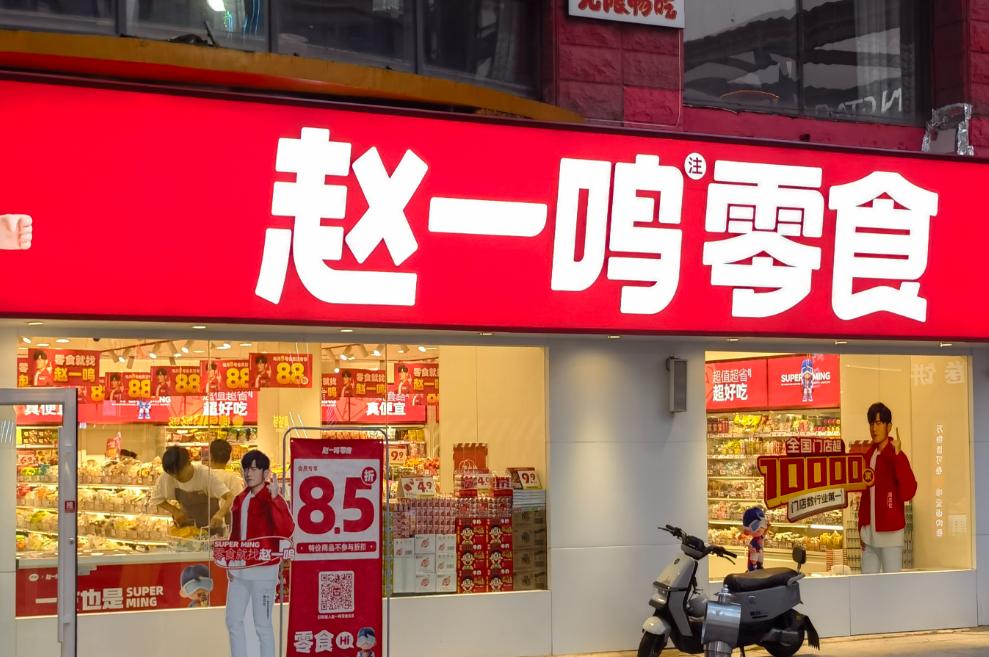
Core Insights - The article discusses the rise of snack retail chains in China, emphasizing the shift in consumer behavior towards value-for-money products and the emotional significance of snacks in modern life [1][6][17] Group 1: Market Trends - The snack industry in China has seen significant growth, with the market size increasing from over 400 billion yuan in 2010 to over 1 trillion yuan in 2021, indicating a strong economic impact [6] - The emergence of chains like "鸣鸣很忙" reflects a broader trend in the consumer market where quality and price are balanced, leading to a new consumer value system [7][12] - The number of "鸣鸣很忙" stores has surpassed 14,000 nationwide, generating over 55.5 billion yuan in revenue, showcasing rapid expansion and consumer acceptance [6][12] Group 2: Consumer Behavior - Consumers are increasingly prioritizing quality and safety over traditional notions of luxury, leading to a preference for affordable yet reliable snack options [6][11] - The concept of "消费平权" (consumer equality) is gaining traction, as consumers in lower-tier cities now have access to the same quality and pricing as those in major urban centers [10][12] - The emotional value of snacks has become significant, with consumers viewing them as a form of self-reward and companionship in a fast-paced, often isolating society [1][17] Group 3: Competitive Landscape - The success of "鸣鸣很忙" and similar chains is attributed to their efficient supply chains and direct sourcing from manufacturers, allowing them to offer competitive pricing without compromising quality [10][11] - Other brands like "蜜雪冰城" and "瑞幸咖啡" have also adopted similar strategies, focusing on high quality at low prices, which has proven effective in attracting consumers [7][10] - The snack retail sector is characterized by a mix of traditional and modern retail strategies, with new entrants challenging established brands by offering better value propositions [11][12] Group 4: Societal Implications - The rise of snack retail chains is seen as part of a larger societal shift towards valuing shared experiences and emotional connections over mere consumption [17] - The concept of "第四消费时代" (Fourth Consumption Era) is referenced, highlighting a transition from individualistic consumption to a focus on community and shared values [13][17] - The growth of snack retail chains is contributing to local economies by creating job opportunities and enabling entrepreneurship among local residents [12]
新单品成长助零食企业去年增收,多家公司计划大笔分红
Cai Jing Wang· 2025-04-30 08:33
Core Insights - The snack industry has seen significant revenue growth, driven by new product launches and channel restructuring, including social e-commerce and discount stores [1][2] - Despite revenue growth, snack companies are facing challenges in maintaining profitability, with fluctuating sales expenses and gross margins [1][8] Revenue Growth Drivers - Major snack companies reported substantial revenue figures for 2024, with Three Squirrels leading at 10.622 billion, followed by other companies like Liangpinpuzi and Qiaqia Foods [2] - New product development has been highlighted as a key contributor to revenue, with Three Squirrels launching over 20 new products that achieved significant sales [3][4] Channel Expansion - The restructuring of sales channels has provided new opportunities for snack companies, with a focus on e-commerce and discount stores [5][6] - Three Squirrels reported an 81.73% increase in revenue from Douyin, indicating the effectiveness of digital marketing strategies [4] International Market Growth - Companies are increasingly targeting international markets, particularly Southeast Asia, to expand their growth potential [6][7] - Qiaqia Foods and other companies have reported significant growth in overseas sales, with Qiaqia's overseas revenue increasing by approximately 90% [6] Profitability Challenges - Many snack companies have experienced rising sales expenses, with increases ranging from 15.55% to 50.92%, primarily due to higher advertising costs [8][9] - Gross margins have shown volatility, with some companies reporting declines due to rising raw material costs and competitive pricing strategies [10] Dividend Distribution - Several companies have announced substantial cash dividends, reflecting confidence in their operational performance and future growth [11][12] - The total cash dividends and share buybacks for some companies represent a significant portion of their net profits, indicating a strong commitment to returning value to shareholders [11]



泰国小学生迷上河南辣条,中国零食卷去东南亚
3 6 Ke· 2025-04-30 02:40
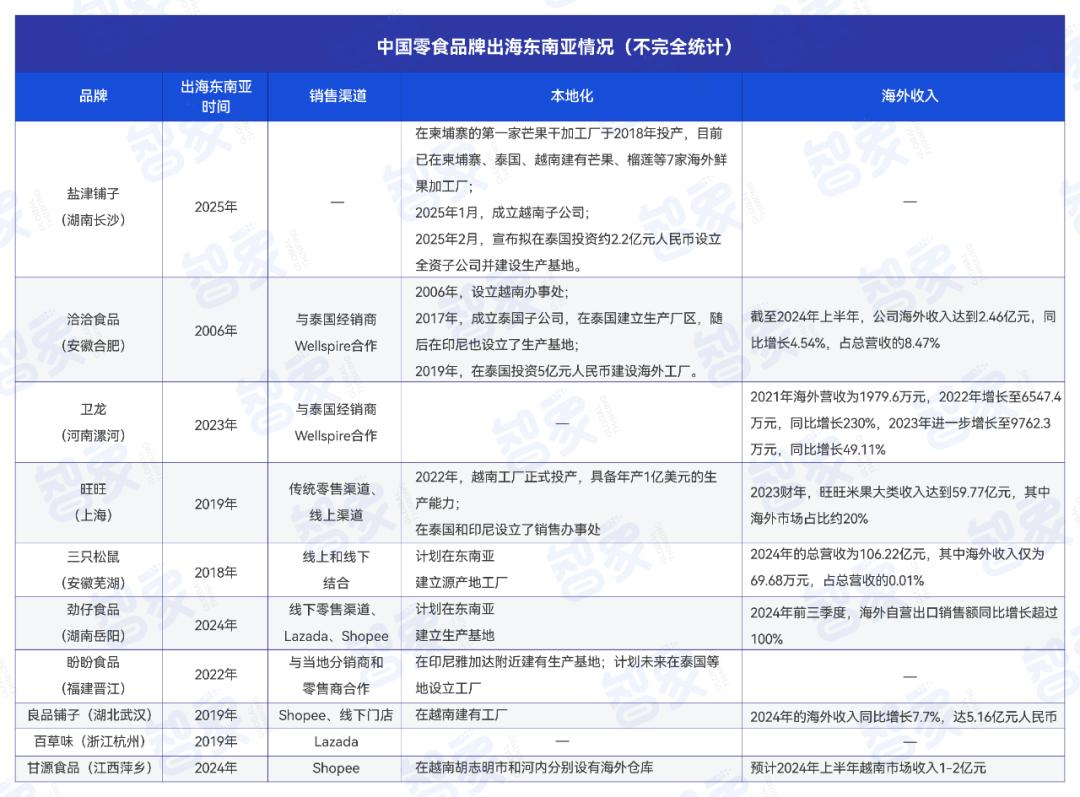
Group 1 - Wangwang invested RMB 138 million in a business jet to facilitate management's domestic and international travel, with a focus on expanding overseas operations [1] - In the fiscal year 2023, Wangwang's overseas business grew by double digits, with snack revenue reaching RMB 5.977 billion, accounting for approximately 20% of total revenue [1] - Southeast Asia has become a primary target for Chinese snack brands due to its large population and cultural similarities, with many brands already establishing a presence in the region [2][5] Group 2 - Companies like Qiaqia, Jinzhai, and Panpan have successfully penetrated the Southeast Asian market, with Qiaqia's Thailand subsidiary contributing RMB 400 million in revenue and nearly RMB 90 million in net profit in 2023 [2] - The Southeast Asian snack market is projected to reach USD 13.1 billion by 2029, with a compound annual growth rate of 10.60% [3] Group 3 - Salted snacks and other unique Chinese products are gaining traction in Southeast Asia, with brands like Yanjin and Qiaqia focusing on local market education to introduce their products [11][12] - The entry strategies of Chinese snack brands vary by country, with some targeting mature markets like Thailand and Singapore, while others focus on emerging markets like Vietnam and Indonesia [11] Group 4 - The retail landscape in Southeast Asia is diverse, with traditional community stores still dominating in Indonesia, where 80% of consumption occurs outside modern retail channels [17] - Successful market entry often relies on innovative channel strategies, as demonstrated by the ice cream brand Aice, which focused on community stores rather than traditional retail [14] Group 5 - Compliance with local regulations is crucial for market entry, with specific requirements for product certification and labeling in countries like Thailand and Indonesia [27] - Localization of products and supply chains is essential for success, with brands adapting flavors and ingredients to meet local preferences [28][31]


内需平稳复苏,新消费急先锋
2025-04-30 02:08
Summary of Key Points from Conference Call Records Industry Overview Alcohol Industry - The liquor industry is showing a stable recovery with major companies like Moutai setting a 9% revenue growth target, Wuliangye aligning with macro indicators, and Luzhou Laojiao emphasizing steady growth. The supply-side pressure in the industry has significantly eased, and channel feedback is expected to improve [1][3]. - Moutai and Wuliangye have reported double-digit growth, slightly exceeding market expectations, while Luzhou Laojiao's cash flow performance is better than its apparent data [3]. Beer Industry - The beer sector performed well in Q1 2025, with small breweries like Zhujiang and Yanjing showing outstanding results. Qingdao Beer and Chongqing Beer met expectations, and structural improvements are noted despite pressure on ton prices [4][5]. Beverage Industry - The beverage sector continues to trend towards health and functionality, with Dongpeng Beverage showing high growth and new products like health water from Lululemon gaining attention. Nongfu Spring is also highlighted as a company to watch [6]. Dairy Industry - The dairy sector is experiencing supply-side adjustments, with Yili's Q1 report showing positive revenue growth. The improvement in demand is expected to resonate with the raw milk cycle, while Mengniu is noted for its defensive attributes [7]. Snack Industry - The snack sector is exhibiting a new consumption growth trend, with companies like Weilong and Yuyou revising their forecasts upward. Yuyou has entered new channels, and Ganyuan's overseas market prospects for Q2 are promising [8]. Textile and Apparel Industry - The textile and apparel industry is showing a trend of low performance followed by high recovery, particularly in sports apparel. Anta Sports is effectively managing multiple brands, while home textile companies like Luolai and Mercury Home Textile are seen as defensive investments [11][12]. Key Recommendations - **Liquor**: Recommended stocks include Moutai, Luzhou Laojiao, and regional leaders like Fenjiu and Wuliangye [10]. - **Beer**: Focus on Qingdao Beer and its strong dividend yield [5]. - **Dairy**: Yili and Mengniu are highlighted as key players [10]. - **Beverages**: Nongfu Spring and Lululemon are recommended [10]. - **Snacks**: Weilong, Yuyou, and Ganyuan are noted for their growth potential [10]. - **Textiles**: Anta Sports and home textile brands like Luolai are recommended for their defensive qualities [11][12]. Additional Insights - The pig farming sector is currently valued highly, with pig prices remaining elevated, but the breeding sector's outlook is cautious due to limited capacity recovery. Key companies to watch include Muyuan, Shennong Group, and Dekang [2][20]. - The poultry industry, particularly yellow feathered chickens, is facing challenges with prices down from last year, but companies like Lihua and Wens continue to expand [21]. - The retail sector is experiencing rapid growth, especially in the snack segment, with companies like Liangpinpuzi expected to open numerous new stores [33][34]. - The home appliance industry is focusing on tariff adjustments and new consumption trends, with companies like Vanward Electric and TCL Electronics showing strong performance [37][38].





一致魔芋20250429
2025-04-30 02:08
Summary of the Conference Call for Yizhi Konjac Company Overview - **Company**: Yizhi Konjac - **Industry**: Konjac products, including konjac powder, konjac food, and related applications Key Points and Arguments 1. **Revenue Performance**: In Q1, Yizhi Konjac's konjac powder revenue remained flat year-on-year, while overseas markets grew over 60% due to higher cost acceptance from international clients and expansion into animal nutrition and health products [2][16] 2. **Konjac Food Segment Growth**: The konjac food segment saw significant growth with a year-on-year increase of 87%, driven by rapid market expansion and strong performance from the marketing team. The OEM business grew by 96%, with major contributions from clients like Weilong, Three Squirrels, and Mixue Ice City [2][4][7] 3. **Partnership with Kudi Coffee**: The company partnered with Kudi Coffee to supply konjac balls, although Kudi is not an exclusive buyer. The profit margin for these products is low due to strict cost control from downstream clients and intense market competition [2][10][11] 4. **Raw Material Cost Pressure**: Rising raw material prices have put pressure on profit margins. The company began using high-priced raw materials in Q1, with a lag in price transmission to downstream clients. The overseas market has seen smoother price transmission compared to the domestic market, which remains cautious [2][18] 5. **Strategies to Mitigate Margin Pressure**: The company is employing various strategies to address margin pressure, including developing new products (e.g., konjac balls, plant-based shrimp), expanding the customer base, increasing the sales proportion of konjac ingredients, and pushing for price transmission [2][18] 6. **Prepaid Accounts and Contract Liabilities**: Prepaid accounts increased by 75%, primarily for konjac purchases from Southeast Asia. Contract liabilities grew by 95%, mainly due to pre-received payments for konjac powder, with overseas orders being processed faster than domestic ones [5][24] 7. **Market Outlook for Konjac Food**: The konjac food market is expected to continue its explosive growth, with increasing consumer recognition of its health benefits. The company plans to focus on this sector over the next one to two years [21] 8. **OEM Client Expansion**: New OEM clients include Jin Zai, with significant contributions from established clients like Weilong and Three Squirrels. The company is also in discussions with other potential clients [7][9] 9. **Impact of Government Subsidies**: Government subsidies vary annually, typically ranging from 5 million to 10 million yuan. The company anticipates higher subsidies this year due to significant investments in projects [30] 10. **Raw Material Supply and Pricing Trends**: The price gap between yellow and flower konjac has narrowed from 30% to under 10%, with both maintaining high price levels. The company expects procurement costs to remain high this year [23][38] Additional Important Insights - **Seasonal Sales Trends**: Historical data indicates that konjac ball sales peak in Q2 and Q3 due to increased demand for fruit tea in warmer weather [11] - **New Product Development**: The company plans to launch new tea drink ingredients, focusing on taste and form variations while maintaining similar application scenarios [12] - **Market Dynamics**: The konjac food industry is experiencing a shift, with larger manufacturers building their production lines, potentially affecting the OEM market share [20][37] - **Future Capacity Plans**: The company aims to fully utilize konjac powder production capacity by June 2025, with a target of 10,200 tons [17] This summary encapsulates the key insights from the conference call, highlighting the company's performance, market dynamics, and strategic initiatives in the konjac industry.
康师傅、李锦记、统一、旺旺、东鹏饮料、王老吉、洽洽确认出席 FBIF2025 食品出海晚宴
FBIF食品饮料创新· 2025-04-30 01:55
5月9日晚,我们将第一次举办食品出海晚宴,主题是 《 VENTURE FORWARD 》 。 很欣喜看到越来越多中国食品品牌开始布局出海,着手开拓海外市场,我们也同样关注到,如何克服文 化差异、市场壁垒、法律合规等多重挑战,成功实现国际化,是许多品牌需要面对的重大课题。 我们非常荣幸地邀请到: 康师傅、李锦记、统一、旺旺、东鹏饮料、王老吉、洽洽、三全、卫龙等 36家 拥有丰富出海经验的食 品品牌; 三得利、味之素、麒麟、明治、卡乐比、伊藤、好侍、养乐多、英斗等 9家 日本国际品牌; 出海渠道方面,邀请到美国、英国、法国、澳大利亚、新西兰、日本、韩国、马来西亚、柬埔寨、新加 坡、阿联酋、沙特、土耳其、伊拉克、加拿大等 15国28家 重要分销商、零售商和电商平台; 盒马、叮咚买菜、复星商社、鲜生活、陕西全意、广州欧深、甘肃千里丝路、甘肃亚盛好食邦等 8家 出海供应链; 中国品牌 张曜东 ,海外发展事业部(亚太中心)副总处长, 旺旺集团 预留 双汇 预留 圣农 吴昊 ,副总裁-全球品类与创新平台, 李 锦记控股 马恩多 ,品牌创始人, 阿麦斯及贝欧宝 ,董事长, 金多多 王凯旭 ,副总裁, 三全食品 范涛 ,CMO ...
新华全媒头条·经济大省挑大梁丨大河奔流勇争先——河南奋力谱写中国式现代化出彩篇章
Xin Hua She· 2025-04-29 16:20
Economic Growth and Development - In 2024, Henan Province's GDP reached 6.36 trillion yuan, with a growth rate of 5.1%, and a first-quarter growth of 5.9% [1] - The province has maintained a stable grain production of over 1.3 trillion jin for eight consecutive years, contributing significantly to national food security [2] - The integration of technological and industrial innovation is driving high-quality economic development, with high-tech manufacturing and strategic emerging industries growing by 14.1% and 10.6% respectively in the first quarter [5] Agricultural and Food Industry Transformation - Henan produces 10% of the nation's grain and 25% of its wheat, with annual exports of 600 billion jin of raw grain and 20 million pigs [4] - The province is transitioning from being a "grain warehouse" to a "kitchen for the nation" and "dining table for the world," with a focus on food processing industries like prepared dishes and snacks [4] - The integration of technology in agriculture is exemplified by smart irrigation systems that enhance crop yields [3] Transportation and Logistics Infrastructure - Henan is leveraging its central location to become a crucial hub for domestic and international logistics, with extensive transportation networks including nearly 10,000 kilometers of highways and railways covering over 53% of the population within three hours [7] - The province's foreign trade in the first quarter reached 204.26 billion yuan, a year-on-year increase of 28%, ranking third nationally [8] Ecological and Environmental Initiatives - Henan is actively implementing ecological protection strategies, achieving a water quality monitoring standard of 86.1% for surface water, exceeding national targets [9] - The province has undertaken significant ecological restoration projects, transforming previously degraded areas into productive landscapes [10] Future Development Strategies - The provincial government aims to enhance employment, support the real economy, and stabilize foreign trade while focusing on high-quality development and integrating into the national market [10]
寻找下一个超级爆款:300+品牌展商,2000+爆款新品,47000+全球创新者邀您共聚FBIF食品创新展2025!
FBIF食品饮料创新· 2025-04-29 00:18
300+ 品牌展商, 2000+ 创新产品,寻找爆品脉络,打造《 全球食品爆品手册 》 (38个案例) 、 《 2025年度食品爆品与创新产品手册-渠道商选品目录 》 (300+品牌和1000+产品) 。FBIF食品 创新展 All in 创新 ,用前沿产品与卓越品质,助力渠道伙伴精准选品。 专业观众可扫码注册观展票 ,与品牌面对面深度沟通。现场还可领取 2本FBIF小蓝书、1本FBIF小采书 纸质版手册 ,每日发布数量有限,先到先得。 (注:观展票不包含论坛、赛事、渠道对接会权益) FBIF食品创新展2025 · 精彩亮点一览 展会现场 : 1、 300+品牌展商 产品展出,覆盖14大品类方向 2、 2000+全球新品 ,直击未来市场风口 3、FBIF Wow食品创新奖 3大赛道 获奖产品集中亮相 4、FBIF小蓝书·全球版 《全球食品爆品手册》 (纸质版) ,精选 20个国际爆品案例 5、FBIF小蓝书·国内版 《2025食品爆品与创新产品手册》 (纸质版) ,收录 700+优质产品 6、FBIF小采书 《FBIF供应链采购指南:代工、配料、包装采购目录》 (纸质版),收录 200+供应 链 企业 7、F ...
卫龙美味(09985):魔芋开启新纪元,辣味王者再启航
HTSC· 2025-04-28 07:24
Investment Rating - The report initiates coverage on WeLong Delicious with a "Buy" rating and a target price of HKD 19.96, based on a 32x PE for 2025 [7]. Core Viewpoints - The Chinese snack industry is characterized by a long-standing multi-category and weak brand presence, with spicy snacks showing stronger addiction and higher repurchase rates, effectively extending product life cycles. WeLong has successfully established itself as a national brand in spicy strips and is positioned to benefit from rapid category expansion as a pioneer in the konjac segment [1][17]. - The spicy snack segment is experiencing high growth and strong consumer loyalty, with the market size for spicy strips around RMB 10 billion and WeLong holding a 28% market share in 2023. The konjac segment is also thriving, with a projected market size of RMB 7 billion in 2024 and an annual growth rate exceeding 20% [2][18][19]. Industry Overview - The spicy snack market is expected to maintain a compound annual growth rate (CAGR) of 10.2% from 2024 to 2026, driven by the addictive nature of spicy foods. The konjac segment is anticipated to surpass the RMB 10 billion mark, with WeLong's market share projected at 42% in 2024 [2][19]. - The report highlights the increasing health consciousness among consumers, which is propelling the growth of the konjac category due to its unique taste and high cost-performance ratio [2][19]. Company Analysis - WeLong is building competitive barriers through its strong brand identity and innovative product development. The company has a mature research and development management system, allowing for modular reuse of technology and continuous product innovation [3][20]. - The company has successfully created a second growth curve, with revenue from vegetable products expected to exceed that from flavored noodle products in 2024. WeLong is also actively transforming its distribution channels to adapt to market demands, enhancing its presence in offline channels and embracing new channels such as snack wholesale and content e-commerce [3][21]. Future Growth Prospects - WeLong's growth strategy focuses on product innovation and channel diversification. The company aims to solidify its supply chain and enhance its reach through various distribution channels, including traditional and emerging platforms [21][22]. - The report emphasizes the potential for WeLong to benefit from the ongoing expansion of the spicy snack market and the increasing consumer preference for healthier snack options [17][22].