
荣盛石化

Search documents
2025年1-11月中国燃料油产量为3850.6万吨 累计下降2.3%
Chan Ye Xin Xi Wang· 2026-01-08 03:49
上市企业:中国石化(600028),中国石油(601857),上海石化(600688),恒逸石化(000703),荣盛石 化(002493),华锦股份(000059),龙宇股份(603003),泰山石油(000554),国际实业(000159),广 聚能源(000096) 相关报告:智研咨询发布的《2026-2032年中国燃料油行业市场全景调研及投资前景研判报告》 根据国家统计局数据显示:2025年11月中国燃料油产量为331万吨;2025年1-11月中国燃料油累计产量 为3850.6万吨,累计下降2.3%。 2020-2025年1-11月中国燃料油产量统计图 数据来源:国家统计局,智研咨询整理 知前沿,问智研。智研咨询是中国一流产业咨询机构,十数年持续深耕产业研究领域,提供深度产业研 究报告、商业计划书、可行性研究报告及定制服务等一站式产业咨询服务。专业的角度、品质化的服 务、敏锐的市场洞察力,专注于提供完善的产业解决方案,为您的投资决策赋能。 ...


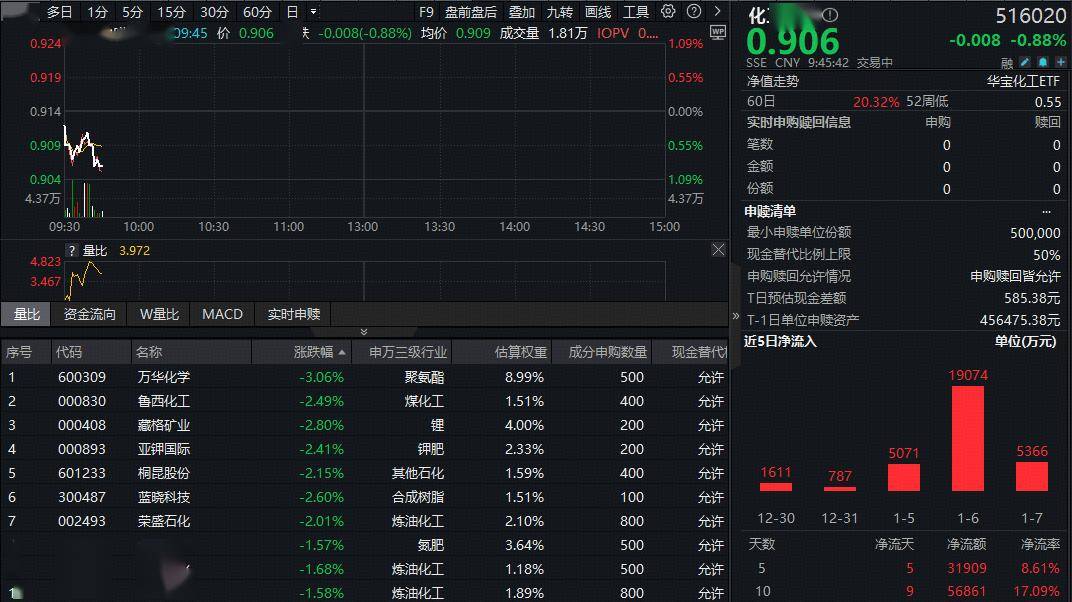
ETF盘中资讯|化工板块低位震荡,化工ETF(516020)跌近1%!资金持续加码,机构看好盈利估值双升
Sou Hu Cai Jing· 2026-01-08 02:15
Group 1 - The chemical sector is experiencing a pullback, with the chemical ETF (516020) showing a decline of 0.88% as of the latest report [1] - Key stocks in the sector, including Wanhua Chemical, Luxi Chemical, and Cangge Mining, have seen significant declines, with Wanhua Chemical dropping over 3% [1][2] - The chemical ETF has attracted substantial capital inflows, with a net subscription of 319 million yuan over the last five trading days and over 568 million yuan in the last ten days [2][3] Group 2 - The construction of projects in the basic chemical industry has decreased by 10% year-on-year, indicating a nearing end to capital expenditures, while domestic demand and export resilience are improving the supply-demand balance [3] - The chemical industry is expected to benefit from policies aimed at reducing competition, leading to potential improvements in performance and valuation [3] - The current state of the chemical industry is at a cyclical bottom, with expectations for enhanced profitability and valuation for leading companies as competition dynamics improve [3] Group 3 - The chemical ETF (516020) tracks the CSI sub-sector chemical industry index, covering various segments and focusing on large-cap leading stocks [4] - Nearly 50% of the ETF's holdings are concentrated in major companies like Wanhua Chemical and Salt Lake Co., allowing investors to capitalize on strong market leaders [4] - Investors can also access the chemical sector through linked funds of the chemical ETF [4]



化工新高!化工ETF(516020)冲锋式大涨3%,机构:2026年化工或迎戴维斯双击
Mei Ri Jing Ji Xin Wen· 2026-01-07 10:13
Group 1 - The chemical sector is experiencing significant gains, with companies like Junzheng Group and Hengli Petrochemical rising over 7%, and others like Rongsheng Petrochemical and Wanhua Chemical increasing by more than 6% [1] - The Chemical ETF (516020) has seen a continuous inflow of funds, totaling over 350 million yuan in the last five trading days, with its latest fund size reaching a new high of 3.893 billion yuan [1] - Wanhua Chemical plans to continuously raise global prices for core products such as MDI/TDI starting December 2025, in line with international giants like BASF and Dow, driven by industry maintenance and rising raw material costs [1] Group 2 - China Galaxy Securities forecasts a negative growth in capital expenditure for the chemical industry in 2024, suggesting a potential supply contraction due to the "anti-involution" trend and accelerated elimination of outdated overseas capacity [1] - The "14th Five-Year Plan" emphasizes expanding domestic demand, which, combined with the onset of a U.S. interest rate cut cycle, is expected to open up demand space for chemical products [1] - The chemical industry may see a cyclical turning point upwards by 2026, transitioning from valuation recovery to earnings growth, referred to as a "Davis double hit" [1] Group 3 - The Chemical ETF (516020) and its linked fund (012537) track the CSI segmented chemical industry theme index, covering various sub-sectors of the chemical industry [2] - Nearly 50% of the ETF's holdings are concentrated in large-cap leading stocks like Wanhua Chemical and Salt Lake Industry, while the remaining 50% includes leading stocks in phosphate fertilizers, fluorine chemicals, and nitrogen fertilizers [2]
石化化工反内卷稳增长系列之十二:电石、氯碱工业:反内卷加速供给侧出清,龙头竞争力有望提升
EBSCN· 2026-01-07 06:22
Investment Rating - The report maintains an "Overweight" rating for the petrochemical and basic chemical industry [1] Core Insights - The "anti-involution" policy is expected to accelerate the elimination of excess supply in high-energy-consuming industries, enhancing the competitiveness of leading companies in the industry [4] - The Ministry of Industry and Information Technology has introduced a growth plan for the petrochemical and chemical industry, aiming for an average annual growth of over 5% in value-added from 2025 to 2026 [3] - The report highlights that the supply-side reforms in the calcium carbide and chlor-alkali industries are likely to improve industry concentration and overall competitiveness [5][6] Summary by Sections Section 1: Policy Impact - The "anti-involution" policy aims to eliminate outdated production capacity in high-energy-consuming sectors, including calcium carbide and chlor-alkali, which is expected to lead to a healthier industry development [3][4] - The government has set strict controls on new capacity in overproduced sectors, which will facilitate the modernization and large-scale development of production facilities [4] Section 2: Calcium Carbide Industry - The total production capacity of calcium carbide in China is projected to be 41.66 million tons by 2025, a decrease of 7.1% from the peak in 2022 [5] - The apparent consumption of calcium carbide is expected to decline by 6.45% year-on-year in 2025, reaching 24.9 million tons due to weak downstream PVC demand [5] - The introduction of the "anti-involution" policy is anticipated to enhance industry concentration and improve overall market conditions [5] Section 3: Chlor-alkali Industry - The total production capacity of caustic soda is expected to reach 51.66 million tons by the end of 2025, with a year-on-year growth of 2.46% [6] - The industry is currently experiencing a downturn, with a projected single-ton gross profit of 744 yuan, indicating a low level of profitability [6] - The "anti-involution" policy is expected to accelerate the exit of outdated production capacity, leading to improvements in supply-side conditions [6] Section 4: PVC Industry - The apparent consumption of PVC is projected to be approximately 18.66 million tons in 2025, a decrease of 7.1% compared to 2020, primarily due to low demand from the construction and real estate sectors [7] - The total production capacity of PVC is expected to be 30.38 million tons, with a low industry concentration of 26% among the top six companies [7] - Stricter environmental regulations and the "anti-involution" policy are expected to drive structural transformation and upgrade within the industry [7] Section 5: Investment Recommendations - The report suggests focusing on the calcium carbide-chlor-alkali-PVC industry chain, highlighting companies such as Luhua Technology, Chlor-alkali Chemical, and Xinjiang Tianye as potential beneficiaries of the improving supply-demand dynamics [8]
光大证券:石化化工行业“反内卷”加速供给侧出清 龙头竞争力有望提升
智通财经网· 2026-01-07 03:14
Group 1 - The core viewpoint of the report is that the Chinese government is promoting "anti-involution" policies and stable growth initiatives, which are expected to lead to the elimination of outdated production capacity in the petrochemical industry and foster healthy industry development [1][2] - The Ministry of Industry and Information Technology (MIIT) plans to implement a stable growth work plan for the petrochemical industry from 2025 to 2026, targeting an average annual growth of over 5% in the industry's added value [2][3] - The focus will be on structural adjustments, optimizing supply, and eliminating outdated production capacity in key industries, including steel, non-ferrous metals, and petrochemicals [2][3] Group 2 - Strict control policies on high-energy-consuming industries such as calcium carbide and caustic soda have been in place since 2016, aiming to limit new production capacity and promote energy-saving and pollution-reduction upgrades [3] - The report indicates that the calcium carbide industry is expected to see an increase in concentration as outdated capacity is eliminated, which will improve overall industry conditions [4] - The liquid alkali industry is currently at a low point, with a projected single-ton gross profit of 744 yuan by the end of 2025, indicating a need for supply-side improvements to drive industry recovery [5] Group 3 - The PVC market is closely tied to the real estate and infrastructure sectors, with a projected apparent consumption of approximately 1,866 million tons in 2025, reflecting a 7.1% decline from 2020 [6][7] - The PVC industry is characterized by low concentration, with the top six companies holding only 26% of the total production capacity, which is expected to change as environmental policies tighten and outdated capacities are phased out [7] - Investment opportunities are identified in various sectors, including the calcium carbide-chloralkali-PVC industry chain and nitrogen fertilizer industry, with specific companies highlighted for potential investment [8]

PTA检修更主动
Ning Zheng Qi Huo· 2026-01-07 02:40
Report Industry Investment Rating No relevant content provided. Core Views of the Report - The concentrated shutdown and maintenance of PTA enterprises remain the main means to balance the market; some old facilities in countries such as Japan and South Korea still drag down the Asian operating rate, with concentrated maintenance in the second quarter. Therefore, PXN will continue to improve in the first half of the year and face pressure in the second half as new production capacity is put into operation. The strategy is to seize low - level long - position opportunities in the first half of the year and follow crude oil operations in the second half [4][122]. Summary by Directory Chapter 1: Market Review - In 2025, PTA reached a high of around 5300 yuan/ton at the beginning of the year. Then, due to seasonal inventory accumulation expectations in the first quarter, the market pressure increased, and the price declined. In the second quarter, tariff increases and new device commissions put pressure on the market. In the second half of the year, supply - demand drivers were weak, and the price fluctuated widely between 4400 - 5000 yuan/ton. In the fourth quarter, there was a significant rebound driven by concentrated PTA maintenance and PXN rebound [9]. Chapter 2: PTA Supply and Demand Situation 2.1 PTA Supply Situation - **PTA投产高峰结束, 2026年无新增产能**: As of the end of 2024, the global PTA capacity was about 110 million tons, expected to reach 116.25 million tons/year in 2025. Asia accounted for over 90%, and China accounted for over 78% of Asian capacity. In 2025 - 2030, new global PTA capacity will mainly come from Asia and the Middle East. China's PTA capacity will see a significant reduction in new capacity after 2025, with no clear new capacity planned for 2026 [13][14]. - **PTA低开工、低利润;主动检修平衡供需**: In 2025, due to over - capacity and losses, many PTA devices were shut down for maintenance. The average domestic PTA device operating rate from January to November was 77.9%, 1.98% lower than the previous year. In 2025, the PTA processing fee was at a low level, and device shutdowns and production cuts increased to balance supply and demand [18][21]. - **国外新装置投产压制, PTA出口量缩减**: In 2025, China's PTA exports declined significantly. From January to October, the cumulative export was 309.64 million tons, a 16.95% decrease compared to the same period in 2024. The main reason was the slowdown in overseas polyester production and the progress of PTA certification in India. However, there were some increases in exports to emerging markets such as the UAE and Russia [28][29]. - **PTA社会库存降低**: By the end of December, PTA social inventory was 3.19 million tons, a significant decrease due to increased maintenance and high polyester production growth [32]. 2.2 PTA Demand Analysis - **内需内生动力仍不足**: In 2025, the retail sales of clothing, footwear, and textiles in China showed a mild recovery. From January to October, the cumulative retail sales reached 1.2053 trillion yuan, a 3.5% year - on - year increase. However, in 2026, although there were policies to support consumption, the slowdown in economic growth and the decrease in residents' income and expenditure would still restrict domestic demand [36][40]. - **外需结构性分化**: In 2025, Sino - US tariff disputes affected textile and clothing exports. From January to October, the cumulative year - on - year growth rates of textile yarn and clothing exports were 1.8% and - 3% respectively. The export market showed a clear differentiation of "growth in textiles and decline in clothing". In 2026, textile exports may show positive signs, while clothing exports will still face pressure [43][46]. - **聚酯产能扩张**: From 2016 - 2024, China's polyester capacity had an average annual growth rate of 7.09%. In 2025, 3.5 million tons of new polyester capacity was added, and in 2026, about 4 million tons of new capacity is planned. The main products for new capacity in 2026 are filaments and staple fibers [47][49]. - **聚酯开工率高、出口增速高,利润压缩**: In 2025, the average polyester operating rate was around 90%. From January to November, polyester production was 72.87 million tons, a 7.56% year - on - year increase. Polyester products were mainly exported, but the industry's profit was compressed. In 2026, the new polyester capacity growth rate will still be high, and profits are expected to remain low, but the average operating rate can maintain resilience [52][66]. Chapter 3: Upstream Analysis 3.1 Crude Oil Situation - **原油供需概况**: In 2025, international oil prices trended downward. The global crude oil market faced weak demand and increased production. IEA adjusted the supply and demand growth forecasts for 2025 and 2026. OPEC+ started to increase production in April 2025 and paused in the first quarter of 2026. The return of OPEC+'s remaining 1.65 million barrels/day of production in 2026 will be an important variable. Non - OPEC+ supply will increase by 1.2 million barrels/day in 2026, with certain increases in Brazil, Guyana, and Canada, while US production is under pressure [68][78]. - **原油消费情况**: IEA, EIA, and OPEC predict an increase in global crude oil demand in 2025 and 2026. In 2026, petrochemical raw materials will be the core source of demand growth. China's crude oil demand will still increase, with petrochemical raw materials being the main growth source [89][97]. - **原油供需结论**: Most institutions predict that the growth of crude oil demand in 2026 will be around 1 million barrels/day. The supply surplus in the 2026 crude oil market is a relatively certain prediction, but the oil price may be more resilient than in 2025, and 2026 is likely to be a bottom - building year for oil prices [98]. 3.2 PX Situation - **PX产能投放进入尾声**: In 2025, the global PX capacity was about 80.68 million tons/year, with Asia dominating the supply. China contributed over 90% of the new global capacity. In 2025, there were no new PX devices in China, and the planned new capacity in 2026 is 2.6 million tons. If the Yulong Petrochemical device is put into operation, the total capacity will approach 47 million tons [99][100]. - **中国开工率偏高,亚洲开工率低**: In 2025, China's average PX operating rate was 87.1%, higher than in 2024, due to sufficient raw material supply and good short - process profits. The Asian PX operating rate was mostly between 78% - 80% due to frequent maintenance of old devices in Japan and South Korea, diversion of aromatic raw materials for oil blending, and slow progress of PX device construction in emerging markets [103]. - **中国产量微增,亚洲产量降低**: In 2025, China's PX production remained stable, with a 0.1% year - on - year increase from January to October. Asian PX production decreased by 2.4% year - on - year from January to October, mainly due to production declines in regions other than China [107]. - **中国进口量增加**: From January to October 2025, China's PX imports were 7.8569 million tons, a 3.85% year - on - year increase. The main trading partners were South Korea, Japan, etc. [111]. - **PX社会库存下降**: By December 27, PX social inventory was 4.07 million tons [114]. - **调油利润偏低迷;PXN改善**: In 2026, there will be more new PX capacity, but it will be concentrated in the second half of the year. PXN will continue to improve in the first half of the year and face pressure in the second half [120]. Chapter 4: Market Outlook and Investment Strategy - **行情展望**: In 2026, the crude oil market will still face a supply surplus, but the oil price may be more resilient. PX will see more new capacity in the second half of the year, with PXN facing pressure. PTA will have no new capacity, but the output of new devices in 2025 will gradually increase, and concentrated maintenance will still be the main means to balance the market. Polyester will have a high new capacity growth rate, with low profits, but the operating rate can maintain resilience [121]. - **投资策略**: In the first half of 2026, seize low - level long - position opportunities; in the second half, follow crude oil operations [122].
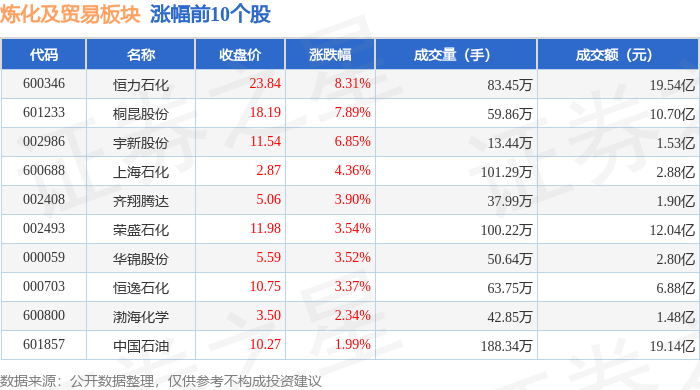
炼化及贸易板块1月6日涨2.36%,恒力石化领涨,主力资金净流入4.08亿元
Zheng Xing Xing Ye Ri Bao· 2026-01-06 09:03
Market Performance - The refining and trading sector increased by 2.36% on January 6, with Hengli Petrochemical leading the gains [1] - The Shanghai Composite Index closed at 4083.67, up 1.5%, while the Shenzhen Component Index closed at 14022.55, up 1.4% [1] Stock Performance - Hengli Petrochemical (600346) closed at 23.84, up 8.31%, with a trading volume of 834,500 shares and a transaction value of 1.954 billion [1] - Tongkun Co., Ltd. (601233) closed at 18.19, up 7.89%, with a trading volume of 598,600 shares and a transaction value of 1.07 billion [1] - Other notable stocks include Yuxin Co., Ltd. (002986) up 6.85%, Shanghai Petrochemical (600688) up 4.36%, and Rongsheng Petrochemical (002493) up 3.54% [1] Capital Flow - The refining and trading sector saw a net inflow of 408 million in main funds, while retail investors experienced a net outflow of 382 million [2] - The main funds' net inflow for Hengli Petrochemical was 122 million, while retail investors had a net outflow of 132 million [3] - Other companies like China Petroleum (601857) and Rongsheng Petrochemical also experienced significant capital movements, with net inflows of 193 million and 70 million respectively [3]



中国巨石(600176):2025年限制性股票激励计划草案点评:激励如期落地,彰显发展信心
GUOTAI HAITONG SECURITIES· 2026-01-06 08:40
Investment Rating - The investment rating for the company is "Accumulate" with a target price of 23.57, compared to the current price of 17.50 [6]. Core Insights - The company has launched a restricted stock incentive plan, which reflects confidence in future operations. The plan targets both growth and stability, covering a wide range of employees including executives and core middle management [2][12]. - The incentive plan proposes to grant 34,528,200 shares, accounting for 0.86% of the total share capital, with a grant price of 10.19 yuan per share. The total number of incentive recipients is 618, representing 4.59% of the total workforce [12]. - The performance commitments of the incentive plan include three key metrics for unlocking shares, with compound annual growth rates (CAGR) for net profit set at no less than 38.5% from 2024 to 2026, 27% from 2024 to 2027, and 22% from 2024 to 2028 [12]. Financial Summary - Total revenue is projected to grow from 14,876 million yuan in 2023 to 22,105 million yuan in 2027, reflecting a CAGR of approximately 10.8% [4]. - Net profit attributable to the parent company is expected to increase from 3,044 million yuan in 2023 to 4,802 million yuan in 2027, with a notable recovery in 2025 showing a 44.8% increase [4]. - Earnings per share (EPS) is forecasted to rise from 0.76 yuan in 2023 to 1.20 yuan in 2027 [4]. Market Data - The company's market capitalization is approximately 70,055 million yuan, with a total share capital of 4,003 million shares [7]. - The stock has traded within a range of 10.80 to 17.50 yuan over the past 52 weeks [7]. Valuation Metrics - The price-to-earnings (P/E) ratio is projected to decrease from 23.01 in 2023 to 14.59 in 2027, indicating an improving valuation as earnings grow [4]. - The return on equity (ROE) is expected to improve from 10.6% in 2023 to 12.9% in 2027 [4].

化工ETF(159870)涨超3.3%,机构称炼化应该是3-5年级别的周期
Xin Lang Cai Jing· 2026-01-06 03:16
数据显示,截至2025年12月31日,中证细分化工产业主题指数(000813)前十大权重股分别为万华化学 (600309)、盐湖股份(000792)、藏格矿业(000408)、天赐材料(002709)、巨化股份(600160)、恒力石化 (600346)、华鲁恒升(600426)、宝丰能源(600989)、云天化(600096)、金发科技(600143),前十大权重股 合计占比45.31%。 炼化也不止px,乙烯现在没启动还在亏损,26-27年减亏/扭亏的概率是比较大的。 化工ETF(159870),场外联接(A:014942;C:014943;I:022792)。 成分股消息方面:恒逸石化文莱二期打开发展空间,上调回购价格上限彰显信心。公司全面启动文莱二 期项目建设、打开未来发展空间。公司已签订《二期实施协议》,并于文莱政府、银行、股东方取得税 收优惠、贷款等方面批文及意向函。二期项目规划1200万吨/年产能,主要生产柴油、PX、纯苯、聚丙 烯及其他附加值较高的成品油及化工产品,预计2028年年底建成投产。公司上调回购价格上限、彰显信 心。根据公司公告,公司前期15-25亿大额回购已累计增持约2.65亿股, ...

民营大炼化行业景气度回升
Qi Huo Ri Bao· 2026-01-05 16:09
Core Viewpoint - The domestic refining market is gradually emerging from an adjustment period, supported by favorable policies and declining international crude oil prices, leading to improved market concentration and prosperity [1][2]. Group 1: Industry Performance - The profitability of major private refining companies, including Hengli Petrochemical, Rongsheng Petrochemical, Hengyi Petrochemical, and Dongfang Shenghong, has been steadily recovering since Q3 2025 [1]. - The integrated refining model and industrial chain advantages are key factors for these leading companies to withstand market fluctuations, improving their gross margins and overall industry prosperity [1][2]. - The refining capacity in China has reached 923 million tons as of 2024, nearing the 1 billion ton limit set by regulatory authorities, indicating the end of the expansion cycle [2]. Group 2: Cost and Pricing Dynamics - The average price of Brent crude oil was $68.17 per barrel in Q3 2025, a year-on-year decrease of 13.4%, while WTI crude oil averaged $64.97 per barrel, down 13.6% year-on-year [3]. - The decline in oil prices has reduced raw material procurement costs for refining companies and improved the price differentials of chemical products [3]. - The global refining capacity is experiencing a clear East-West differentiation, with older refineries in Europe and the U.S. being phased out, while Asian facilities continue to come online [3]. Group 3: Future Outlook - The industry is expected to continue its moderate recovery, although demand-side pressures remain a concern [5]. - The core variable affecting corporate profitability in 2026 will still be crude oil prices, with expectations of prices dropping to the marginal cost of shale oil [6]. - The refining market is anticipated to see a divergence in profits between chemical and refining sectors, with large refining companies benefiting from a higher proportion of chemical products [7].
