
荣盛石化

Search documents
民营大炼化行业景气度回升
Qi Huo Ri Bao· 2026-01-05 16:09
Core Viewpoint - The domestic refining market is gradually emerging from an adjustment period, supported by favorable policies and declining international crude oil prices, leading to improved market concentration and prosperity [1][2]. Group 1: Industry Performance - The profitability of major private refining companies, including Hengli Petrochemical, Rongsheng Petrochemical, Hengyi Petrochemical, and Dongfang Shenghong, has been steadily recovering since Q3 2025 [1]. - The integrated refining model and industrial chain advantages are key factors for these leading companies to withstand market fluctuations, improving their gross margins and overall industry prosperity [1][2]. - The refining capacity in China has reached 923 million tons as of 2024, nearing the 1 billion ton limit set by regulatory authorities, indicating the end of the expansion cycle [2]. Group 2: Cost and Pricing Dynamics - The average price of Brent crude oil was $68.17 per barrel in Q3 2025, a year-on-year decrease of 13.4%, while WTI crude oil averaged $64.97 per barrel, down 13.6% year-on-year [3]. - The decline in oil prices has reduced raw material procurement costs for refining companies and improved the price differentials of chemical products [3]. - The global refining capacity is experiencing a clear East-West differentiation, with older refineries in Europe and the U.S. being phased out, while Asian facilities continue to come online [3]. Group 3: Future Outlook - The industry is expected to continue its moderate recovery, although demand-side pressures remain a concern [5]. - The core variable affecting corporate profitability in 2026 will still be crude oil prices, with expectations of prices dropping to the marginal cost of shale oil [6]. - The refining market is anticipated to see a divergence in profits between chemical and refining sectors, with large refining companies benefiting from a higher proportion of chemical products [7].


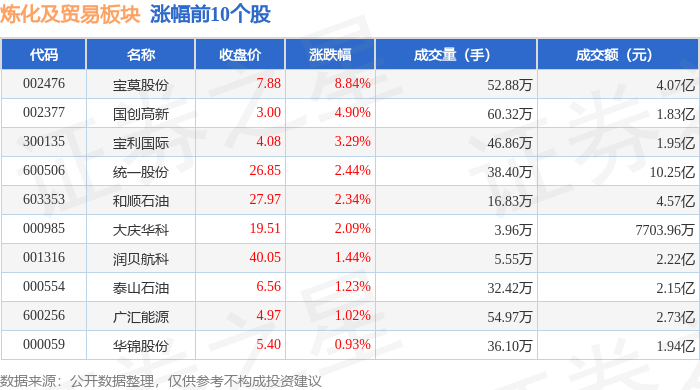
炼化及贸易板块1月5日跌2.48%,恒逸石化领跌,主力资金净流入7350.1万元
Zheng Xing Xing Ye Ri Bao· 2026-01-05 09:09
| 代码 | 名称 | 收盘价 | 涨跌幅 | 成交量(手) | 成交额(元) | | --- | --- | --- | --- | --- | --- | | 000703 | 恒逸石化 | 10.40 | -3.44% | 73.54万 | 7.60亿 | | 601857 | 中国石油 | 10.07 | -3.27% | 308.40万 | 31.00亿 | | 600346 | 恒力石化 | 22.01 | -2.31% | 39.64万 | 8.70亿 | | 601233 | 桐昆股份 | 16.86 | -2.03% | 41.02万 | 6.92亿 | | 000301 | 东方感虹 | 10.70 | -1.74% | 28.35万 | 3.02亿 | | 600028 | 中国石化 | 6.09 | -1.46% | 222.37万 | 13.56亿 | | 002493 | 荣盛石化 | 11.57 | -1.20% | 67.59万 | 7.76亿 | | 600800 | 渤海化学 | 3.42 | -1.16% | 34.78万 | 1.19亿 | | 600688 | 上海石 ...




委内瑞拉局势对原油影响几何?
Guotou Securities· 2026-01-05 02:57
Investment Rating - The report assigns an investment rating of "Outperform" relative to the market, indicating a projected return that exceeds the CSI 300 Index by 10% or more over the next six months [6]. Core Insights - The geopolitical situation in Venezuela, particularly the recent military actions by the U.S., is expected to have limited short-term impact on oil prices due to the current low production levels of approximately 1 million barrels per day [3]. - Venezuela holds the world's largest proven oil reserves, estimated at around 300 billion barrels, which represents about 17% of global reserves. This heavy crude oil is highly complementary to the U.S. light crude production, potentially enhancing operational efficiency and profitability for U.S. refineries [2]. - The potential for increased foreign investment in Venezuela's oil infrastructure could lead to a significant rise in oil exports, possibly reaching 3 million barrels per day in the medium term, which may exert downward pressure on oil prices [3]. Summary by Sections Oil Supply and Demand - Venezuela's current oil production is about 1 million barrels per day, with exports around 900,000 barrels per day, indicating a limited supply situation [3]. - The U.S. refineries, primarily located along the Gulf Coast and West Coast, are designed to process heavy, high-sulfur crude oil from Venezuela and Mexico, making access to Venezuelan oil crucial for their operational efficiency [2]. Market Impact - The short-term market impact of the U.S. military actions is expected to be minimal due to the already factored-in geopolitical risks and the current oversupply in the global oil market [3]. - In the medium term, the anticipated return of U.S. oil companies to Venezuela could revitalize the country's oil production capabilities, which have been hindered by mismanagement and sanctions [3]. Refinery Operations - Chinese refineries are significant buyers of Venezuelan oil, with over 70% of Venezuela's oil exports directed to China, accounting for about 7% of China's total oil imports [10]. - The recent geopolitical developments may lead to a temporary decline in refinery operations in China due to potential supply disruptions, which could increase prices for refined products like diesel and asphalt [10].
推荐炼油炼化、钾肥、磷化工、SAF投资方向
Zhong Guo Neng Yuan Wang· 2026-01-05 01:42
Core Viewpoint - The petrochemical industry is currently facing significant "involution" competition, leading to a situation where companies are experiencing increased production without corresponding profit growth. The industry's overall operating revenue profit margin has declined from 8.03% in 2021 to an expected 4.85% in 2024. However, since 2025, some sub-industries have begun to recover, with a year-on-year net profit growth of 10.56% in the first three quarters, indicating a gradual stabilization and recovery in industry profitability [1][2]. Supply Side - The cumulative fixed asset investment in the chemical raw materials and chemical products manufacturing industry turned negative starting June 2025, with capital expenditures in the SW basic chemical industry and several sub-industries declining for multiple consecutive quarters. The current expansion cycle in the industry is nearing its end. In September, policies aimed at stabilizing growth in the petrochemical industry were introduced to address low-price disorderly competition and promote the orderly exit of backward production capacity. Sub-industries such as silicone, caprolactam, and PTA polyester have responded by developing or drafting industry guidelines to combat "involution." It is anticipated that there will be stricter approvals for new chemical product capacities, and the elimination of backward production capacity (e.g., small scale, high energy consumption, and high pollution) will accelerate, effectively alleviating the issue of supply surplus in the petrochemical industry [2][3]. Demand Side - Traditional demand is expected to see moderate recovery due to global central banks entering a rate-cutting cycle and pausing balance sheet reductions, supported by monetary and fiscal policy stimuli. Emerging demand from sectors such as new energy, SAF (Sustainable Aviation Fuel), and AI continues to drive the need for key chemical materials that support technological upgrades in industries [3]. - The overseas chemical capacity reduction, driven by high energy costs and aging facilities, has led to a wave of plant closures in the European chemical industry since 2025. Currently, China's chemical product sales account for over 40% of the global market. With a complete domestic petrochemical industry chain and many chemical products being highly competitive globally, it is expected that Chinese chemical companies will continue to increase their market share, accelerating the digestion of surplus capacity [3]. Macro and Chemical Product Prices - As of December 2025, the manufacturing PMI index was reported at 50.1%, an increase of 0.9 percentage points from the previous month, indicating expansion. The China Chemical Product Price Index (CCPI) was reported at 3927 points, a decrease of 9.4% from 4333 points at the beginning of the year, reflecting a decline in the ex-factory prices of major chemical products [3]. Oil Prices - In 2025, the international oil market experienced a downward trend, with Brent crude futures averaging approximately $69.15 per barrel and WTI crude futures averaging about $65.87 per barrel. This was influenced by a mix of factors including OPEC+ gradual production increases, geopolitical conflicts, fluctuations in U.S. oil inventories, and macroeconomic sentiment. OPEC+ announced a pause in production increases at the beginning of 2026 after a cumulative increase of 411,000 barrels per day from October to December 2025 to alleviate surplus pressure. The demand from non-OECD countries and aviation fuel, along with petrochemical raw materials, has become a major support for oil prices. Major institutions have narrowed their demand growth expectations for 2025-2026 to between 700,000 and 1.4 million barrels per day [4]. Investment Recommendations - The refining and chemical sector is expected to see a recovery in overall profits due to moderate oil prices and reduced cost volatility. The supply-demand relationship in the refining and chemical industry, particularly in the aromatics industry chain, is expected to continue to optimize. Key recommendations include China Petroleum (601857) and Rongsheng Petrochemical (002493) [5]. - In the potassium fertilizer sector, potassium salt resources are expected to remain scarce, with global supply and demand expected to maintain a tight balance over the next 2-3 years. Key recommendations include Yara International (000893), which has significant potassium salt mining rights in Laos [6]. - In the phosphorus chemical sector, the demand for lithium iron phosphate batteries is expected to enhance the marginal pull on phosphorus ore demand, leading to a revaluation of phosphorus ore. Key recommendations include Chuanheng Co., Ltd. (002895) and Yuntianhua Co., Ltd. (600096) [6]. - In the sustainable aviation fuel (SAF) sector, the EU has mandated a gradual increase in SAF content in aviation fuel, with global SAF demand expected to double to 2 million tons by 2025. Key recommendations include Zhuoyue New Energy, a leading domestic biodiesel company [6].



推荐炼油炼化、钾肥、磷化工、SAF投资方向 | 投研报告
Sou Hu Cai Jing· 2026-01-05 01:33
Core Viewpoint - The petrochemical industry is currently facing significant "involution" competition, leading to a situation where companies are experiencing increased production without corresponding profit growth. The industry's operating revenue profit margin has declined from 8.03% in 2021 to an expected 4.85% in 2024. However, since 2025, some sub-industries have begun to recover, with a year-on-year increase of 10.56% in net profit attributable to the parent company in the first three quarters, indicating a gradual stabilization and recovery in industry profitability [2][3]. Supply Side - Investment in fixed assets in the chemical raw materials and chemical products manufacturing industry has turned negative since June 2025, with capital expenditures in the basic chemical industry and several sub-industries declining for multiple consecutive quarters. The current expansion cycle in the industry is nearing its end. In September, policies aimed at stabilizing growth in the petrochemical industry were introduced to address low-price and disorderly competition and to promote the orderly exit of backward production capacity. Sub-industries such as silicone, caprolactam, and PTA polyester have responded to these "anti-involution" measures by either issuing or formulating industry guidelines. It is anticipated that there will be stricter approvals for new chemical product capacities, and the elimination of backward production capacity (such as small scale, high energy consumption, and high pollution) will accelerate, effectively alleviating the issue of supply surplus in the petrochemical industry [2][3]. Demand Side - Traditional demand is expected to see a moderate recovery due to global central banks entering a rate-cutting cycle and pausing balance sheet reductions, supported by monetary and fiscal policy stimuli. Emerging demand from sectors such as new energy, SAF (Sustainable Aviation Fuel), and AI continues to drive the need for key chemical materials that support technological upgrades in industries [3]. - The overseas chemical capacity reduction, driven by high energy costs and aging facilities, has led to a wave of plant closures in the European chemical industry since 2025. Currently, China's chemical product sales account for over 40% of the global market, with a well-established domestic petrochemical industry chain. As overseas capacity continues to clear and demand is expected to recover, Chinese chemical companies are likely to see an increase in global market share, accelerating the digestion of surplus capacity [3]. Macro and Chemical Product Prices - As of December 2025, the manufacturing PMI index was reported at 50.1%, an increase of 0.9 percentage points from the previous month, indicating expansion. The China Chemical Product Price Index (CCPI) was reported at 3927 points, a decrease of 9.4% from 4333 points at the beginning of the year, reflecting a decline in the ex-factory prices of major chemical products [3]. Oil Prices - In 2025, international oil prices exhibited a fluctuating downward trend, with Brent crude futures averaging approximately $69.15 per barrel and WTI crude futures averaging about $65.87 per barrel. This fluctuation was influenced by a combination of factors, including OPEC+'s gradual production increases, geopolitical conflicts, and macroeconomic sentiment. OPEC+ announced a pause in production increases at the beginning of 2026 to alleviate surplus pressures after a cumulative increase of 411,000 barrels per day from October to December. The demand from non-OECD countries, along with aviation fuel and petrochemical raw material needs, has become a major support for oil prices. Major institutions have narrowed their demand growth expectations for 2025-2026 to a range of 700,000 to 1.4 million barrels per day [4]. Investment Recommendations - The refining and chemical sector is expected to see a recovery in overall profits due to moderate oil prices and reduced cost fluctuations. The industry is also experiencing a shift towards "reducing oil and increasing chemicals," supported by clear anti-involution policy signals. Recommended companies include China Petroleum and Rongsheng Petrochemical [5][6]. - In the potassium fertilizer sector, potassium salt resources are expected to remain scarce, with a tight balance in global supply and demand over the next 2-3 years. Recommended company: Yara International, which holds significant potassium salt mining rights in Laos [6]. - In the phosphorus chemical sector, the demand for lithium iron phosphate in energy storage is expected to enhance the marginal pull on phosphorus ore demand, leading to a revaluation of phosphorus ore. Recommended companies include Chuanheng Co. and Yuntianhua [6]. - In the sustainable aviation fuel (SAF) sector, the EU has mandated a gradual increase in SAF blending ratios, with global SAF demand expected to double to 2 million tons by 2025. Recommended company: Zhuoyue New Energy, a leading domestic biodiesel enterprise [6][7].

国信证券晨会纪要-20260105
Guoxin Securities· 2026-01-05 01:16
宏观与策略 宏观快评:12 月 PMI 数据解读-年末脉冲,助力收官 固定收益专题研究:2026 年 1 月转债市场研判及"十强转债"组合 策略深度:资配跨年展望(三)-龙头科技,强者恒强 总量专题(首席经济学家团队):总量专题-26 年牛市的变与不变 行业与公司 证券研究报告 | 2026年01月05日 | 晨会纪要 | | --- | | 数据日期:2025-12-31 | 上证综指 | 深证成指沪深 | 300 指数 | 中小板综指 | 创业板综指 | 科创 50 | | --- | --- | --- | --- | --- | --- | --- | | 收盘指数(点) | 3968.84 | 13525.02 | 4629.93 | 14545.57 | 3911.49 | 1344.20 | | 涨跌幅度(%) | 0.09 | -0.58 | -0.45 | -0.30 | -0.51 | -1.15 | | 成交金额(亿元) | 8295.11 | 12156.30 | 4444.91 | 4402.74 | 5436.91 | 492.84 | $\frac{10}{100}$$\frac ...
华泰证券今日早参-20260105
HTSC· 2026-01-05 01:09
Group 1: Macro Insights - The New Year's holiday saw a significant increase in travel and consumption, with daily cross-regional personnel flow up 19.5% year-on-year and average consumer spending rising over 30% compared to last year [2][3] - The manufacturing PMI showed a seasonal rebound, indicating a recovery in exports and manufacturing activity [2] - Real estate transactions remain low, but there is a call for stronger policy support to stabilize the market [2] Group 2: Oil and Energy Sector - The geopolitical situation in Venezuela has shifted dramatically, with the U.S. taking control of the oil industry, which may have far-reaching implications for global geopolitics and trade [3] - The potential for market-driven investments in Venezuela's oil sector could reshape the energy landscape in the Americas [3] Group 3: Investment Strategy - The spring market is expected to continue its upward trend, supported by improved PMI data and favorable liquidity conditions [6][9] - The focus for investors should be on thematic investments in sectors like commercial aerospace, humanoid robots, and domestic computing power [6] - A balanced approach is recommended, with an emphasis on high-dividend stocks and cyclical sectors such as consumer goods and energy [6] Group 4: Transportation Sector - During the New Year's holiday, the number of cross-regional travelers reached 595 million, with a daily average increase of 19.62% year-on-year, driven by a low base from the previous year [16] - The railway sector experienced the highest growth rate at 52.6%, indicating strong demand for rail travel [16] Group 5: Consumer Sector - The New Year's holiday saw a steady increase in consumer spending, with total spending reaching 847.89 billion yuan, a 6.3% increase year-on-year [17] - The report highlights structural opportunities in the consumer sector, particularly in domestic brands, AI-enabled technology consumption, and emotional spending [17] Group 6: Real Estate Sector - The emphasis on managing expectations in the real estate market has increased, with a focus on stabilizing market sentiment [18] - There is optimism for investment opportunities in well-managed real estate companies and high-dividend property management firms [18] Group 7: Chemical Industry - The polycarbonate (PC) industry is expected to enter a favorable cycle due to strong demand from the electric vehicle sector and limited new capacity additions [19] - The industry is projected to achieve high operating rates of 87% to 95% from 2025 to 2027, indicating a positive outlook for key players [19] Group 8: Technology Sector - The CES 2026 event is anticipated to shift focus towards AI-driven technologies, marking a significant transition in the consumer electronics landscape [20] - The report suggests that AI applications will be a key area to watch, with implications for various sectors including automotive and industrial applications [20] Group 9: Fixed Income Market - The bond market is expected to face mixed conditions, with short-term trading opportunities arising from new public fund sales regulations [13] - The report suggests a focus on short-term strategies and flexible operations in response to market dynamics [14]
化工-Q4业绩前瞻及多品种更新推荐
2026-01-04 15:35
Summary of Chemical Industry Conference Call Industry Overview - The chemical sector is entering a clear cyclical turning point starting from July 2024, with 2026 expected to be a significant year for the industry. [2] - Supply-side reforms have led to a substantial decrease in new capacity and production growth, creating a foundation for valuation recovery and an upward trend in the chemical stocks. [2] - Despite the current demand not fully recovering, the certainty on the supply side has resulted in strong stock performance. [2] Key Insights - **Investment Recommendations**: Prioritize large leading companies such as Hengli Petrochemical, Rongsheng Petrochemical, and Hualu Chemical, as well as high-elasticity targets in the polyester industry chain. [2][4] - **Oil Price Forecast**: Anticipation that oil prices may bottom out in the first half of 2026, providing a final opportunity for increased investment in the chemical sector. Historical data indicates that chemical stock prices typically bottom out about a year before oil prices. [5] - **PTA Market**: PTA prices have recently improved, with low-cost companies achieving slight profits. 2026 is expected to mark the beginning of profit recovery for PTA. [6] - **Aromatics Sector**: The aromatics industry, particularly PX prices, has shown significant increases due to expanded oil product cracking margins and reduced supply from the U.S. [10] - **Chlor-alkali Industry**: The chlor-alkali sector has faced simultaneous declines in caustic soda and PVC prices, leading to overall losses. Limited new capacity in caustic soda and PVC is expected to accelerate the exit of outdated capacities. [12][13] Additional Insights - **Biodiesel Market**: The second-generation biodiesel prices remain strong, with significant capacity increases expected from companies like Zhuoyue New Energy. [14] - **Refrigerant Market**: The refrigerant sector has seen price increases across major products, with a positive outlook for future price growth. [21][22] - **Silicon and Chromium Market**: Prices for silicon and chromium have remained stable, with expectations for a price increase in March due to seasonal demand. [7] - **Tire Industry**: The tire market is experiencing a seasonal slowdown, but domestic brands like Sailun are showing strong sales growth. [24] Conclusion - The overall outlook for the chemical sector in 2026 is strongly positive, with recommendations to focus on large leading enterprises and high-elasticity targets while closely monitoring supply-demand dynamics for optimal investment timing. [7]

荣盛石化:审议通过《关于公司2026年年度互保额度的议案》
Zheng Quan Ri Bao Wang· 2026-01-04 14:14
Core Viewpoint - Rongsheng Petrochemical (002493) announced the approval of the proposal regarding the mutual guarantee limit for the year 2026 at its fourth extraordinary general meeting of shareholders in 2025 [1] Group 1 - The company held its fourth extraordinary general meeting of shareholders on January 4 [1] - The proposal concerning the mutual guarantee limit for 2026 was reviewed and approved [1]
供需逐步向好下PC或迎景气周期
HTSC· 2026-01-04 12:36
Investment Rating - The report maintains an "Overweight" rating for the basic chemical industry [2] Core Views - The report indicates that the supply and demand for polycarbonate (PC) are gradually improving, suggesting that the industry may enter a prosperous cycle [6][8] - The demand for PC is expected to grow significantly due to the increasing penetration of downstream applications such as electric vehicles, electronics, and optical materials [9] - The report highlights that the domestic production capacity of PC has increased from 12% in 2017 to 49% by 2025, indicating a significant shift towards domestic production [6][9] Summary by Sections Investment Recommendations - Recommended stocks include: - Wanhua Chemical (600309 CH) with a target price of 85.20 and a "Buy" rating - Luxi Chemical (000830 CH) with a target price of 17.85 and a "Buy" rating - Hengli Petrochemical (600346 CH) with a target price of 24.48 and an "Overweight" rating - Rongsheng Petrochemical (002493 CH) with a target price of 12.48 and an "Overweight" rating [5][34] Supply and Demand Dynamics - The report forecasts that the industry operating rates will improve to 87% in 2025, 94% in 2026, and 95% in 2027, driven by limited new capacity additions and ongoing demand growth [10] - The overall demand for PC is projected to reach 360 million tons in 2024, with a compound annual growth rate (CAGR) of 11% from 2018 to 2024 [9][32] Competitive Landscape - The competitive landscape for PC is relatively favorable, with major production concentrated among leading chemical companies that possess the necessary technical qualifications [6] - The report notes that the market concentration has decreased from 80% in 2017 to 62% globally by 2025, while domestic concentration is expected to be 66% [6] Price Trends - As of December 30, 2024, PC prices have increased by 3% from the low point in September 2024, indicating a recovery in the market [10] - The report highlights that the price of PC is expected to continue to rise as supply and demand improve [10]

