
万辰集团

Search documents
马年启新程|26股获机构上调评级至“买入”!
Xin Lang Cai Jing· 2026-02-21 23:47
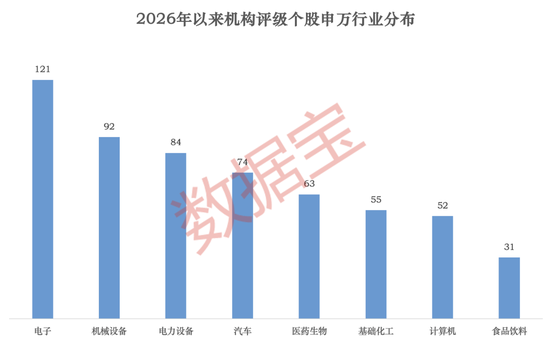
Core Viewpoint - The report highlights the increasing institutional interest in various sectors, particularly in electronics and automotive, with a significant number of stocks receiving "buy" ratings from analysts. Group 1: Institutional Ratings - A total of 63 institutions conducted 1,827 ratings since 2026, with 932 stocks receiving "buy" ratings, including buy, accumulate, strong recommendation, and recommendation [1][12]. - The electronics sector has the highest number of rated stocks, followed by machinery, power equipment, automotive, pharmaceuticals, basic chemicals, and computers, with each having over 50 rated stocks [2][13]. Group 2: Electronics Sector Performance - The electronics index has risen by 8.41% this year, significantly outperforming the Shanghai Composite Index, with the semiconductor index showing the highest increase of 13.93% [4][14]. - Key semiconductor companies like Baiwei Storage, Zhaoyi Innovation, SMIC, and Jiangfeng Electronics have received ratings from five or more institutions, indicating strong market interest [4][14]. Group 3: Notable Stocks - 67 stocks have received attention from five or more rating agencies, with Dongpeng Beverage, BYD, Wancheng Group, Kweichow Moutai, and China Duty Free leading the list [5][15]. - Dongpeng Beverage is projected to achieve revenue of 20.76 billion to 21.12 billion yuan in 2025, with a year-on-year growth of 31.07% to 33.34%, and a net profit of 4.34 billion to 4.59 billion yuan, reflecting a growth of 30.46% to 37.97% [5][15]. - BYD's sales in January were 210,100 units, a year-on-year decrease of 30.11%, attributed to inventory reduction and a transitional policy period [5][15]. Group 4: Future Growth Prospects - Baiwei Storage is expected to achieve revenue of 10 billion to 12 billion yuan in 2025, with a year-on-year growth of 49.36% to 79.23%, and a net profit of 850 million to 1 billion yuan, reflecting a growth of 427.19% to 520.22% [10][19]. - The company is focusing on AI storage solutions and has strong competitive advantages through self-developed chips and advanced packaging capabilities [11][19].





研判2026!中国休闲食品饮料零售行业发展背景、产业链图谱、市场规模、竞争格局及发展趋势分析:CR5市场占有率仅6%[图]
Chan Ye Xin Xi Wang· 2026-02-16 01:07
Core Insights - The retail market for leisure food and beverages in China is evolving from a traditional "snack" category to a high-frequency necessity, driven by rising consumer income and changing consumption patterns [1][3][5] - By 2025, the market size of China's leisure food and beverage retail industry is projected to reach 39,653 billion yuan, with a year-on-year growth of 6.1% [1][5] - The market is characterized by a fragmented competitive landscape, with a CR5 market share of only 6% in 2024, indicating a large number of small to medium-sized enterprises [6][7] Industry Overview - Leisure food and beverage retail focuses on convenience and entertainment, catering to individual and family consumers through both offline and online channels [2] - The industry can be categorized into leisure food retail and leisure beverage retail, with further segmentation based on retail channels [2] Development Background - Rising national income and consumption levels are foundational for the growth of the leisure food and beverage retail industry, with per capita consumption expenditure expected to reach 29,476 yuan in 2025, a nominal increase of 4.4% [3][4] - There is a shift in consumer demand from mere indulgence to a combination of health and indulgence, with health-oriented products becoming mainstream [3][5] Industry Chain - The industry chain includes upstream manufacturers of various leisure foods and beverages, midstream retail channels such as supermarkets and e-commerce, and downstream consumers across all age groups [5] Current Market Status - The retail industry has expanded its scope to cover various consumption scenarios, becoming a key part of daily life, with significant growth in consumption frequency and penetration [1][5] - The distribution of market channels by 2025 is projected to be approximately 44.8% for supermarkets, 22.6% for grocery stores, 14.1% for e-commerce, and 12.2% for specialty stores [1][5] Competitive Landscape - The market is highly fragmented, with major players including Hunan Mingming Hen Mang Commercial Chain Co., Ltd., Walmart (China), Yonghui Supermarket, and others [6][7] - Hunan Mingming Hen Mang reported a total revenue of 463.71 billion yuan for the first nine months of 2025, with its two brands contributing significantly to this figure [7] Development Trends - The industry is expected to focus on health and functionality as core competitive advantages, with consumers increasingly favoring products with natural ingredients and minimal additives [8][9] - There is a growing emphasis on quality-price ratio and emotional value in consumer demand, with products serving not just as snacks but also as means for emotional comfort and social interaction [9] - The retail landscape is moving towards a multi-channel approach, integrating online and offline strategies to enhance consumer convenience and engagement [10][11]






记者实探:深圳零食折扣店货架卖空了!
Shen Zhen Shang Bao· 2026-02-14 10:55
以好特卖、零食有鸣、零食很忙等为代表的折扣零食店,正成为深圳人返乡前囤年货的最后驿站。相比 传统超市,它们价格更亲民,品类更集中,春节大礼包更是早早售罄。 一位在南山大学城工作的市民李女士告诉记者:"今晚的飞机回湖北,买点零食路上吃,也给家里小孩 带点。"李女士笑着说,"在超市买这些可能要上百,这里50元左右就搞定了,划算!" 当被问及春节是否歇业时,一位店员摇头道:"我们春节都不休息,照常营业。"她解释道,虽然很多深 圳人回老家了,但留下来过年的年轻人也不少,"而且走亲访友、朋友聚会,零食需求还是很大的。" 据了解,目前,国内量贩零食行业已形成稳定的双强竞争格局。其中,万辰集团(300972)旗下拥 有"好想来""老婆大人"等品牌。而鸣鸣很忙则拥有"零食很忙""赵一鸣"等品牌。 记者走进位于南山区大学城的一家零食有鸣门店,发现春节期间最受欢迎的"春节零食大礼包"已售罄, 货架上也有一些空空的感觉。营业员告诉记者:"春节零食大礼包早就卖完了,这几天生意特别好,都 是准备返乡过年的年轻人,来买些路上吃的,或者带回去当年货。" 财报显示,万辰集团披露的2025年度业绩预告显示,公司全年营收预计突破500亿元大关, ...
冰火两重天!蛇年万辰集团股价翻倍,三只松鼠、良品铺子大跌
Shen Zhen Shang Bao· 2026-02-14 09:31
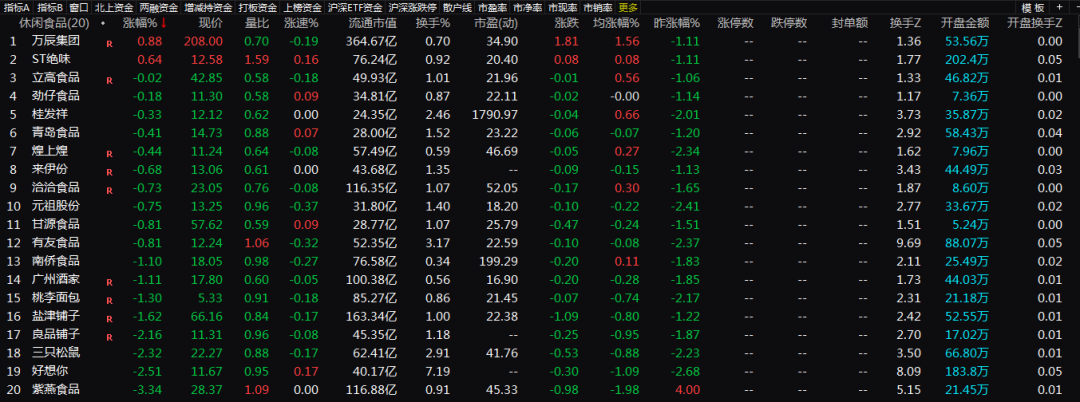
Core Viewpoint - The leisure food sector in A-shares experienced mixed performance in the Year of the Snake, with 50% of the 20 stocks in the sector declining during the period from February 5, 2025, to February 13, 2026, and only two companies seeing stock price increases on the last trading day [1]. Group 1: Stock Performance - Wancheng Group (300972) led the sector with a remarkable increase of 103.03%, becoming the only "double" stock in the sector [3]. - Ziyan Food (603057) followed with a rise of 71.67%, while Huang Shang Huang (002695) and Hao Xiang Ni (002582) both saw increases around 40% [3]. - Conversely, Three Squirrels (300783) experienced a significant decline of 30.94%, and Liangpin Shop (603719) fell by 23.36% [3][4]. - Ganyuan Food (002991) also faced a decline exceeding 30% [3]. Group 2: Company Performance and Financials - Wancheng Group reported a strong performance, projecting a net profit of 1.23 billion to 1.4 billion yuan for 2025, representing a year-on-year growth of 222.38% to 266.94% compared to 2024 [3]. - The company's growth is attributed to its deep engagement in the snack retail sector, with significant increases in sales scale and profit margins [3]. - In contrast, Three Squirrels expects a net profit of 135 million to 175 million yuan for the previous year, a decline of 57.08% to 66.89% year-on-year [5]. - Liangpin Shop anticipates a net loss of 120 million to 160 million yuan for 2025, impacted by store optimization and a decrease in sales revenue [5].
即时零售重塑年货消费新生态
Zheng Quan Ri Bao· 2026-02-13 15:29
本报记者 梁傲男 春节将至,年货市场竞争升温。即时零售成为今年市场最大变量,正悄然重塑年货消费格局与节奏。在家准备晚饭的市民 程女士发现食材短缺后,打开即时零售App,几下点击便完成下单。不到30分钟,新鲜的鱼虾和配菜便送抵家中。像程女士这 样的消费经历,正是当下年货消费的新常态缩影。 即时零售正以"随时响应、快速触达"的特性,消弭了线上线下消费场景的边界。以往,消费者需要精心规划购物行程,甚 至辗转于不同商店进行比较。如今,这种模式正被一站式"即时满足"所替代。 以"数字化即时履约"为核心,即时零售行业正重构消费市场的版图,成为扩内需、促消费的重要支撑。《即时零售行业发 展报告(2025)》(以下简称"报告")显示,2026年即时零售市场规模预计将突破1万亿元,"十五五"期间年均增速将达 12.6%。行业规模扩张与业态革新双线并进,已然成为零售业增长的新动能。 从"囤货"到"即时" 提升平台复购率 随着消费主力人群的代际更迭,过去以家庭为单位、提前进行的"集中式囤货",正被场景驱动的"即时满足"所替代。 报告显示,需求侧呈现"年轻、即时、健康"三大特征,2024年31岁至45岁消费群体占比达55%。美团闪购 ...
是时候该重估零食量贩店的投资价值
3 6 Ke· 2026-02-13 13:12
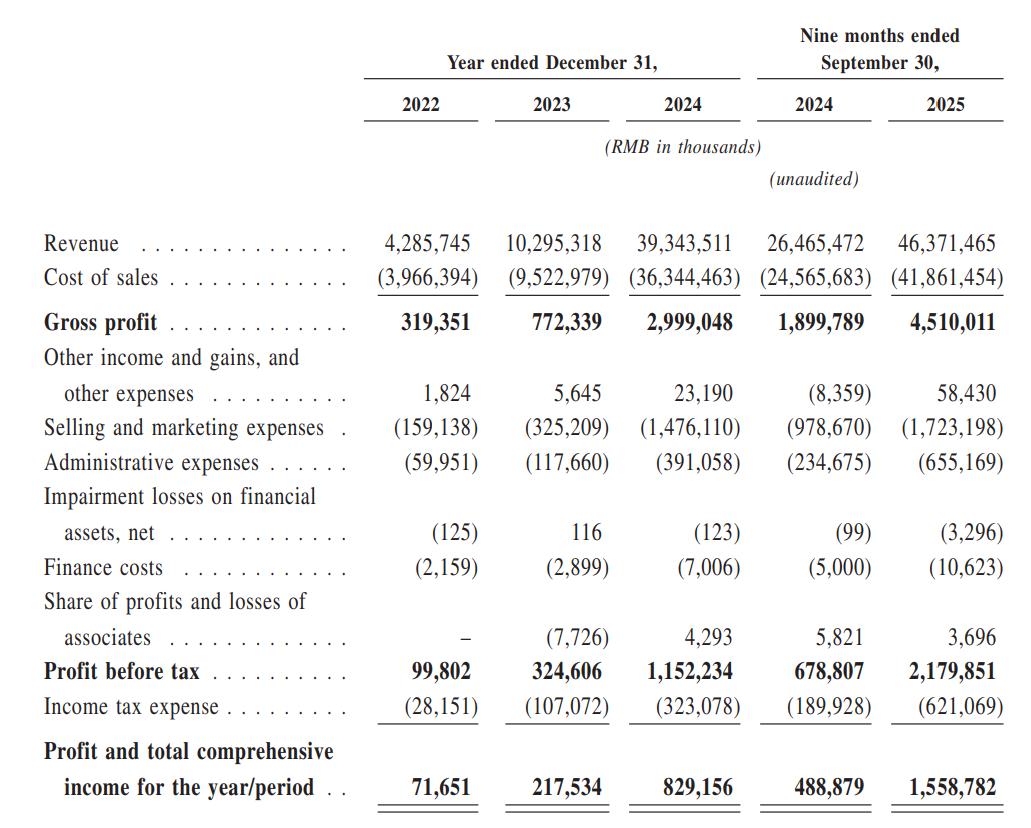
Core Viewpoint - The rapid growth of the snack retail sector, particularly the bulk snack stores represented by "Ming Ming Hen Mang," indicates a shift in consumer habits and market dynamics, positioning these stores as sustainable retail models rather than short-lived trends [2][19]. Group 1: Market Performance - "Ming Ming Hen Mang" experienced a significant IPO, with the Hong Kong public offering oversubscribed by approximately 1,899 times, raising over 500 billion HKD in frozen funds [3] - On its first trading day, the stock opened at 445 HKD, reflecting an 88.08% increase from the issue price of 236.6 HKD, and closed at 400 HKD, a 69.06% rise [3] - As of February 3, the stock price stabilized between 405 and 408 HKD, maintaining a market capitalization of around 870 to 880 billion HKD [3] Group 2: Financial Health - For the nine months ending September 30, 2025, "Ming Ming Hen Mang" reported revenue of 46.37 billion RMB, a year-on-year increase of 75.2%, with adjusted net profit soaring by 240.8% to 1.81 billion RMB [5] - The gross profit margin improved from approximately 7.5% in 2022 to 9.7% in 2023, while the net profit margin increased from 1.8% to 3.3% [6][7] - The company is transitioning from a "thin profit" model to a "thicker profit" approach, indicating a shift towards sustainable profitability [7] Group 3: Market Dynamics - The bulk snack retail sector has seen explosive growth, with the number of stores reaching approximately 45,000 by the end of 2025, a significant increase from about 1,800 in 2020 [16][17] - The market size for bulk snacks is projected to exceed 140 billion RMB in GMV by 2024, with the sector's share of the overall snack retail market rising from 7.6% in 2019 to 14% in 2024 [16] - "Ming Ming Hen Mang" and its competitor "Hao Xiang Lai" together hold over 70% of the market share, establishing a stable duopoly in the sector [18] Group 4: Competitive Landscape - Both "Ming Ming Hen Mang" and "Hao Xiang Lai" are expanding rapidly, with "Ming Ming Hen Mang" surpassing 21,000 stores and "Hao Xiang Lai" exceeding 15,000 stores, covering extensive geographic areas [17][9] - The two companies are well-positioned to capture the growing demand in lower-tier markets, which are expected to account for a significant portion of consumer spending growth by 2030 [18] Group 5: Strategic Insights - The operational model of "Ming Ming Hen Mang" emphasizes high inventory turnover and cost control through a flexible supply chain, which has led to improved gross margins [8] - The company is focusing on expanding its store network and enhancing its product offerings to meet evolving consumer preferences, particularly in lower-tier markets [8][27]
人均消费不到50元零食店买年货,这是什么趋势|热财经
Xin Lang Cai Jing· 2026-02-13 09:28
Core Insights - The rise of discount snack stores, represented by brands like "Hao Xiang Lai" and "Zhao Yi Ming," is becoming a new choice for young consumers during the Chinese New Year, offering more affordable prices and a concentrated product range compared to traditional supermarkets [1][3] - The discount snack store model relies on direct sourcing from manufacturers and streamlined supply chains, allowing for lower prices and a combination of well-known brands for traffic and private label products for profit [3][4] - The infrastructure improvements in county-level markets, including cold chain logistics and digital management systems, have enabled the rapid expansion of discount snack stores [3][4] Industry Dynamics - The competitive landscape of the discount snack industry is characterized by two dominant players: Wanchen Group with brands "Hao Xiang Lai" and "Lao Po Da Ren," and "Ming Ming Hen Mang" with brands "Liang Shi Hen Mang" and "Zhao Yi Ming" [1] - The shift in consumer behavior among young people reflects a desire for control over their purchasing decisions, moving away from the fixed specifications and prices set by manufacturers in traditional supermarkets [4] - The current growth of discount snack stores may face challenges, including quality control risks associated with private label products and the sustainability of price wars driving expansion [4]
消费洞察-如何看待2026年量贩零食连锁的成长性
2026-02-13 02:17
Summary of the Conference Call on the Snack Retail Industry Industry Overview - The conference call focuses on the snack retail industry, particularly the leading companies, Mingming Hen Mang and Wancheng Group, which have entered a cost reduction and efficiency improvement phase since 2025 [2][3]. Key Insights and Arguments - **Profit Margin Improvement**: Both companies have seen significant profit margin increases, with Mingming Hen Mang's margin rising by 1.5-1.6 percentage points and Wancheng Group's by nearly 2 percentage points, primarily due to supply chain restructuring and optimization of consumer scenarios [2][3]. - **Factors Driving Gross Margin Increase**: - Increased retail scale leading to lower procurement prices [6]. - Higher proportion of private label products, which now exceeds 10% [6]. - Increased rebates from upstream suppliers since 2025 [6]. - Enhanced logistics and distribution efficiency, reducing transportation costs [6]. - **Cost Reduction**: The decrease in expense ratios is linked to reduced subsidies for new stores and gross profit for franchisees, although gross margin improvement remains the main driver of profit margin growth [5][7]. - **Future Profit Margin Trends**: The trend of profit margin improvement is expected to continue into 2026, albeit at a slightly reduced rate compared to 2025, driven by declining procurement prices for second and third-tier brands and an increase in private label product share [8][10]. Competitive Landscape - The snack retail industry currently has a stable competitive landscape with only two major players, both of which had over 20,000 stores by the end of 2025. This rapid expansion provides ample motivation and time for cost reduction and efficiency improvements [9][10]. - The industry is characterized by a significant performance elasticity, with potential growth rates exceeding 50% in the short term [14]. Long-term Growth Potential - Long-term expansion depends on available store opening space and the ability to sustain same-store sales growth. Both companies have substantial expansion potential in their respective stronghold regions and are beginning to enter first-tier cities [11]. - Same-store sales growth has been under pressure, with Mingming Hen Mang experiencing a slight decline in 2025. However, improvements are noted in the latter half of the year due to store upgrades and enhanced digital membership operations [12][13]. Importance of Digital Membership Operations - Digital private membership operations are crucial for long-term growth in the chain retail sector. By establishing a digital membership system, companies can better understand consumer needs, optimize product offerings, and enhance operational efficiency [13]. Conclusion - The snack retail industry is poised for continued growth driven by cost reduction and efficiency improvements, with a focus on enhancing same-store sales through digital membership strategies and store optimization. The competitive landscape remains favorable for the leading companies, providing a solid foundation for future expansion and profitability [14][16].
鸣鸣很忙(01768):休闲食饮连锁头部企业,双品牌协同启成长新篇
Shenwan Hongyuan Securities· 2026-02-12 13:52
Investment Rating - The report initiates coverage with an "Accumulate" rating for the company [2][7]. Core Insights - The company, "Ming Ming Hen Mang," is a leading player in the casual food and beverage retail sector, focusing on a dual-brand strategy with "Zero Food Busy" and "Zhao Yi Ming Snacks" [6][17]. - The casual food and beverage retail market is expected to grow from RMB 2.9 trillion in 2019 to RMB 3.7 trillion by 2024, with a CAGR of 5.5% [6][41]. - The company has a strong market presence with 19,517 stores across 28 provinces, 59% of which are located in county and town markets, covering 1,341 counties [6][17]. Financial Data and Profit Forecast - Revenue is projected to grow significantly, with estimates of RMB 10,295 million in 2023, RMB 39,344 million in 2024, and reaching RMB 63,164 million by 2025, reflecting a year-on-year growth rate of 140.22% in 2023 and 282.15% in 2024 [5][7]. - Net profit attributable to ordinary shareholders is expected to rise from RMB 217 million in 2023 to RMB 834 million in 2024, and RMB 2,292 million in 2025, with growth rates of 203.45% and 283.44% respectively [5][7]. - The company’s PE ratios for 2025, 2026, and 2027 are projected to be 33X, 24X, and 20X respectively, indicating a favorable valuation compared to peers [7]. Market Dynamics - The casual food and beverage retail market is characterized by a high degree of fragmentation, with the top five chain retailers holding only 6% market share in 2024 [6][55]. - The down-market segment is becoming a key growth driver, with GMV expected to reach RMB 2.3 trillion by 2024, growing at a CAGR of 6.5%, significantly outpacing high-tier markets [6][45]. Competitive Advantages - The company employs a dual strategy of expanding high-tier stores while penetrating lower-tier markets, enhancing its store network through a franchise model [6][9]. - The supply chain and logistics capabilities are robust, with partnerships established with over 2,500 suppliers, allowing for efficient procurement and cost management [6][20]. - The company is transitioning to a full-category "discount supermarket" model, optimizing store formats and expanding product offerings to enhance revenue potential [6][19]. Fundraising and Strategic Initiatives - The company plans to utilize raised funds to enhance supply chain capabilities, upgrade store networks, and strengthen brand promotion efforts [6][24]. - Future growth is anticipated through strategic investments and acquisitions, further solidifying the company's market position [6][24]. Valuation and Growth Potential - The company is expected to achieve revenues of RMB 631.64 billion, RMB 798.83 billion, and RMB 924.82 billion from 2025 to 2027, with corresponding net profits of RMB 22.92 billion, RMB 30.89 billion, and RMB 37.43 billion [7][8]. - The current market valuation suggests a potential upside of approximately 10% based on the average PEG ratio of comparable companies [7].
东吴证券:食品饮料行业渠道变革大时代 优质连锁零售业态蓬勃发展
Zhi Tong Cai Jing· 2026-02-11 03:24
Core Insights - The retail industry is shifting towards a buyer's market driven by rational consumer behavior, excess capacity, and technological advancements, leading to the rise of high-cost performance retail formats such as hard discount stores [1] - The growth of high-cost performance and essential high-frequency chain formats is notable, with snack wholesale stores experiencing significant market expansion [2] - The decline in rental prices and the slowdown of online growth have opened new opportunities for quality chain formats, particularly community-based essential businesses [3] - Leading companies are adopting a common strategy of expanding store size and product categories to enhance operational efficiency in response to lower rental costs [4] Group 1 - The retail landscape is undergoing a transformation with a focus on community, small-scale, specialized, and discount-oriented formats, with hard discount retail being a prominent global trend [1] - Snack wholesale stores have seen their market size surge from 10.9 billion yuan in 2020 to 129.7 billion yuan by 2024, with leading companies like Mingming Hen Mang and Wancheng Group surpassing 10,000 stores [2] - The rental market is under pressure, particularly in third-tier cities, providing cost advantages for offline chain formats, while online penetration rates are stabilizing between 24%-26% [3] Group 2 - Companies are leveraging the opportunity of declining rents by increasing store sizes and expanding product offerings, which enhances overall operational efficiency [4] - The investment outlook remains positive for snack wholesale industries, with recommendations for companies like Wancheng Group and Mingming Hen Mang due to their high certainty and growth potential [5] - Companies like Guoquan and Babi Food are highlighted for their innovative strategies and potential for expansion, particularly in the small dumpling store format [5]

