
蜜雪集团

Search documents
建银国际:维持蜜雪集团“跑赢大市”评级 料下半年净利润增17%
Zhi Tong Cai Jing· 2025-11-28 03:09
蜜雪集团今年上半年业绩超预期,尽管外卖补贴常态化,集团仍交出韧性业绩。线下方面,公司透过品 牌/IP主导的活动带动门店客流;线上则升级"蜜雪冰城"小程式及会员体系,提升用户参与度与留存率, 两者共同抵销外卖价格战降温带来的流量拖累。 报告表示,集团调整门店销售点(POS)策略,实现健康可持续增长,预计今明两年国内门店销售点增长 率分别为11%/9%;海外市场方面运营策略调整将持续至2026年上半年,海外净新增门店数量将于2026 年下半年上涨。集团层面,预计2025-2026年门店销售点分别增加14%/10%。 建银国际发布研报称,维持蜜雪集团(02097)"跑赢大市"评级,主要考虑到半年业绩表现优于预期,该 行小幅上调2026年盈测1%。由于补贴退坡速度略慢于该行此前预期,故预计2025年下半年收入增长 25.4%,净利润增长17%。 ...
蜜雪冰城要卖早餐?回应来了
Xin Lang Cai Jing· 2025-11-28 02:24
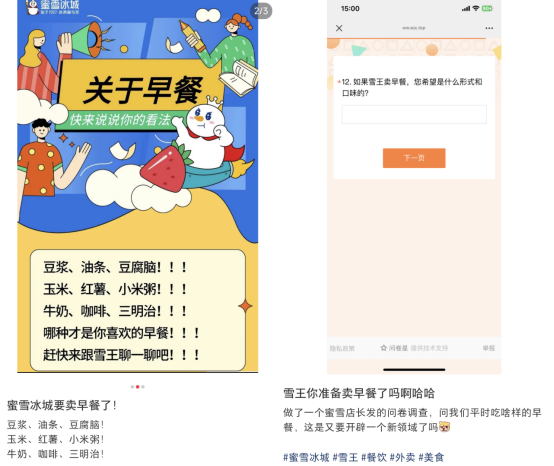
Core Insights - The company Mixue Ice City is exploring the breakfast market by launching a survey to understand consumer preferences for breakfast items [1] - The company has introduced a "Breakfast Series" in select cities, featuring products priced at 5 yuan each [4][6] - Mixue Ice City has expanded its product offerings to include fresh beer through an investment in a company called Fresh Beer Fulu, acquiring a 53% stake for approximately 297 million yuan [6][7] Company Developments - The breakfast offerings include various milk drinks such as Five Red Milk and Five Black Milk, and are currently being tested in cities like Dalian, Xi'an, Nanning, and Hangzhou [4][6] - The company reported a significant revenue increase, achieving 14.87 billion yuan in the first half of 2025, a 39.3% year-on-year growth [7] - As of June 30, 2025, Mixue Ice City has expanded its global store count to 53,014, adding 9,796 new stores compared to the previous year [7] Market Context - The breakfast segment is competitive, with established players like McDonald's, KFC, and Starbucks already offering breakfast options [6] - Other brands like Heytea and Naixue's Tea have previously ventured into breakfast products, indicating a growing trend in the beverage industry [6] - Mixue Ice City's recent move into the beer market signifies a diversification strategy aimed at expanding its product range beyond traditional beverages [6][7]

蜜雪冰城要卖早餐了?部分城市“早餐奶”已上线
Mei Ri Jing Ji Xin Wen· 2025-11-27 16:26
Core Insights - The company is launching a breakfast initiative, including a survey to gather consumer preferences on breakfast options [1][4] - New breakfast products, such as various milk options, are being introduced at a price point of 5 yuan each [2][4] - The company has recently made a significant investment in the fresh beer sector, acquiring a 53% stake in a fresh beer brand for 297 million yuan [4] Financial Performance - For the first half of 2025, the company reported a revenue of 14.87 billion yuan, a year-on-year increase of 39.3% [4] - Gross profit reached 4.71 billion yuan, reflecting a growth of 38.3% compared to the previous year [4] - Net profit was reported at 2.72 billion yuan, with a substantial year-on-year increase of 44.1% [4] Expansion and Market Presence - As of June 30, 2025, the company has expanded its global store count to 53,014, adding 9,796 stores year-on-year [5] - The store network covers all provincial-level administrative regions in China and extends to 12 overseas countries and regions [5] - The company's stock closed at 413 HKD per share on November 27, with a market capitalization of 156.8 billion HKD [5]
古茗22亿港元派息创纪录,超16亿流向老板团队
Guo Ji Jin Rong Bao· 2025-11-27 15:03
Core Viewpoint - The tea brand Gu Ming (01364.HK) is conducting a significant cash giveaway through a special dividend exceeding HKD 22 billion, benefiting both consumers and shareholders [1][2]. Group 1: Dividend Details - Gu Ming's board proposed a dividend of HKD 0.93 per share, totaling approximately HKD 22.1 billion based on 2.38 billion shares outstanding [2]. - Over 70% of the dividends will go to the company's actual controller and concerted parties, interpreted as a profit distribution to the owners [2]. - The special dividend aligns with a prior commitment made before the company's IPO, promising at least HKD 2 billion in special dividends by December 2025 [2]. Group 2: Shareholder Distribution - The majority of the shares, approximately 72.77%, are held by the founder Wang Yunan and concerted parties, indicating that over HKD 16 billion will flow to them from this dividend [2]. - Wang Yunan, through a family trust, holds about 39.56% of the shares, expected to receive around HKD 8.75 billion; CEO Qi Xia is set to receive about HKD 4 billion, and executive director Ruan Xiudi is expected to get around HKD 2.78 billion [2]. Group 3: Historical Context - This is not the first substantial dividend; Gu Ming previously distributed HKD 1.74 billion in January 2025, just before its IPO [3]. - The total dividends from both distributions exceed HKD 41 billion, surpassing the company's cumulative profit over the past year and a half [4]. Group 4: Financial Performance - In the first half of 2025, Gu Ming reported a net profit of HKD 16.25 billion, with a net profit margin of 28.72%, outperforming competitors in the new tea beverage sector [7]. - The company has a total of 11,179 stores as of mid-2025, ranking second only to Mi Xue Bing Cheng in terms of scale [8].
上市券商投行业务前三季度净收入251.5亿元 2026年又将押注哪些热点赛道?
Mei Ri Jing Ji Xin Wen· 2025-11-27 13:29
Core Insights - The investment banking sector is experiencing a recovery with significant growth in net income and IPO activities, particularly in A-shares and H-shares [1][2][3] Group 1: Market Performance - In the first three quarters of 2025, listed brokers achieved a net investment banking income of 251.5 billion yuan, a year-on-year increase of 24% [1][2] - A-shares and H-shares IPO scales grew by 61% and 237% respectively, with Hong Kong IPOs ranking first globally [1][2] - The top five companies in the investment banking sector accounted for 52% of the market share, with several mid-sized brokers experiencing growth rates exceeding 50% [1][3] Group 2: Future Outlook - The investment banking industry anticipates that hard technology, mergers and acquisitions, and green finance will be core hotspots in 2026 [1][4] - The deepening of the registration system and the demand for cross-border financing are expected to drive market expansion [1][3] Group 3: Strategic Initiatives - Companies are enhancing their organizational mechanisms and focusing on industry-specific strategies to improve service efficiency and client support [5][6] - Investment banks are actively responding to policy changes, such as the "Eight Articles of the Sci-Tech Innovation Board" and "Six Articles of Mergers and Acquisitions," to capitalize on market opportunities [5][6] - Firms are building comprehensive platforms for merger opportunities and establishing dedicated departments to streamline merger and acquisition processes [6][8] Group 4: Cross-Border Expansion - Major investment banks are strengthening their presence in the Hong Kong market, leveraging cross-border integration advantages to enhance service capabilities [7][8] - Companies like Huatai have completed numerous Hong Kong IPO projects, positioning themselves among the top in the market [7]






中国银河证券:提振消费是系统工程 增强消费品供需适配性
智通财经网· 2025-11-27 03:57
Core Viewpoint - The consumption industry in China needs to focus on the medium- and long-term goals outlined in the "14th Five-Year Plan," with short-term attention on policies related to consumption by 2026. The outlook for overseas business development in the consumption sector by 2026 is optimistic [1][2]. Group 1: Background and Policy Initiatives - On November 26, six departments issued a notice regarding the "Implementation Plan for Enhancing the Adaptability of Supply and Demand for Consumer Goods," aiming for a significant optimization of the supply structure by 2027, creating three trillion-level consumption fields and ten hundred-billion-level consumption hotspots [2]. - By 2030, a high-quality development pattern characterized by positive interaction between supply and consumption is expected to be established, with a steady increase in the contribution of consumption to economic growth [2]. Group 2: Consumption Stimulus Measures - National subsidies are the fastest way to stimulate short-term demand, with significant policy support since July 2024, including a special bond fund of 150 billion yuan allocated for supporting the replacement of consumer goods. An additional 300 billion yuan is planned for 2025 [3]. - The Central Economic Work Conference in December 2024 prioritized boosting consumption as the main task for 2025, leading to various policies aimed at enhancing consumption [4]. Group 3: Implementation Plan Measures - The "Implementation Plan" outlines five major areas with nineteen initiatives, including accelerating the application of new technologies and models, expanding the supply of unique and new products, and accurately matching the needs of different consumer groups [5]. - It also emphasizes cultivating new consumption scenarios and business formats, as well as creating a favorable development environment through financial support and market order maintenance [5]. Group 4: Investment Recommendations - Investment focus includes high-dividend quality companies during market style shifts, with specific recommendations in various sectors such as new consumption in the social service sector (e.g., Gu Ming, Da Mai Entertainment, Mi Xue Group) and food and beverage (e.g., Dongpeng Beverage, Lihigh Food) [6]. - Other sectors of interest include agriculture (e.g., Zhongchong Co.), sportswear (e.g., Anta Sports, Xtep International), and technology consumption (e.g., TCL Electronics, Hisense Home Appliances) [6].
研报掘金丨中国银河证券:内地提振消费政策发力 潮玩谷子赛道推荐泡泡玛特

Ge Long Hui· 2025-11-27 03:51
Core Viewpoint - The report from China Galaxy Securities highlights the recent issuance of a notice by six national ministries regarding the implementation plan to enhance the adaptability of supply and demand in consumer goods, aiming to further promote consumption [1] Industry Summary - The consumption industry is advised to pay attention to the medium- and long-term goals outlined in the 14th Five-Year Plan, with a short-term focus on consumption-related policies for 2026 [1] - The firm holds an optimistic view on the development of overseas business in the consumption sector by 2026 [1] Company Recommendations - In the new consumption sector of the social service industry, the following companies are recommended: Gu Ming, Da Mai Entertainment, and Mi Xue Group [1] - In the food and beverage sector, the recommendations include Dongpeng Beverage and Lihigh Food, with attention to Wancheng Group, Guoquan, and Nongfu Spring [1] - In the agriculture sector, Zhongchong Co., Ltd. is recommended [1] - In the textile and apparel sector, the focus is on Anta, Xtep International, and Hailan Home [1] - In the technology consumption sector, recommended companies include TCL Electronics, Hisense Home Appliances, Ugreen Technology, and Stone Technology [1] - For high-dividend home appliance companies, Midea Group and Haier Smart Home are highlighted [1] - In the light industry sector, Yongyi Co., Ltd. and Aorijin are recommended, while in the trendy toys sector, Pop Mart is suggested [1]
中国及香港股票策略-2026 年展望:主题、风险、政策灵活性及 2026 年一季度首选标的-China & HK Equity Strategy_ 2026 Outlook_ Themes, risks, policy optionality and preferred picks for 1Q26
2025-11-27 02:17
Summary of Key Points from the Conference Call Industry Overview - The report focuses on the **China & Hong Kong equity market** with a specific outlook for **2026** and investment strategies for **1Q26** [2][5][10]. Core Insights and Arguments - **Constructive Stance**: The report maintains a positive outlook on MXCN/CSI300, predicting a further rally in 2026 with targets set at **100** for MXCN, **5,200** for CSI300, and **16,000** for MXHK, reflecting growth rates of **15%**, **15%**, and **9%** year-on-year respectively [2][7][8][9]. - **Investment Themes**: Four key investment themes for 2026 are highlighted: 1. **Anti-involution**: Expected to accelerate post-March NPC, improving margins and return on equity (ROE) [5][6]. 2. **AI Infrastructure Growth**: Anticipated growth in global AI infrastructure capex will benefit localization plays in China [5][6]. 3. **Global Macro Support**: Positive macroeconomic conditions, including easing fiscal and monetary policies in developed markets, are expected to boost overseas sales [5][6]. 4. **K-shaped Recovery**: Consumption recovery is expected to favor food & beverage and premium luxury sectors, while mid-tier consumption may suffer [5][6]. Risks Identified - **Geopolitical Tensions**: Ongoing tensions between the US and China, particularly ahead of the US mid-term elections, pose risks to market stability [5][6]. - **Earnings Consensus Risks**: The report notes a potential decline in consensus EPS growth for MXCN from approximately **15%** to **9%** due to intense competition in quick commerce platforms [5][6]. - **Property Market Concerns**: Reports of softening luxury sales and price declines in mainland China may trigger policy changes, including relaxation of home purchase restrictions in prime districts [5][6]. Sector Recommendations - **Overweight (OW)**: Communication Services, IT, Materials, and Staples sectors are recommended for investment [6][11][12]. - **Underweight (UW)**: Energy and Utilities sectors are advised against [6][11][12]. - **Top Picks for 1Q26**: Notable stocks include Baidu, NetEase, Midea, MIXUE, PDD, Pop Mart, Trip.com, Tingyi, Futu, Innovent, CATL, and COLI [6][13][15]. Valuation and Earnings Insights - **Valuation Normalization**: Since September 2024, MXCN/CSI300 has shown a return of **29%/30%** in USD terms, indicating a recovery from previous valuation discounts [20][22]. - **Earnings Growth**: The report highlights a broadening recovery in earnings across various sectors, despite weak headline EPS growth at the index level [42][44]. Additional Important Points - **EPS Revision Trends**: The breadth of EPS revisions has improved significantly, indicating a potential for recovery in earnings [58][59]. - **Market Under-Ownership**: The report emphasizes that China equity remains under-owned both domestically and internationally, suggesting potential for increased allocation [5][6]. This summary encapsulates the key insights and recommendations from the conference call, providing a comprehensive overview of the current state and future outlook of the China & Hong Kong equity markets.
揽金超2500亿港元 港股IPO募资今年有望夺全球榜首
Xin Lang Cai Jing· 2025-11-26 20:41
Core Insights - The Hong Kong IPO market has experienced a significant surge in activity, with 398 companies applying for listings this year, far exceeding last year's total of 115 [2][6] - The total amount raised through IPOs in Hong Kong has reached 258.275 billion HKD, marking a 259.45% increase compared to the same period in 2024 [1][2] - The performance of newly listed stocks has been optimistic, with 63 out of 88 new stocks rising on their first trading day [4] Group 1: IPO Market Overview - As of November 24, 89 new stocks have been listed in Hong Kong this year, with a total fundraising amount of 258.275 billion HKD, representing a 53.45% increase in the number of new listings and a 259.45% increase in fundraising compared to the same period last year [1] - The number of IPO applications submitted this year has reached 398, the highest in nearly a decade, following regulatory changes that have expedited the approval process [2][6] - In the first three quarters of this year, the number of IPOs was 16, 27, and 25, with total fundraising amounts of 18.670 billion HKD, 90.211 billion HKD, and 78.865 billion HKD respectively, showing significant year-on-year growth [3] Group 2: Performance of Newly Listed Companies - Among the 88 new stocks listed this year, 63 saw their prices increase on the first day, with 14 stocks doubling in value, and the highest increase recorded at approximately 330% [4] - The first-day performance of new stocks has been generally positive, with a low initial public offering (IPO) failure rate of 23.86% [4] Group 3: Industry Insights - The top industries attracting investment include industrial engineering, pharmaceuticals and biotechnology, and software services, with industrial engineering alone raising 798.18 billion HKD [3] - The "A+H" dual listing model has contributed significantly to the fundraising boom, with 167 companies now listed under this model, including 17 new additions this year [5][6] - The overall valuation of H-shares is generally lower than A-shares, indicating a market sentiment that reflects concerns about pricing and potential for depreciation [6][7]
蜜雪幸运咖全球门店破万!食品饮料ETF天弘(159736)昨日成交额超7000万元,机构:2026消费大年看好大众品需求
2 1 Shi Ji Jing Ji Bao Dao· 2025-11-26 01:32
Group 1 - The A-share market experienced a rebound on November 25, with all three major indices closing in the green [1] - The Tianhong Food and Beverage ETF (159736) recorded a trading volume exceeding 70 million yuan, with leading stocks including Jinzi Ham, Angel Yeast, and Bailong Chuangyuan showing significant gains [1] - The Tianhong Agriculture ETF (512620) was actively traded, achieving a turnover rate of 5.27% and a trading volume over 20 million yuan, with top-performing stocks including Biological Shares, Roniu Mountain, and Cangge Mining [1] Group 2 - The Tianhong Food and Beverage ETF (159736) tracks the CSI Food and Beverage Index, focusing on leading high-end and mid-range liquor stocks, as well as key players in beverages, dairy, and condiments, with top ten weighted stocks including "Moutai, Wuliangye, Luzhou Laojiao, and Yanghe" [1] - As of November 24, the Tianhong Food and Beverage ETF (159736) had a scale of 5.627 billion yuan, ranking first among food and beverage ETFs in Shenzhen [1] - The Tianhong Agriculture ETF (512620) closely follows the CSI Agriculture Index, covering sectors such as breeding and agricultural chemicals, with leading stocks including Muyuan Foods, Wens Foodstuff Group, and Haida Group [1] Group 3 - The Huashu Network announced a public auction for 6,500 tons of domestic frozen pork on November 20, 2025 [2] - Structural opportunities in the food and beverage industry are expected to continue, with new consumption trends and a recovery in traditional consumption [2] - According to Citic Securities, the demand for most consumer goods has experienced a decline over the past two years, but inventory levels are stabilizing, and demand is expected to improve, particularly in dairy and frozen food sectors [2]
