比亚迪股份

Search documents
Yuhang Economic Development Zone: "Qihang Road" Connects to a New Industrial Future
Globenewswire· 2026-02-25 06:19
Core Insights - The Hangzhou Municipal Government has approved new station names for Metro Line 10 and the Hangzhou-Deqing Intercity Railway, enhancing regional connectivity and industrial development [1] - Yuhang Economic Development Zone is positioned as a key industrial platform in Hangzhou, focusing on smart manufacturing and attracting various industries [3][5] Group 1: Transportation and Infrastructure - Two stations in Yuhang Economic Development Zone have been renamed to reflect their significance in regional transportation: Renhe South Station is now "Dongshanyang Station," and Renhe North Station is "Qihang Road Station" [1] - Qihang Road Station serves as the northern terminus of Metro Line 10's extension and a critical transfer hub for the Hangzhou-Deqing Intercity Railway, enhancing connectivity between Hangzhou and surrounding areas [1] Group 2: Economic Development Zone Overview - Yuhang Economic Development Zone is strategically located in the Yangtze River Delta, providing exceptional geographical advantages and access to major transportation routes [3] - The zone emphasizes smart manufacturing, focusing on new equipment, new materials, and new energy, forming a "One Smart, Three New" industrial system [5] Group 3: Innovation and Research - The zone has partnered with Zhejiang University to establish the Advanced Electrical Equipment Innovation Center, which focuses on research in new energy vehicle systems and intelligent robotics [6] - Over 570,000 square meters of incubation space are available, supporting the growth of enterprises at all stages [6] Group 4: Supportive Policies - Yuhang Economic Development Zone offers substantial support policies for attracting global resources, including equipment subsidies and R&D grants for eligible projects [7] - Specific incentives are provided for integrated circuit and robotics enterprises, promoting industry growth [7] Group 5: Comprehensive Development - The zone is advancing its development philosophy of enhancing the environment, technology, and smart manufacturing to support industrial upgrading [8] - Educational, medical, and residential amenities are being developed to support talent and enterprises, including schools and commercial complexes [8] Group 6: Future Outlook - Yuhang Economic Development Zone aims to enhance its smart manufacturing capabilities and achieve national-level economic and technological development status through continuous improvements in its ecosystem and business environment [9]
固态电池深度:电池变革重要赛点,设备材料全新颠覆
2026-02-25 04:13
那第二就是在这个能量密度的提升上,也是要重点关注这个高镍,还有富锂锰基的正极, 负极这边重点关注锂金属、硅碳负极,以及其他的一些这个辅材的这种变化。那第二个大 大的方向就是在设备端。今年我们其实也能够看到一些这个接近量产设计的这样的,虽然 还是叫中式线,但实际上是以量产线为标准去打造的。这样的一些产线会逐渐的落地,也 能看到设备企业在这里面获得一些比较前期的这样关键的订单形成一个较好的卡位。那从 投资的这个角度来看,也就是从这个关键材料、关键设备以及一些有潜力的这个电池企业 这三条主线去入手。 那接下来,我们也对整个材料和设备,做,每个环节做一个比较系统的梳理。那首先,还 是再强调一下这个全球的一个固态电池发展的这样的阶段。那目前我们能看到,就是未来 要实现这个电动飞机、长续航的汽车,以及一些这个长续航的人形机器人,还有一些特殊 的这个场景,那这个能量密度,必然是要达到 400 瓦时每公斤以上的。那只有全固态的这 个电池体系可以使比较稳定的达到这样的一个目标。从它的本真特性来说,它也是能够实 现更高的安全性、更宽的这个温域去适配后续的一些这个高端场景,还有这个甚至是太空 场景的这样的应用。 会议助理: 欢迎, ...
美国Robotaxi法规进展解读及后续展望
2026-02-25 04:13
Summary of the Conference Call on Robot Taxi and Autonomous Driving Policies Industry Overview - The conference focused on the developments in the autonomous driving industry, particularly in the context of Robot Taxi services in the United States and China [1][29]. Key Points from the Conference U.S. Autonomous Driving Policies 1. **Historical Context and Current Status**: - The U.S. government is divided into federal and state levels, both of which participate in autonomous driving legislation [2]. - Prior to 2016, the U.S. lacked a systematic framework for autonomous driving, leading to a fragmented approach [2][3]. - Post-2016, significant progress was made with the release of the AV 1.0 policy, establishing a foundational framework for future regulations [3][4]. 2. **Legislative Developments**: - The U.S. Department of Transportation (DOT) and the National Highway Traffic Safety Administration (NHTSA) have been pivotal in shaping the regulatory landscape since 2016 [4]. - The introduction of the Self Drive Act of 2026 aims to ensure the U.S. maintains its leadership in the autonomous driving sector by establishing a national safety data repository and clarifying federal priorities [7][8]. 3. **Key Legislative Proposals**: - The proposed Motor Vehicle Modernization Act increases the exemption limit for manufacturers from 2,500 to 90,000 vehicles and extends the exemption period to five years [9]. - The legislative process involves multiple steps, including committee reviews and votes, before becoming law [14][18]. 4. **Impact of Upcoming Regulations**: - The anticipated regulations are expected to facilitate the deployment of Robot Taxi services and enhance operational transparency for autonomous vehicles [6][19]. Chinese Autonomous Driving Regulations 1. **Regulatory Framework**: - China's autonomous driving vehicles (L3 and above) must undergo a two-phase process: application for access and pilot testing on public roads [21][22]. - Recent policies have clarified the requirements for these phases, with significant developments occurring in 2023 [21][23]. 2. **Approval Process**: - The Ministry of Industry and Information Technology (MIIT) has approved L3 vehicle models from Changan and BAIC for pilot testing, marking a significant step towards commercialization [24][25]. 3. **Standards and Compliance**: - Two key standards are being developed: Strong Standard A focuses on safety requirements for autonomous driving systems, while Strong Standard B addresses compliance testing for road usage [26][27]. - These standards are crucial for ensuring that vehicles meet safety and operational criteria before being allowed on public roads [28]. Market Implications - The advancements in both U.S. and Chinese regulations are expected to accelerate the development and deployment of Robot Taxi services, with companies like Tesla, Waymo, and various Chinese manufacturers being highlighted as key players [29]. - The overall trend in the Robot Taxi industry is positive, with ongoing monitoring and analysis of regulatory changes being essential for stakeholders [29]. Additional Insights - The conference emphasized the importance of continuous tracking of both policy changes and technological advancements in the autonomous driving sector to identify investment opportunities and risks [29]. - The potential for significant market growth in the Robot Taxi industry is underscored by the increasing regulatory support and technological readiness [29].

盾安环境20260224
2026-02-25 04:13
Summary of Conference Call Notes Company and Industry Overview - The conference focused on **Duan Environment**, a company in the **HVAC (Heating, Ventilation, and Air Conditioning)** industry, particularly in the context of new energy vehicles and thermal management solutions. Key Points and Arguments 1. New Business Opportunities - Duan Environment has diversified its business, with new revenue streams from **liquid cooling**, **energy storage thermal management**, and **nuclear power central air conditioning**. The revenue from these new business areas is projected to exceed **300 million** by **2025** [2][12]. - The company is expected to benefit from the growth in energy storage and the rapid development of AIDC (Automated Identification and Data Capture) liquid cooling air conditioning [2][12]. 2. Governance and Management Changes - Since **April 2022**, when Gree Electric Appliances took a controlling stake in Duan Environment, there have been positive changes in governance, including a second phase of the equity incentive plan set to launch in **September 2025**, targeting a **15%** annual growth rate [2][10][11]. - The management team has shown strong performance, exceeding previous equity incentive targets, indicating effective governance and operational execution [3][10]. 3. Financial Performance and Valuation - Duan Environment's current valuation stands at **11 times** earnings, significantly lower than competitors like Sanhua Intelligent Control, which trades at **40-50 times** earnings. This suggests a potential for value discovery in the near term [5][26]. - The company’s sales have reached approximately **3 billion**, with a notable recovery in sales to major clients like Midea [7][10]. 4. Strategic Collaborations and Market Position - Gree's involvement is expected to enhance Duan Environment's capabilities in automotive thermal management, leveraging Gree's strong position in commercial vehicles [8][10]. - The company has established a solid foothold in the nuclear power sector, historically accounting for over **50%** of its central air conditioning revenue, although this has decreased to around **10%** recently due to investment slowdowns in nuclear fission [14][15]. 5. Competitive Landscape - Duan Environment is positioned as the second-largest player in the global HVAC component market, with a market share of approximately **26%** in key valve components [22][23]. - The company is actively working to improve its product offerings, particularly in electronic expansion valves, which currently represent a growth opportunity [23][24]. 6. Future Growth Projections - The company anticipates significant growth in its automotive thermal management segment, projecting revenues of **1.2 billion** by **2025**, with a **50%** growth rate expected [17][26]. - The overall HVAC market is projected to grow at **8%** annually, driven by demand in emerging markets and climate change effects [22]. 7. Risks and Challenges - Potential risks include rising raw material costs, domestic market challenges, and the impact of real estate sector slowdowns on central air conditioning demand [26]. - Concerns regarding shareholder dilution due to previous reductions in stakes by major shareholders have been addressed, with no immediate concerns noted [26]. Additional Important Content - The company has made strategic acquisitions, such as the purchase of Shanghai Dacai, which is expected to enhance its product capabilities and market reach [19][20]. - Duan Environment's focus on expanding its overseas production capabilities, particularly in Thailand, is seen as a critical growth driver [19][24]. This summary encapsulates the key insights and strategic directions discussed during the conference call, highlighting Duan Environment's growth potential and market positioning within the HVAC industry.

英国靠煤炭崛起,美国凭石油称霸,中国单月用电破万亿意味什么?
Sou Hu Cai Jing· 2026-02-25 03:54
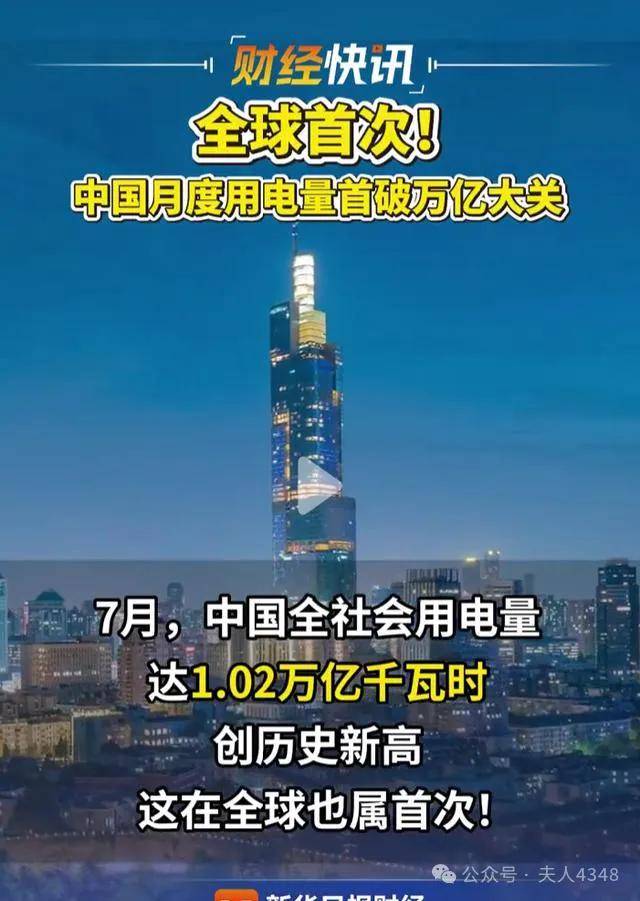
Group 1: Energy Consumption Milestone - In July, China's total electricity consumption exceeded 1 trillion kilowatt-hours for the first time in a month, equivalent to the annual electricity consumption of the ten ASEAN countries combined, and surpassing the total of Germany and France [1] - This figure represents a doubling compared to ten years ago, marking a historic milestone in energy consumption [1] Group 2: Historical Context of Energy Sources - The evolution of energy sources has been pivotal in shaping civilizations, with coal playing a crucial role in the Industrial Revolution and the rise of the British Empire [3][4][6] - Coal's energy density far exceeds that of wood, with one million tons of coal releasing heat equivalent to the combustion of six million acres of forest [7] - The transition from coal to oil marked a significant shift in energy dynamics, with the U.S. emerging as a leader in oil production after the first modern oil well was drilled in Pennsylvania in 1859 [9][12] Group 3: China's Energy Strategy - China, as the world's largest industrial nation, faces a unique energy challenge with abundant coal reserves but heavy reliance on imported oil and gas [13] - The country is pursuing a significant energy revolution, transitioning from fossil fuel dependence to renewable energy sources, particularly electricity [14] - China's strategy includes maximizing coal's clean and efficient use while aggressively expanding renewable energy capacity in wind and solar [14] Group 4: Implications for Industry and Technology - The recent surge in electricity consumption supports high-end manufacturing and a fully digitalized smart society, indicating a profound industrial transformation [14][15] - The electric vehicle industry has seen a 25.7% increase in electricity consumption, while solar manufacturing has surged by 30%, highlighting the energy-intensive nature of these sectors [15][16] - The rise of AI and data centers, which require substantial energy, underscores the importance of electricity as a strategic resource for future competitiveness [17][18] Group 5: Future Outlook - China's annual electricity consumption has surpassed 10 trillion kilowatt-hours, accounting for one-third of global consumption, while the U.S. stands at approximately 4 trillion [19] - The ongoing construction of the world's largest hydropower station and plans for over a hundred new nuclear power plants aim to establish China as a leading energy power [19][20] - Electricity is evolving from a mere commodity to a core strategic resource that influences national strength and global capital flows, signaling the onset of a new industrial revolution centered around China [20]

突然拉升!000056,122万手封涨停
Zhong Guo Ji Jin Bao· 2026-02-25 03:29
Market Overview - The shipping sector has shown strong performance, with the real estate sector also experiencing notable gains [2][5] - Major indices opened higher, with the Shanghai Composite Index up by 0.5%, Shenzhen Component Index up by 0.49%, and the ChiNext Index up by 0.11% [2] Shipping Sector - The shipping sector has been robust, with companies like China Merchants Energy Shipping (601872) achieving a record high, and China Ocean Shipping (600026) and China Merchants South Oil (601975) hitting the daily limit [5] - The cost of chartering a Very Large Crude Carrier (VLCC) to transport oil from the Middle East to China has surged to over $170,000 per day, tripling since the beginning of the year, driven by geopolitical tensions and changes in global oil supply [7] Real Estate Sector - The real estate sector has seen significant upward movement, with companies like Huangting International (000056) and Chengdu Investment Holdings (600649) reaching their daily limits [8] - Promotions and discounts have been launched by over 140 real estate projects in Guangzhou, indicating a potential recovery in the housing market as demand from the holiday period is expected to be released [10] - Analysts predict a "small spring" recovery in core city real estate markets, with major institutions raising their forecasts for Hong Kong property prices significantly for 2026, with JPMorgan increasing its forecast from 5%-7% to 10%-15% [10]





中国汽车给欧洲市场普及插混
3 6 Ke· 2026-02-25 03:26
Core Insights - The article discusses the significant shift in the automotive trade dynamics between Germany and China, highlighting the decline of German car exports to China and the rise of Chinese automotive brands in the European market [1][7][11]. Group 1: Trade Dynamics - German car exports to China are projected to drop below €14 billion by 2025, a decrease of nearly 50% from nearly €30 billion three years ago [3][7]. - In January, Chinese automotive brands saw an 80% year-on-year increase in sales in Europe, capturing a market share of 7.4%, nearly double from a year prior [3][9]. - The demand structure in the Chinese market is changing, with local brands rapidly improving their product offerings in the new energy vehicle sector, which is squeezing the market share of German automakers [7][9]. Group 2: Market Performance - BYD has become the best-selling Chinese automotive brand in Germany, with January sales reaching 2,069 units, a 1000% increase year-on-year [9][12]. - The overall European market saw a 3.6% decline, while Chinese brands' sales surged, indicating a significant competitive shift [9][10]. - The sales of plug-in hybrid vehicles (PHEVs) from Chinese brands accounted for 29% of their total sales in Europe in January, up from 11% the previous year [12][18]. Group 3: Strategic Responses - German automakers are adapting by enhancing local R&D capabilities and forming partnerships, such as Volkswagen's investment in XPeng and collaborations with Horizon Robotics [18][20]. - The decision-making cycle for German car manufacturers is longer, typically taking 3-5 years for new models, while Chinese companies can iterate in about 18 months, creating a competitive disadvantage for German firms [20][21]. - German Chancellor Merz's visit to China aims to negotiate for more time for the German automotive industry to adjust to these changes [21][23]. Group 4: Future Outlook - The interaction between the Chinese and European automotive industries is evolving from a one-way technology transfer to a two-way technology flow, which could foster mutual technological advancements [23]. - The competitive landscape is shifting, with both sides needing to adapt to the changing market dynamics and consumer preferences [6][23].


1月乘用车市场销量分析:开年遇冷呈短期波动 合资表现相对稳健
Zhong Guo Zhi Liang Xin Wen Wang· 2026-02-25 03:22
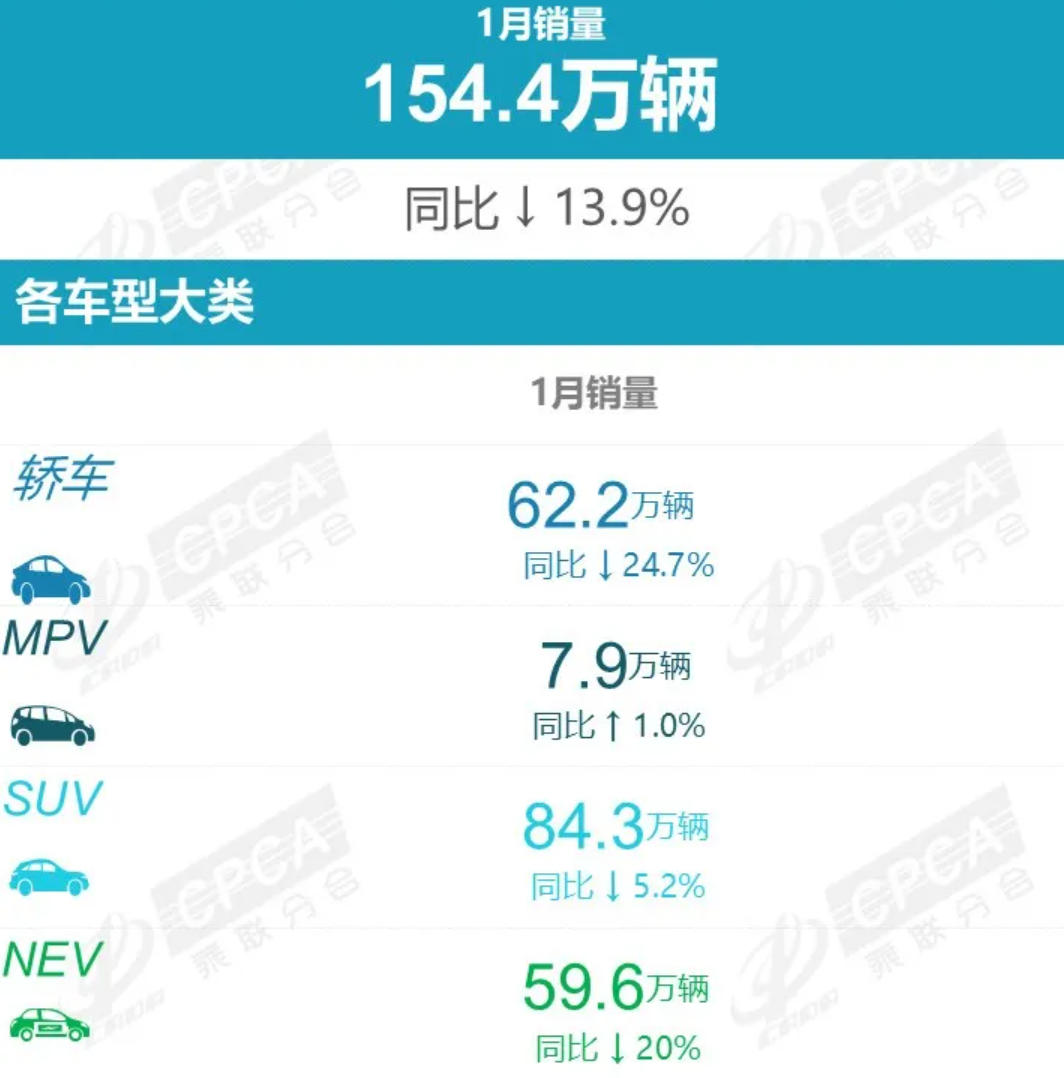
Core Viewpoint - The domestic passenger car market in China experienced a significant decline in January 2026, with retail sales dropping by 13.9% year-on-year to 1.544 million units, influenced by policy adjustments and consumer demand exhaustion [1]. Market Performance Summary - The overall retail sales of narrow passenger cars in January reached 1.544 million units, a year-on-year decrease of 13.9% [1]. - The sedan market saw the most substantial decline, with sales of 622,000 units, down 24.7% year-on-year [3]. - The SUV market, while also under pressure, performed better than sedans, with sales of 843,000 units, down 5.2% year-on-year [3]. - The MPV market showed a slight increase of 1.0%, reaching 79,000 units [3]. - The new energy vehicle (NEV) market faced a significant drop, with sales of 596,000 units, down 20.0% year-on-year, attributed to the end of the tax exemption policy [3]. Brand Performance Summary - Domestic brands faced considerable pressure, with retail sales of 890,000 units in January, down 18% year-on-year, and a market share of 57.5%, a decrease of 3.5 percentage points [4]. - In contrast, joint venture brands showed relative stability, with retail sales of 470,000 units, down 4% year-on-year, significantly less than domestic brands [5]. - Luxury car sales totaled 180,000 units, down 15% year-on-year, with a market share of 11.6%, a decline of 0.5 percentage points [5]. Key Players in the Market - Leading domestic brands such as Geely, BYD, Changan, and Chery all experienced declines, with BYD's sales dropping by 53% [7]. - In the joint venture sector, FAW-Volkswagen sold 132,300 units, down 3.5%, while Toyota brands showed positive growth, with FAW Toyota and GAC Toyota achieving year-on-year increases of 8.3% and 0.3%, respectively [9]. - The top ten sales list included Hongmeng Zhixing and Brilliance BMW, with Hongmeng Zhixing achieving a remarkable 65.5% year-on-year growth, selling 57,915 units [10][12]. New Energy Vehicle Market Insights - BYD maintained its position as the leading NEV manufacturer with sales of 94,176 units, but experienced a significant year-on-year decline of 53% [13]. - Geely followed closely with sales of 92,135 units, down 21.6% [12]. - Notable performers included Xiaomi Auto, which saw a 70.3% increase in sales, reaching 39,002 units, and NIO, which grew by 95.2% to 27,061 units [15][17]. Future Market Outlook - The passenger car market is expected to enter a low point in February 2026 due to the seasonal impact of the Spring Festival, with sales likely to remain subdued [17]. - However, the introduction of trade-in policies in some regions may lead to a recovery in the market post-Spring Festival [17].
当方向盘交给AI,会发生什么
2 1 Shi Ji Jing Ji Bao Dao· 2026-02-25 02:50
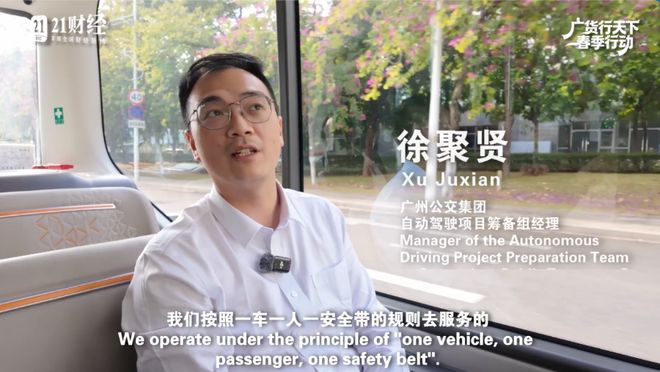
Core Insights - The article discusses the transformative impact of AI on urban transportation in Guangdong, highlighting the integration of autonomous driving technology and smart traffic management systems [1][2][17] - It emphasizes the collaboration between advanced manufacturing and modern services to create a new intelligent economy, enhancing safety and efficiency in urban transport [1][17] Group 1: AI Integration in Transportation - AI has been deeply integrated into transportation in Guangdong, with autonomous buses and smart traffic systems improving the flow and safety of urban transport [2][5] - The implementation of AI-driven traffic management during the 15th Games in Guangzhou resulted in zero errors, complaints, or accidents, showcasing the effectiveness of the system [9][11] Group 2: Challenges and Future of Autonomous Driving - Despite the current success, concerns remain about accountability in case of AI decision-making errors during autonomous driving [7] - Experts predict that the year 2026 will mark a significant milestone for the large-scale application of autonomous driving technology, with continuous advancements expected in the next three to five years [17][20] Group 3: Economic and Social Implications - The rise of autonomous public transport may lead to the reorganization of job roles, with traditional driving positions evolving into safety monitoring roles [13][15] - The shift towards AI in transportation is expected to reduce the number of vehicles on the road, thereby transforming urban infrastructure and reducing parking needs [15][17] Group 4: Global Impact and Market Expansion - Companies like BYD have surpassed Tesla in electric vehicle sales, indicating a growing global presence for Chinese smart transportation solutions [17][18] - The expansion of companies like XPeng into new markets reflects the international demand for AI-driven transportation solutions, contributing to the global output of China's smart traffic ecosystem [18][17]

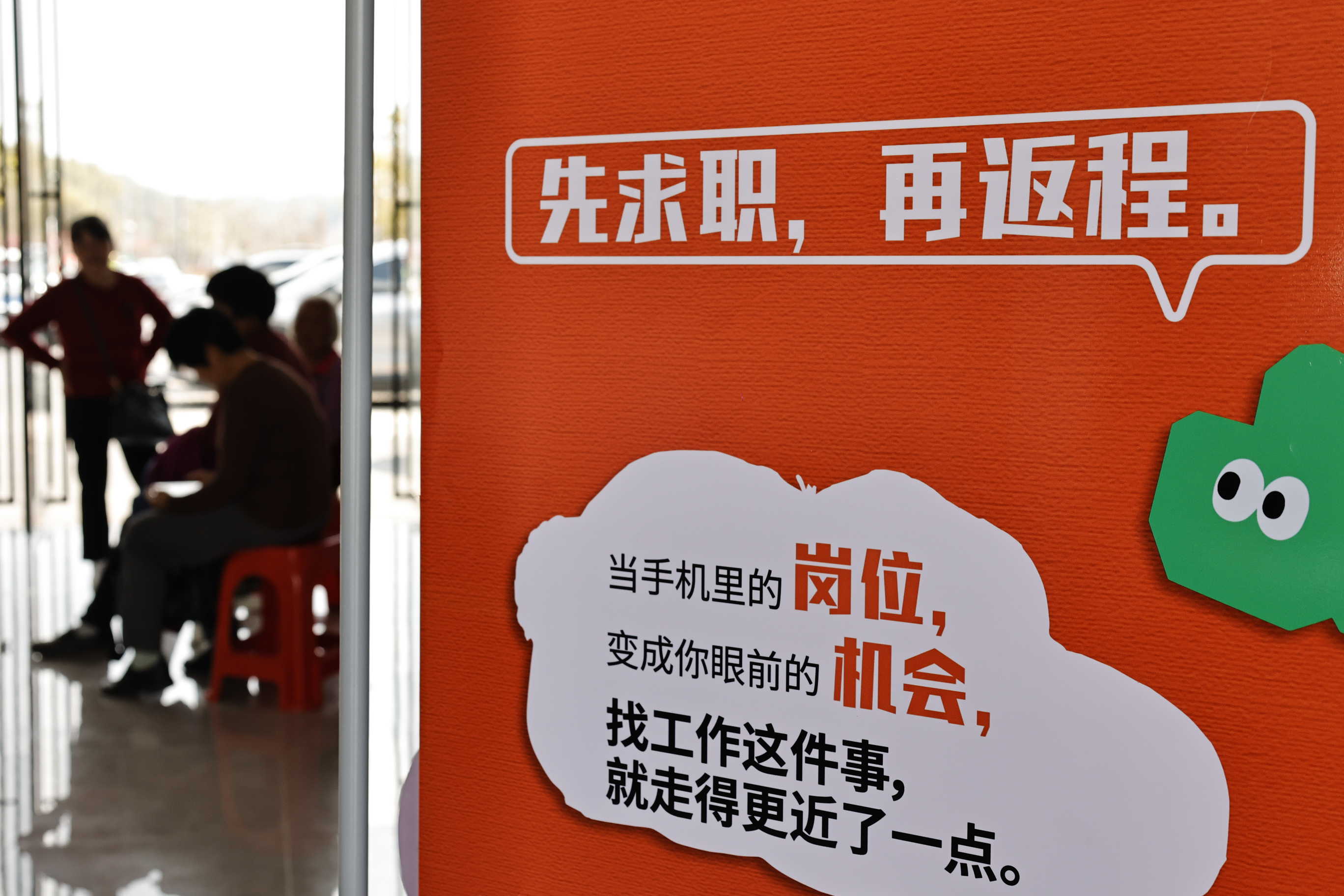
AI简历、AI面试进村,名企岗位提前“见到”河源四都镇老乡
Zhong Jin Zai Xian· 2026-02-25 01:41
Core Insights - The AI employment service station in Longchuan Town, Heyuan City, is transforming the job-seeking process by enabling young people to complete interviews in under ten minutes using AI technology [1][3] - The introduction of AI-assisted resume writing has significantly improved the conversion rates for job seekers, with the work experience page conversion rate rising to 31.4% and the self-introduction page conversion rate increasing to 92.5% [3] - The trend of "interviewing before returning" is emerging, allowing job seekers to prepare and apply for jobs before returning to urban areas, thus increasing their chances of securing employment [7][8] Group 1 - The AI employment service station operates as a "job-seeking preparatory camp," providing hands-on assistance to villagers in using AI tools for resume writing [3] - AI-generated resumes and interview preparation resources are helping job seekers overcome barriers related to self-presentation and confidence [5] - The service is part of a broader initiative to bring employment resources closer to rural communities, allowing individuals to prepare for job opportunities without needing to travel [7] Group 2 - The spring recruitment peak is occurring earlier this year, with over 150,000 companies utilizing AI interviews for initial screening, streamlining the hiring process [8] - Major companies such as Midea, BYD, and McDonald's are actively seeking candidates, indicating a robust demand across various sectors including manufacturing, logistics, and service industries [7][8] - The AI employment service is contributing to a shift in the job market, making the process of job searching more accessible and efficient for rural populations [7][8]