
中广核矿业

Search documents
AI数据中心能源:美国以核裂变为“现实依托”,可控核聚变短期难奏效
Haitong Securities International· 2025-07-18 12:57
Investment Rating - The report suggests a positive outlook on the nuclear fission industry as a viable energy source for AI data centers, while indicating that nuclear fusion remains a long-term prospect [6]. Core Insights - Meta is rapidly expanding its AI data center capabilities, planning to invest $68 billion in capital expenditures by 2025, with a focus on building multiple hyperscale data centers [2][9]. - The Hyperion project in Louisiana is set to become the largest single AI data center globally, with an initial capacity of 2 GW, expanding to 5 GW [2][10]. - The energy supply strategy for AI data centers includes short-term reliance on natural gas turbines and long-term commitments to renewable energy and nuclear power [3][4]. Summary by Sections Investment Strategy - Meta's capital expenditure strategy reflects a strong commitment to AI development, with significant investments planned for the construction of multi-GW data centers [2][10]. - The company is also raising nearly $29 billion through financing to support its ambitious projects [2][9]. Energy Supply and Infrastructure - The report highlights the energy bottleneck as a critical factor for the expansion of AI data centers, with Meta implementing natural gas turbines to meet initial power demands [3]. - In the medium to long term, Meta is securing renewable energy agreements and a 20-year nuclear power agreement to ensure a stable, low-carbon energy supply [3][4]. Nuclear Energy Outlook - Nuclear fission is currently viewed as the most feasible "firm power" option for AI data centers, while nuclear fusion is still in the experimental phase and may take decades for commercial viability [4][6]. - The U.S. government is actively supporting nuclear energy expansion, with plans to add 300 GW of nuclear capacity by 2050 [4].

行业深度报告:我国天然铀供应商有望受益长期供需紧张
NORTHEAST SECURITIES· 2025-07-18 09:14
Investment Rating - The report rates the industry as "Outperforming the Market" [5] Core Insights - The global demand for electricity is expected to grow significantly, with a projected increase of 4.0% in 2024, driven by advancements in data centers, electric vehicles, and heat pumps [1][19] - Nuclear power is regaining attention due to its stable, low-carbon, and cost-effective nature, with a forecasted global nuclear power generation of 2,768 TWh in 2024, marking a 2.5% increase from the previous year [2][37] - China's nuclear fuel demand is projected to reach approximately 13,000 tons of uranium (tU) in 2024, accounting for 19.4% of global demand, while its domestic uranium production is only about 3% of the global total [2][78] Summary by Sections Global Uranium Supply and Demand - The global electricity demand is expected to grow robustly, with a 4.0% increase in 2024, surpassing previous years [1][19] - Nuclear power generation is anticipated to reach a record high of 2,768 TWh in 2024, with a 2.5% year-on-year growth [2][37] - The International Atomic Energy Agency (IAEA) predicts that by 2040, natural uranium demand will be between 86,000 to 116,000 tons, with a compound annual growth rate of 1.5% to 3.4% [2][54] China's Uranium Suppliers - China Uranium Industry holds a dominant position in the domestic market, with plans to expand production capacity and a projected output of 4,500 tons of U3O8 in 2024 [3] - China General Nuclear Power Corporation (CGN) has significant uranium resources in Kazakhstan, with a forecasted production of 1,324 tons of uranium in 2024 [4] - Wanli Stone is also expected to benefit from asset injections and technological advancements in uranium resources [4] Investment Recommendations - The report suggests that the uranium supply-demand imbalance will support high uranium prices in the coming years, with financial institutions holding a total of 34,846 tons of physical uranium in 2024, a 4.4% increase from the previous year [2][70]
印度民航总局要求波音本周完成对燃油控制开关的检查,AI发展助推核电审批提速
Haitong Securities International· 2025-07-18 01:07
Investment Rating - The report suggests a positive investment outlook for the nuclear power sector, driven by recent administrative orders from the Trump administration, which are expected to enhance the investment logic for nuclear power as a significant energy source for AI consumption [6]. Core Insights - The report highlights a significant push in the U.S. for $90 billion in technology and energy investments, particularly in AI and energy infrastructure, with a focus on simplifying the permitting process for AI data centers [17]. - The energy construction sector is seeing legislative advancements, such as Oregon's first microgrid framework and Georgia Power's integrated resource plan to maintain coal plants for data center support [21][22]. - The global energy market is experiencing fluctuations, with U.S. retail electricity prices averaging $0.13/kWh and oil prices showing slight declines [4]. - The report notes a robust demand for industrial robots, with a projected installation of 541,302 units in 2023, despite a slight decrease from the previous year [41]. Summary by Sections Global Infrastructure and Construction Equipment - The U.S. is witnessing a surge in AI and energy investments, with significant projects planned in Pennsylvania, including a $14.25 billion data center [19]. - Legislative measures in Oregon aim to enhance community resilience through microgrid frameworks, addressing growing electricity demands and extreme weather events [21]. Global Electrical and Intelligent Equipment - The U.S. electricity demand forecast has been revised upwards, with expectations of a 15.8% increase by 2029, indicating a strong need for electrical infrastructure [25]. - The report indicates a stable price index for electrical transformers, with a projected compound annual growth rate of 8.27% from 2024 to 2030 [29]. Global Energy Industry - The average retail electricity price in the U.S. is reported at $0.13/kWh, with fluctuations in natural gas and oil prices noted [4]. - The report emphasizes the need for increased investment in transmission infrastructure, with over $50 billion approved for new transmission expansions in the U.S. [28]. Global Defense and Aerospace - The aerospace sector is recovering steadily, with increased defense spending and modernization demands, highlighting opportunities in high-performance structural components and aerospace parts manufacturing [7].
核电核准维持10台,产业链如何受益
2025-07-16 06:13
Summary of Conference Call Records Industry Overview - The conference call primarily discusses the **nuclear power industry** in China, focusing on the approval and development of nuclear power plants and their implications for related sectors such as equipment manufacturing and uranium supply. Key Points and Arguments Nuclear Power Approvals - In April, the government approved **10 nuclear power units**, which matches the average annual approval rate of the past three years, indicating a strong commitment to effective investment and economic growth [1][3] - The approval of nuclear power units is expected to stimulate demand for nuclear equipment and materials, with a focus on companies like **Yinliu Co., Ltd.** and others in the nuclear supply chain [3] Market Dynamics - The transition to a more market-oriented environment by **2025** is highlighted, with a focus on ensuring the profitability of nuclear power amidst increasing competition from renewable energy sources [2] - The government aims to establish a unified national electricity market by the end of **2025**, which will enhance the competitiveness of nuclear power [2] Equipment and Supply Chain - Companies involved in the manufacturing of nuclear equipment, such as **Yinliu Co., Ltd.**, are expected to benefit from the increased approvals and demand for nuclear components [4][5] - The call emphasizes the importance of domestic suppliers in the nuclear sector, including major electrical equipment manufacturers [8] Uranium Demand and Supply - The approval of new nuclear units is projected to increase the demand for **natural uranium** by approximately **2,400 tons** annually, as nuclear power is the primary consumer of uranium [9][10] - The supply side is constrained due to a lack of capital investment in uranium mining over the past decade, leading to a projected supply-demand gap of **30,000 to 31,000 tons** in the coming years [11][12] - The price of uranium is expected to rise significantly, potentially reaching **$100 per pound** by **2024**, to incentivize new mining investments [12] Long-term Outlook - The long-term outlook for uranium demand is positive, with expectations of a growing supply gap post-2030, necessitating higher prices to stimulate new production [12][13] - The only publicly listed uranium mining company in Asia, **Zhonggang He Mining**, is highlighted as a potential investment opportunity due to its control over uranium resources in Kazakhstan [13] Additional Important Insights - The role of nuclear power in the decarbonization of the energy system is emphasized, as it complements renewable energy sources like wind and solar [6][7] - The call also discusses the strategic importance of nuclear power in achieving a new energy system dominated by renewables, highlighting its contribution to grid stability [7] This summary encapsulates the critical insights from the conference call, focusing on the nuclear power industry's current status, future prospects, and the implications for related sectors.

7300亿南下资金重构港股生态:2025上半年高股息与硬科技双主线深度解析
智通财经网· 2025-07-15 13:18
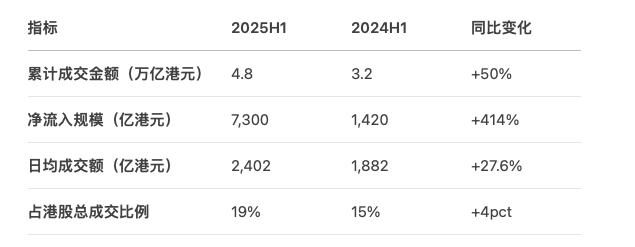
Core Insights - The Hong Kong stock market experienced a significant rebound in the first half of 2025, with the Hang Seng Index rising by 20%, leading among major global indices [1] - The primary driver of this rebound was the substantial inflow of mainland funds through the "Hong Kong Stock Connect" channel, coupled with a global reassessment of the value of "cheap Chinese assets" [1] - The net inflow of southbound funds reached over 730 billion HKD, marking a 414% increase year-on-year and setting a historical record for the same period [3][5] Market Dynamics - The total trading volume through the Hong Kong Stock Connect reached 4.8 trillion HKD, a 50% increase compared to the previous year, accounting for 19% of the total trading volume in the Hong Kong market [2][3] - Southbound funds have significantly reshaped the investor structure in the Hong Kong market, with their proportion of total trading volume rising from less than 10% in 2020 to nearly 20% [4] - The inflow of southbound funds has enhanced the correlation between the Hong Kong and A-share markets, while also increasing the independence of the Hong Kong market from global trends [4] Sector Preferences - The southbound funds showed a clear preference for high-dividend and innovative pharmaceutical sectors, with energy, telecommunications, and banking being the top three sectors for net buying [6][7] - The energy sector attracted a net buying of 620 million HKD, while telecommunications and banking received 410 million HKD and 380 million HKD, respectively [6][7] - The innovative pharmaceutical index saw significant gains, with some stocks experiencing over 60% increases, reflecting a strong recovery after a prolonged downturn [6][8] Investment Trends - The current market environment is characterized by a "barbell strategy," where investors are seeking both stable cash flow from high-dividend assets and growth potential from innovative sectors [10][16] - The anticipated interest rate cuts by the Federal Reserve are expected to further highlight the defensive value of high-dividend sectors, while the commercialization capabilities of innovative pharmaceutical companies will be crucial for growth stocks [16] - The semiconductor, innovative pharmaceuticals, and energy security sectors are expected to benefit from policy support and sustained inflows from mainland funds [17] Notable Stocks - The top-performing stocks in the Hong Kong Stock Connect included Lao Pu Gold, which saw a staggering increase of 330.18%, followed by Sangfor Technologies and Rongchang Biopharmaceuticals with increases of 288.98% and 278.12%, respectively [11][12] - The presence of diverse sectors among the top gainers indicates a broad market interest, with biotechnology leading the way [11][12] - Stocks like Rongchang Biopharmaceuticals have gained significant institutional recognition, with over 50% of holdings through the Hong Kong Stock Connect [13]

港股核电股再度走强,中核国际(02302.HK)涨超22%,中广核矿业(01164.HK)、中广核电力(01816.HK)涨超3%,中广核新能源(01811.HK)涨超1.5%。
news flash· 2025-07-14 01:49
Group 1 - The core viewpoint of the article highlights the strong performance of nuclear power stocks in the Hong Kong market, with notable increases in share prices for several companies [1] Group 2 - China National Nuclear Corporation International (02302.HK) saw a rise of over 22% in its stock price [1] - China General Nuclear Power Corporation Mining (01164.HK) and China General Nuclear Power Corporation Electric (01816.HK) both experienced increases of over 3% [1] - China General Nuclear Power Corporation New Energy (01811.HK) recorded a rise of over 1.5% [1]

DoD入股MP以加速美国稀土磁体独立,但短期全球稀土永磁体生产仍高度集中于中国
HUAXI Securities· 2025-07-13 05:16
Investment Rating - Industry rating: Recommended [3] Core Insights - The U.S. Department of Defense (DoD) has invested billions in MP Materials to accelerate the independence of U.S. rare earth magnets, but global production remains highly concentrated in China in the short term [9][14][45] - Nickel prices have decreased due to a significant drop in demand and production halts in Indonesia, which may impact local mining operations [12][20][23] - Cobalt prices have risen due to supply tightening from the Democratic Republic of Congo, which accounts for approximately 75% of global electric vehicle battery supply [13][31] - Lithium carbonate prices have increased, but future price movements will depend on downstream demand recovery [7][38][44] - Antimony prices have remained stable, with domestic supply still tight, and production expected to decline in the coming months [32][36] Summary by Sections Rare Earth Industry - MP Materials announced a partnership with the DoD to enhance domestic production capabilities, with a new magnet manufacturing facility expected to be operational by 2028 [45][46] - The DoD has committed to a minimum price of $110 per kilogram for NdPr products, ensuring stable cash flow for MP Materials [46][47] Nickel Industry - As of July 11, LME nickel spot price was $14,955 per ton, down 1.09% from July 4, with total LME nickel inventory increasing by 1.83% [20] - Domestic NPI smelting costs remain under pressure, affecting the acceptance of high-priced raw materials [20][23] Cobalt Industry - As of July 11, cobalt prices have shown mixed trends, with electrolytic cobalt at 249,300 yuan per ton, down 0.99%, while cobalt oxide increased by 1.54% [24][31] - The extension of a temporary export ban by the Congolese government is expected to tighten global cobalt supply [31] Lithium Industry - The average price of battery-grade lithium carbonate reached 63,800 yuan per ton, up 2.36% as of July 11 [7][38] - Market sentiment is cautious, with inventory levels remaining high, limiting upward price movement [38][44] Antimony Industry - Domestic antimony ingot prices have stabilized, with supply constraints expected to support future pricing [32][36]




中广核矿业(01164.HK):全球核电复苏下的铀资源核心资产 新长协定价机制抬升业绩预期
Ge Long Hui· 2025-07-12 19:22
Group 1 - The company, China General Nuclear Power Corporation (CGN), is the only pure uranium listed company in East Asia, backed by CGN Group, which provides a stable platform for overseas uranium resource development and financing [1] - As of the end of 2024, the company holds a total of approximately 34,000 tons of uranium resources from four uranium mines in Kazakhstan, utilizing in-situ leaching methods with lower mining costs than the global average [1] - The company has a stable financial structure, maintaining a debt-to-asset ratio below 50% over the past two years, and is expected to benefit from the injection of high-quality assets from CGN Group in the future [1][2] Group 2 - The company has established a robust profit model through a dual approach of self-production and international trade, with a pricing mechanism linked to spot prices, allowing for profit expansion as uranium prices rise [2] - In 2024, the company is projected to achieve a revenue of HKD 8.624 billion, a year-on-year increase of 17%, with a net profit of HKD 342 million, despite some impacts from tax rate adjustments [2] - The new sales agreements are expected to elevate profit margins, with a pricing mechanism that increasingly reflects market conditions [2] Group 3 - The global nuclear power revival is accelerating, with the World Nuclear Association (WNA) predicting an average annual compound growth of over 4% in natural uranium demand from 2024 to 2040 [3] - The supply-demand gap for uranium is expected to widen in the medium to long term due to high resource concentration and declining exploration investments since 2015, leading to a tightening supply trend [3] - The company is positioned to benefit from the anticipated high uranium prices, supported by its low-cost structure and abundant resources [3] Group 4 - The company is expected to achieve net profits of HKD 573 million, HKD 942 million, and HKD 1.183 billion in 2025, 2026, and 2027 respectively, reflecting significant year-on-year growth [3] - The company’s projected price-to-earnings (PE) ratio for 2026 is 18X, which is below the industry average PE of 29X for comparable companies in the US [3]
中广核矿业股价重启上行 近年来产量稳步提升
Zheng Quan Shi Bao Wang· 2025-07-12 00:23
Group 1: Market Trends - The price of uranium has been recovering due to increased global nuclear energy policies, with CGN Mining (01164.HK) stock rising significantly, nearly 95% from its low of HKD 1.19 on April 9 to HKD 2.32 on July 11 [1] - In June, the Sprott Physical Uranium Trust (SPUT) revised its agreement with Canaccord Genuity to raise approximately USD 200 million for uranium procurement, allowing for the purchase of 1,012 tons of uranium, which is double the previously stated amount [1] Group 2: Policy Developments - The U.S. nuclear policy has shifted positively, with President Trump signing four executive orders to accelerate reactor testing and enhance uranium mining and enrichment capabilities [2] - Other countries, including Germany, Belgium, and Japan, have also expressed positive statements regarding nuclear energy development, contributing to an expected increase in global nuclear power demand and tightening uranium supply [2] Group 3: Company Performance - CGN Mining's average unit sales cost for natural uranium is between USD 68-74 per pound U3O8, while the average sales price is between USD 58-61 per pound U3O8, indicating a potential negative impact on gross profit due to accounting methods [3] - The new sales framework agreement with CGN Uranium has adjusted the base price from USD 61.78 to USD 94.22 per pound U3O8, with a higher proportion of spot prices, enhancing pricing flexibility [2][3] - Analysts believe that CGN Mining will benefit from rising uranium prices and the adjusted sales pricing mechanism, leading to a positive impact on performance and valuation [3]
中广核矿业(01164):全球核电复苏下的铀资源核心资产,新长协定价机制抬升业绩预期
Hua Yuan Zheng Quan· 2025-07-11 08:31
Investment Rating - The report assigns a "Buy" rating for the company, marking its first coverage [5][10]. Core Views - The company is positioned as a core asset in uranium resources, benefiting from the global nuclear power recovery and a new long-term pricing mechanism that enhances performance expectations [5]. - Backed by China General Nuclear Power Group, the company has a leading global resource layout and long-term growth potential, being the only pure uranium listed company in East Asia [5][10]. - The company has a dual-driven model of "self-produced + international trade," which stabilizes growth and profitability [6]. Summary by Sections Market Performance - The closing price is HKD 2.26, with a market capitalization of HKD 17,177.54 million [3]. Financial Performance - The company achieved a revenue of HKD 86.24 billion in 2024, a year-on-year increase of 17%, with a net profit of HKD 3.42 billion [6][21]. - The projected net profits for 2025, 2026, and 2027 are HKD 5.73 billion, HKD 9.42 billion, and HKD 11.83 billion, reflecting growth rates of 67.5%, 64.4%, and 25.6% respectively [8][10]. Business Model - The business model consists of self-produced trade and international trade, with the international trade segment providing stable profit through price differences [19]. - The company holds a 49% equity stake in several uranium mines in Kazakhstan, ensuring a stable supply and cost advantage [5][41]. Pricing Mechanism - The new pricing mechanism for 2026-2028 includes a base price (BP) and spot price (SP) structure, with BP set to increase annually, enhancing profit margins [6][49]. Market Outlook - The global nuclear power revival is expected to drive uranium demand, with an average annual growth rate of over 4% from 2024 to 2040 [7]. - The company is well-positioned to benefit from the tightening supply of uranium due to high resource concentration and declining exploration investments [7]. Valuation - The company’s projected P/E ratio for 2026 is 18X, which is below the industry average of 29X, indicating potential undervaluation [10].