
兔宝宝

Search documents
兔宝宝跌2.05%,成交额2801.22万元,主力资金净流出49.63万元
Xin Lang Zheng Quan· 2025-10-21 01:49
Core Viewpoint - The stock price of Rabbit Baby has shown fluctuations, with a recent decline of 2.05%, while the company has experienced a year-to-date increase of 10.21% in its stock price [1][2]. Company Overview - Rabbit Baby, officially known as 德华兔宝宝装饰新材股份有限公司, is located in Deqing County, Zhejiang Province, and was established on December 27, 2001, with its stock listed on May 10, 2005 [2]. - The company specializes in the production and sales of decorative materials, including decorative panels, paints, wall coatings, adhesives, and various furniture products, with a revenue composition of 77.04% from decorative materials, 12.15% from cabinets, and smaller percentages from other categories [2]. Financial Performance - For the first half of 2025, Rabbit Baby reported a revenue of 3.634 billion yuan, a year-on-year decrease of 7.01%, while the net profit attributable to shareholders increased by 9.71% to 268 million yuan [2]. - The company has distributed a total of 2.942 billion yuan in dividends since its A-share listing, with 1.6 billion yuan distributed over the past three years [3]. Shareholder Information - As of June 30, 2025, the number of shareholders increased by 10.64% to 43,200, with an average of 17,035 circulating shares per person, a decrease of 9.29% [2]. - Notable changes in institutional holdings include a reduction in shares held by 东方阿尔法产业先锋混合A and new entries from 香港中央结算有限公司 and 国富中小盘股票A [3].

1-9月地产链数据联合解读
2025-10-20 14:49
Summary of Conference Call Records Industry Overview: Real Estate - **Market Performance**: The real estate market in 2025 is expected to see a decline in sales area, sales amount, land acquisition area, and new starts by approximately 10%, 12%, 12%, and 20% respectively, with real estate development investment decreasing by about 15% [1][3][4] - **Quarterly Expectations**: The fourth quarter of 2025 is anticipated to show poor data, but there may be improvements in the first quarter of 2026 due to the resilience of the market, stabilizing around 2 trillion [1][4] - **Price Trends**: New home prices in first and second-tier cities are expected to continue rising, while second-hand home prices will depend on the balance of supply and demand [1][4] Risks in the Real Estate Sector - **Key Risks**: The industry faces three main risks: delivery risk, systemic financial risk, and local debt risk. Most large real estate companies have resolved or can control their debt issues, with only a few, like Evergrande, still needing attention [1][5] Construction Industry Insights - **Investment Trends**: Narrow infrastructure investment saw a year-on-year decline of 4.6% in September 2025, marking the third consecutive month of negative growth, indicating that upcoming quarterly results may not meet expectations [1][6][7] - **Future Outlook**: Without unexpected policy support, infrastructure investment growth may continue to remain negative over the next six months [8][11] Manufacturing and Real Estate Investment - **Performance Metrics**: Both manufacturing and real estate investments are underperforming, with manufacturing down 1.9% year-on-year in September and real estate investment down 21.3%, indicating significant economic pressure [1][9] Building Materials Sector - **Current Status**: The building materials industry is also facing challenges, with cement production down 8.4% year-on-year in September and an expected cumulative decline of about 5.2% for the year [1][10] - **Future Expectations**: There is a need for policy support to improve demand in the building materials sector [10] Stock Recommendations - **Consumer Building Materials Stocks**: These stocks are worth attention due to the low environment and the necessity for upward policy support. Leading companies have moved away from dependence on real estate and are entering a moderate growth phase [2][13] - **Promising Companies**: Companies like Three Trees, Henkel Group, and Oriental Yuhong have shown signs of upward growth, driven by various strategic initiatives [14] - **Watchlist Companies**: Companies such as Weixing, Rabbit Baby, and Beixin are still worth monitoring despite not yet proving an upward growth point [15] Cement Industry Challenges and Opportunities - **Market Conditions**: The cement industry is currently facing low domestic demand, but there are opportunities in overseas markets, particularly in Africa, and strong demand in western infrastructure projects [17] Glass Industry Recommendations - **Recommended Stocks**: Xinyi Glass and Qibin Group are recommended due to their cost advantages and ability to maintain profitability at the industry cycle's bottom [18] Fiberglass Sector Outlook - **Future Prospects**: The fiberglass sector has an optimistic outlook, with strong demand in the electronic cloth segment and leading companies like China Jushi, Jushi Group, and Zhongcai Technology being highlighted as key recommendations [19]
资金面逐步发力,C端建材拐点或现
HTSC· 2025-10-20 12:08
Investment Rating - The report maintains an "Overweight" rating for the construction and building materials industry [6]. Core Views - The funding environment is gradually improving, with expectations for increased fiscal support in the fourth quarter, particularly benefiting the real estate sector [1]. - The report highlights a potential turning point for consumer building materials revenue due to improving demand and a decrease in price pressures in 2025 [2]. - The cement industry is experiencing a push for price increases, but demand support remains weak, leading to price fluctuations [3]. - The flat glass market shows signs of price stabilization, but supply-side improvements are still needed [4]. Summary by Sections Investment Environment - Infrastructure, real estate, and manufacturing investments in China showed mixed results, with infrastructure investment up by 1.1% year-on-year, real estate down by 13.9%, and manufacturing up by 4.0% [1]. - The central government has allocated an additional 500 billion yuan to local governments, indicating a proactive fiscal approach [1]. Real Estate Market - From January to September 2025, real estate sales, new starts, and completion areas decreased by 5.5%, 18.9%, and 15.3% year-on-year, respectively [2]. - September saw a positive turn in monthly housing completion area, suggesting a potential recovery in the sector [2]. Cement Industry - Cement production from January to September 2025 was 1.259 billion tons, down 5.2% year-on-year, with a notable price increase in September [3]. - The average cement price in September was 351 yuan per ton, reflecting a 1.4% month-on-month increase [3]. Glass Industry - The flat glass production for the first nine months of 2025 was 729 million weight cases, down 5.2% year-on-year, with prices stabilizing in September [4]. - The photovoltaic glass market showed better performance with a price increase of 19% month-on-month [4]. Recommended Stocks - The report recommends several stocks with a "Buy" rating, including China Liansu (2128 HK), Sichuan Road and Bridge (600039 CH), Yaxiang Integration (603929 CH), Sankeshu (603737 CH), Tubaobao (002043 CH), and Dongfang Yuhong (002271 CH) [7][29].


建筑材料行业跟踪周报:短期关注十五五,中期等待经济工作会议定调-20251020
Soochow Securities· 2025-10-20 11:52
Investment Rating - The report maintains an "Overweight" rating for the construction materials industry [1]. Core Viewpoints - Short-term focus is on the "15th Five-Year Plan," while mid-term strategies await the economic work conference for direction [1]. - The construction materials sector has shown a decline of 4.11% this week, underperforming compared to the Shanghai and Shenzhen 300 index, which fell by 2.22% [4]. - The report highlights the importance of domestic circulation and technological advancements in the industry, particularly in the context of the upcoming economic policies [4]. Summary by Sections 1. Bulk Construction Materials Fundamentals and High-Frequency Data - **Cement**: The national average price for high-standard cement is 346.8 CNY/ton, down by 2.3 CNY/ton from last week and down 61.8 CNY/ton from the same period in 2024. The average cement inventory ratio is 67.3%, up 0.6 percentage points from last week [4][20][15]. - **Glass**: The average price for float glass is 1301.0 CNY/ton, up 11.2 CNY/ton from last week and up 46.6% from 2024. Inventory levels have increased, indicating a potential oversupply [45][51]. - **Fiberglass**: The market for fiberglass remains stable, with prices for non-alkali yarn around 3250-3700 CNY/ton, showing a year-on-year decline of 3.93% [4][6]. 2. Industry Dynamics Tracking - The report notes that the cement market is experiencing weak demand, particularly in northern regions due to weather conditions, while southern regions face financial constraints [13][14]. - The glass market is characterized by high inventory levels and weak demand, leading to price fluctuations [44][51]. - The report emphasizes the need for supply-side reforms and the potential for price stabilization in the fiberglass sector as excess capacity is addressed [7][8]. 3. Weekly Market Review and Sector Valuation - The construction materials sector's valuation is at historical lows, with expectations for policy support to enhance profitability and valuation recovery [4][6]. - The report suggests that leading companies in the cement industry, such as Huaxin Cement and Conch Cement, are well-positioned to benefit from industry consolidation and improved market conditions [4][6].
超半数装修建材股实现增长 菲林格尔以42.70元/股收盘
Bei Jing Shang Bao· 2025-10-20 10:28
Core Viewpoint - The renovation and building materials sector experienced a slight increase, closing at 15,281.49 points with a growth rate of 1.16% on October 20 [1] Group 1: Stock Performance - Several renovation and building materials stocks saw price increases, with Filinger leading at 42.70 CNY per share, up by 5.93% [1] - Kairun shares closed at 12.79 CNY, marking a 5.44% increase, ranking second in the sector [1] - Tubao shares ended at 12.70 CNY, with a rise of 5.31%, placing third among renovation and building materials stocks [1] - Conversely, *ST Yazhen led the decline with a closing price of 38.79 CNY, down by 5.00% [1] - Jingxue Energy closed at 20.89 CNY, down by 1.92%, ranking second in losses [1] - Beijing Lier shares ended at 8.72 CNY, with a decrease of 1.80%, ranking third in the decline [1] Group 2: Industry Reform - The Ministry of Housing and Urban-Rural Development has committed to deepening reforms in the construction industry, focusing on industrialization, digitalization, and greening as development paths [1] - The reform aims to transition the construction industry from a traditional extensive model to a refined and intelligent approach, with key initiatives including the promotion of prefabricated buildings and the application of construction robots [1] - The ultimate goal of these reforms is to achieve high-quality development across the industry, enhancing the quality, efficiency, and sustainability of "Chinese construction" [1]



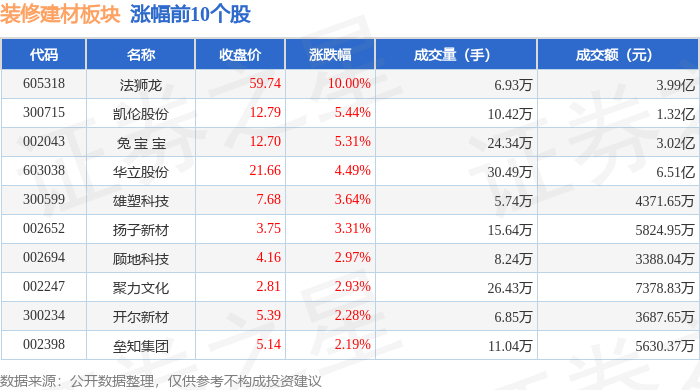
装修建材板块10月20日涨1.09%,法狮龙领涨,主力资金净流出8722.74万元
Zheng Xing Xing Ye Ri Bao· 2025-10-20 08:27
Core Insights - The renovation and building materials sector increased by 1.09% on October 20, with Fa Shilong leading the gains [1] - The Shanghai Composite Index closed at 3863.89, up 0.63%, while the Shenzhen Component Index closed at 12813.21, up 0.98% [1] Sector Performance - Fa Shilong (605318) closed at 59.74, with a rise of 10.00% and a trading volume of 69,300 shares [1] - Kairun Co. (300715) saw a closing price of 12.79, up 5.44% with a trading volume of 104,200 shares [1] - Rabbit Baby (002043) closed at 12.70, increasing by 5.31% with a trading volume of 243,400 shares [1] - Other notable performers include Huali Co. (603038) up 4.49%, Xiong Plastic Technology (300599) up 3.64%, and Yangzi New Materials (002652) up 3.31% [1] Capital Flow - The renovation and building materials sector experienced a net outflow of 87.23 million yuan from institutional investors, while retail investors saw a net inflow of 46.72 million yuan [2] - The sector's overall capital flow indicates a mixed sentiment, with institutional investors withdrawing funds while retail investors are actively buying [2] Individual Stock Capital Flow - Huali Co. (603038) had a net inflow of 20.15 million yuan from institutional investors, while retail investors had a net outflow of 54.22 million yuan [3] - Kairun Co. (300715) saw a net inflow of 10.31 million yuan from institutional investors, but retail investors withdrew 9.36 million yuan [3] - North New Materials (000786) had a net inflow of 10.09 million yuan from institutional investors, with retail investors also withdrawing funds [3]


马太效应加速释放,兔宝宝全渠道拓展卡位存量提质主赛道
Quan Jing Wang· 2025-10-20 07:56
Core Viewpoint - The report from Dongguan Securities suggests that starting from 2025, the "anti-involution" policy will gradually improve the profitability of certain consumer building materials companies through price increases, while urban renewal policies will drive demand in the building materials market [1] Group 1: Industry Trends - The domestic real estate market has undergone significant adjustments, leading to a short-term imbalance in supply and demand in the consumer building materials industry due to insufficient consumption momentum and a surge in production capacity [1] - The "anti-involution" consensus is ending homogeneous competition, accelerating the exit of backward production capacity, and top enterprises are enhancing their comprehensive competitiveness, indicating a potential for high-quality growth in the industry [1][5] - The building decoration materials market in China is expected to open a new round of growth opportunities driven by urban renewal, old community renovations, and the rise of green building materials and smart home solutions [2] Group 2: Company Performance - Rabbit Baby (兔宝宝) achieved revenue of 3.634 billion yuan and a net profit of 268 million yuan in the first half of 2025, reflecting a year-on-year increase of 9.71% and 1.35% respectively [1] - The company has expanded its retail channels significantly, with 4,673 decoration materials stores by mid-2025, including 2,192 decorative material stores and 2,481 town stores, with over 3,000 stores capable of providing "board customization" services [2] - Rabbit Baby's custom home retail business is focused on high-quality development, with a year-on-year sales increase of 46.5% in the home decoration channel in the first half of 2025, and a total of 1,808 custom home stores [4] Group 3: Strategic Initiatives - Rabbit Baby is enhancing its offline retail presence by expanding its town network and upgrading stores, while also pushing for a "board + customization" model to address customer pain points [2] - The company collaborates with over 20,000 furniture manufacturers and has established a home decoration operation company to offer various cooperation models to top home decoration enterprises [3] - The company is committed to sustainable practices and has received high ESG ratings, positioning itself as a leader in the decoration materials industry [4]
建材行业报告(2025.10.13-2025.10.19):内需避险逻辑强化,关注低位建材板块
China Post Securities· 2025-10-20 06:55
Investment Rating - The industry investment rating is "Outperform the Market" and is maintained [1] Core Viewpoints - The report emphasizes that the market is entering a window of strengthened domestic demand logic, driven by factors such as heightened Sino-US trade tensions, the release of Q3 reports, and a pullback in the technology sector. This may lead to increased attention on low-position domestic demand sectors, particularly in the building materials sector, which includes cement, glass, and consumer building materials [4][5] - The report suggests that the cement industry is expected to see a gradual recovery in demand as it enters the peak season, although growth remains limited. The implementation of policies to restrict overproduction is anticipated to enhance capacity utilization in the medium term [5][10] - The glass industry is facing a downward trend in demand due to real estate impacts, with short-term demand remaining weak and prices showing signs of loosening. The report notes that while environmental policies may not lead to a drastic reduction in capacity, they will increase costs and accelerate industry adjustments [5][15] - The fiberglass sector is experiencing growth driven by demand from the AI industry, with expectations for a significant increase in both volume and price for low-dielectric products [5] - The consumer building materials sector is projected to see a bottoming out of profitability, with strong price increase demands supported by anti-involution policies, leading to potential improvements in profitability for leading companies [5] Summary by Sections Cement - The cement market is gradually entering the peak season, with overall demand showing limited recovery. In August 2025, cement production was 148 million tons, down 6.2% year-on-year [5][10] - The report highlights the need to monitor the impact of weather and demand release rhythms on infrastructure and housing construction [5] Glass - The glass industry is currently facing a decline in demand, with prices showing signs of loosening post-holiday. The report indicates that the supply-demand imbalance persists, and future demand improvements are uncertain [5][15] Fiberglass - The fiberglass sector is benefiting from the AI industry's demand, with expectations for a surge in both volume and price for specific products. The report expresses optimism about the ongoing growth trend in this sector [5] Consumer Building Materials - The report notes that the consumer building materials sector has reached a profitability low point, with strong price increase demands expected to lead to profitability improvements for leading companies in the second half of the year [5][18]
兔宝宝涨2.24%,成交额9180.68万元,主力资金净流出456.24万元
Xin Lang Zheng Quan· 2025-10-20 03:15
Core Insights - The stock price of Rabbit Baby (兔宝宝) increased by 2.24% on October 20, reaching 12.33 CNY per share, with a total market capitalization of 10.231 billion CNY [1] - The company has seen a year-to-date stock price increase of 9.23%, with significant gains over various trading periods: 7.87% in the last 5 days, 13.96% in the last 20 days, and 27.46% in the last 60 days [1] Company Overview - Rabbit Baby, officially known as 德华兔宝宝装饰新材股份有限公司, was established on December 27, 2001, and went public on May 10, 2005 [1] - The company specializes in the production and sales of decorative materials, including decorative panels, paints, wall coatings, adhesives, and various furniture products [1] - The revenue composition is as follows: decorative materials 77.04%, cabinet products 12.15%, brand usage fees 5.54%, flooring 3.90%, others 0.79%, and wooden doors 0.58% [1] Financial Performance - For the first half of 2025, Rabbit Baby reported a revenue of 3.634 billion CNY, a year-on-year decrease of 7.01%, while the net profit attributable to shareholders increased by 9.71% to 268 million CNY [2] - The company has distributed a total of 2.942 billion CNY in dividends since its A-share listing, with 1.6 billion CNY distributed in the last three years [3] Shareholder Information - As of June 30, 2025, the number of shareholders increased to 43,200, with an average of 17,035 shares held per shareholder, a decrease of 9.29% [2] - Notable changes in institutional holdings include a decrease in shares held by 东方阿尔法产业先锋混合A and new entries from 香港中央结算有限公司 and 国富中小盘股票A [3]
风格切换当下,周期有哪些看点?
2025-10-19 15:58
Summary of Key Points from Conference Call Records Industry Overview Power Generation Industry - The thermal power industry benefits from a significant decrease in coal costs, with Q3 performance continuing the recovery trend. The expected bottom for coal prices provides confidence for electricity price negotiations, and the anticipated increase in capacity prices improves the industry's business model. However, attention is needed on the potential impact of coal supply and demand changes on costs [1][4][7]. - The hydropower sector experienced significant fluctuations in Q3 due to the flood season, but the unexpected autumn floods may lead to an upward adjustment of the annual power generation target. Key players like the Yangtze River Basin, Sichuan Investment, and Huaneng Hydropower show strong competitiveness [1][5]. - Nuclear power has a confirmed long-term growth potential, with a peak in new unit commissioning expected in 2027. The acceleration of new unit approvals and the macroeconomic backdrop of declining interest rates enhance its influence, although market-oriented trading may exert short-term pressure on performance [1][6]. Construction and Building Materials - Silver Dragon Co. benefits from an increased proportion of high-strength product usage and overseas business expansion, with Q3 performance expected to maintain high growth rates. Emerging businesses in aerospace steel wire products show strong competitiveness [1][8]. - Three Trees reported growth in revenue and net profit in Q3, driven by demand for existing and second-hand housing, and accelerated development of high-margin retail formats. The trend of domestic substitution is evident [1][8]. - Rabbit Baby's stock price increase is attributed to sector rotation and its low valuation with high dividend characteristics. Q3 revenue growth is expected to turn positive, with investment income enhancing performance and maintaining a high dividend yield [1][9]. - Huanxin Cement's mid-year performance saw a significant increase, with domestic and international cement business net profit per ton rising. The acquisition of Nigerian cement assets enhances performance, supported by supply-side reform logic [2][10]. Market Trends and Insights Market Sentiment and Style Changes - Recent changes in market sentiment and style have positively impacted the public utility sector, with the utility index rising nearly 3% since October, outperforming the Shanghai Composite Index by about 3% [3]. Real Estate Market Dynamics - During the National Day holiday, the real estate market showed signs of recovery, with first-tier cities experiencing slight growth and third-tier cities seeing a 20% year-on-year increase. However, second-hand housing transactions showed a significant decline [11]. - High-frequency data indicates a doubling of new housing supply in core cities from August, with a 30%-40% year-on-year increase. This suggests a positive outlook for future sales driven by optimistic expectations [12]. Future Policy Expectations - The fourth quarter is expected to maintain a loose policy tone, with ongoing implementation of real estate storage and urban renewal policies. There is also an increasing expectation of interest rate cuts, creating a favorable environment for the real estate sector [15]. Investment Recommendations - Investors are advised to focus on pure development companies, particularly smaller and mid-sized real estate firms that may experience valuation recovery or fundamental-driven trading opportunities due to improving policy expectations and fundamentals [16].