
中孚实业

Search documents
静待铜矿短缺逻辑兑现,铜价有望震荡上行:有色金属大宗金属周报(2025/10/13-2025/10/18)-20251019
Hua Yuan Zheng Quan· 2025-10-19 11:50
Investment Rating - The investment rating for the non-ferrous metals industry is "Positive" (maintained) [3] Core Views - The report anticipates a potential upward trend in copper prices due to expected shortages in copper mines, particularly with the global second-largest copper mine, Grasberg, facing production halts. The report suggests that the copper supply-demand balance may shift from tight equilibrium to shortage by 2026 [4] - The report highlights the performance of various metals, including aluminum, lithium, and cobalt, with specific recommendations for companies to watch in each segment [4] Summary by Sections 1. Industry Overview - Recent macroeconomic developments include a new round of US-China trade negotiations and comments from Trump regarding the unsustainability of high tariffs on China [8] 2. Market Performance - The overall performance of the non-ferrous metals sector saw a decline, with the Shanghai Composite Index down 1.47% and the Shenwan Non-Ferrous Metals Index down 3.07%, underperforming the Shanghai Composite by 1.60 percentage points [10][11] 3. Valuation Changes - The PE_TTM for the Shenwan Non-Ferrous Metals Index is 26.96, down 1.78 from the previous week, while the PB_LF is 3.22, down 0.22 [19][22] 4. Copper - Copper prices have seen a decline, with LME copper down 1.86% and SHFE copper down 1.77%. However, the report indicates a potential for price recovery due to supply disruptions and seasonal demand [21][44] 5. Aluminum - Aluminum prices are experiencing fluctuations, with LME aluminum down 0.45% and SHFE aluminum down 0.47%. The report notes a decrease in inventory levels, which may support price stability [33][44] 6. Lithium - Lithium prices are showing mixed trends, with lithium carbonate down 0.27% and lithium spodumene up 0.83%. The report suggests that lithium prices may stabilize due to seasonal demand [73] 7. Cobalt - Cobalt prices have increased, with MB cobalt up 5.40% to $20.98 per pound, driven by changes in export regulations from the Democratic Republic of Congo [86]




有色金属周报20251019:关税不确定性扰动持续,避险推动金银续创新高-20251019
Minsheng Securities· 2025-10-19 06:07
Investment Rating - The report maintains a "Buy" rating for the industry, highlighting several key companies as investment opportunities [4]. Core Views - The report emphasizes that tariff uncertainties continue to disrupt the market, leading to increased demand for safe-haven assets like gold and silver, which have reached new highs [1][2]. - Industrial metal prices are expected to remain strong due to supply disruptions and optimistic macroeconomic forecasts, despite short-term volatility caused by tariffs [2][3]. - Energy metals, particularly lithium and cobalt, are projected to perform well due to strong demand from the electric vehicle and energy storage sectors [3]. - Precious metals are benefiting from strong central bank purchases and high expectations for interest rate cuts, which are expected to support gold prices in the medium to long term [3]. Summary by Sections Industrial Metals - Tariff-induced short-term volatility is affecting copper prices, but supply disruptions are expected to support prices [2]. - Aluminum demand remains resilient, with a decrease in social inventory indicating a potential price stabilization [2][19]. - The report highlights key companies in the industrial metals sector, including Luoyang Molybdenum, Zijin Mining, and China Aluminum [2]. Energy Metals - Cobalt prices are rising due to new export quota regulations from the Democratic Republic of Congo, while lithium demand remains strong due to the growth of the electric vehicle market [3]. - Key companies recommended in this sector include Huayou Cobalt and Tianqi Lithium [3]. Precious Metals - Gold prices are expected to continue rising due to strong demand from central banks and geopolitical uncertainties [3]. - Recommended companies in the precious metals sector include Western Gold, Shandong Gold, and Zijin Gold [3].


金价冲击4400美元
Xin Lang Cai Jing· 2025-10-17 12:00
Core Viewpoint - The market is currently consolidating, with the Nonferrous Metal Leaders ETF (159876) experiencing fluctuations, ultimately closing down by 1.69% despite an early gain of over 2% [1][3]. Market Performance - The Nonferrous Metal Leaders ETF (159876) had a total trading volume of 57.74 million yuan and a latest scale of 606 million yuan as of October 16, with an average daily trading volume of 12.2 million yuan in October [1]. - Among the three ETFs tracking the same index, this ETF leads in both scale and liquidity [1]. Component Stocks - Notable performers include the copper leader Baiyin Nonferrous Metals, which hit the daily limit, and lithium leaders Shengxin Lithium and Zhongfu Industrial, both rising over 2% [3]. - The top ten gainers included five gold leaders, with Western Gold rising over 3% and Zhongjin Gold increasing over 2% [3]. - Conversely, stocks like Bowei Alloy and Chuangjiang New Materials saw declines exceeding 6%, negatively impacting the index [3]. Gold Price Influences - International gold prices are approaching 4,400 USD/ounce, driven by three main factors: 1. Historical trends show gold prices typically rise during the Federal Reserve's rate-cutting cycles, with an average increase of 6% within 60 days of such announcements [4]. 2. The recent U.S. government shutdown has heightened risk aversion, increasing demand for gold [5]. 3. The ongoing trend of de-dollarization and diversification of reserve currencies is expected to sustain global central bank gold purchases, with global official gold reserves reaching a record high of 36,274 tons as of June [5]. Future Gold Price Predictions - Some institutions remain optimistic about gold prices, with Bank of America predicting a potential rise to 6,000 USD in spring 2024 [6]. - Current allocations of gold in global investment portfolios are relatively low, indicating room for growth [6]. Sector Opportunities - The rare earth sector is expected to see significant performance in Q3, with companies like Northern Rare Earth and Shenghe Resources projecting substantial profit increases due to rising prices and capacity releases [6]. - In lithium, advancements in solid-state battery technology are anticipated to boost demand, with leading companies maintaining a high self-sufficiency rate in lithium supply [7]. - Copper prices are expected to rise due to supply disruptions, particularly from the Grasberg mine in Indonesia, which is crucial for energy transition and new production capabilities [7]. Long-term Outlook - The nonferrous metals sector is positioned as a key player in the current commodity bull market, driven by long-term capital expenditure cycles and increasing demand for strategic metal resources [8]. - The Nonferrous Metal Leaders ETF (159876) offers a diversified investment approach across various metals, including copper, gold, aluminum, rare earths, and lithium, which can mitigate risks associated with investing in a single metal [10].

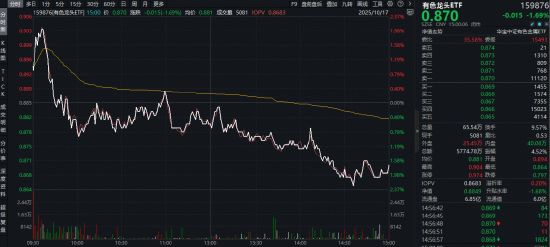
太强了!可能还有一波行情?金价冲击4400美元!有色龙头ETF(159876)逆市劲涨2%,西部黄金拉升6%
Xin Lang Ji Jin· 2025-10-17 01:52
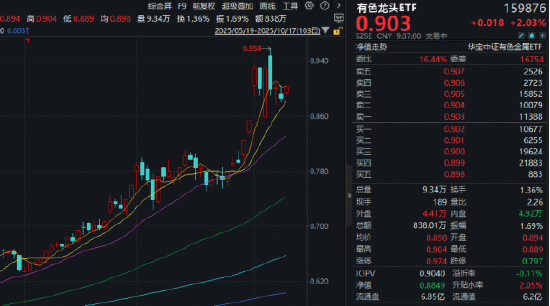
Core Viewpoint - International gold prices have reached new highs, with COMEX gold approaching $4400 per ounce, leading to significant gains in the A-share market, particularly in the non-ferrous metal sector [1] Group 1: Market Performance - Gold stocks led the surge in the A-share market on October 17, with the non-ferrous metal sector ETF (159876) rising over 2% during intraday trading [1] - Key stocks such as Shengxin Lithium Energy increased by over 8%, while Western Gold and Silver Nonferrous rose by more than 6% [1] Group 2: Policy and Economic Environment - The Ministry of Industry and Information Technology, along with eight other departments, has issued a "Work Plan for Stable Growth in the Non-Ferrous Metal Industry (2025-2026)," marking a new phase of institutional support and structural prosperity for the industry [3] - The Federal Reserve has initiated a new round of interest rate cuts, potentially transforming the global liquidity environment [3] Group 3: Supply and Demand Dynamics - Supply constraints are evident, with limited new copper mine discoveries and slow capital expenditure leading to tightened global copper supply, which is expected to push prices higher [4] - Demand is being driven by sectors such as AI, new energy, and infrastructure upgrades, with significant increases in the demand for copper, aluminum, lithium, and rare earths [4] Group 4: Future Outlook - Non-ferrous metals are positioned as key players in the current commodity bull market, supported by long-term capital expenditure cycles and rising global manufacturing investment [5] - The industry is expected to experience a core bull market over the next one to two years, particularly in industrial non-ferrous metals, small metals, and gold [5] Group 5: Investment Strategy - A diversified investment approach through the non-ferrous metal sector ETF (159876) and its associated funds is recommended to capture the overall sector performance while mitigating risks [7]

铝铜比何时修复?
2025-11-04 01:56
Summary of Conference Call on Aluminum and Copper Market Dynamics Industry Overview - The current copper-to-aluminum ratio is at a historical high of approximately 4.2 times, with expectations for a correction during the latter part of the interest rate cut cycle, suggesting aluminum may replicate copper's upward trend over the next three to five years [1][2][8] - The aluminum sector is currently undervalued, with an average dividend yield of 5-10% and a price-to-earnings (PE) ratio of 8 times, projected to rise from 8-9 times to 10-15 times by 2026, potentially doubling or more [1][2][15] Key Insights and Arguments - The inflation cycle typically sees gold leading, followed by silver, then copper and aluminum; thus, aluminum, which is currently at a low price point, should be a focus [1][3] - The average valuation metrics for the non-ferrous metals sector include a price-to-book (PB) ratio of 2 times, a return on equity (ROE) of 20%, and a PE ratio of 8 times, indicating a combination of resilience and dividend defensiveness [1][3] - The copper-aluminum price bottom usually occurs at the end of an interest rate cut cycle, aligning with economic recovery phases [4][5] Market Dynamics - The supply of electrolytic aluminum in China has reached its capacity ceiling, while uncertainties in overseas energy consumption will gradually restore the copper-to-aluminum ratio to normal levels [1][9] - Fund holdings in the sector are significantly lower than the previous year, with only 4.7% to 4.8% allocation in Q2, indicating a relatively low market crowding and room for recovery [1][7] Future Projections - Aluminum is expected to become a resource commodity similar to copper due to its price elasticity and diverse demand, with a current profit margin of approximately 3,000 yuan per ton [2][8] - The anticipated increase in demand for alternative materials, such as aluminum wire bundles, is expected to further support aluminum's market position [10] - The global energy consumption for electrolytic aluminum production accounts for about 3% to 3.5% of total electricity usage, with potential supply uncertainties due to energy constraints [11][12] Investment Opportunities - Companies with high elasticity, such as Zhongfu, Yun Aluminum, and Tianshan, are recommended for those seeking growth, while more stable options include Hongqiao, Hongchuang Holdings, and China Aluminum [2][15] - The aluminum sector's dividend yield is projected to remain strong, with some companies maintaining a dividend payout ratio of 60% [14] Conclusion - The aluminum sector is poised for significant growth over the next few years, driven by supply constraints and increasing demand for aluminum as a substitute material. The current market conditions present a favorable investment landscape for both growth and income-focused investors [15][18]




工业金属板块10月15日涨2.66%,中孚实业领涨,主力资金净流出6.82亿元
Zheng Xing Xing Ye Ri Bao· 2025-10-15 08:27
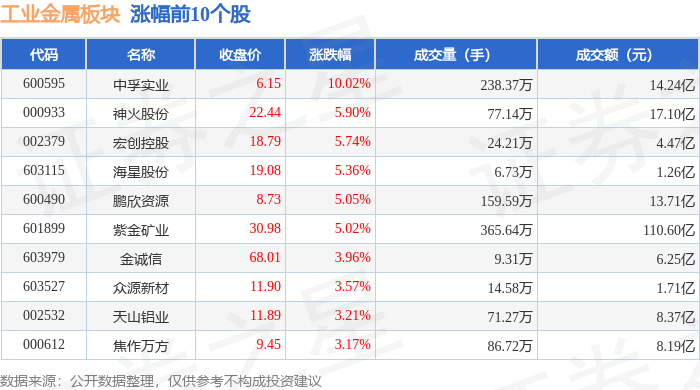
Market Overview - On October 15, the industrial metals sector rose by 2.66% compared to the previous trading day, with Zhongfu Industrial leading the gains [1] - The Shanghai Composite Index closed at 3912.21, up 1.22%, while the Shenzhen Component Index closed at 13118.75, up 1.73% [1] Top Gainers in Industrial Metals - Zhongfu Industrial (600595) closed at 6.15, up 10.02% with a trading volume of 2.38 million shares and a turnover of 1.424 billion yuan [1] - Shenhuo Co. (000933) closed at 22.44, up 5.90% with a trading volume of 771,400 shares and a turnover of 1.71 billion yuan [1] - Hongchuang Holdings (002379) closed at 18.79, up 5.74% with a trading volume of 242,100 shares and a turnover of 447.1 million yuan [1] Top Losers in Industrial Metals - Huayu Mining (601020) closed at 30.45, down 2.90% with a trading volume of 758,300 shares and a turnover of 2.279 billion yuan [2] - Xinweiling (920634) closed at 29.81, down 2.84% with a trading volume of 39,200 shares and a turnover of 1.16 million yuan [2] - Baiyin Nonferrous Metals (601212) closed at 5.40, down 2.35% with a trading volume of 4.6459 million shares and a turnover of 2.488 billion yuan [2] Capital Flow Analysis - The industrial metals sector experienced a net outflow of 682 million yuan from institutional investors, while retail investors saw a net inflow of 991 million yuan [2] - Major stocks like Zijin Mining (668109) had a net inflow of 563 million yuan from institutional investors, while retail investors had a net outflow of 205 million yuan [3] - Zhongfu Industrial (600595) saw a net inflow of 145 million yuan from institutional investors, but a net outflow of 10.3 million yuan from retail investors [3]


可能还有一波行情?有色龙头ETF(159876)场内翻红!中孚实业涨停,紫金矿业涨近5%
Xin Lang Cai Jing· 2025-10-15 07:35
今日(10月15日)揽尽有色金属行业龙头的有色龙头ETF(159876)场内价格一度下挫2%,现回到水面以上,场内价格现涨0.45%,实时成交额超7900万元,交投活跃! 深交所数据显示,有色龙头ETF(159876)近5日连续吸金,合计金额3.05亿元。反映资金看好板块后市,积极进场抢筹! 成份股方面,中孚实业涨停,神火股份、盛和资源涨逾5%,紫金矿业、雅化集团、赤峰黄金等个股跟涨。 政策面上,工业和信息化部等八部门联合印发《有色金属行业稳增长工作方案(2025—2026年)》,行业正式进入"制度性支持+结构性景气"的新阶段。叠加美联储已于9月利率会议上正式开启 1、货币属性:"美元锚"松动,重塑有色金属定价 不同的有色金属,景气度、节奏与驱动点并不一致,分化在所难免,如果看好有色金属板块,一个比较轻松的思路是通过全覆盖来更好地把握整个板块的贝塔行情。揽尽有色金属行业龙头的有色 风险提示:有色龙头ETF及其联接基金被动跟踪中证有色金属指数,该指数基日为2013.12.31,发布于2015.7.13,指数近5个完整年度的涨跌幅为:2020年,35.84%;2021年,35.89%; 责任编辑:杨赐 供给端,全 ...
短期狂欢?还是超级周期?有色龙头ETF盘中上探2.5%创新高,获资金净申购1860万份!
Xin Lang Ji Jin· 2025-10-14 11:48
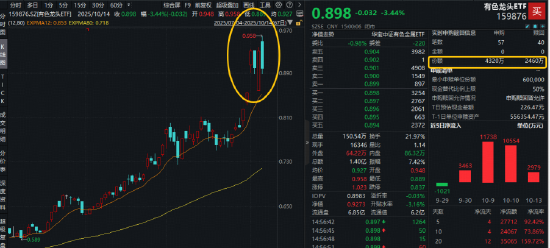
Group 1 - The core viewpoint of the news highlights the strong performance of the non-ferrous metal sector, particularly the Non-Ferrous Metal Leader ETF (159876), which saw a peak increase of 2.58% before closing down 3.44% on October 14, with a total trading volume of 140 million yuan and a net subscription of 18.6 million units throughout the day [1] - The Non-Ferrous Metal Leader ETF has attracted a total of 297 million yuan in net inflows over the past four days, reaching a historical high of 635 million yuan as of October 13 [1] - The Ministry of Industry and Information Technology and seven other departments have jointly issued a "Work Plan for Stable Growth in the Non-Ferrous Metal Industry (2025-2026)", marking a new phase of "institutional support + structural prosperity" for the industry [2] Group 2 - The supply side faces challenges with limited new copper mine discoveries and slow release of refined copper capacity, exacerbated by an accident at the Grasberg copper mine in Indonesia, which may tighten global copper supply expectations [5] - On the demand side, a new engine driven by AI and renewable energy is emerging, with significant demand for copper, aluminum, lithium, and rare earths from sectors like data centers, power infrastructure upgrades, and new energy vehicles [5] - The industry is expected to enter a long-term upward price cycle due to capital expenditure cycles and increasing demand for strategic metal resources amid global manufacturing investment trends [6] Group 3 - The Non-Ferrous Metal Leader ETF (159876) and its linked funds are designed to track the CSI Non-Ferrous Metal Index, which includes significant weights in copper (27.6%), gold (14.5%), aluminum (13.1%), rare earths (10.4%), and lithium (8.4%), providing a diversified investment approach [8] - The recent performance of individual stocks within the sector shows notable gains, with companies like Chuangjiang New Material and Huayu Mining seeing increases of over 10% and 5% respectively, while Tengyuan Cobalt and others faced declines exceeding 11% [4]
煤炭概念涨1.17%,主力资金净流入这些股
Zheng Quan Shi Bao Wang· 2025-10-14 09:10
Core Points - The coal sector saw an increase of 1.17%, ranking fourth among concept sectors, with 56 stocks rising, including Baotailong and Dayou Energy hitting the daily limit [1] - Major gainers in the coal sector included Jiangxi Tungsten Equipment, Hezhan Intelligent, and Lu'an Environmental Energy, which rose by 7.65%, 5.81%, and 5.70% respectively [1] - The sector experienced a net inflow of 127 million yuan from main funds, with 40 stocks receiving net inflows, and six stocks exceeding 100 million yuan in net inflows [2][3] Fund Flow Analysis - Jiangxi Tungsten Equipment, Dayou Energy, and Quzhou Development had the highest net inflow rates at 20.92%, 15.25%, and 14.55% respectively [3] - Quzhou Development led the net inflow with 214 million yuan, followed by Jiangxi Tungsten Equipment, Zhongfu Industrial, and Lu'an Environmental Energy with net inflows of 152 million yuan, 135 million yuan, and 121 million yuan respectively [2][3] Stock Performance - The top performers in the coal sector included: - Quzhou Development: +3.91% with a turnover rate of 3.67% and a net inflow of 213.52 million yuan [3] - Jiangxi Tungsten Equipment: +7.65% with a turnover rate of 9.28% and a net inflow of 152.16 million yuan [3] - Lu'an Environmental Energy: +5.70% with a turnover rate of 2.81% and a net inflow of 121.39 million yuan [3] - Notable declines were seen in Tongkun Co., Dongyangguang, and Zhongchuang Zhiling, which fell by 4.62%, 3.24%, and 2.49% respectively [1][2]


新能源、有色专题:河南铝产业调研
Hua Tai Qi Huo· 2025-10-14 08:32
Report Industry Investment Rating No relevant content provided. Core View of the Report The ore price is still in a game stage. Domestic mines in northern China are affected by rainfall, and alumina plants are facing losses, so it is difficult to give a premium to the ore end. The rainy season in Guinea is coming to an end, but the port arrival volume has not recovered, the port inventory has slightly declined, and the price of imported ore is relatively firm. Currently, alumina plants have not triggered production cuts. Later, attention should be paid to the fluctuation of imported ore prices. If the ore price does not fall, the situation of cash - flow losses cannot be maintained for a long time, and enterprises in Henan with insufficient domestic ore supply will face greater difficulties. From the perspective of Henan, there is no negative impact on the consumption end. Although the overall operating rate has declined year - on - year, the output has increased year - on - year, and the growth rate is higher than the national average. Affected by capacity expansion, local processing enterprises may face problems such as insufficient orders, low operating rates, and low processing fees, but in actual production, they have not shown cash - flow losses through methods such as increasing the amount of scrap added and increasing scale to reduce costs, and the overall output is still guaranteed [2]. Summary According to the Directory 1. Henan Alumina in Operation with Imported Ore Capacity Faces Pressure - Henan's alumina built - in capacity is 13.07 million tons, operating capacity is 8.9 million tons, with an operating rate of 68%, the lowest in the country where the national average is 85.6%. There are currently only 5 alumina factories in production, all of which are large - scale group enterprises [9]. - The production cost in Henan is also the highest in the country. The current cash cost of producing with domestic ore is 2,940 yuan/ton, and with imported ore is 3,100 yuan/ton. According to the current market price, domestic ore production breaks even, while imported ore production faces cash - flow losses [9]. - The reason why production cuts have not been triggered is not that the price is too low, but mainly because the loss period is not long enough. Calculated according to the cash cost and the alumina website quotation, the production with imported ore in Henan started to lose money in mid - to - early September, and the three - network average price of the long - term agreement in September is 3,100 yuan/ton. From the factory's perspective, cash losses will start in October, so production cuts have not been triggered at present [9]. - Alumina winter storage has no impact on Henan. The monthly alumina output in Henan is 650,000 tons, while the monthly electrolytic aluminum output is only 150,000 tons. The local alumina supply is sufficient and the transportation distance is short. Even in case of extreme weather in winter, the impact is extremely limited. Moreover, the relocation of electrolytic aluminum production capacity in Henan is the mainstream trend [10]. 2. Research on Enterprises in Henan's Alumina Industry - Enterprise 1: A Henan alumina plant with a built - in capacity of 2.6 million tons. It has 4 roasting furnaces, with 3 in operation at present, with a daily output of 1,800 tons. The annual sales of non - metallurgical alumina and aluminum hydroxide reach 1.7 million tons. It uses more than 100,000 tons of domestic ore per month, accounting for about 25%, which is a relatively low level in Henan. The bauxite inventory is 1.5 months. There is no cash - flow loss in September, and the high cost is mainly due to the high - priced ore in the previous period in the current bauxite inventory [11]. - Enterprise 2: A Henan alumina plant with a built - in capacity of 1.4 million tons. It shut down a 400,000 - ton imported ore production line in the first half of the year and has no plan to resume production. Currently, all 1 million tons use local domestic ore from its own mines, and the probability of further shutdown is very low. It may reduce production due to environmental protection factors such as natural gas in winter, but the impact is limited. Lithium extraction has been carried out in the production process, with an annual output of more than 1,000 tons of lithium, and the cost is higher than that of lithium extraction from salt lakes [11]. - Enterprise 3: A Henan electrolytic aluminum plant with a built - in capacity of 360,000 tons operating at full capacity. 70,000 tons of production capacity has been transferred to Ningxia, and the remaining capacity will also be transferred later. It sells 100% of its products through long - term agreements. The alumina raw material inventory is 5 days, but the tailings are not very useful, and the actual available inventory is 2 days. It does not carry out winter storage, and the nearest alumina plant is only 20 kilometers away, so it can ensure supply even in case of extreme weather [11]. 3. Henan's Processing Enterprises' Dilemma Does Not Equal Poor Consumption - The supply of aluminum elements and the supply of aluminum processed products are in two different dimensions. Since September, it has entered the traditional seasonal consumption peak season. From the perspective of aluminum elements, the supply of electrolytic aluminum has increased by 1.14% year - on - year, the daily output has increased by 0.08% month - on - month, and the proportion of molten aluminum has increased by 2.54% year - on - year and 1.23% month - on - month, which is the main reason for the decline in the operating rate and processing fees felt by processing plants [24]. - Aluminum rods and aluminum strips and foils are the most mainstream primary processed products, accounting for a large proportion of aluminum consumption. As of now, the output of aluminum rods in 2025 is about 13.65 million tons, with a year - on - year growth rate of 5.8%. The cumulative output of aluminum strips and foils from January to August is 9.637 million tons, with a cumulative year - on - year increase of 0.2%. The cumulative output of aluminum strips and foils in Henan from January to August is 4.023 million tons, with a cumulative year - on - year growth of 2.9%, and the year - on - year growth rate in August is 3.7% [24]. - Henan is a concentrated area for aluminum strip production in China, accounting for 39% of the national output. Currently, the operating rate of local enterprises is generally lower than in previous years, and enterprise profitability is difficult. However, this is not due to poor consumption. The output growth rate of aluminum strips and foils in Henan has long been higher than the national average, but the processing fees need to compete with integrated electrolytic aluminum processing plants, resulting in a poor feeling for Henan's processing plants [24]. 4. Research on Henan's Aluminum Processing Enterprises - Enterprise 3: An aluminum strip processing enterprise. It purchases 40% of the molten aluminum from local aluminum plants at a discount of 120 yuan/ton to the Yangtze River price, and the remaining 60% is aluminum ingots for easy adjustment of production. Its built - in capacity is 70,000 - 80,000 tons, and the current operating rate is over 60%, which has increased compared with the off - season, but was 100% in the same period last year. The overall operating rate of aluminum strip and foil enterprises in Gongyi is 50% - 60%, which is difficult for factories to make a profit. The discount for molten aluminum procurement has been narrowing year by year, and electrolytic aluminum plants are in a strong position in sales. If aluminum ingots are remelted, about 40 cubic meters of natural gas are needed, and it is rare for the discount of aluminum ingot procurement in Gongyi to exceed 200 yuan/ton. There are also losses in remelting, and the electrolyte loss for purchasing molten aluminum is about 150 yuan/ton. 20% of the downstream consumption is exported through traders, and the normal finished product inventory is 1,000 tons. If the inventory exceeds the normal level, the operating rate will be considered to be reduced [25]. - Enterprise 2: An aluminum rod processing enterprise. It purchases 100% of the molten aluminum from surrounding electrolytic aluminum plants at a discount of 120 yuan/ton to the Yangtze River price. Previously, the discount could reach 200 yuan/ton. Due to long - term agreements, it cannot adjust production and operates at 100% throughout the year. The electrolyte loss is 0.5%, and the total loss in the production process is 1.2%. The maximum annual loss is 100 - 200 yuan/ton, and currently it is at the break - even point. Since there are no costs such as bank interest, depreciation, and land, it still makes a profit. There were originally 4 aluminum rod processing enterprises in the park, and now only this one remains. It needs to compete with integrated electrolytic aluminum and aluminum rod plants in Inner Mongolia and Shandong, so the competition is difficult. Local downstream processing enterprises often expand production through loans to reduce costs, but the processing profit has been declining year by year, and the method of blind expansion is unsustainable [26]. 5. Summary Alumina - Henan's alumina built - in capacity is 13.07 million tons, operating capacity is 8.9 million tons, with an operating rate of 68%, the lowest in the country where the national average is 85.6% [37]. - The production cost in Henan is also the highest in the country. The current cash cost of producing with domestic ore is 2,940 yuan/ton, and with imported ore is 3,100 yuan/ton. According to the current market price, domestic ore production breaks even, while imported ore production faces cash - flow losses [37]. - The three - network average price of the long - term agreement in September is 3,100 yuan/ton. From the factory's perspective, cash losses will start in October, so production cuts have not been triggered at present [37]. Downstream Consumption - Since September, it has entered the traditional seasonal consumption peak season. From the perspective of aluminum elements, the supply of electrolytic aluminum has increased by 1.14% year - on - year, the daily output has increased by 0.08% month - on - month, and the proportion of molten aluminum has increased by 2.54% year - on - year and 1.23% month - on - month, which is the main reason for the decline in the operating rate and processing fees felt by processing plants [38]. - Henan is a concentrated area for aluminum strip production in China, accounting for 39% of the national output. Currently, the operating rate of local enterprises is generally lower than in previous years, and the overall operating rate is about 60%. However, the cumulative output of aluminum strips and foils from January to August is 4.023 million tons, with a cumulative year - on - year growth of 2.9%, and the year - on - year growth rate in August is 3.7% [38].